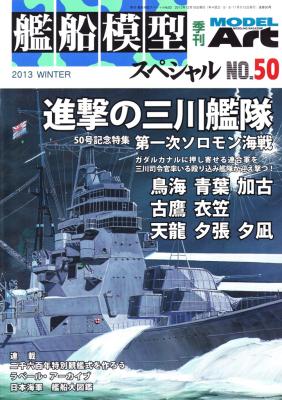
The feature article of September’s issue covers some of battleships of the Pacific during the Second World War. They use the Hasegawa 1/450th Yamato (there are actually two builds of this particular model by two builders), Fujimi 1/700 Kirishima, Pit Road 1/700 USS North Carolina 1944, Dragon 1/700 USS Pennsylvania 1944, and the HP Models HP 1/700 USS Tennessee 1944 as representatives of some of the vessels that were used by the Allies and Axis. Each model is beautifully built and accompanied with color photographs during the build and b&w in-action photos. This article encompasses thirty six pages of this issue.
What's New
The Squadron Detail In Action series was started in 1971. This series covers the development, testing, and production of aircraft, armored vehicles, and ships. The focus of this book is on the M3 Gun Motor Carriage.
At the beginning of World War Two, the United States realized the need for an effective antitank weapon. Through this need, the Military used the M3 halftrack as the base and married it to the M1897A4 75mm gun to create the M3 Gun Motor Carriage. In October, 1941, the first production contract began. By October, 1944, the Gun Motor Carriage was considered obsolete by the U.S. Army. During its career many of these units were used by Great Britain and U.S. Marines well into 1945.
Jeep must be an American icon. They’ve been around forever and keep on going.
Engine
Well, there isn’t an engine. All you get is an oil pan molded into the chassis.
Chassis
The chassis features nice detail and crisp engraving. The exhaust pipe, front and rear differentials, and springs are separate assemblies. The kit comes with actual springs for springs – they were a very pleasant surprise. It’s been a long time since I’ve had to screw the chassis to the body, but this kit calls for it. Fit is right on and the screw heads are covered by the suspension parts. The kit also has metal axles to hold the wheel/tires to the suspension. Wheels are gorgeous bead-lock units and the no-name tires are just beautiful. I’d like to see the wheels/tires in a Revell Parts Pack that they had years and years ago.
Having just finished the Eduard Royal Class Spitfire Mk.IX kit, I can say that this kit is absolutely perfect; however, that is the Royal Class kit. The Weekend Edition of this kit will be lacking two essential items in plastic – the ballistic bulkheads. The Weekend Edition won’t have the PE parts that the Royal Class kit has. Quickboost calls them bulkheads, but they are actually the ballistic protection plates behind the cockpit.
Molded perfectly in thin light grey resin, these two pieces are easy enough to remove from the pour block, and just need paint to upgrade your cockpit. Your other option is to cut your own bulkheads. We all know what a pain it is to get them perfect. Quickboost does that for you.
This set is essential for the Weekend Edition of the Spitfire. If you have the Royal Class or the Profipack, you will not need it unless you don’t want to deal with the PE parts in the kit.
Highly recommended.
You want your Flogger to stand out on the model table? How about opening up the entire nose section? Now we are talking. What can be cooler than complete electronic bays? Normally the whole process would be hours of research, and then hours of scratchbuilding. Thanks to Aires, this will be significantly easier.
You get 25 high-quality light grey resin pieces that feature bulkheads, access panels, and radio/radar equipment. Unlike most Aires sets, this set does not come with any photo etch parts. Everything is rendered perfectly in resin. The bays are deep and have the equipment added from behind. Just exquisite molding.
You think you have to wire the electronics? Nope; miraculously, Aires has even molded the wiring. All the modeler will need to do is artful painting.
The Trumpeter MiG-23 is a nice kit, but the seat and the whole cockpit is simplified. It may be just the limitations of plastic molding technology, but now you don’t have to scratchbuild the cockpit. The Aires set comes in their normal packaging in a plastic container, with foam securing the parts in place. It is effective. I did have one piece fall off the sprue, but that is to be expected in shipping, sometimes.
There are nine exquisite resin parts perfectly molded in light grey resin. The amount of detail in this set has to be seen to be believed. The cockpit is perfection. The undercuts on the side walls are impressive. The same can be said for the instrument panel coaming. The pour blocks are small and will be easy to remove.
Plusmodel’s Aero Line continues its tradition of providing the modeler with simple and interesting pilot figures. The latest is a pilot for the MiG-15. This is a two-piece figure. The biggest part is the pilot himself. The other piece is the parachute pack. Both are perfectly cast in light grey resin. There is very little clean-up required. The thin wafer of material around the figure is easily removed by hand and cleaned up with a sharp blade. The face is perfectly formed. The proportion of the figure are perfect. The stance of the pilot is relaxed and completely natural. The equipment is perfectly sculpted, as well. I could not find anything I didn’t like. The small parachute pack is easily attached to the pilot’s backside.
The figure is safely packaged in a plastic container with the parts safeguarded by a piece of foam. Included on the packaging is a painting of the figure. Inside the packaging is the same painting but much larger.
The Trumpeter F-100 series of models is nice. If you are like me, it is really tough to get rid of the mold line on the round parts such as the refueling probe. I can get rid of the mold line, but keeping it round is not my forte. Quickboost offers a quick and easy upgrade. This set provides three pieces of resin molded perfectly in light grey resin.
The probe comes in three pieces. One is the fuselage mounting point with a perfectly hollowed out tip. Then there is the long probe itself. I was amazed at how straight this part was and, best yet, no mold line. The part is removed from the base. Then the final part is the probe end. This is really a nice looking piece. It is an accurate representation. It will require a sliver of resin to be sanded off the end, but that is an easy operation.
While designed for the F-100, the probe tip can be used on any US aircraft that has an in-flight refueling probe.
Let’s face it, ejection seats in kits usually leave something to be desired. Usually, the culprits are the lack of seat belts or just the limitation of the plastic molding process. The ejection seat is also the most visible part of the interior, either with the canopy open or closed.
It sure would be nice to have a well-detailed seat in your Hun. Quickboost provides just that – a perfectly detailed seat complete with seatbelts and shoulder harness. It is easy enough to remove the resin pour block. My example was perfectly cast in light grey resin. It is perfect and just needs a coat of paint to bring it alive. It is an easy addition to either your Trumpeter or Monogram Hun.
Easy installation, perfectly cast, and highly detailed...what more can you ask for? Absolutely nothing. Another great product from Quickboost. Remember if you are doing an F-100F you will need two seats.
Highly recommended.
Thanks to Quickboost and IPMS/USA for the review copy.
The US M10 was originally developed as a tank destroyer while the StuG III was a turretless, low-profiled tracked vehicle developed for direct fire support for infantry formations. This book discusses how these two fighting vehicles went beyond their respective design missions when called upon. It also covers how they fought one another during the 11 month campaign on the battlefields of northwest Europe in 1944-45.
I found the book to be well thought out with a very coherent outline. It’s well written with easy to understand explanations. It has beautiful color maps, paintings, cutaway artwork, and a wide range of period b&w photographs.
The book itself is well printed with a gum binding. The print is easy to read and the photographs are very clear. The artwork and cutaway illustrations are colorful and honestly represented. The maps and charts are rendered so that any layperson can understand them.