Reviews

Book Author(s)
Tom Cooper, Albert Brandolini, Adrien Fontanellaz
Illustrators: David Bocquelet; Tom Cooper, and Luca Canossa
Review Author
Frank Landrus
Published on
Company
Helion & Company
MSRP
$29.95

Helion produces books on many aspects of Military History from the Late Medieval period through to the present day. Helion was established in 1996, and since then they have published almost 1,200 books, with 100 or more new titles coming out every year. The 'Africa@War' series covers African military history since 1945.

Book Author(s)
Krzysztof Dabrowski
Illustrators: David Bocquelet; Tom Cooper; Anderson Subtil
Review Author
Frank Landrus
Published on
Company
Helion & Company
MSRP
$24.95

Krzysztof Dabrowski from Poland has a lifelong interest in the subject of military aviation, and has written dozens of articles on a variety of related subjects for printed magazines and the ACIG.org/ACIG.info, AeroHisto and The Boresight websites. His particular area of interest is the air warfare during the Cold War, the aircraft involved, and the experiences of their crews. This is his first instalment for Helion and he is working on a second title (Dropping the Big Ones: Live Testing of Soviet Nuclear Bombs, 1949-1962) for release in 2021.

Review Author
Bill O'Malley
Published on
Company
ICM
Scale
1/24
MSRP
$127.00

The Ford Model T, nicknamed the Tin Lizzie, was produced from 1908 to 1927. Over 15,000,000 vehicles were produced in many configurations, including a sedan, roadster, light delivery vehicle, pick-ups, fire trucks, etc. The Tin Lizzie's were known for their affordability, reliability, and durability.

Ukrainian-based ICM has produced several variations of the model T, including a 1913 speedster, a 1913 roadster, a 1917 ambulance, a 1914 firetruck, a 1912 light delivery car, a 1911 touring car, a 1912 commercial roadster, a 1917 LCP WW1 Australian army car and a 1917 utility Australian armor army car, a 1917 model T, a 1917 LCP with Vickers MG, and a RNAS armored car. Many of these kits were subsequently issued with passengers or crew.

Review Author
John Noack
Published on
Company
UMM-USA
MSRP
$22.90

First off, my apologies to Jon Vojtech, the generous genius behind the UMM product line. Jon graciously provided the Reviewers Corps with a nice selection of new products at the National Convention in Hampton VA, this year, and I am very late in submitting my review.

If you need to make extremely fine cuts in a part – plastic, soft metal, 3D resin, or cast resin material – this tool will do the trick. The blade itself is razor thin (sorry…), coming in at 0.1mm or about 0.004”. Using a blade this thin means applying gentle pressure, letting the very fine teeth do the work – push too hard and you’re likely to bend or snap the blade.

The handle is 3D printed filament, and incorporates a recess for the included Allen wrench that’s used to change blades. And speaking of that, the handle will accommodate a number of blades including the UBT12 Medium Rough Razor Saw.

Review Author
Brett W Scholten
Published on
Company
Squadron
MSRP
$4.46

Nice things often come in simple packages. The Squadron Tool Decal Positioner is an example of this, measuring in at 10 cm (slightly less than 4 inches). A small contoured rod with a rubbery tip used to position decals is the simple solution to this old modeler’s “fat finger” problem.

I came back into the hobby after a long hiatus. I was used to thick decals that I could slide around with my fingers. I quickly learned that the current aftermarket decals were much thinner, and folded in on themselves or tore very easily. To solve this dilemma, I then started using a pencil, toothpicks, and other items to try and slide the decals into position. Sometimes it worked, other times it did not.

For that reason, I jumped at the chance to review the Squadron Tool Decal Positioner.

Review Author
Will Kuhrt
Published on
Company
Revell
Scale
1/24
MSRP
$75.00

The Revell Porsche 911 Carrera 3.2 Cabriolet is a beautiful model kit issued in 2024 by Revell Germany.

Contained in the box is a bag containing a small sample of Revell model glue and the following Revell colors: 02, 04, 99, 302, 331 and 378. Also sealed in bags are one clear sprue, white sprues B, MD, Q, F, and P, along with silver sprues A and J. The parts are mostly free from flash. There is one set of very nicely molded rubber tiresand a full-mold upper body (N).

I am not a car model builder, so this project was a personal challenge. I learned and grew through this build and had some great conversation with car builder friends. The build begins with the engine. The assembly process was very straightforward and easy. I had no issues. There are several steps of applying decals (to belts), and this was a little tricky only because of the very small surface. The finished engine looks really nice and is an impressive feature of the model!

Book Author(s)
Ryusuke Ishiguro and Tadeusz Januszewski
Review Author
Bill Kluge
Published on
Company
Mushroom Model Publications - MMP Books
MSRP
$40.00

Following the lead of the German Navy in WWI, several countries, including Britain, France, the United States, Italy and the Soviet Union all pursued development of aircraft capable of submarine transport, as well as the submarines capable of carrying them. But no country more so than Japan carried the development of these aircraft and naval vessels to the logical conclusion. During the 1920s, Japan purchased aircraft technology from Germany and submarines from France and Great Britain, and using them as a starting point, developed the most successful submarine launched aircraft and aircraft carrying submarines of any navy before and during WWII.

Review Author
Bob LaBouy
Published on
Company
Eduard
Scale
1:48
MSRP
$93.00

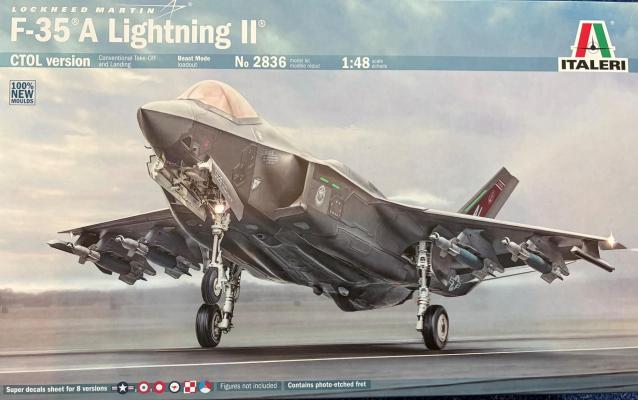
This kit was a ‘Limited Edition’ kit, released at the 2025 IPMS/USA National Convention in Hampton Roads, Virginia. It was quickly sold out on both Eduard ‘s online store and at the 2025 Convention. The instruction booklet contains 23 pages, including some color guides for the weapons, masks and overall aircraft decal markings.

I was initially impressed with several aspects of this Eduard repackaging of the Kinetic F/A-18C, including the surface details (including recessed panel engraving), the placement of panels along the surfaces, the wing fold details, the beautiful box art, and especially the kit decals. As I began to dry fit the various subsections, the novelty wore off. From what I expected to be a beautiful kit, I quickly realized I had purchased a total rehash of the original Kinetic kit, along with what I consider to be numerous major fit and finish issues.

Review Author
Michael Oberholtzer
Published on
Company
ModSand
Scale
N/A
MSRP
$20.99

This handheld tool is designed to get into tight spaces like wing roots, intakes, or other tight or hard to reach spaces. It has four resin-like tips which are to be superglued to the tip of the tool, and sandpaper is to be attached to the tip with double-sided tape. I have to admit that at first this seemed like a pain to set up, but it is really very quick and easy. I tested the tip change out by removing the attached tip and prying it off with a hobby knife, and it came off cleanly and in one piece. I then glued on another tip, the one with the triangular point. I attached a small piece of sandpaper with double-sided tape, and then trimmed the sandpaper to match the tip with my hobby knife, and the sander was ready to use. As advertised, it works well in awkward spots like wing roots, as shown in the accompanying photos. I also find it useful in cleaning up areas to be glued where paint needs to be carefully removed.

Review Author
Michael Oberholtzer
Published on
Company
Quickboost
Scale
1/48
MSRP
$9.99

These FOD covers are a straightforward and simple addition to Eduard’s nice Mirage III. They come without instructions, but none are really needed beyond the one picture provided. Nicely cast in pinhole-free gray resin, they just need to be removed from the mold base, washed and painted. Detail is nice and pops out with a dark wash. Based on my references and internet photos I’ve found, these covers were usually painted yellow, although I did find a few in red. I painted one in each color to see how they would look. I used Tamiya white spray-can primer, followed by Vallejo medium yellow and red RLM 23 Model Air paints. After the paint dried, MiG Dark Wash was applied. (The wash is a bit heavy to make the detail more visible in the photos.) I dry-fitted the two FOD covers in place on my Mirage III CJ in Israeli markings to show how they look in place.