
The Consolidated B-24 Liberator: Reuben Fleet, the Factories, and the Product
With over 650 titles in print, Fonthill Media publishes high-quality subjects including Archaeology and Ancient History, Aviation, Biography, Local History and Heritage, Military and General History, Sport, Transport and Industrial History.
Dr William Wolf was a dentist for twenty-two years before retiring at the age of 45 to pursue his aviation interests and outdoor pastimes. Over the past forty-five years, he has amassed an archive of over 27,000 books and magazines, 10,000 or more images, and hundreds of reels of microfilm, among other material, on this subject. He is the author of twenty-four books on aerial warfare in World War Two, including nine on American bombers, two on US fighters, five on American flying units, and three volumes on US aerial armament. Wolf is no stranger to massive tomes as evidenced by his volumes on US Aerial Armament in World War II, Vol.1 (2009, 400 pages), US Aerial Armament in World War II, Vol.2 (2010, 320 pages), The 5th Fighter Command in World War II Vol 1 (2011, 448 pages), The 5th Fighter Command in World War II: Vol. 2 (2012, 352 pages), The 5th Fighter Command in World War II Vol 3 (2014, 448 pages), the Douglas A-20 Havoc (2015, 520 pages), the Martin B-26 Marauder (2014, 640 pages), and the Consolidated B-32 Dominator (2006, 272 pages).
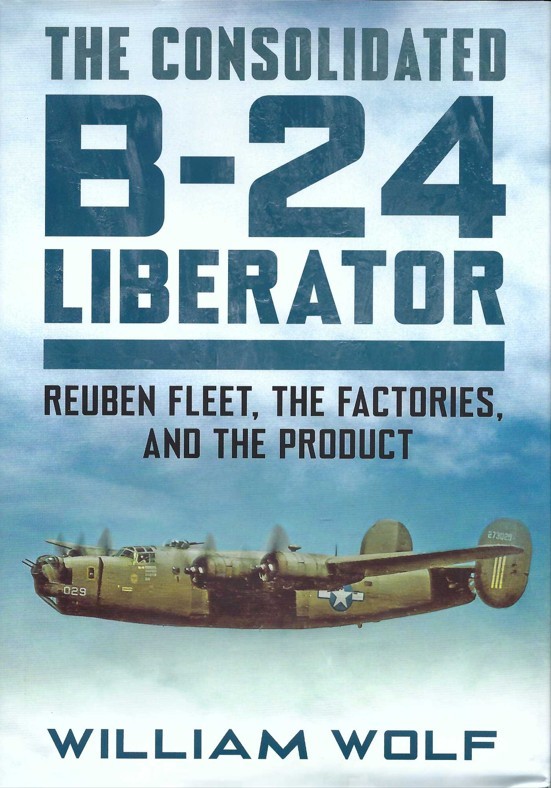
Part One of a planned three-volume set on the Consolidated B-24 Liberator, this is a heavy book at 3 pounds and 14 ounces. This 7" x 10" hard cover is supplied with a nice gloss paper jacket and clocks in at 624 pages. I counted 450 black and white photographs and drawings plus the jacket's two color photos. The front cover features a colored (or colorized) photograph of Consolidated B-24J-5-CO, s/n 42-73029 over the Kwajalein Atoll, Marshall Islands, in June 1944. This airfield was originally built by the Japanese and featured a single coral surfaced runway. The Marines landed on Kwajalein Atoll on January 31, 1944, later repairing the airfield for use by US fighters and bombers. Aircraft 42-73029 served with the 7th AF, 11th BG, 431st BS at Kwajalein airfield from March 31 through August 4, 1944. The rear cover features a color (or colorized) picture of Consolidated B-24D-15-CF, s/n 42-63960, that was based at RAF Harrington Airfield, Northamptonshire, England. Nicknamed "Dorothy", she served with the 8th AF, 389th BG, 564th BS before being transferred to the 492nd BG, 856th BS. Here, she is seen flying in formation over Cognac, France, on February 8, 1944. The plane crash-landed on February 4 (or 6), 1945, at Harrington Airfield with all ten crew members surviving, even though the aircraft was badly damaged.
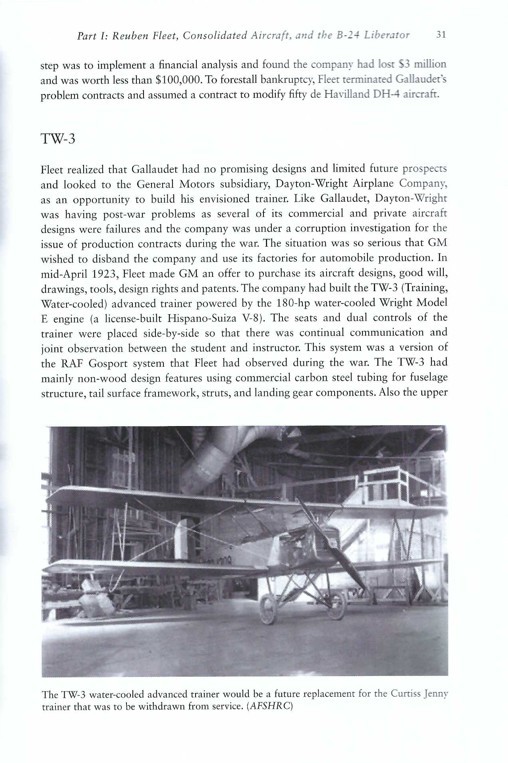
Dr William Wolf delivers a tour de force on the founder of Consolidated, Reuben Fleet, and the factories that would manufacture the Consolidated B-24 Liberator. The first Consolidated manufactured aircraft was the TW-3 (Training, Water-Cooled) advanced trainer. The Dayton-Wright Company had just begun manufacturing this side-by-side trainer when General Motors (who had bought Dayton-Wright in 1919) closed the company down in 1923. Reuben Fleet acquired the TW-3 contract along with its chief designer, Colonel Virginius E. Clark, from General Motors. The TW-3 would begin being delivered as the Consolidated TW-3 as viewed at the bottom of Page 31. Unfortunately, when evaluated by instructors at Brooks Field in San Antonio, Texas, Reuben Fleet found that the instructors did not like the side-by-side seating in the TW-3. A clear view of landing the plane was quite important to the instructors and being on one side or the other obscured the view of the opposite side. The Army supported a change to a tandem arrangement which was made by adding longerons. The end result was a hump between the tandem cockpits, resulting in the instructors referring to the revised TW-3 as the Consolidated Camel.
One of the first aircraft to use the Davis wing was the privately funded Consolidated Model 31 long range patrol boat. Designed for both civilian and military considerations, the Model 31 first flew on May 5, 1939. The Pearl Harbor attack occurred just as performance testing was completed and the US Navy bought the Model 31, assigning it the designation XP4Y-1. It was quickly outfitted with dorsal, nose and tail guns along with the capability to carry 4,000-lbs of external stores. A production order for 200 P4Y-1 was placed, and a factory was built to construct this order in New Orleans, Louisiana. The only problem was the shortage of the Wright R-3350 Twin Cyclone engines, which also powered the Boeing B-29 Superfortress. The importance of the Model 31 would soon be seen in the Consolidated Model 32. General H. H. Arnold was concerned that Boeing would not be able to meet the manufacturing need for the B-17 Flying Fortress and proposed that Consolidated build B-17 Flying Fortresses under license. Consolidated visited Seattle to discuss this with Boeing but found that the B-17 design was continuing to evolve and that Boeing did not have enough work at the time. The result was that Consolidated proposed a faster, longer-range bomber with a greater bomb load than the Fortress. After the AAC inspected a Model 32 mock-up, the result was an order for the XB-24, s/n 39-556. The first flight was achieved on December 29, 1939, from Lindbergh Field for 17 minutes. Consolidated test pilot William Wheatley can be spotted in the lower black and white photograph on Page 119. Wheatley became a test pilot for Consolidated in February 1929, in Buffalo, New York. When Consolidated moved to San Diego, California, he and his family moved with Consolidated. Sadly, Wheatley died on an acceptance flight of a Royal Air Force Liberator B Mk. II, AL503, when it crashed into San Diego Bay on June 2, 1941. The XB-24 can be seen at the top of the page in front of the San Diego Consolidated factory. This prototype featured Consolidated's twin tail design from the Model 31, along with the Davis Wing. The twin bomb bays were each the same capacity and size of its rival, the Boeing B-17 Flying Fortress. The original round engine nacelles are also visible before they were changed to the elliptical nacelles of later models. The original engines were supercharged R-1830-33 radials that were traded out for turbocharged R-1830-41 engines. This modification changed the designation to XB-24B along with the serial number to 39-680. The XB-24B prototype stayed with Consolidated, later being modified to a company transport. She was scrapped on June 20, 1946, at Brookley Field, Mobile, Alabama.
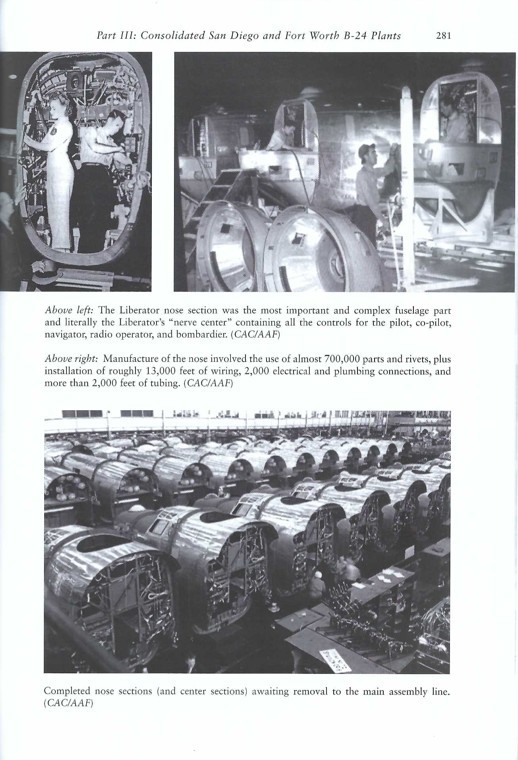
All five manufacturing plants are addressed, starting with the Consolidated Sand Diego facility. The Liberator nose section was the most complex section with all controls for the pilot, co-pilot, navigator, radio operator, and bombardier. The first B-24 Liberators were essentially hand-built, as were most aircraft of the era. As B-24 orders increased, there were three major expansions at the San Diego plant. The original plant was 247,000 square feet, but by the end of 1942, the square footage had increased to 3,363.000. True assembly line production would not be achieved until 1944 using lessons learned from the Ford Willow Run manufacturing facility. Assembly line photographs of the nose section assembly can be seen on Page 281. The nose section was composed of almost 700,000 parts, plus 13,000 feet of wiring, over 2,000 feet of tubing, and 2,000 electrical and plumbing connections.
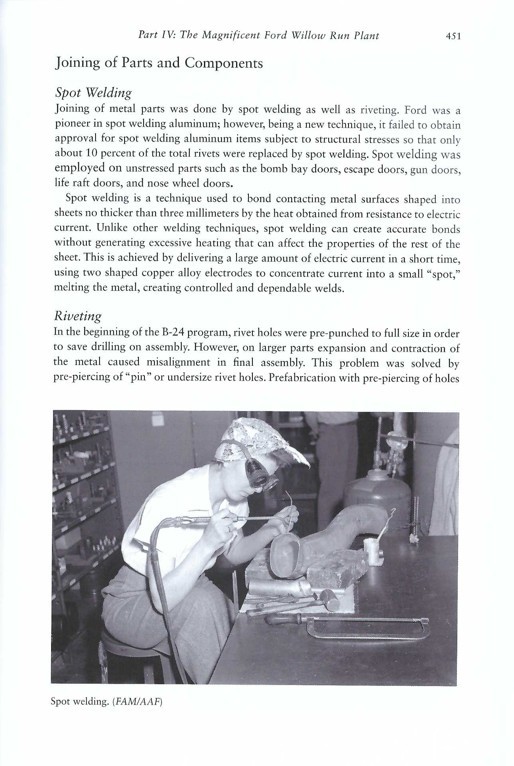
The Ford Willow Run manufacturing site had a tool design engineering group of up to 1,000 men to implement the required dies, jigs, and fixtures. Sub-Assembly fixtures were designed for nearly every operation. Metal part joining was accomplished with riveting and spot welding. Ford was a pioneer in aluminum spot welding methods, an example of which can be seen on Page 451. Spot welding applied a large amount of current to melt the metal for a short time on a specific small "spot". This innovative technique was used primarily on joints with low structural stress and was used primarily for the bomb bay doors, crew escape doors, gun doors, and nose wheel doors. Spot welding improved assembly times for the Willow Run B-24 parts because it could reduce the need for rivets that were much more time-consuming.
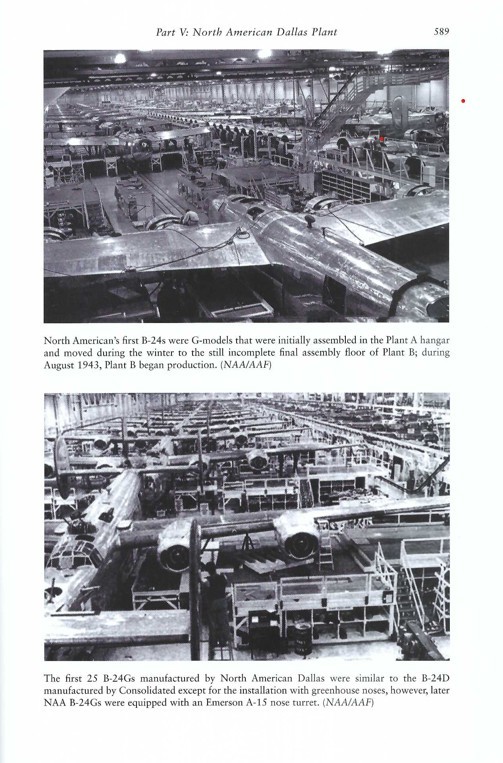
Significant attention is paid to the Consolidated San Diego, Consolidated Fort Worth, and the Ford Willow Run manufacturing plants. The North American manufacturing plant in southwest Dallas and the Douglas Tulsa facility are also addressed. North American Dallas manufactured B-24G Liberators can be viewed on Page 589. The first 25 Liberators were similar to the B-24D and were built as the B-24G Liberator with a Sperry ball turret. The remaining 405 B-24G-1 Liberators built utilized am Emerson A-15 nose turret, making them similar to the B-24J. North American would produce 536 B-24J Liberators at the Dallas plant. When Liberator production stopped, the North American Dallas plant was to manufacture 1,000 Fairchild C-82 Packets, but with the war ending, only 3 were manufactured, leaving 977 partial airframes. North American occupied the government-owned manufacturing facility from August 1941 to August 1945. North American produced 20,000 aircraft, including B-24 Liberators, T-6 Texans, and P-51 Mustangs. The next tenant was Texas Engineering and Manufacturing Company [TEMCO]. TEMCO would act as a subcontractor for the Lockheed F-104 Starfighter, Lockheed P2V Neptune, McDonnell F-101 Voodoo, Boeing B-47 Stratojet, and the Globe Swift. April 8, 1948, saw Chance Vought Aviation sublease space from TEMCO as Vought began to manufacture F4U Corsairs, and later F7U Cutlasses and F8U Crusaders. TEMCO would merge with James Ling, an electronics firm, and later merged with Vought in 1963, creating the LTV Corporation. The LTV A-7 Corsair II would be the next aircraft manufactured in the facility. Northrop Aviation bought LTV Corporation in 1991, and the plant would become Vought Systems of Northrop-Grumman, primarily making sub-assemblies. Subcontracting would include the Boeing 747, 757, and 767, in addition to the B-2 and McDonnell Douglas C-17.
The contents listed below just reinforce how thorough this book is.
- Foreword
- Inflation Adjuster
- Caption Credit Abbreviations
- Preface
- Acknowledgments
- Part I: Reuben Fleet, Consolidated Aircraft, and the B-24 Liberator
- Introduction
- Reuben Fleet: The Early Years
- Fleet in the Service of His Country
- Fleet is Introduced to Flying
- Fleet Joins Army as a Pilot
- Fleet as Assistant XO of Training
- Fleet, Officer-in-Charge of the New Aerial Mail Service
- Further World War I Assignments
- Fleet in the Post-War Air Service
- Fleet Becomes an Aircraft Builder
- Fleet Enters Civilian Aviation Manufacture
- TW-3
- Fleet Creates the Consolidated Aircraft Company
- Virginius E. Clark
- Hispano-Suiza V-8 (HS-8) Engines
- Consolidated Produces the First Primary Trainers
- Buffalo Plant Established
- PT-1 [Model 1] Trusty
- PT-3 [Model 2] Husky
- NY-1/-2/-3 Huskys
- N2Y-1
- O-17 Courier
- Consolidated's Excess Profits
- Consolidated Enters the Large Aircraft Markets
- Isaac Laddon
- Sikorsky-Consolidated S-37B Model 11 Bomber
- Consolidated Designs and Builds Flying Boats
- Fleet Organizes Tonawanda Products Corporation
- Consolidated Enters the Latin American Market
- Commodore [Model 16]
- P2Y-1 and 2 Rangers [Model 22]
- Consolidated and the Private Aircraft and Mail Market
- Husky Junior [Model 14] / Fleet
- Fleet of Canada
- Gordon Mounce
- Fleet and Personal Secretary Lauretta Golem Crash in the Fleet
- Fleetster [Model 17]
- Consolidated Acquires and Retires the Thomas-Morse Company
- The PB-30 [PB-2] Fighter Establishes Consolidated as an Innovator
- Fleet and Consolidated Face the Depression Years
- Model 18 XBY-1
- Consolidated Meets the Depression
- Last Gasp of the Thomas-Morse Division
- Consolidated Become a Major Industry Player with the Illustrious Catalina
- The San Diego Plant Goes into Production
- PB2Y-1 Coronado [Model 29]
- Boeing Gets an Early Start in the Four-Engined Bomber Competition
- David Davis and the Davis Wing
- Consolidated Adopts the Davis Wing
- The Davis Wing at Consolidated After the B-24
- David Davis and his Wing after Consolidated
- The Davis Wing Considered
- Consolidated Model 31 Long Range Patrol Boat and the Davis Wing
- Consolidated Pre-XB-24 Four-Engined Bomber Proposals
- Consolidated Model 32/XB-24: B-24 Precursor
- Consolidated Model 32
- Consolidated XB-24: The Redesignated Model 32
- Consolidated Heads Toward B-24 Production
- Fleet Acquires the Hall Aluminum Aircraft Company
- The Effect of the British and French Purchasing Commissions
- French Purchasing Commission
- British Purchasing Commission
- British Air Commission [BAC]
- Anglo-French Purchasing Board
- Effect of the British and French Purchasing Commissions
- Increased Demand for Aircraft Changes the American Pre-War Aircraft Industry
- Consolidated Wins New Contracts and Expands for B-24 Production
- George Mead
- Consolidated Expands to Meet Demand
- Consolidated Confronts the West Coast Labor Unions
- Consolidated Merges with Vultee
- Tom Girdler: The Force Behind the Merger
- Victor Emanuel
- Stinson Airplane Company
- The Jerry Vultee and the Vultee Aircraft Company
- Richard Milar
- Dick Palmer's Trainers Put Vultee on the Aviation Map
- AVCO Becomes a Force in the Aviation Industry
- AVCO Pursues Rueben Fleet
- The Final Finances of the Merger
- The Merger: Aftermath and Clarification
- Fleet at the New Company
- The New Consolidated Hierarchy
- Tom M. Girdler: Chairman
- Henry Woodhead: President
- I. M. Laddon: General Manager
- Vice Presidents: Charles Leigh and Charles Perelle
- David Fleet: Executive Vice President
- Consolidated-Vultee's Wartime Contributions
- Epilog: Consolidated Post-War
- Consolidated-Vultee
- Victor Emanuel and AVCO
- Floyd Odlum
- Epilog: Reuben Fleet After the Merger
- Reuben Fleet: Private Citizen and Air Power Advocate
- Reuben Fleet and Family
- Reuben Fleet: According to Ex-Wife Dorothy
- Tom Girdler on Reuben Fleet
- Fleet Marries Secretary Eva Wiseman and Retires
- Reuben Fleet: Philanthropist
- Part II: Liberator Production Pool, Committee, and Manufacturer Contracts
- Liberator Production Pool
- Maintenance and Parts Interchangeability
- B-24 Committee
- Coordination of B-24 Program
- B-24 and Knock-Down Kit Contracts
- Consolidated Contracts
- Joint Contracts: Consolidated San Diego and Fort Worth, Douglas and North American
- Ford Willow Run Contracts
- Consolidated—Ford as a Subcontractor Contracts
- Douglas-Ford as a Subcontractor Contracts
- Ford Prime Contracts
- Liberator Production Pool
- Part III: Consolidated San Diego and Fort Worth B-24 Plants
- Section 1: Consolidated San Diego
- Developing the San Diego Facility
- The Original Plant
- Plant Expansion
- Early Planning
- First Expansion
- Chronology of the Highlights of the First Expansion [Table]
- Second Expansion
- Chronology of the Highlights of the Second Expansion [Table]
- Third Expansion
- Chronology of the Highlights of the Third Expansion [Table]
- Additional Expansions
- The San Diego Plant
- Description of the San Diego Property
- Location and Access
- Plant #1 Complex
- Plant #1 Buildings [Table]
- Plant #2 Complex
- Plant #2 Buildings [Table]
- Factory Camouflage
- Airfields
- Roads and Railways
- Utilities and Services
- Management
- Consolidated-Vultee Management 1944
- The San Diego Consolidated Labor Force
- San Diego and the Labor Supply
- The Labor Build-up
- Worker Training
- Work Force Growth and Production
- Utilization of the Available Work Force
- Black Workers
- Military Personnel
- Marginal Workers
- Work Week and Shift Distribution
- Employee Morale
- "Nothing Short of Right is Right"
- Lodging and Housing
- Rents
- Dormitories
- Women's Housing
- Linda Vista
- Housing Problems Continue
- Rationing
- Company Services
- Community Factors
- Labor Relations
- Absenteeism and Turnover
- Work Force Conclusions
- Building the Liberator
- Engineering
- The Plan
- Initial Difficulties
- Engineering Changes
- The Master Change Record and the Treatment of Changes
- Engineering Changes and the B-24 Committee
- Production Methods and Tooling
- Consolidated's Tooling Plan
- Assembly Tooling
- Changes Made
- Tooling Difficulties
- Cost of Tooling
- Tooling Developments
- Master Tooling Dock
- Reproduction of Tooling Gauges by Tooling Docks
- Manufacture of Tooling
- Machine Tools
- Machine Tool Procurement
- Production Plan
- Production Acceleration
- Period of Production Acceleration
- Production Control
- Inspection
- The Army-Navy "E" Award
- Raw Materials and Purchased Parts
- Feeder Shop Plan and Subcontracting
- Feeder Shops
- Sub-Contracting
- San Diego Plant B-24 Sub-Contractors [Table]
- Government-Furnished Equipment and Spare Parts
- Government-Furnished Equipment [GFE]
- Rejected and Salvaged Items
- Consolidated Assembly Line
- San Diego Liberator Construction Evolves
- Nose Section Manufacture
- The Final Liberator Assembly Line
- San Diego Liberator Construction Gallery
- Consolidated Wartime Aircraft Totals
- Consolidated San Diego Summary and Conclusion
- Facility Construction Period
- Pre-Production Period
- Production Period
- Conclusions and Evaluations
- Developing the San Diego Facility
- Section 2: Consolidated San Diego
- Consolidated Fort Worth B-24 Plant
- Fort Worth's Aviation Heritage
- Fort Worth and World War I Aviation
- Amon Carter: "Mr. Fort Worth"
- Fort Worth and the 1920s
- The Rise of Fort Worth's Aviation Industry
- Enter Reuben Fleet
- Edgar Gott and the B-24
- Reuben Fleet Romances Amon Carter and Consummate the Deal
- The Consolidated Fort Worth Plant
- Fort Worth Workforce
- Fort Worth B-24 Knock-Down Assembly and Production
- The KD Kits Arrive from Willow Run
- Fort Worth Production
- B-24 Manufacture is Terminated and B-32 Production Begun
- Consolidated Fort Worth Plant Post-War to Present
- Fort Worth Contract Deliveries [Table]
- Summary of the Cost of Consolidated's Fort Worth Facility [5-23-44] [Table]
- Tarrant / Carswell AAF
- Section 1: Consolidated San Diego
- Part IV: The Magnificent Ford Willow Run Plant
- Henry Ford and Automobile Mass Production
- The Trimotor Tin Goose: Ford's First Aircraft Manufacturing Endeavor
- The Auto Industry Begins Aircraft Manufacture
- The Reuther Report
- The American Automobile Industry Becomes a Defense Industry
- William Knudson
- The Bomber Program Develops
- Aircraft Factory Conversion vs. New Construction?
- Ford and Charles Sorensen Enter the U.S. Air Defense Program
- Ford Top Management has Internal Problems
- Henry Bennett: Henry Ford Confidant and Enforcer
- The Willow Run Factory is Conceived
- The Site
- Location
- The Architect: Albert Kahn
- The Layout Board Model
- Groundbreaking
- Willow Run Named
- Plant Construction
- Early Production Planning
- The "Tax Turn"
- Construction Begins
- Chronology of Willow Run B-24 Manufacture, 1941-1945
- 1941
- 1942
- 1943
- 1944
- 1945
- Milestones
- The Plant
- Buildings and Floor Area [Table]
- Cost of Ford Willow Run [Table]
- Building the Enormous Willow Run Complex
- Willow Run Captures the Public's Imagination at Home and Abroad
- The Bomber Plant: Manufacturing and Assembly
- Main Building
- Administrative Building
- IBM Service
- Factory Supply Transportation
- Worker Transportation
- Factory-Based Transportation
- Airfields and Hangers
- Utilities
- Specialized Buildings and Amenities
- Mass Producing the B-24
- Pre-Production
- Deciphering the Consolidated Data
- Lofting and Pattern Shops
- From Building KDs to Building Complete B-24s
- Ford is Contracted to Build One Complete "Educational" B-24
- Ford Gives in to the UAW Labor Union to Build Complete Liberators
- The Willow Run Workforce
- Limiting Factors to Achieving Mass Production
- The Ford Manpower Plan
- Build-up of the Labor Force of Willow Run
- The Labor Supply
- Women
- Rosie the Riveter
- Black Workers
- Little People
- Wages
- Work Week and Shift Distribution
- Employee Training
- Worker Morale
- Worker Absenteeism
- Worker Turnover
- The Willow Run Manpower Problem and Worker Productivity
- Worker Housing
- Willow Run Houses its Workers
- Unions, Worker Grievances, and Race Riots
- "De-concentration": Moving Work to the Workers
- Production at Willow Run
- Ford's Plan for B-24 Production
- Workability of Ford's Plan
- Strengths of the Ford Plan
- Weaknesses in the Ford Plan
- Ford Implements the Plan
- Assembly Tooling
- Dies
- Hard Dies
- The Anticipated Advantages of Hard Dies
- Overcoming the Disadvantages of Hard Dies
- Die Types
- Blanking and Piercing Dies
- Forming Dies
- Drawing Dies
- Jigs: The Key to Mass Production
- Machine Tools
- Joining of Parts and Components
- Spot Welding
- Riveting
- Heat Treatment
- Production Tooling: "Tooling Up"
- Magnitude of Tooling
- Tooling Up Difficulties
- Difficulties in Parts Manufacturing
- Engineering at Willow Run
- The Engineering Plan
- Assembling the Basic Engineering Material from Consolidated
- Putting the Consolidated Pieces Together
- Handling of Engineering Changes
- Engineering Reorganization at Willow Run
- The 801 Change: Model Designation Change from B-24E to B-24H
- Master Changes B-24E and H [Table]
- Raw Materials and Purchased Parts
- Ford's Purchasing Plan
- The Ford Purchasing Plan in Practice
- Purchasing Difficulties
- Parts Storage
- Material Control
- Material Control's Operation
- Raw Stock Material Control Department
- Purchased Parts Control Department
- Production Control Department
- Purchasing Specification Department
- Material Control Liaison
- Subcontracting: Other Ford Plants and Outside Sub-Contractors
- Early Operation
- Methods of Sub-Contracting
- Other Ford Plants as Sub-Contractors
- Ford Rouge B-24 Sub-Assembly Plant
- Vendor Sub-Contracting
- Spare Parts
- Ford's Spare Parts Plan
- Ford Spare Parts Operation
- Government-Furnished Equipment [GFE]
- The Ford GFE Plan
- Ford GFE Operation
- GFE Reorganization
- Inspection and Government Control
- Ford's Inspection Plan
- Willow Run Inspection in Operation
- AAF Control in Willow Run
- Willow Run Visitors
- Rate of Production Acceleration
- The Willow Run Mass Production Plan
- The 8- and W-Series KD and Complete Aircraft Production Plan
- Preparation for Production
- Long, Slow Period of Production Acceleration
- Reorganization at Willow Run
- Willow Run Crises
- Production Crisis
- Truman Committee Investigation
- Ford and the 1943 Detroit Race Riots
- Period of Rapid Production Acceleration
- Ford and Willow Run Management
- The Management Plan
- Initial Organization
- Ford and Willow Run Management
- The Passing of Edsel Ford and Its Aftermath
- Edsel Ford Passes
- Henry Ford II: (Only) Ford Motor Company Heir Apparent
- Henry Ford II Postscript
- Ford Motor Company After the Demise of Edsel Ford
- Willow Run After the Demise of Edsel Ford
- The Fabled Willow Run Production Line
- An Improbable Description
- Movement of the Assembly Lines
- The Division of the Fuselage for Mass Production
- Willow Run Manufacturing Section
- The Center Wing Section: The Essence of Liberator Manufacture
- Center Wing Skin and Stringer Assembly (Department 936A)
- Center Wing Vertical Assembly (Department 936)
- Assembly of the Center Wing Section
- Ingersoll Center Wing Milling Machine
- Center Wing Horizontal (Department 937)
- Fuselage and its Component Assemblies
- Final Assembly (Department 947) Stations 1 through 14
- Four-Hour Stations: Final Assembly (Stations 15 to 28)
- Fuselage and its Component Assemblies Gallery
- Knock-Down (KD) Kit Production and Transport
- B-24Es Assembled from KD Kits
- Transporting KD Kits
- KD Kit Gallery
- Was "Willow Run" a Success?
- Gallery Willow Run B-24 Milestones
- Willow Run Post-War
- Ford Does Not Exercise Its Plant Options
- Kaiser Takes Control
- RACER Trust
- Yankee Air Museum
- Future Autonomous Vehicle Testing Site
- Part V: North American Dallas Plant
- Planning and Building the Dallas Plant
- NAA Builds Plant B for B-24 Production
- Assembling KD and Scratch B-24s
- NAA Dallas B-24 Production and Costs
- North American B-24 Liberator Production [Table]
- Total Cost of Plancor No. 25 NAA Dallas (1 September 1944)
- NAA Dallas Plant Epilog
- Part VI: Douglas Tulsa Plant
- Planning and Building the Tulsa Plant
- Assembling the B-24s
- Contract Deliveries by Douglas Tulsa
- Summary of Cost of the Douglas Tulsa Facility (20 May 1944) [Table]
- Bibliography
- Index
Dr William Wolf's first volume on The Consolidated B-24 Liberator is not a quick read [I spent eight days on it], but it is fascinating. This tome serves as the most complete insight into Reuben Fleet since William Wagner's memoir from 1976 [Aero Publishers Reuben Fleet and the Story of Consolidated Aircraft] based on Reuben Fleet interviews which is long out of print. This tale reveals the people involved that led to the development of the Consolidated B-24, along with the trials and tribulations of creating the manufacturing facilities to successfully produce the Liberator. It is difficult to pick out a favorite part, but I really enjoyed the sections on the Consolidated Fort Worth and North American Dallas manufacturing plants. This is probably because I have lived in the DFW metroplex since 1980, and I have visited both plants many times over the years. That is on top of having attended presentations from employees who have worked at both facilities. That is not to dismiss the decisions and learning experiences involved in setting up Consolidated San Diego or Ford Willow Run. Just the politics of Ford's assembly line at Willow Run alone is interesting. I am looking forward to the succeeding volumes on the Consolidated B-24 Liberator from Dr William Wolf. If you are interested in the Consolidated B-24 Liberator, this is an essential volume for both the aviation historian and the scale modeler.
My thanks to Casemate, Fonthill, and IPMS/USA for the chance to review this great book. Highly recommended!


Reviewer Bio
Frank Landrus

Frank retired from the Ophthalmic industry with over thirty-six years of Research and Development experience. Frank's first model kit was a 1959 Hawk 1/72 US Marines Vought AU-1 Corsair and has been building models for over sixty years. Frank's first encounter with IPMS was attending a North Central Texas ScaleFest show in 1984. Frank soon became more involved in Make-N-Take activities and became the IPMS Western Coordinator for Make-N-Takes [West of the Mississippi River]. Make-N-Takes quickly became a local model contest and airshow staple reaching a high of reaching over 1,300 children before the COVID shutdown. Frank has volunteered to assist in contest judging since 1985 and is currently the Nationals Head Figure Judge until he is dead or they find someone better.
Comments
Add new comment
This site is protected by reCAPTCHA and the Google Privacy Policy and Terms of Service apply.
Similar Reviews