When this package arrived I pulled it out of its mailing pouch, and if I didn’t recognize the Eduard Logo and packaging, I would have thought that someone had sent me real tiny leaves. That’s how realistic these fern leaves looked. They are already colored green and the color is perfect. It is colored on both sides, which makes assembly easy due to not having to worry about the wrong side showing because of it not being painted. They are very thin which also make them very fragile but can be easily bent to conform to any angle or shape you may need. Even though Eduard has decided that these ferns are 1/35 scale, they can be used for just about any scale within reason. The only drawback is that there is no picture of any kind, which shows how they should be “planted” or anchored to a “branch”. I guess we’ll have to figure it out on our own; which really isn’t that difficult.
Most model builders think of useful small hobby tools when they hear someone say TRITOOL. However, this TRITOOL item is a fundamental building material for use in scratch building, customizing or finishing models. It is a unique self-adhesive sheet of thin pre-finished foil (film) that is intended to replicate red finishes on aircraft or other models (other primary colors are available, such as white, black, yellow, orange, blue, etc.). The package contains one 90mm x 200mm sheet of material that has a red semi-gloss finish. It appears to be the correct color for reproducing a Japanese Hinomaru.
When I saw the review list and “Mr Paint Station” and “Gunze” I was thinking this could be cool. In reality it’s not exactly what the name implies. What Mr Paint Station is actually is a holding device for painting. What you get in cellophane bag are four 3” x 5” “boxes” that are built so that the corrugation is facing out. These open corrugations then allow you to place toothpicks or other thin holding clamps you may have, into them to hold parts while they dry or perhaps when you paint them.
The cellophane bag shows that Gunze may produce a set of holding sticks that are meant to insert into the corrugation, none are supplied in the Mr Paint Station package. Unfortunately I can’t read Japanese, so I don’t know what their actual product name is or how much they cost.
One of the long time problems modelers have had is what to do if they want to pose an aircraft in flight- after all, that's their natural habitat, in the air. Another problem we modelers have had is how to show off the underside of our exquisitely detailed airplanes or the like while they sit on their gear.
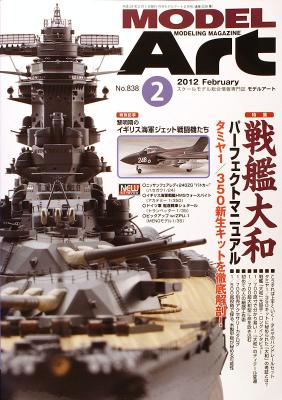
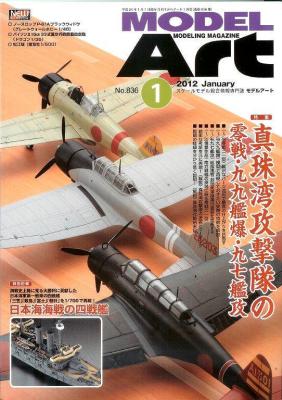
The March publication of Model Art Modeling Magazine focuses on Formula 1 racing with several articles filling the first sixty-three pages of this issue. The magazine also includes new kit reviews, modeling tips, and new kit and item releases. As is typical for Model Art, the magazine measures 182mm by 258mm (about 71/8 by 101/8 inches), and is printed on thick, glossy paper. The production quality is high with these magazines, and just over half of it is printed in color with black and white pages interspersed throughout of the issue. Just in case this is the first review of a Model Art magazine that you are reading, understand that the entire magazine is printed in Japanese with only an occasional English subtitle for those of us who are monolingual, or are just unable to read Japanese text.
The April publication of Model Art Modeling Magazine focuses on the Japanese Air Self-Defense Force aircraft in 2021, air defense power after ten years, with several articles on this topic filling the first fifty-five pages of this issue. The magazine also includes new kit reviews, modeling tips, and new kit and item releases. As is typical for Model Art, the magazine measures 182mm by 258mm (about 71/8 by 101/8 inches), and is printed on thick, glossy paper. The production quality is high with these magazines, and just over half of it is printed in color with black and white pages interspersed throughout of the issue. Just in case this is the first review of a Model Art magazine that you are reading, understand that the entire magazine is printed in Japanese with only an occasional English subtitle for those of us who are monolingual, or are just unable to read Japanese text.
Seventy-one years after the French capitulated to the Wehrmacht in the summer of 1940 the French Army still seems to the butt of jokes. Regardless, the campaign still generates a great deal of interest in the academic and hobby community. With Tamiya’s release of the Char B1bis and the UE Armored Carrier, there is still a tremendous amount of interest in the modeling community for French subjects.
I love tools. I don’t think you can have too many. Occasionally I come across one that I say "how did I live without that?" That is what this tool is. More than a simple jig, this machined metal tool allows you to flat sand the bottom of the wheels evenly and consistently. Let’s face it a perfectly round wheel is not realistic nor are the flat wheels that are common on aftermarket wheels. That is where this tool comes in, the perfect balance of weight without being flat.
How do you use it? Simple get your tire from the kit, clean up the seam lines, set the angle, clamp the wheel between the flat spots on the tool and leave about 1/8 inch out the bottom. Then simply sand with 320 sandpaper while applying pressure to the base plate. It is that simple, but does it work?
- ALC 311Klear Kote Light Sheen 4oz/120ml
- ALC 312 Klear Kote Semi-Matte 4oz/120m
- ALC 313 Klear Kote Matte 4oz/120ml
- ALC 314 Klear Kote Flat 4oz/120ml
- ALC 408 Armoured Glass Tint 1oz/30ml
- ALC 600 Aqua Gloss Clear 4oz/120ml
As has been the case for as long as I have known him, Tony Hipp seems to be on an endless quest to develop and bring to market still more excellent products for the discriminating modeler. For years, we’ve searched for the ultimate natural metal finishes, and when Alclad first came on the market, every other product took a distant place far behind. Tony’s products, my estimation, have become the benchmark to which all standards are measured.
These new offerings are not aluminum paints, but will go a long way to make whatever your modeling project is more realistic.
When we hear the words Battle of Britain, those of us who build aircraft models, especially those flown in WW II, immediately think of Spitfires and Hurricanes fending off what was, during that summer of 1940, the best air force in the world. They were the icons of that aerial struggle, but they were only part of the story. The Battle of Britain was also the story of young fighter pilots who flew the Spitfires and Hurricanes, as well as those who piloted lesser-known RAF aircraft and those pilots and gunners of Coastal Command who protected convoys in aircraft bearing names like Hudson, Skua, and Roc. On the ground, the Battle of Britain also was the Home Guard training for the expected invasion; the aerial spotters with tin hats and binoculars; neighbors sadly picking through their bomb scattered possessions, and children climbing over the rubble in the streets.