When I was a young boy, I was like many my age and played with toy soldiers. I remember the armies attacking each other and chipping the paint off a lot of them. My mother took me into Manhattan every Christmas to see all the toys at Macy’s, and the ones that fascinated me the most were the toy soldiers. I only wish I saved them all from my childhood. As I grew older and began painting military miniatures, I attended many figure shows and was totally in awe at the collections of toy armies displayed, but I had no idea of the value of them.
For those unfamiliar with this magazine, it is to my mind one of the finest general purpose modeling magazines in the world today. It is filled with high quality articles covering the whole gamut of plastic modeling, from aircraft, armor, and ships to sci-fi and figures. The models appearing in these articles are very well built, well photographed, and in color, and the magazine is printed on high quality glossy paper. This issue contains 160 pages and measure 7” x 10”. The modeling articles are interspersed with the odd photo essay, together with numerous advertisements. The one drawback, at least from this reviewer’s perspective, is that it is entirely in Japanese script.
Issue 834, the subject of this review, contains the following:
Being primarily an armor modeler, I was interested in this kit after seeing a fellow modeler’s build on the web. After all, it has tracks, doesn’t it?
The kit is, in a word, miniscule…really. I was a little surprised that, for a 1/32 kit, it was so small. Don’t let size fool you though, Fujimi has provided a little gem here. The kit features only three small sprues; two molded in bright yellow styrene that make up the excavator itself, and one molded in white styrene containing 13 parts that provide some general construction site supplies – wheelbarrow, cones, etc. No decals or markings of any kind are included in the kit, an unfortunate drawback in my opinion.
The mere 60 parts are crisply molded and required little, if any, clean up. A few parts may require a quick pass from a #11 blade to remove some minor mold seam, but that’s it.
This wonderfully documented book covers the history of one of Germany's largest paratrooper regiments – the Fallschirmjager Regiment 6, FJ.Rgt.6. Originally published in German in 2007, the book has been translated into English by Mara Taylor and released in the United States by Casemate Publishing in 2011.
Following a short Preface, Chapter 1, The Initial Organization, begins with the unit's formation on February 13, 1943 under the command of Major Egon Liebach, an experienced paratrooper and troop leader. The focus of Major Liebach's training was field exercises and close combat. In addition, advanced training was provided in combat parachute and glider deployment. As it turned out, they acted more as ground troops than as a parachute assault unit. In fact, their nickname, The Lions of Carentan, came about as a result of the strong defense they put up around Carentan during the Normandy invasion.
Concord Publishing has continued its series of illustrated campaign histories. This volume focuses on the siege of Sevastopol from 1941-42. Dimitry Zgonnik has four full color illustrations that highlight the uniforms of German soldiers during this campaign.
Beginning in the fall of 1941, the 11th Army, under the command of Erich von Manstein, was given the objective of capturing the Crimean Peninsula, which, by default, meant neutralizing the Soviet fortress of Sevastopol. After several attempts in the fall of 1941, the Germans failed to capture Sevastopol. In the spring of 1942, Manstein was able to eject the Soviets from the Crimea and besiege Sevastopol. Many buffs remember the Crimean campaign because of the Germans use of the Super gun Gustav which was used to reduce the Soviet fortifications. After a bloody siege, the city fell. The book does not include a map of the campaign, so you will have to look elsewhere to follow along.
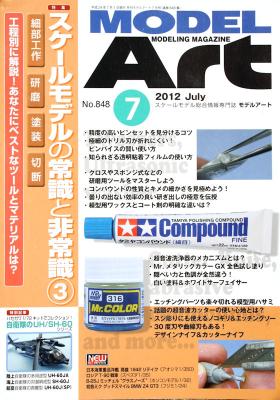
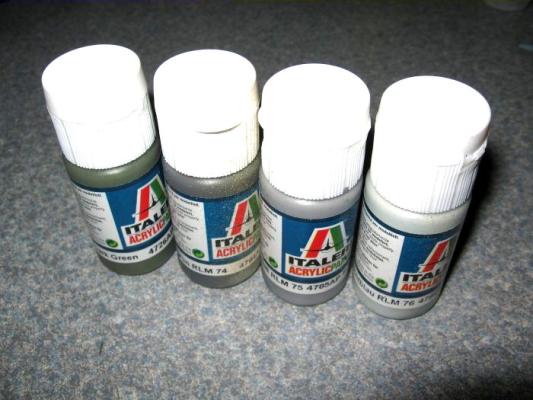
ModelArt No. 832 monthly update has the usual features of new product kits, as well as a feature topic. This month, the topic is aluminum metallizing finishes. Pages 5-49 show a list of four entire pages of different paints with a picture of its bottle and a painted plastic spoon so you can see how it looks – a thorough encyclopedia of available aluminum metallic paints. Examples of how to use the paints to build real kits are detailed for 1/32 scale P51D, Tojo, and Tony fighter aircraft. Other examples include more fighter aircraft, a B26an airliner, a Formula One racing car, several luxury sedans, and even tank treads. The text is in Japanese, but the numerous photographs help decipher what is being done. At least this section gives some advanced modeling tips for aluminum finishes.
The October publication of Model Art Modeling Magazine focuses on 1/35 scale German World War II armored reconnaissance vehicles. The magazine also includes new kit reviews, modeling tips, and new kit and item releases. As is typical for Model Art, the magazine measures 182mm by 258mm (about 7 and 1/8 by 10 and 1/8 inches), and is printed on thick, glossy paper. The production quality is high with these magazines, and just over half of it is printed in color with black and white pages interspersed throughout of the issue. Just in case this is the first review of a Model Art magazine that you are reading, understand that the entire magazine is printed in Japanese with only an occasional English subtitle for those of us who are monolingual, or are just unable to read Japanese text.
Editor's note: This magazine is also available as an "Ap" for i-Pad; as are Tamiya Magazine and the AFV series.
Let me first say that, prior to getting these review copies, I have never read any issues of Airfix Model World. I must admit, many of the model magazines out of the UK look the same to me at first glance, and I made the mistake of lumping this one in with the rest.
The format is very similar to the other UK model magazines – high quality glossy cover from stiff stock, and glossy pages. To me, this is where the similarities stop. I read each of these issues cover to cover, and have to say I honestly enjoyed them all. Each of the articles was in-depth, well-written, and accompanied by many photos. Quite often I have seen that magazines tend to run very short articles (in terms of text), that often leave me wishing I had more. Not so here.
Saturday morning cartoons once again meet the modeling bench in Round2’s resurrection of classic kits featuring Warner Brothers’ beloved Road Runner and his nemesis, Wile E. Coyote. Of the three newly re-released kits, this review focuses on the hapless Wile E. Coyote and the Wile E. Willys – a loony dragster embodying a skateboard culture theme.
The MPC-branded kit consists of 4 sprues of colored parts (including 1 chrome-plated), a set of peel-and-stick decals, and a pre-painted vinyl Wile E. Coyote figure. Construction is touted as snap-together, but we found it necessary to apply either superglue or Tamiya liquid cement for virtually every step.
The Parts
The Goddess of Flight provides a sturdy and classy display base for models. The Goddess figure consists of seven parts, all cast in resin. Her feet are contained within a base that can simulate clouds or water, depending on what model she will be supporting. There are no “feet” per se, but a resin locating peg that slips into the cloud/water base.
This cloud/water base comes with a ¼” (approx.) nut that is embedded firmly in the resin. The nut slides upward through a finished wooden base which provides lateral support for the finished Goddess and a whole lot of “class”. The wooden base is circular, comes completely finished and is very attractive.