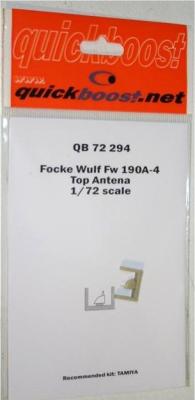
The later Ju 88Gs and Ju 188 have always been favorites of mine, causing me to collect anything and everything about these aircraft. Surprising these latest editions from Hasegawa are not always easy to obtain here in North America this could be due to the timing of their releases as it happened during the distribution transition from Dragon USA to Hobbico. Nevertheless, now that Hobbico is established with the Hasegawa lines, these late war Ju 88/Ju 188’s should get easier to obtain. So it was with great excitement that I was able to review these engine intakes from Quickboost.
For those of you interested in World War One aviation you are probably familiar with Windsock Worldwide, a publication of Albatros Publications, Ltd. out of the U.K. If you are a modeler of World War One aviation and not familiar then you might check them out at your soonest. In addition to their bi-monthly Windsock magazine, Windsock publishes “Data Files” dealing, in detail, with specific single subjects. The bi-monthly Windsock magazine deals with more than one WW-I aircraft subject and always includes at least one highly competent and detailed review and build article. As a modelling publication and reference series on WW-I aviation subjects they are second to none, unequivocally.
The Aircraft
The Boeing 737 was developed in the 1960s as a low-cost development of the 707 and 727. It’s the only Boeing “narrow body” airliner still in production. There are 9 versions, ranging from 85 to 215 passengers. While not approaching the Bf-109 in numbers, the 737 is the best-selling jet airliner in history, with 6638 delivered, with 2186 more on order as of December 31, 2010 (Editor: Boeing source).
The 737 in this kit is the -400 version, with CFM-56 engines. Because of the low wing and large diameter of the engines, the lower side of the nacelle is flattened, giving a distinctive “hamster pouch” look. The -300 and -500 versions differ from the -400 in fuselage length, with the -400 being 10 feet longer than the -300 and the -500 is 8 feet shorter than the -300.
The folks at Quickboost continue to add superb detail sets to their growing catalog of items. For this review I will be looking at the exhaust detail set for the 1/72 Hasegawa G8N1 Renzan.
The Hasegawa 1/72 G8N1 Renzan has been on the market for many years, in several different boxings. The molds for each issue of the kit are the same, so this exhaust upgrade set will work with any of the G8N1 kits you may have in your collection.
The Japanese WWII G8N1 Renzan Bomber was a late war Japanese WWII found-engine Bomber project. The initial prototype was completed late in 1944, and several test flights were made before the war ended. Perhaps the most recognized image of a Renzan is the photo in orange paint scheme in captured US Markings.
Master Model was a new name for me. I had not heard of them before nor had I seen any of their product lines. After this review sample arrived I can safely say I am more than impressed with the quality of their work! This new group from Poland has quite a line of brass detail parts on the market. Here I will be looking at one of their new sets: 1/72 WWII Japanese Type 99 20mm Mark 2 Cannon Barrels (set of 4).
Packaged in a small plastic bag, with a cardboard backing & header were four of the nicest brass parts I have seen. Master Model’s brass parts are very finely turned brass parts that look like the real thing – only much, much smaller! All I can say when I looked at these parts was “WOW – How did they do that?!?”
The Me-163 Komet is the only rocket-powered aircraft ever seeing combat. The whole combat history of this unique point-defense interceptor is covered by this book of the Aviation Elite Series as it only served with JG400.
The book is structured in five chapters, the first one covering the Me-163 development and the following four covering the operational service of 1.Staffel, 2.Staffel, I.Gruppe, and II.Gruppe respectively. It also has a series of appendixes covering unit organization, selected biographies, operational flight logs for each Me-163 and a very interesting appendix regarding the armament, including the use of SG 500 Jägerfaust, a recoilless mortar-style weapon which was fired vertically.
The Romanian Air Force in World War II saw extensive combat in the Eastern Front against the Soviet Air Force and against the USAAF and RAF in home defense roles. Later, in late 1944 Romania changed sides and saw combat against the Luftwaffe.
This book covers all the fighter aircraft in the Romanian Air Force during World War II. The fighter aircraft inventory included British, German, Polish, and locally designed airplanes, plus captured soviet airplanes, yielding to a rather varied set of camouflage styles. Specifically, the book covers the Hawker Hurricane, Bf 109E and 109G, He 112, Bf 110G, PZL 11 and PZL 24, IAR 80/81, plus captured Mig-3, I-16 and Fw-190A/F.
History: The Fieseler Fi 156 is a fabric and steel tube constructed 3 place liaison aircraft. It is noted for its short takeoff and landing characteristics used by all the German forces. It’s primarily used by German upper echelon personnel including Hitler himself. It also played a major role in a daring rescue of the imprisoned Italian dictator Benito Mussolini.First produced in 1939 the type remained in production throughout WWII. The total production was around 1549 aircraft. During the winter months, it was fitted with skis. It was also produced after the war by France and Czechoslovakia.
It had a crew of 2/3; empty weight 930 kg; maximum speed 175 km/h; minimum speed 51 km/h and a range 385 km. Power was provided by an Argus AS-10C inverted V8, (air-cooled) with 240-hp; takeoff distance 26 meters (no wind).
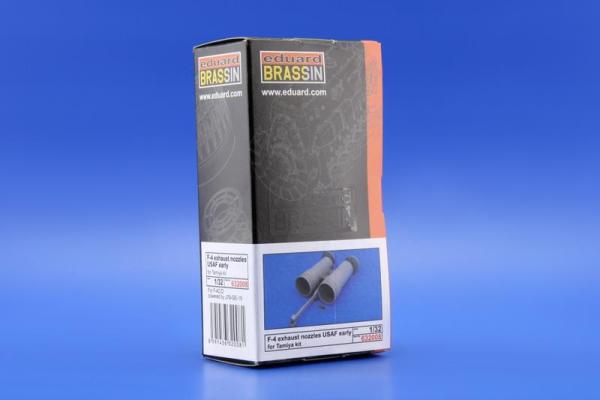
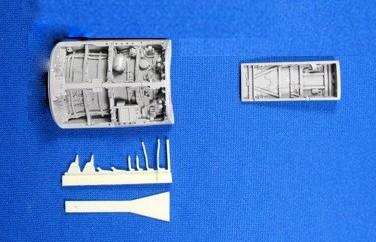
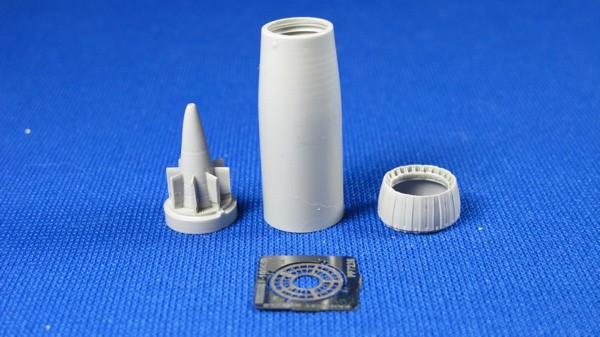
Well known for their exceptional photo-etched parts, Eduard recently crossed over to the resin world with the introduction of the Eduard “BRASSIN” line. The sets under this line consist of high quality resin castings with Eduard’s exception photo-etched parts. [Some sets also contain color photo-etch and/or mask sets.] The latest in this new product line is a 1/48th scale engine set for the F-16N. The set consists of the exhaust and the intake fans for F-16’s powered by the F110 GE-100 engine. While billed for the Tamiya kit, the set can be used for any F-16 featuring this engine.
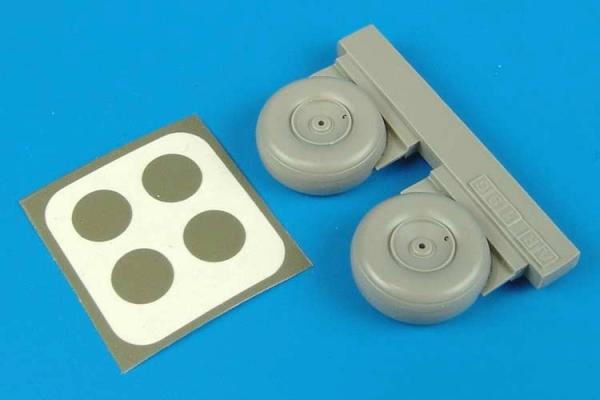
Aires has long been known for their superb resin detail sets. Recently, Aires launched a new detail set line known as Wheelliant. The new line uses a smooth cast resin that captures even the minutest details. Sculpting in multi-piece, highly detailed sets, the new line offers modelers an excellent alternative to kit parts.