Best known as the world’s first atomic bomber, the B-29 Superfortress was arguably the most advanced aircraft to see combat operations in World War II, and was the only American heavy bomber of the era to see combat during the Korean War.
Introduction
Many of us grew up building the many versions and scales of the utility helicopter of the time – the Bell UH-1 Iroquois of the "Huey" family. Those first flew in 1956 and over 16,000 of them were produced starting in 1960. "Utility" was the key word. They've been used for everything from search and rescue and medical evac to gunships and forward air control to fire fighting and much, much, more. A real workhorse!
Any replacement was going to have some big shoes to fill. So along came Sikorsky’s H-60 with all its “utility” combinations, and many of the H-1's were able to retire to their well-deserved place in history, with no loss in capability to the many who counted on them for the last half century.
Hobby Boss has provided the modeler with a nice choice for an Mi-4 “Hound.” Detail on the Hobby Boss kit is crisp. However, some PE would definitely help out. Eduard has answered the call with multiple PE sets for the Hobby Boss Mi-4. For the modeler who chooses to button up the cargo compartment, the Eduard Interior Self-Adhesive “Zoom” set is perfect.
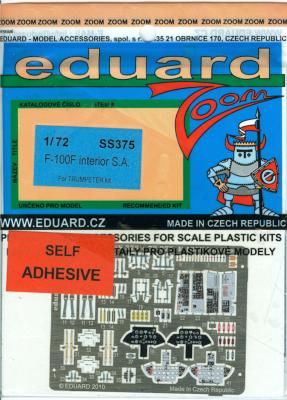
This PE set consists of instrument panel, seat harnesses, overhead panels, and the little instrument panel that sits on the side of the front windscreen frame. The PE set is pre-painted and self-adhesive. The modeler is required to sand away the detail on the center console and the overhead consol. There is no need to sand away the kit’s instrument panel as the PE replaces the whole thing; a nice touch.
First, exceptional thanks to our friends at Revell for re-releasing “the Beast” and providing IPMS/USA a copy to review!
This kit is a re-release of the former Monogram “Promodeller” Helldiver, originally issued in 1997. When you open the box, the only difference between then and now is that the molds have been around a bit longer, the instruction sheet is different, the decals are different, and the copyright mark on the underside of the elevator says “China.” One thing I noted was there were a few rough flash edges on the clear parts for the canopy; other than that, the kit is flash and sinkmark free.
This Japanese design started in 1939 for the Imperial Japanese Navy. The first prototype was designated J2M1, and it took flight in March, 1942. Prior to this maiden flight, the Japanese were well under way to engulfing all of the Pacific countries and had brought the United States into the war. Engine difficulties plagued the aircraft from the start of production in December 1942 with the J2M2 Model 11. 131 were built and deployed to pilots in December, 1943. Many of these were taken off the line were sent backl for testing as engine difficulties became severe in the field. This led to development of the J2M3 Model 21 (307 built) that reflected changes to the armament design. The machine guns were scratched, giving way to two 20mm cannons and two short-barrel cannons in the wings. By the time these were deployed to pilots in February 1944, Japan was fighting for survival one island at a time in the Pacific Theater. The aircraft never met its high expectations.
Eduard Models from the Czech Republic has chosen its MiG-21 series to be one of the mainstays of its plastic model line. Reasons to choose the MiG-21 series abound: it has been flown by many different air forces on different continents, it has been finished in desert, tropical and natural metal finishes, and it is one of the icons from the Cold War.
The kit comes in 9 sprues and a total of 464 parts. Don’t be scared by that number since about half of the parts are not used – mainly underwing ordinance that it is worth saving for other builds. There are many, many small parts in this kit. But Eduard has extra small sprue gate connectors attached to them, making it easy to clean them up before assembly.
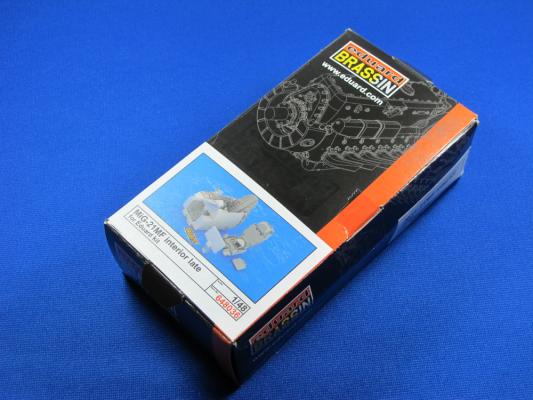
Eduard Models from the Czech Republic keep expanding its line of detail sets for its line of 1/48 MiG-21s. This time, they added a resin cockpit from their Brassin line for the MiG-21MF (early).
As with most Brassin line sets, there are resin and some photo-etch parts. The photo-etch fret is pre-painted and includes many details, like instrument dials, besides the traditional seat belts.
For some reason, there are two kinds of resin used in this set. One is darker than the other. I’m not sure what the difference is. Something that might be a first for Eduard (at least, it’s the first time I’ve seen it) is the inclusion of a part molded in clear resin for the gun sight. Another added value is the addition of a mask set for accurate painting of the interior detail.
A nice detail to have included is a pilot’s helmet among the resin parts. It would look really cool either sitting on the seat or hanging from the cockpit side.
While the control stick is a small detail in any aircraft cockpit, it is one of the more obvious ones. This control column from Quickboost is minutely detailed for such a small part, from the canvas boot at the bottom to the buttons on the handgrip. The tiny lever on the front of the grip is even there.
When Kinetic announced the release of a C-2A Greyhound, I was very interested after having seen VRC-40 Rawhides above the USS Carl Vinson last summer. When the opportunity came up to build one, I jumped at the chance.
Looking at the plastic, much of the kit is a carryover from their excellent E-2C Hawkeye kits, with the wings, engine and props duplicated. Included are a new fuselage and full interior, along with a back ramp. Molding and panel lines are excellent and I dove right into the interior.
This conversion is designed to be used with the excellent Eduard Bf-109E-1/E-3 kit. I chose to use the Weekend Edition E-1 kit. The conversion set comes securely packed in an attractive box. The twenty resin parts are in one small zip-lock bag, while the three small decal sheets are in another zip-lock bag. The instructions are printed on two sides of an 8.5” x 11” sheet. There is one picture of the actual aircraft on the front, and a three view drawing on the back showing decal placement, along with painting instructions. There is a brief history of the type, along with some basic instructions on dealing with the resin pieces. The instructions are strictly of the narrative type, but are well written and fairly easy to follow.