I flew the AH-1 Cobra for 15 years, and to say that I’m intimately familiar with it would be an understatement. I love this helicopter and flew it in combat and as a maintenance test pilot. If the Army still had it in the inventory, I would still be in.
Aires has added the Type A wheels and masks for the F6F Hellcat to their line of resin aircraft accessories. This latest addition is molded in a grey resin, is smooth, seamless and bubble free. When I compared the type A tire to the type B tire I found that the type A had a diamond tread look to it, while the type B had smooth sides and a few lines that circled the tire. That’s all I could find about the different types except that they were used as a “that’s what we have at the moment” type of application.
For comparison I pulled out a Heller Hellcat from my stash. There really is no comparison. The Heller tires are molded as separate halves that have to be glued together while the Aires parts are solid with no seam to sand down and the paint masks are a very welcome addition to assist in painting.
Aires has added the wheels and masks for the SU-27 Flanker to their line of resin aircraft accessories. This latest addition is molded in a grey resin; it’s smooth, seamless and bubble free.
For comparison I pulled out an Italeri Sea Flanker from my stash but found out that the Sea Flanker had 2 wheels up front. I called a friend of mine and he had the right kit so I compared it to the Encore SU-27. The Aires parts seem to be a little more detailed than the Encore wheels and the Aires paint masks are a very welcome addition to assist in painting.
I very highly recommend this product if you want a nice set of tires for your SU-27 model. I’d like to thank Aires Hobby Models and IPMS USA for the chance to do this review.
The usual “Heavy Appreciation” goes out to Hasegawa USA for providing IPMS USA yet another fantastic re-release of one of Hasegawa’s catalog for review.
This kit is a re-release of Hasegawa’s mid-1980’s F-1 models. The molds have endured the test of time, and no flash is present on this kit. Engraved panels, accurate details, tight construction, and a change in pace for F-1 lovers in the form of a new decal sheet. Although I like the standard F-1 Japanese three-color scheme, this was just, well, different!
Hasegawa has been releasing many of its kits as Limited Edition issues during the last few years, and this iteration of its new-tool “advanced 737” kit in the colors of Air Do---the relatively new identity of Hokkaido Airlines---follows suit. The moldings and parts are the same as previous issues, with white fuselage halves and gray for all other parts. (Photo 37Parts.jpg) The kit comes with a stand plus alternate parts for displaying the model with gear retracted or extended. A forward interior bulkhead is provided with a big metal bolt to insert in its center, to act as ballast and prevent tail-sitting. Just to make sure my model had enough weight up front, I inserted the bolt into the front of the bulkhead instead of the rear, so the bolt head was closer to the nose.
Fine recessed surface detail is the hallmark of this kit and there was no flash on any of the parts---even the tiny gear struts and engine exhaust cones.
The Cross & Cockade International is the quarterly publication of a non-profit organization known as The First World War Aviation Historical Society. The UK based organization has been publishing these journals since 1970 with the objective of furthering the study of First World War Aviation History. The Company overview on its Facebook page says “Cross and Cockade International can trace its history back to the 1960s. We have always attracted some of the premier historians in the field. Our current President is Air Vice Marshal Peter Dye (Rtd), Director-General of the RAF Museum. We publish a high-quality quarterly journal of original research into the subject.”
NOTE: The journal is apparently not available as single issues, but by volumes. Back issues sell for $33.50 per volume.
MMD-Squadron has added a 1/48 scale US WW II era parachute to their True Details resin aftermarket parts line. The parachute is sculpted to represent a chute in pre or post-mission repose with integral pack, cushion, harness and hardware visible. It is well sculpted with an amazing amount of detail for such a small item.
This parachute would be a perfect diorama accent for any US WWII aircraft model, posed the way parachutes were typically placed on the wings or stabilizers of aircraft prior to a mission so pilots could quickly ‘suit up’ for a takeoff. Two parachutes come packaged on a blister card with a foam pad backing to protect the fragile features of the casting. They are molded in gray resin on a very thin layer of molding scrap. No assembly is required. They just need to be sanded off the small casting scrap, painted and positioned. A fresh #11 blade can then be used to carefully trim away scrap from the edges of the parachute without damaging the details.
Mushroom Model Publications are available in North American from Casemate Publications.
MMP is expanded their excellent selection of scale plans for various aircraft. Sets No. 1 and 2 (detailed below) have been available for several years. In 2014 scale sets, 3, 4, 5, 6, and 7 have been released. One can see that the plans are of excellent quality and are filled with detail that many modelers value.
The pages, themselves can be removed from the publication and are suitable for framing, even suitable to decorate a display base! The price is right, the quality is excellent, and the subject matter is appealing.
Set No. 1 (978-83-89450-79-1 ) priced at $10.72, formatted in A4 Softcover, spiral wire binding 24 pages in A3 - Pages - 24 (0 in colour) contains plans in 1/48th for these aircraft:
I’d like to express my ongoing appreciation to Ross at SAC for continuing to provide us with review items; I know that everyone at IPMS/USA sincerely appreciates your contributions.
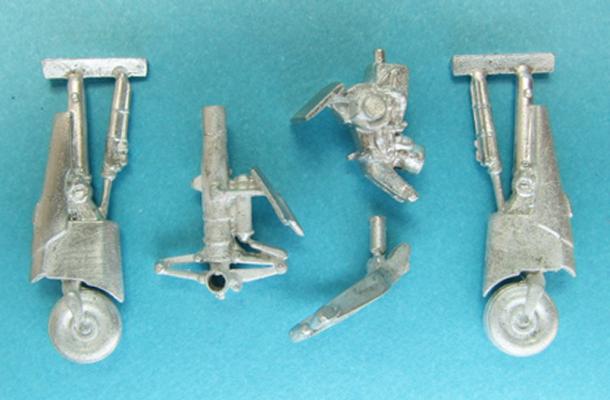
This is another in a series of “drop fit and direct replacement” metal gear for your models. In this case, the set is for the Kinetic-series of Alpha jets in 1/48. In my case, it is being used on my “Wingman” German aftermarket release of the kit, and as such, the weight of the resin cockpit, seats, and more make use of metal gear almost mandatory if you don’t want the “failed plastic gear” effect on your model. As an aside, the Wingman release is fantastic too, but that’s not the point of the review.
As you can see by the pictures, 11 parts are provided for this set, totally replacing the plastic parts in the kit. I will say that the metal parts have a bit more “crisp” look to them, and with no mold seam, you can install and paint with confidence.
Quickboost has come out with a very nice aftermarket set of correct engine cowls for the 1/72 Academy P-38 Lightning. Right out of the clear packaging I could see that they did a very nice job in detail and size.
I took the kit cowls out and noticed I had to glue on the lower radiator intakes. The intakes did not fit very well, and would have to be filled and sanded. I then compared both cowls and you can see in the photos the kit lower intakes are bigger and thicker than the Quickboost. The scoops on the side look much nicer and are hollow, whereas the kit scoops are solid. After comparing them I started the task of cutting the Kit cowls off and installing the Quickboost ones. I used a very thin saw blade to do the job. Be careful and take your time so as not to ruin the rear cowls of the kit.