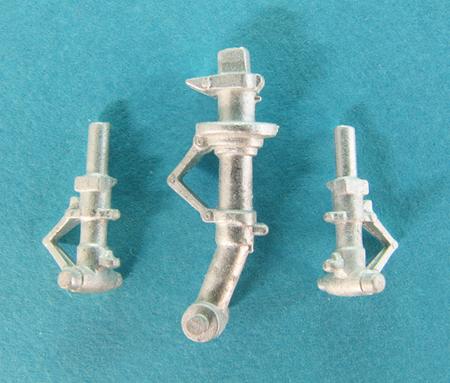
When the fledgling United States Air Force sought a jet-powered interceptor to replace the piston-powered P-61 Black Widow and P-82 Twin Mustang, they selected the Curtiss-Wright XF-82 Blackhawk. When the prototype didn't live up to expectations, the USAF turned to the one company that had an effective jet-powered fighter in service - Lockheed. As with the piston-powered interceptors, the new turbine-powered machines would have to have a two-man crew… one to fly the aircraft, the other to operate the intercept radar. Having developed the successful T-33A, a two-seat trainer variant of the F-80 Shooting Star, Lockheed was given the green light to create an interceptor out of the T-33A in an accelerated development program.
Windsock WWC Summer 2014 is the second issue of Volume 30…and/or the second edition of the first centenary year of Albatros’ rebranded publication. It provides readers with a substantial amount of WWI aircraft modeling information and both historical and technical reference. An extended FRONT LINE NEWS section leads into the regular columns: OUR READERS GALLERY (Featuring two very well-built Nieuports) and LOGBOOK ENTRIES (Reviewing 4 new titles) before getting into the meat of this issue. What follows is a 3+ page article (complimented by multiple color photos) about an impressive large scale radio-controlled Avro 504K powered by a fully operational 1:4 scale Bentley rotary engine that makes this unique combination fly as well as it looks!
Thanks very much to Revell for providing IPMS/USA this re-release… This is a timely addition to their catalog for D-Day interest (Was it really 70 years ago?) or just those of us wanting to build a C-47! We appreciate your support; I also provide the usual thanks to IPMS/USA leadership for allowing me to review this item.
This is the venerable C-47 originally released by Monogram in 1978, now molded in China and carried by Revell. The original Monogram copyright on the lower exterior wing now says “China 1978”, and a stamp with that information was also used on the inside of the kit in white ink… Molded in Dark olive green and clear, this kit has survived the test of time, to include releases of a DC-3 version, and later an AC-47 gunship with later minigun fit. No flash, and fit (with the exception of that noted later) is great.
Thanks to Aires for providing IPMS/USA this wheel set for review… As ALWAYS we appreciate your support, and thanks to IPMS USA leadership for allowing me to review this set.
About 20 years ago I never thought we would be living in the age of such cool resin parts… and then I receive this set for review. The “Oh cool” factor (some call it ‘wow’) is very high here.
The Hobby Boss F-14 appears to be a great kit. One area that needs a bit of picking up the bar on is the wheels and tires. Enter Aires Wheeliant!
Inside the Retro-red slip cover are 8 wheel halves, and four tires which have been pre-flattened to a proper level for high pressure tires. Also included (at least in this package) was a length of copper wire to add brake lines. Absolutely a great idea!
The Kit
Many 1/72nd modelers have been chomping at the bit for Eduard to release its new tooled 1/72nd MiG-15 after the initial MiG-15 tooling was severely damaged. Now, we finally have the definitive 1/72nd MiG-15 and MiG-15bis! This review is for the MiG-15 Profipack. The sturdy, top-opening box includes three sprues of grey plastic, one clear sprue, a small photo-etch fret, canopy masks, and decals for five early MiG-15s. The parts are crisply molded with recessed panel lines, and the clear parts are very clear and fairly thin, with only a little distortion on the main canopy.
Upon initial inspection, it may seem like you can build any mainline MiG-15 variant, ie early MiG-15 and MiG-15bis. However, there are some key differences between the MiG-15 and MiG-15bis. Here are a list of parts that cover both variants (MiG-15/MiG-15bis):
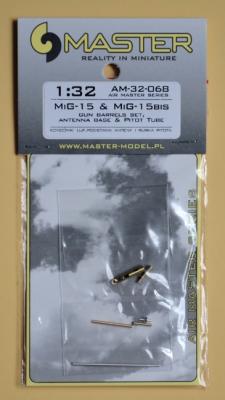
Following the release of Eduard’s spectacular 1/72nd MiG-15 and MiG-15bis kits, Master Model of Poland has released turned brass gun barrels for these kits. Included in the package are barrels to replace the kit’s 37mm cannon and two 23mm cannon. In addition, Master Model has included a pitot tube and antenna base, both out of turned brass as well.
The 37mm cannon consist of two parts, one sliding into the other. The instructions make this clear and the two parts fit together flawlessly. I added these parts to my already in-progress Eduard MiG-15. However, I would highly recommend these parts be added before you start painting your model. It’s also not entirely clear, but the small antenna base replaces the small bump on the kit fuselage. The instructions show the location clearly, but do not make any mention to removing the kit’s “antenna base.”
History Brief
The Westland Whirlwind was a British heavy fighter. Designed by Teddy Petter from the RAF's specification drawn up in 1937, the Westland Aircraft Company produced a single-seat, twin-engined monoplane, prototype which flew on 11 October, 1938 with Whirlwind production starting early the next year.
It was the RAF’s first single-seat, twin-engined, cannon-armed fighter and a contemporary of the Supermarine Spitfire and Hawker Hurricane. The aircraft’s small tube fuselage with its 'T'-tail was an advanced design for its time and the entire plane was built of stressed-skin duraluminium2. The pilot was seated in one of the first 'bubble' type canopies, giving the pilot an almost 360 degree view, and the low forward position of the wing gave the pilot excellent visibility.
First: Thanks to Aires for providing IPMS USA this really fantastic item to review! We appreciate your support; thanks also to IPMS USA leadership for allowing me to review this item.
This upgrade consists of two parts; the swing boom which sets the radome away from the aircraft, and the actual radome itself. A note about what this is; the Airborne Early Warning Sea Kings in the Royal Navy were a stop-gap measure to provide additional radar early warning to the RN fleet of impending low-level cruise missiles or fighters attacking the fleet during the Falklands/Malvinas war in 1982. Their intent was to stand off a distance from where the ships were and provide the outer net of warning.
This boarding ladder is one of those spiffy little accessories which can add a lot to the presentation of a model. In this case, it’s being added to an old Attack kit of a Pakistani Shenyang JJ-5 trainer (based on the MiG-17).
I cut the ladder itself loose from the PE sprue, and I also cut out the ladder pads. These are very tiny in 1/144, so be really careful.
I bent the sides of the ladder using a “high-tech” tool, namely a pair of “duckbill” pliers. The pliers have a decent grip and good straight sides. I took a photo of the ladder with one side bent, then the other. I spent a few minutes getting the sides trued up and made sure the ladder steps were square with the side rails.
Once the ladder was trued up, I applied a spot of thick CA to one of the ladder pads and touched the ladder top to the CA. I then trued up the pad with the ladder top. Same with the other ladder pad.
Wolfpack issued their 1/48 T-38 kit to nice reviews, and Furball Aero-Designs has issued a sheet of 11 mostly-white Talons. Included are 5 1/2" x 8 1/2" sheets in color with profiles of the planes as well as color call outs and decal placements. The last side has stencil placements with top and bottom shots. The decal sheet is the same size and is beautifully printed by Cartograf. Included are the stencils and marking for two aircraft.
The markings included are all USAF and are: