The title of this book is somewhat misleading. Very little of it has to do with “handgun skills,” with that taken to mean skill with a handgun. A look at the cover indicates this, showing a target, shooting glasses, and three pistols, but also a couple of cartridges, ear protectors and cleaning materials. It's really a personal look at handguns, attempting to cover all of the bases and not delving too deeply into any of them.
What's New
New to the modeling world is Hobby Collective. This excellent decal sheet covers the 1/72 JASDF UH-60J helicopter in 40th Anniversary markings.
Included in the bag are one decal sheet and a double-sided direction page.
The decal sheet itself is slightly larger than a standard sheet and includes markings for a single helicopter (UH-60J 28-4556) from the Japanese Air Self Defense Force in markings to commemorate the 40th Anniversary of the group. The aircraft is very colorful in white over yellow with markings of a dragon on both sides of the fuselage.
The directions are all in Japanese but, with a few minutes of study, the modeler can determine what needs to be done. One side is printed in color and has FS color callouts and decal placements. The back is black and white and includes the decal placements for the stencil data of the aircraft.
MiniArt has released a huge number of diorama and scenic kits, designed with the scratchbuilder and kitbasher in mind. This kit is a simple unreinforced brick building ruin, suitable for almost any era or location in the world that has used this type of construction technique.
This kit consists of 35 parts, including a vacuformed base measuring 238x170mm, one sheet of vacuformed walls, one sprue of injection-molded styrene accessories (the accessory sprue seems to be the compulsory treat included in all MiniArt kits), and a one-page, double-sided instruction sheet.
Miniart has released a huge number of diorama and scenic kits designed for universal use. Miniart also includes excellent injection-molded accessory sprues in their kits. This kit includes the same accessory sprue as kit# 35530 Street Accessories.
This kit consists simply of two sheets of semicircle-patterned vacu-formed cobblestone brick streets, a sprue containing parts for a park bench and other accessories in 1/35 scale, and a 2-sided instruction sheet, which is really not necessary.
The streets are in two vacu-formed sheets which, when combined, measure 336x249mm. I only used a 40mm circle of the streets as basing for a scratchbuilt steampunk Walker project of mine, which is really in about 1/54 scale, so it is quite universal for modelers of all genres and multiple scales.
This excellent decal sheet contains markings for five aircraft – all Canadian-built Mosquitoes! Included in the package are one standard size decal sheet and a double-sided full color directions page which includes some brief historical data and individual aircraft information.
Aircraft included are:
- DHC Mosquito B.XX “New Glasgow” KB162
- Mosquito B.VIII (KB315) “The Spook” US Markings & serial number
- DHC Mosquito B.XX KB195
- Mosquito F.B.26 KA406 as the 1,000th Mosquito built by deHavilland Canada
- Mosquito F.B.26 (FB1) purchased by the Chinese in 1948
The decals are well done, and printed in perfect register.
I highly recommend this decal sheet to anyone looking to build a Mosquito that is a little different than the rest. Iliad Design has done a great job of picking some unique aircraft that will look great on the contest table or in your display case.
Tom “The Mongoose” McEwen is one of drag racing’s icons. He is still one of the most popular drivers in the sport of drag racing. He has raced both funny cars and rail dragsters and set more speed records than any other driver. He earned the nickname “The Mongoose” from racing his arch rival Don “The Snake” Prudhomme during the 70s, which many consider the Golden Age of Drag Racing. This model kit represents the rail dragster that Tom McEwen drove during the 70s. The kit was first released in 1974 and, in spite of being 38 years old, has held up quite nicely. This kit has been released 3 previous times since 1974 and I for one am happy to see it come out again. The molds have held up well and the kit is filled with all kinds of extras, making it worth getting. There are plenty of aftermarket decals available, making it worth getting more than one.
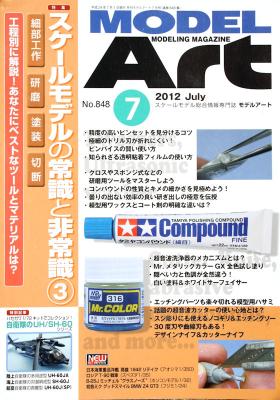
This is a monthly publication from Japan that covers all manner of modeling subjects, ranging from finished models to kit reviews and model building tips, and includes many advertisements. Finding it on the shelves of bookstore in the US is a bit of a challenge, but it can be found online at a number of sites. It is printed on glossy paper, measures 7 1/8” by 10 1/8”, and contains 172 pages. The photo quality (a mixture of full color and black and white) is excellent. Unfortunately, for those who don’t read Japanese, it serves as a great picture book, because (with the exception of some headings and subheadings) the text is entirely in Japanese.
The JGSDF Modeling and Equipment is a MUST have for anyone wanting a top notch pictorial of current JGSDF equipment. Let’s do the main downside first, it’s in Japanese! OK, so getting over that, there are some very way cool things in this edition.
This magazine is packed with pictures and (if you read Japanese) text on all the latest equipment used by the Japanese army. The first couple of pages cover the disaster relief for the earthquakes that hit Japan. Then into the modeling guide, which covers 90 pages of different models. A list way too long to list here!
Then into the equipment guide. Everything from the current handgun, small arms, and body armor to the AH-64 attack helicopter is covered in color pictures. Just a great reference!
This is a high quality, glossy page magazine with great picture layouts and was very enjoyable. I would recommend this magazine to anyone interested in the Japanese army from about the 1960s to today.
Eduard has released a PE exterior and interior upgrade for their new 1/144 MiG-21bis. I’ve reviewed the kit separately.
The “Kit”
Inside the envelope, you get a 2 ½ by 3 inch PE fret, cockpit and canopy detail, decals, and the instruction sheet. There are enough parts on the PE to do one of the two MiGs in the kit, and some “extras” which could be used on the second aircraft, such as the two different sets of chocks or the tailpipe interior which doesn’t need to be installed if you’re using the exhaust cover.
This is the second of three reviews of the new Eduard 1/144 MiG-21s.
The aircraft here is the MiG-21bis, the last variant of the later MiGs.
The MiG-21 in its various forms has been around for a really long time, entering service in 1959, and it’s still in service. The early versions are considered second generation fighters, but the newer versions, such as the MF, SMT and bis are third generation. That big added hump on the fuselage and upgraded avionics/electronics bring the MiG-21 into the third generation.
The Kit
You get two of every part, with an extra canopy for each one. You also get a pair of Eduard masks for the kit(s). Four different MiGs could be built from the decals included – Finnish, Polish Navy (!), Bulgarian, and Hungarian. I chose the Finnish one, as this one interested me when the Finns bought them.