This book looks at all of the piston engine fighter aircraft used by Sweden from 1925 to 1946 and their paint schemes. Each aircraft is covered with many period pictures, some even in color. There is a section on the operational history, a listing of production numbers, as well as a chart detailing the individual aircraft history of all aircraft of each type that served Sweden. Each aircraft section ends with color notes spelling out the colors used for each. While not in FS numbers, these callout will still prove useful to the modeler. The book is more of a history of these aircraft in Swedish service with color information included than it is an in-depth analysis of the colors used on these aircraft.
What's New
The I-20 was a Type C-1 Class submarine, which was based on the Junsen-type, developed from the Type KD6. The C-1 Class was designed to carry the Ko-Hoteki midget submarine or Kaiten suicide torpedo. All 5 of the boats in this class took part in the Pearl Harbor attack on December 7, 1941. All of them launched midget submarines near the harbor entrance and they were never expected to return to the mother ship.
The kit was released for the 70th anniversary of the Pearl Harbor attack. There are examples of the midget submarines at the Naval Submarine School, Groton, Connecticut. While I was in Submarine School I was able to walk around them and take some pictures. In the end, the I-29 was finally
sunk by the USS Ellet in late August of 1943.
The kit comes with a really nice 16-page instruction booklet which leads you through the assembly process. The steps are pretty logical, and the assembly is well represented by pictures.
The Aircraft
SAAB of Sweden built the Draken as an interceptor in the early 60s, with a recon version soon following. The Draken was used by Sweden, Denmark, Finland, and Austria. All operational Drakens were retired between 1993 and 1999. There are a few flyable Drakens at the Test Pilot School at Mojave Spaceport in California.
The aircraft in this kit is a pair of Danish RF-35s, the reconnaissance version. The major differences are the nose, which contains the camera suite, and the wingtips and tail top, which are different.
THE KIT
You get the basic Hasegawa Draken fighter kit, which has been out for over 10 years. The additions are a resin camera nose, resin wingtips, and a new top for the vertical stabilizer.
ASSEMBLY
OK, I am not a Phantom Phreak, but I am a Phantom Phan. I have only built about 20 F-4s in the last 10 years. I also drove about 80 miles from home to Springfield, IL, to watch a couple of F-4Ds take off.
The chapters are:
- In the Beginning
- To Battle
- CAS, McCutcheon and Control
- The Toughest Years
- Golden Hawk Eyes
- Appendices
Also included are 30 color side view profiles of USMC combat Phantom IIs.
I found this book to be a wealth of information about the Marines’ deployments to Vietnam from 1966 to 1973. The chapters cover a unit’s deployment and a history which hits the high points of operations.
Osprey Publishing continues to expand the Duel Series with the 47th installment of this collection, Gladiator vs. CR.42 Falco. This book has the typical sections of the previous books in the series – i.e., Development, Strategic Situation, Combat, Statistics, and Analysis and Aftermath.
The book is well written and incredibly well researched. The main adversaries fought each other in what some historians would consider secondary theaters of war. However, those theaters expanded from sand dunes of North Africa and the Mediterranean to the green fields of Eastern Africa and into the Middle East and Iraq, certainly an area much larger of than the main theatre of operations of WWII.
Background
Some of the most exciting racing can be found with American Sprint Cars. The series may also be called “The World of Outlaws”. These cars feature a high power-to-weight ratio and huge wings. These small cars race around dirt tracks and thrill crowds around the country. Steve Kinser has been one of the biggest stars in this series with over 550 “A” feature wins and 20 championships during his career.
This kit features the 2011 series markings of Steve’s car which was sponsored by Bass Pro Shops. This car features an eye-catching scheme of black, white, and a florescent red. Steve’s car owner is Tony Stewart.
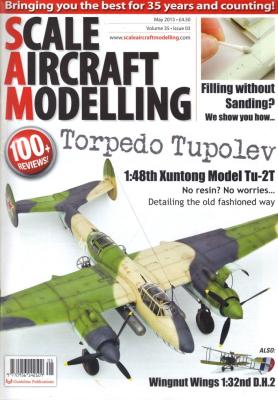
Scale Aircraft Modelling is an excellent monthly publication focusing on modeling scale aircraft. Averaging just under 100 pages, SAM is filled with build articles featuring some of the newer kits on the market, as well as projects based on old favorites. Printed on glossy paper in full color, this magazine is a treasure chest of information about modeling techniques as well as a great source of information on new products.
The cover article in this issue is entitled, “Kaleidoscope Cod” referring to the Kinetic C-2 Greyhound. Mike Williams does an absolutely stunning job on the C-2. The article includes a list of additional items used in the project, which paints produced the beautiful paint job, and those weathering agents which Mike used. The article is a great resource for anyone attempting the C-2.
Three riders on horseback, swords drawn with the colors flying, charging into battle. All sculpted by A. Gagarin, and Master Box has added another fine set of figures to an already impressive list. Molded in a light tan color, the semi-soft plastic is flash-free and needs only minor clean up. The set features three mounted figures on the attack with full combat gear. Each horse and figure has around 15-20 parts that fit nicely and is well balanced.
Bottom line, I highly recommend this to any modeler or Civil War buff. My thanks to Dragon Models USA and Master Box for the kit, and IPMS for the opportunity to review another fine product.
For those who stay up on the latest US Navy aircraft, we have all heard of the evolution of the classic Hornet into the all new F/A-18 E/F Super Hornet. As with any aircraft, it’s undergone several updates even within its short service thus far. One of the areas that has been updated is the infamous Environmental Control System (ECS) exhaust. Several iterations of design have been tried before the exhaust ports settled on the BARD stacks. With the early vents came insulation blankets installed behind the vents as a stopgap solution to the skin damage that was happening aft of the vents. Now, all Super Hornets from Lot 28 and up have the newer stacks built in during assembly, with modifications starting to be retrofitted on earlier jets. Several kits have hit the market within the last several years, some better than others.
The Mark-77 bomb (MK 77) air-dropped incendiary bomb contains a fuel gel mix that is similar to napalm, but different in that it is kerosene-based rather than gasoline-based. Of course, its effects are similar to napalm, thus the term is used generically to describe the Mk-77 even though it technically is not napalm. The Mk-77 is the primary incendiary weapon used by the US, and has been used in both Operation Desert Storm and recent operations in OIF/OEF. One of the main uses during Desert Storm was to ignite the miles of oil filled trenches being used as barricades by Iraq against collation forces.
The primary fusing system consists of the igniter Mk-273 Mod 0 with the M918 fuse, or the initiator Mk-13 (igniter Mk-273 Mod 1 with the Mk-343 fuse). The Mk-77 Mod 4 also has provisions in the nose and tail for an alternate fusing system using the AN-M173A1 fuse and AN-M23A1 igniter.