
Warpaint Special #8: Boeing B-47 Stratojet
Guideline Publications is the UK's leading publisher of modelling and hobby-related magazines. With a world-class portfolio of titles and an international Social Media presence, Guideline Publications has a dedicated readership that is constantly expanding into new areas. This English-language book, Warpaint 8, Boeing B-47 Stratojet, is authored by Kev Darling with artwork by Sam Pearson. The latest Guideline’s A digital edition will soon be available. News on Guideline’s publications can be found on Facebook.
Kev Darling is an aviation historian, writer, and publisher based in South Wales. He served in the Royal Air Force as an aircraft engineer for nearly 30 years, from June 1973 to March 2003. He has written at least 30 books since 1987, working in the RAF Illustrated series, Crowood Aviation series, Crowood Combat Legend series, Specialty Press' WarbirdTech series, as well as Guideline's Warpaint series.
Warpaint's latest is their standard portrait A4 [8.25” x 11.75”] format square-back softbound publication that is 104 pages, excluding the covers. Sam Pearson contributes eight pages of color illustrations that include 24 color side profiles along with two pages of 1/192 line drawings showing top, bottom views, and four side profiles. I counted 72 color photographs and 189 black-and-white photographs.
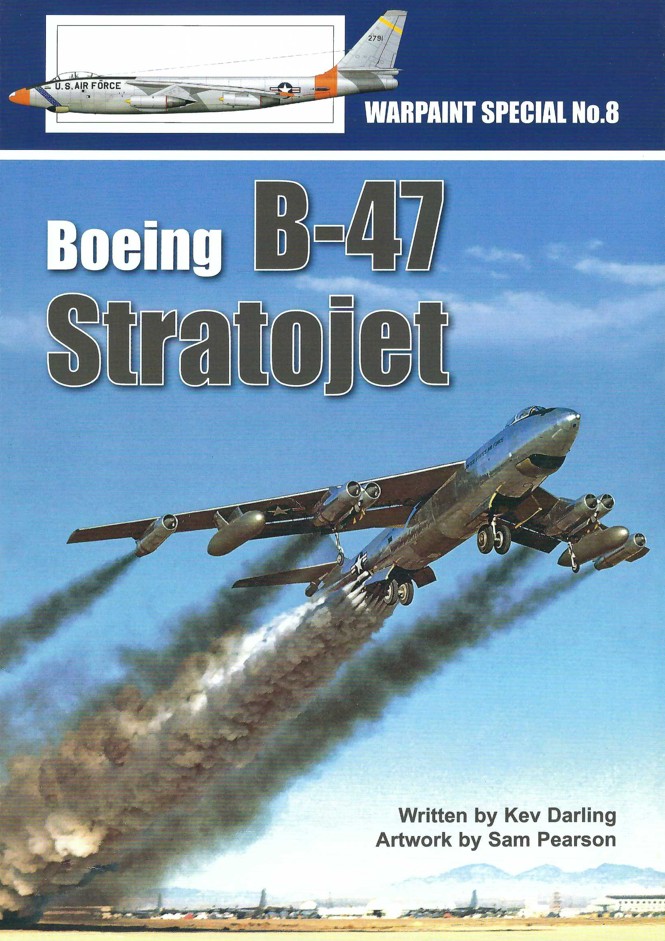
The front cover features a Sam Pearson color side profile of a Boeing RB-47E-35-BW, 52-791. She is depicted serving with the 3920th Combat Support Group, based at RAF Brize Norton in 1961. The 3920th Combat Support Group provided primary support functions for SAC Stratojets and Boeing KC-97 Stratofreighters and was renamed to the 3920th Strategic Air Wing on February 1, 1964, but the 3920th ceased all operations on March 31, 1965. B-47 Stratojet deployments changed from 90-day temporary deployments to 30-day alerts under Operation Reflex in 1958. The Stratojets were held to a high degree of readiness, armed with nuclear bombs until September 1964. The April 15, 1954, color photograph on the front cover is of a Boeing B-47 taking off under full power, including a full set of ATO bottles.
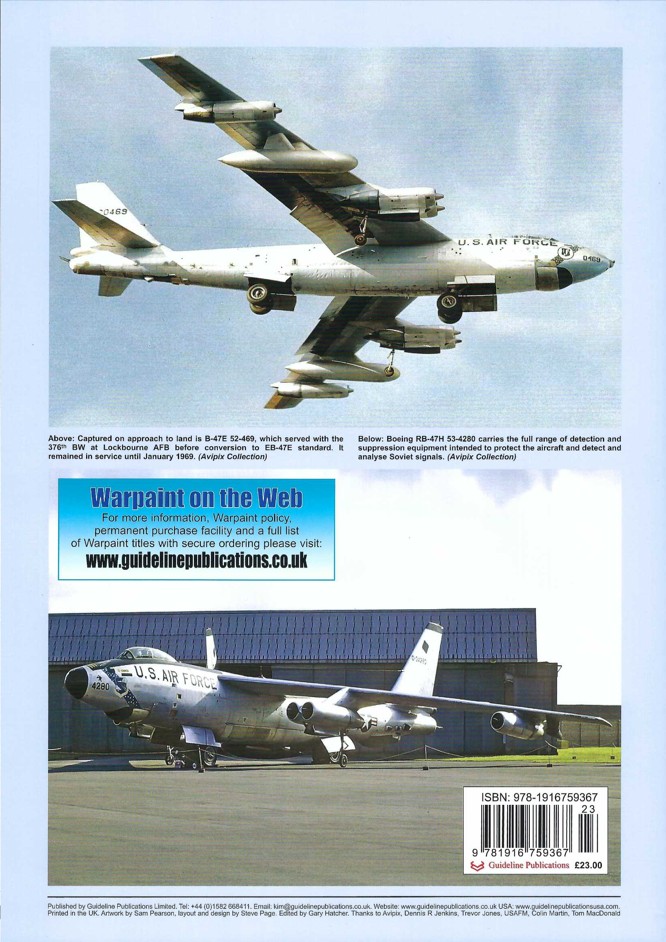
The top of the rear cover features B-47E-85-BW, 52-469, while serving with the 376th BW at Lockbourne AFB, Ohio. She was later converted to an EB-47E and served until January 1969. Replacing the nuclear weapons in the bomb bay was a classified ECM jammer system called Phase IV or ‘Blue Cradle’. A rotation of ten EB-47Es were sent to RAF Upper Heyford every three weeks until Operation Reflex was terminated. She was sent to MASDC [Military Aircraft Storage and Disposition Center - now Davis-Monthan AFB] on June 9, 1964, declared excess on January 13, 1969, before being scrapped at MASDC. The bottom of the rear cover depicts RB-47H-1-BW, 53-4280, carrying the full range of detection and suppression equipment. She served with the 98th SAW and 55th SRW at Forbes AFB, Kansas. She was flown to MASDC on May 25, 1967, declared excess on June 18, 1969, and scrapped at MASDC.
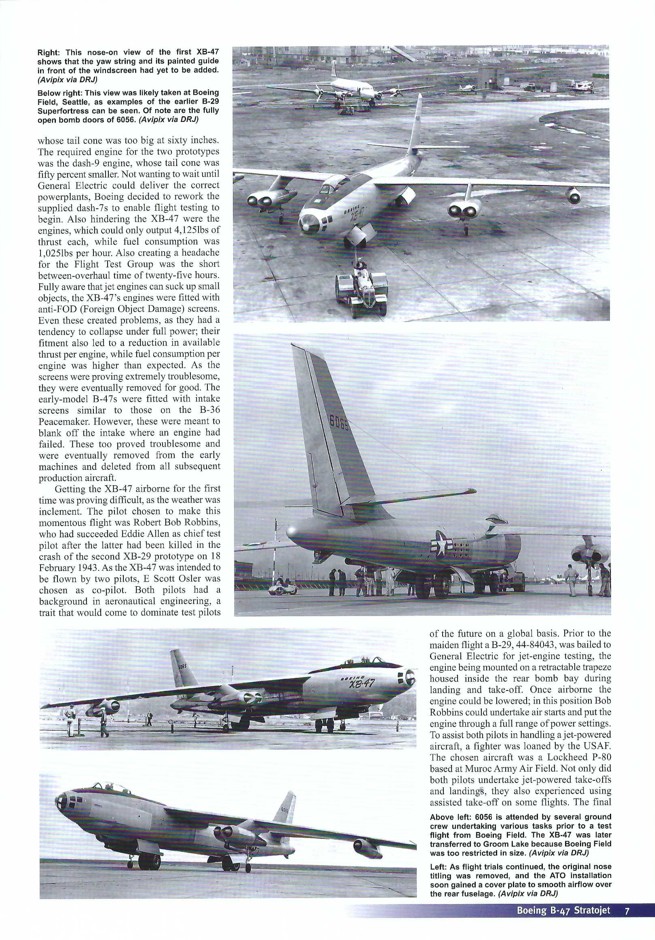
Ken Darling kicks off with Chapter One beginning in 1943 when the USAAF requested designs built around the Allison-General Electric TG-180 turbojet [Soon to be the J35]. Development work on what would become the B-47 under Project MX-584 was initiated on January 31, 1945. Boeing was not the only company involved with prototypes being built by Curtiss-Wright [XA-43[, North American [XB-45], Convair [XB-46], Martin [XB-48]. North American won the honor of being America’s first jet bomber while Boeing was asked to go back to the drawing board. After many changes, the first XB-47 finally flew on December 17, 1947. The two XB-47 prototypes were close to production aircraft, missing only some operational equipment that would be added later in testing. Four black-and-white photographs are shown on Page 007 of the first prototype, XB-47, 46-065, powered by six Allison J-35-GE-7 turbojet engines. The second XB-47, 46-066, would be powered by General Electric J-47-GE-3 engines, which were later retrofitted to 46-065. Boeing XB-47, 46-065, while flying at 10,000’ over Moses Lake AFB performing a new autopilot system test, had the canopy locks fail causing the canopy and frame to open and slam back, hitting the test pilot, Edward Scott Osler, in the head, killing him. John Bernard Forasero, Jr. was able to remove Scott Osler’s body and turn off the autopilot, allowing test pilot James Archibald Fraser to move to the front pilot position, and guide the XB-47 back to the runway. Fraser was so upset about the incident that he stopped flying the B-47 test program.
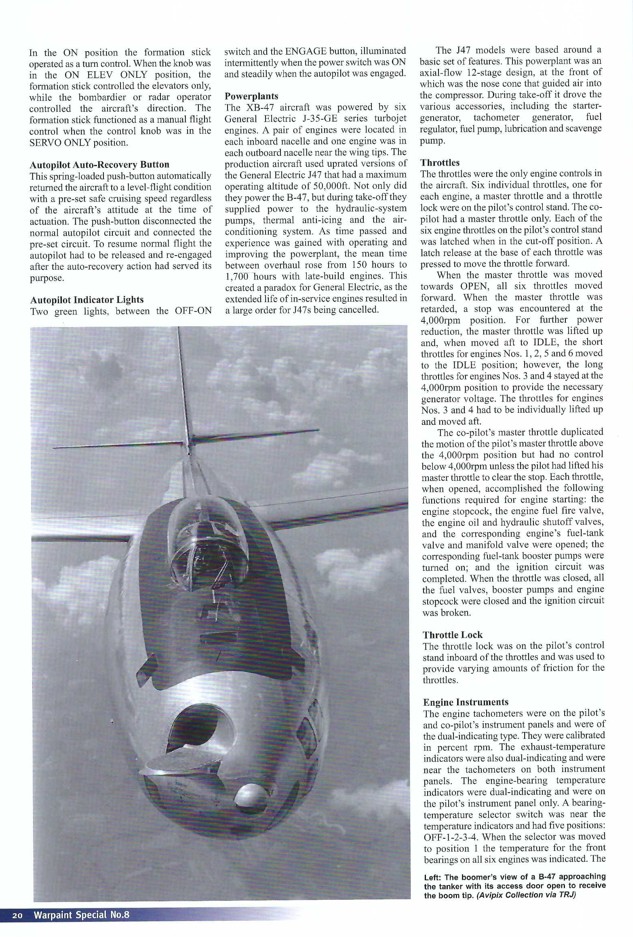
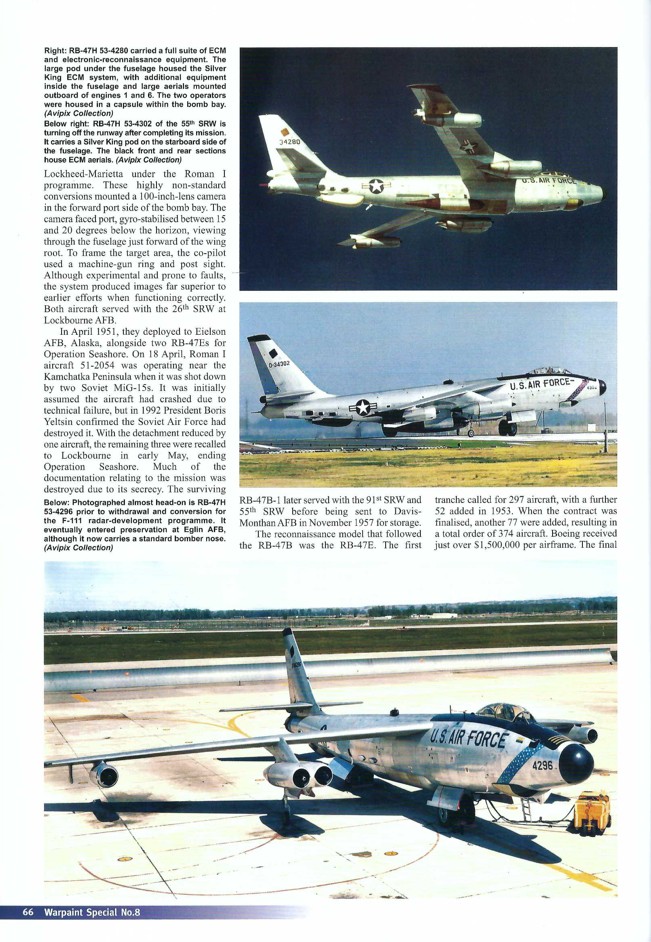
Chapter 4: Stratojet: Under the Skin covers the individual systems within the Boeing B-47. The thin laminar flow wing was a key feature and was able to flex upwards 45-inches and downwards 16-inches. Testing was performed that found the maximum flex was 17.5 feet at failure. Operational use found the normal downwards flex was 5-feet on the tarmac. Another feature was aerial refueling. The open refueling receptacle is shown at the bottom of Page 20 of an early Stratojet as noted by the nose windows. Three Boeing RB-47H aircraft can be spotted on Page 66 in Chapter 11, Birth of the Secret Squirrels. The top color photograph is RB-47H 53-4280 and shows off the Silver King ECM system. The large fuselage pod replaced the bomb bay and housed two ECM operators. She served with the 98th Strategic Aerospace Wing [SAW] and 55th Strategic Reconnaissance Wing [SRW] before going to MASDC on May 25, 1967. The middle color photograph is RB-47H 53-4302 with its Silver King ECM system moved to the starboard side of the fuselage. The two large black ventral sections house ECM aerial antennas. She served with the 55th SRW at Forbes AFB, Kansas. She was sent to MASDC on March 22. 1967 and was declared excess on June 7, 1969, and scrapped. The color photograph at the bottom of the page is RB-47H 54-4296 just prior to being converted to support the General Dynamics F-111 radar development program. She is now preserved at Eglin AFB, Florida, although she was converted back to her standard B-47E nose configuration. She entered service in 1956 and was assigned to the 55th SRW, flying several missions over Soviet airspace. She was the last USAF Stratojet in active service before being sent to MASDC on December 29, 1967. She was sent to North American in Inglewood, California, in 1968 for the F-111 program
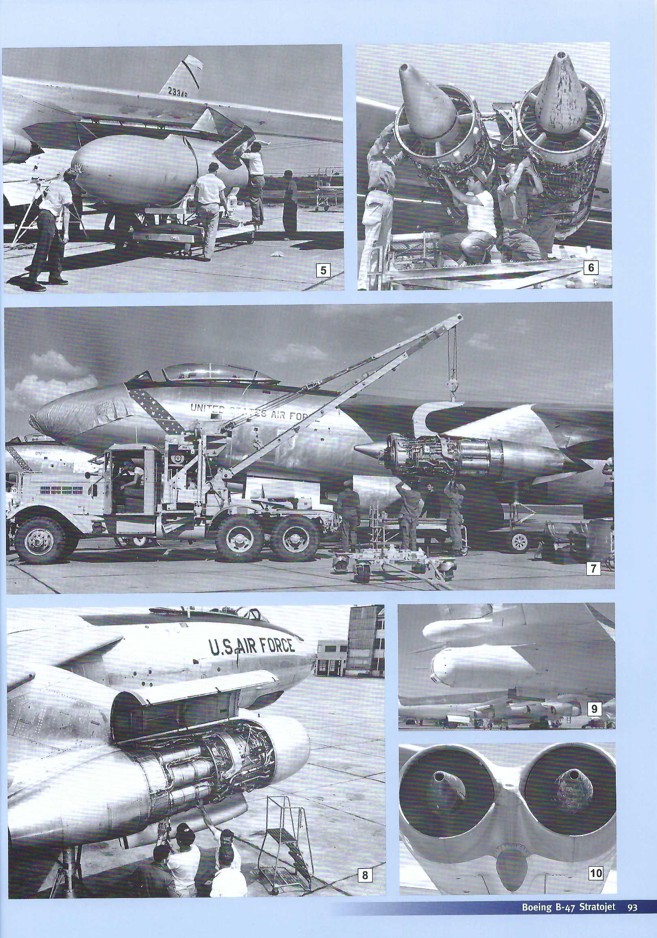
One of the standard features of Warpaint is the easily shown off the l In Detail section as seen on Page 93. Here you have three pages consisting of 15 black and white photographs. Six of these period photographs are displayed on Page 93. The upper left photograph is of the fitting of an external fuel tank to the outer wing of a B-47E. Engine maintenance was eased by the many access panels to the engines as shown in photographs 6, 7, and 8. Photograph nine shows that not all B-47s had their tail guns mounted, although it was apparently fairly simple to reinstall the two M24A1 20mm autocannons.
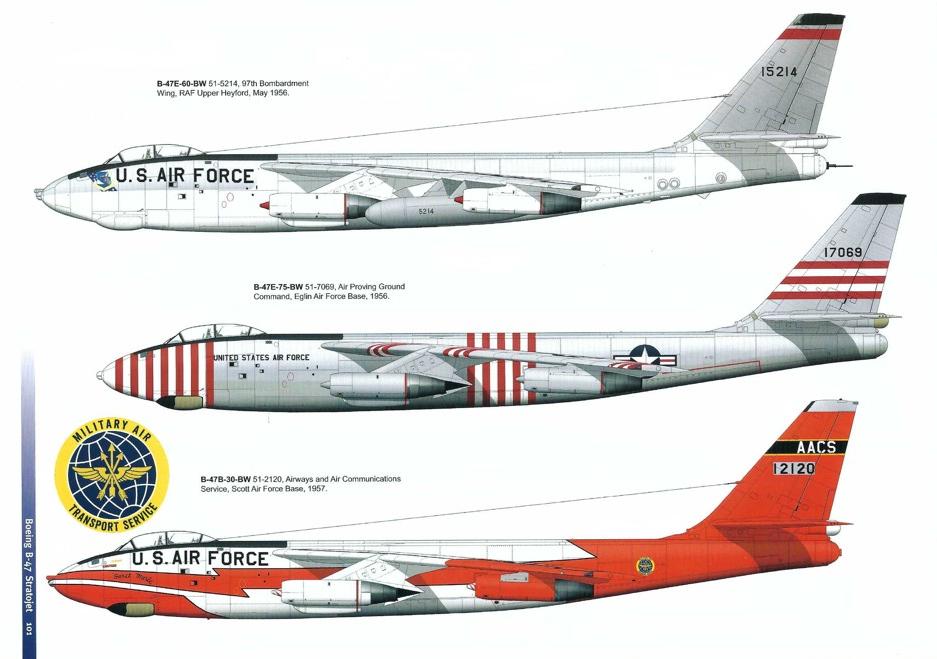
Three examples of the color side profiles by Sam Pearson can be viewed on Page 101. In this case, these are three variants of the B-47 Stratojet. The top color profile is of B-47E-60-BW, 51-5214, serving with the 97th Bombardment Wing at RAF Upper Heyford on a 60-day rotation in May 1956. She originally entered service with the 303rd Bomb Wing before being transferred to the 97th BW in 1956 at Biggs AFB, Texas. She was transferred to the 96th BW at Dyess AFB, Texas, in 1958 before being sent to MASDC on March 24, 1961. She was scrapped on April 19, 1961. The center profile with the bright red and white stripes is of B-47E-75-BW, 51-7069, based at Eglin Air Force Base in 1956, serving with Air Proving Ground Command. She was originally accepted by the USAF on June 23, 1953, with her first flight on September 24, 1953. Interestingly, it was used as a nuclear bomb toss test aircraft, which was hard on the wings. She was out of service on January 13, 1959. The lower color profile is of B-47B-30, 51-2120, at Scott Air Force Base in 1957, serving with MATS for Airways and Air Communications Service. Currently displayed at Whiteman AFB, Missouri, the home of the 509th Bomb Wing operating the B-2 Spirit. The Chapters include:
- Chapter 1: Boeing’s First Jet Bomber – Making the Dream Come True
- Chapter 2: XB-47: Design and Build [Page 007]
- Chapter 3: Testing the XB-47
- Chapter 4: Stratojet: Under the Skin
- Chapter 5: Production Begins and First Deliveries
- Boeing B-47 Stratojet Production [Table]
- Chapter 6: The Stratojet Enters Service
- Boeing RB-47B Stratojet
- MB-47
- DB-47B
- TB-47B
- WB-47B
- TB-56 / YB-47C
- Chapter 7: Strategic Air Command’s Spearhead: The Boeing B-47E Stratojet
- Chapter 8: Stratojet Mass Production Begins in Earnest
- Chapter 9: The Stratojet Finally Rises
- Chapter 10: The Stratojet Joins SAC at Last
- Chapter 11: Birth of the Secret Squirrels [Page 066]
- Chapter 12: Stratojet Trials and Tribulations
- Chapter 13: NAVAIDS For the Future
- Chapter 14: The Stratojet at NACA and NASA
- Chapter 15: Boeing B-47 Stratojet Operators
- Chapter 12: Stratojet Trials and Tribulations
- Boeing B-47 Stratojet In Detail [Page 093]
- Boeing B-47 Main Differences [Table]
- Boeing B-47 Technical Details [Table]
- Boeing B-47 Stratojet 1/192 Scale Drawings by Sam Pearson
- Colour Side Profiles by Sam Pearson [Page 101]
The Boeing B-47 Stratojet has been released in 1/48-scale as a vacuum-formed kit by ID Models and Sanger, but both are long out of production. JETMADS announced a 3D Resin kit in 2021, but it is not on their current list of projects. Hasegawa released a new tool 1/72-scale kit in 1968 as a B-47E and was many times over the years by AMT, FROG, Hales, and Minicraft, with the last release in 2024. Hobbycraft / Academy released a new tool B-47B in 1/144-scale in 1998, followed by a B-47E, RB-47H. The most recent release was in 2017. There are some older releases in ‘box scale’: 1/113, 1/180, 1/200, 1/205, 1/240 and 1/600-scales.
Ken Darling delivers a nice monograph on the Boeing B-47 Stratojet that I was able to read easily in four evenings. I found it interesting that the USAF continued to push turboprops, resulting in the two XB-47D Stratojets. The turboprops provided better fuel consumption, takeoff, and climb performance, but the cost was a lower top speed. There were many issues to work out with the turboprops, but ultimately the lack of funding finished off the concept. The text is well supplemented with very clear photographs with good captions. Sam Pearson provides well-executed color side profiles and the 1/192-line drawings. This is a great reference on the Boeing B-47 Stratojet and would be a handy addition to your reference library. If you are building any of these model kits, I would consider this edition essential as an aid to your build. If you own any of the previous releases in the Warpaint series, you know what you are getting. If this is your initial entry into this series, you will be quite pleased.
My thanks to Guideline Publications and IPMS/USA for the chance to review this great monograph.
Highly recommended!
Reviewer Bio
Frank Landrus

Frank retired from the Ophthalmic industry with over thirty-six years of Research and Development experience. Frank's first model kit was a 1959 Hawk 1/72 US Marines Vought AU-1 Corsair and has been building models for over sixty years. Frank's first encounter with IPMS was attending a North Central Texas ScaleFest show in 1984. Frank soon became more involved in Make-N-Take activities and became the IPMS Western Coordinator for Make-N-Takes [West of the Mississippi River]. Make-N-Takes quickly became a local model contest and airshow staple reaching a high of reaching over 1,300 children before the COVID shutdown. Frank has volunteered to assist in contest judging since 1985 and is currently the Nationals Head Figure Judge until he is dead or they find someone better.
Comments
Add new comment
This site is protected by reCAPTCHA and the Google Privacy Policy and Terms of Service apply.
Similar Reviews