
Flashes in the Dark Volume 2: USAF Nuclear Espionage in Argentina, 1960-1966
Helion is a UK-based company that produces books on many aspects of Military History from the Late Medieval period through to the present day. Helion was established in 1996 by University of Warwick graduate Duncan Rogers. Since then, they have published over 1,200 books, with 100 or more new titles coming out every year, for readers around the world. Casemate markets Helion books in the United States.
Gustavo Marón was born in Mendoza, Argentina, in 1971 into a family of Lebanese immigrants. In 1998, he graduated as a lawyer from the Law School of the National University of Cuyo, Argentina. Since then, he has worked as an advisor to various aeronautical associations, companies and organizations. In parallel, he teaches Aeronautical Law at various Argentine universities and other educational establishments in the country. To date, he has published more than two hundred aircraft investigations on different aspects of Argentine Civil Aviation. This is his third book published by Helion.
Helion’s latest volume in the Latin America @ War series is a square back soft cover that includes 76 glossy paper pages [excluding covers] in their standard portrait A4 [8.25” x 11.75”] format. This tome is the 53rd in this series and was released in Britain on April 23, 2026, and in the United States on May 29, 2026. I counted 113 black and white photographs. There are two color maps prepared by b.b.h.illustrations. Luca Canossa provides ten color aircraft side profiles and Tom Cooper chimes in with two aircraft side profiles.
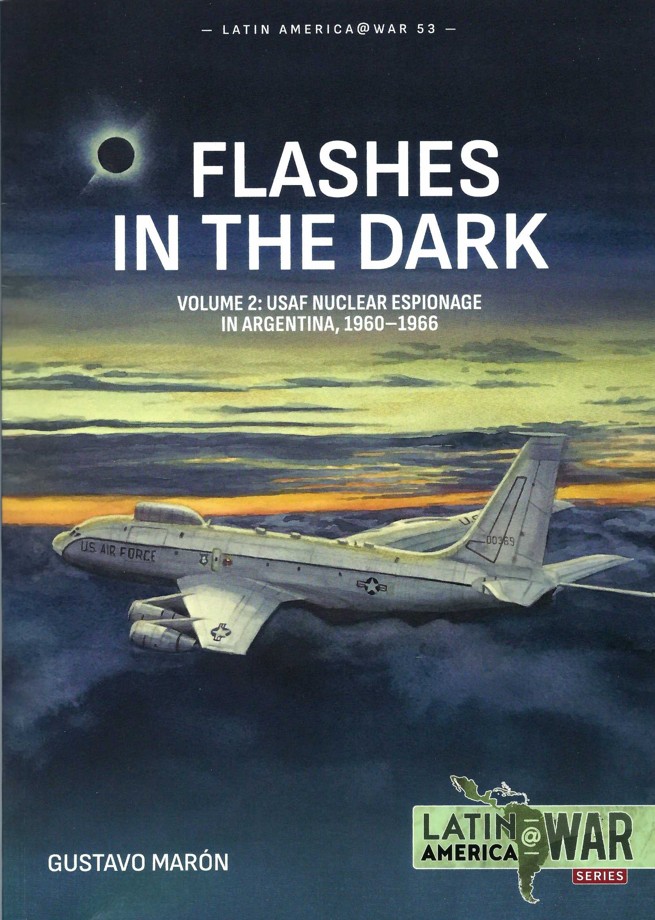
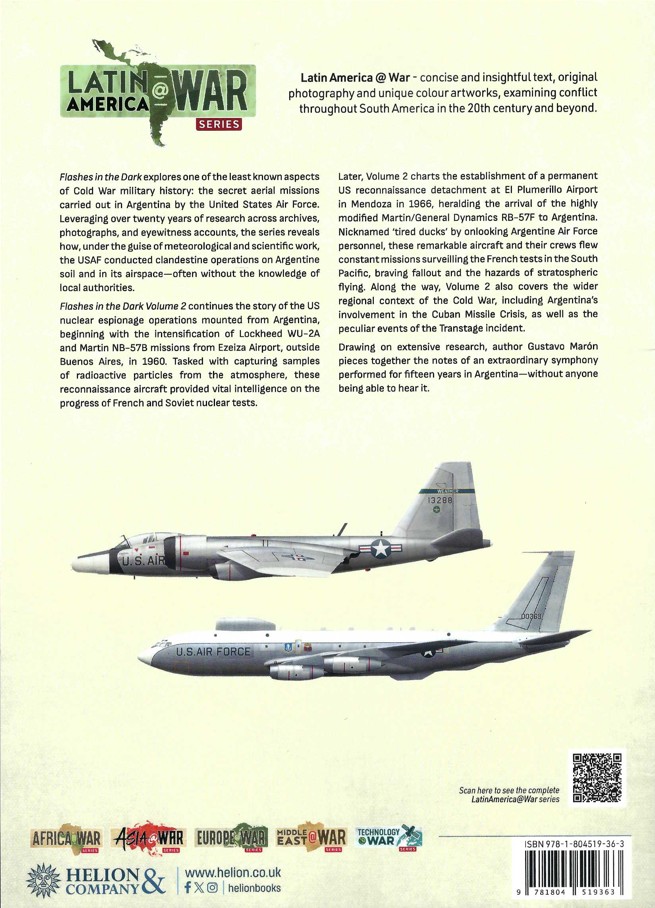
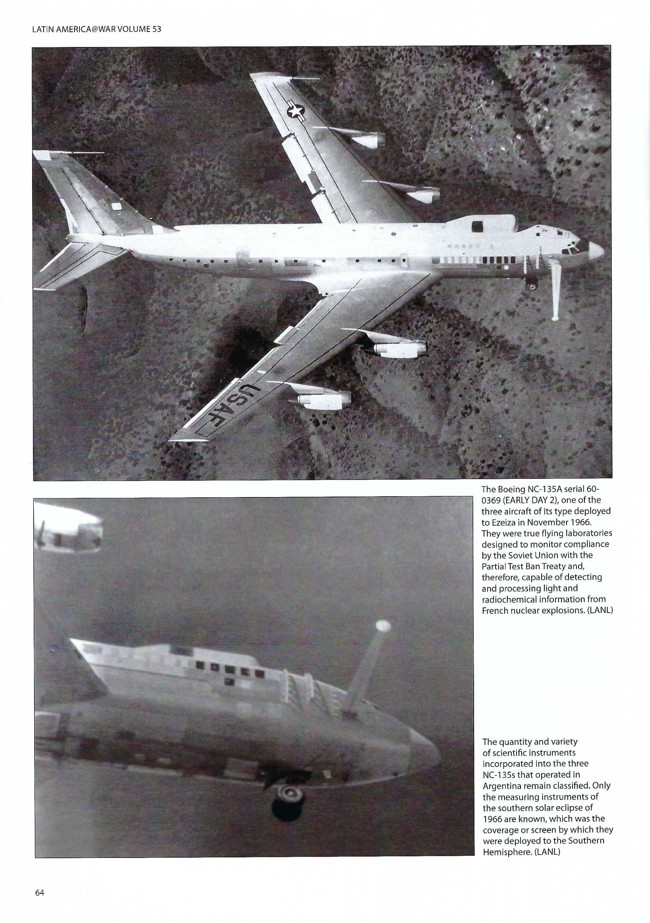
The front cover’s color painting of Boeing NC-135A [s/n 18144; 60-0369] by Renalto Dalmaso. Built as Boeing C-135A-BN [717-157], she achieved her first flight on June 23, 1961, and would go on to serve over 30 years. She was re-configured as a “Testbed” in June 1964 under Big Safari at the General Dynamics plant in Fort Worth, TX. She saw service from 1964 through 1976 as an airborne nuclear weapons monitor before going to the Chanute Technical Training Center as GNC-135A, a ground instructional airframe on June 9, 1976. When Chanute AFB was closed down in 1993, she was cut in half with the forward fuselage going to Wright Patterson AFB as a Fire Training Aid. Photographs of her right side can be spotted on Page 64 with some interesting antennas and windows. The rear cover color profiles are by Luca Canossa. The lower profile is of the front cover bird, NC-135A 60-0369. The upper profile is on RB-57F, 63-13288, as she served with the 57th Weather Reconnaissance Squadron [WRS] as part of Operation Quick Dip. Conversions were done by General Dynamics in Fort Worth, TX, from RB-57A, B-57B, and RB-57D airframes.
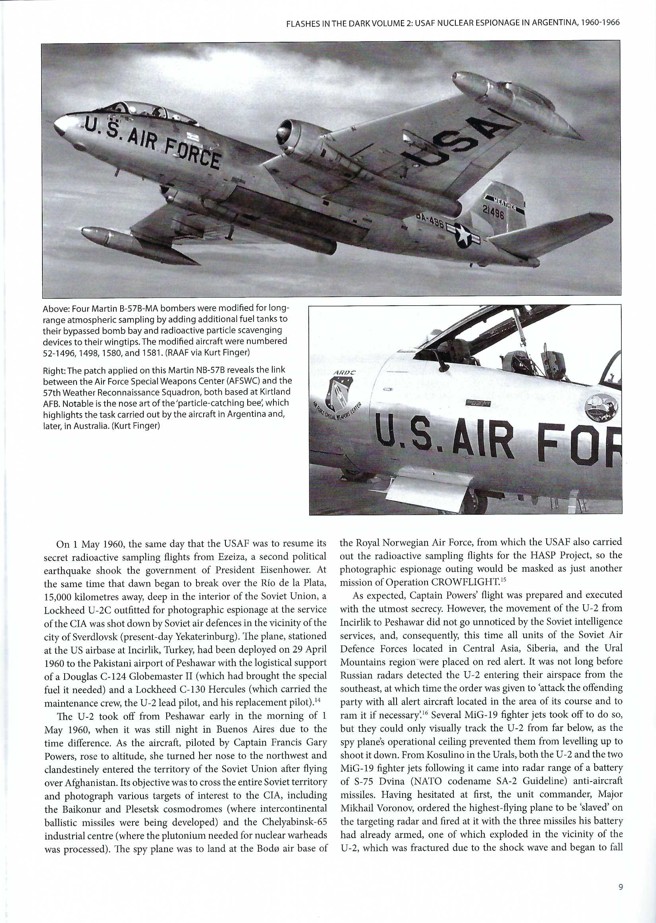
This second volume of Flashes in the Dark from Gustavo Marón starts off with seismic events that form the basis of the rest of the book. The first was the entry of France into the nuclear club followed by the Soviet shootdown of Gary Powers. President Eisenhower was able to re-establish the USAF presence in Argentina with a visit in February 1960. This led to four Martin NB-57B Canberras being based at Ezeiza. One of these is shown at the top of Page 09 NB-57B, 52-1496, displaying her radioactive particle scavenging devices at the wingtips and the additional fuel tanks in the bomb bays. She would later be transferred to Australia where she would crash on take-off at RAAF Laverton on September 17, 1962, with the loss of both crew members. The center photograph highlights the 57th Weather Reconnaissance Squadron’s badge displaying a ‘particle catching bee’. The chapter ends with the detonation of the Soviet Tsar Bomba that got the world’s attention with a 58 megatons explosion.
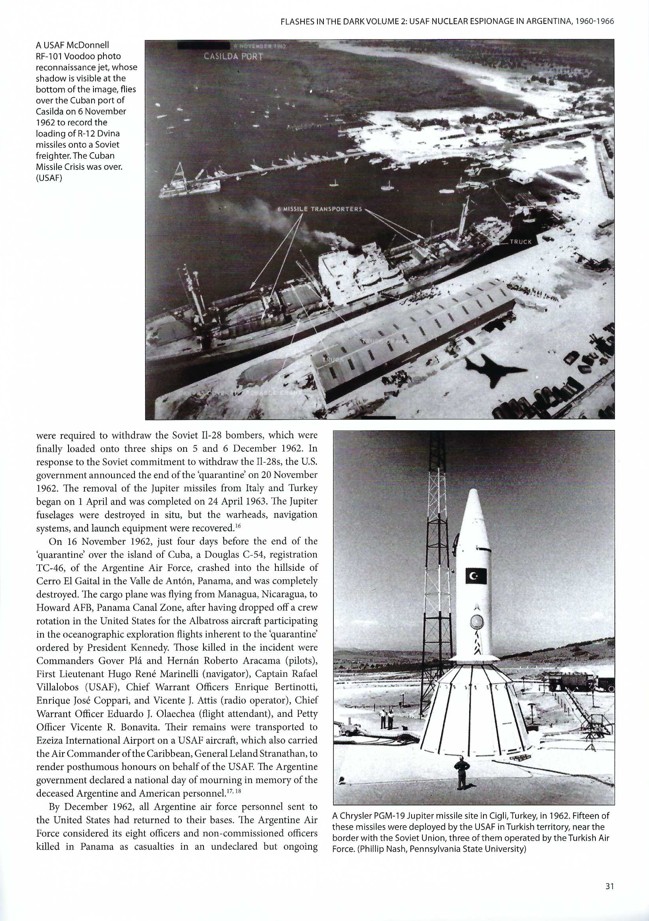
Chapter Two covers the implications of the Bay of Pigs fiasco followed by the Cuban Missile Crisis. The top of Page 31 shows a McDonnell RF-101 Voodoo overflying the Cuban port of Casilda on November 6, 1962, as R-12 Divina missile transporters are shown loaded onto a Soviet freighter. Casilda was a small natural port on the South side of Cuba serving the town of Trinidad. This medium range ballistic missile carried the NATO designation of SS-4 ‘Sandal’ with operational introduction in late 1958. Its standard payload would yield 2.3 megatons, but the R-12 could also deploy conventional explosives or chemical weapons. The photograph at the bottom of the page shows one of fifteen Chrysler PGM-19 Jupiter missile emplacements at Ciğli Air Base [aka Izmir Air Station], Turkey, in 1962. This was the USAF’s first nuclear armed medium-range ballistic missile deploying a 1.44-megaton W49 warhead. That being said, it was originally a US Army project, later joined by the US Navy, that the USAF did not want. The US Navy would leave the program to pursue the Polaris missile. In exchange for Russia’s removal of ballistic missiles from Cuba, all Jupiter missiles were removed from service by April 1963.
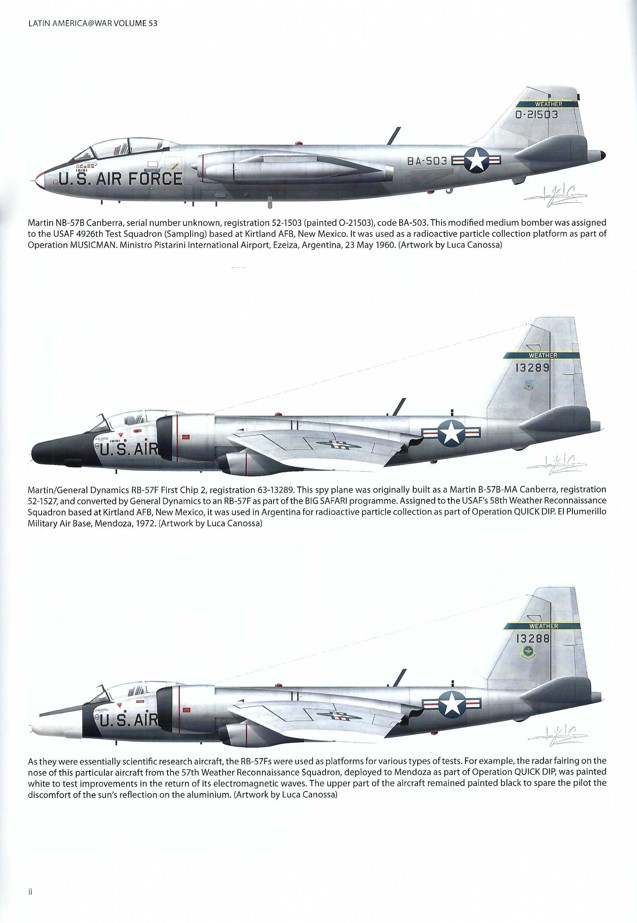
Three color side profiles by Luca Canossa can be found on Page 36ii. The top profile by Luca Canossa is of a Martin NB-57B Canberra, 52-1503, that participated in Operation MUSICMAN. She served with the 4926th Test Squadron [4925th Test Group] based at Kirtland AFB, New Mexico. The 4926th was created on April1, 1953 but re-designated as the 1211th Test Squadron on August 16, 1961, before being discontinued on June 8, 1963. Here, she is shown with radioactive sampling devices instead of fuel tanks on her wing tips on May 23, 1960, at Ministro Pistarini International Airport, Ezeiza, Argentina. She was later converted to an EB-57B and then to a WB-57B before crashing, killing the crew, on January 14, 1980, at Plattsburgh AFB, New York. The center profile represents RB-57F, 63-13289, serving with the 58th Weather Reconnaissance Squadron based at Kirtland AFB. RB-57F Canberras were nicknamed ‘tired ducks’ by Argentine Air Force personnel. Shown in 1972 when she was based at El Plumerillo Military Air Base, Mendoza, she was part of Operation QUICK DIP. Originally manufactured as B-57B-MA Canberra, 52-1527, she was one of 21 converted by General Dynamics to the RB-57F configuration as part of the BIG SAFARI program. She was transferred to Tolicha Peak, NV, in 1991 for use as a range target. The bottom profile displays RB-57F, 63-13288, serving with the 58th Weather Reconnaissance Squadron stationed at Kirtland AFB. Like the center profile she was based at El Plumerillo Military Air Base, Mendoza, and was part of Operation QUICK DIP. Note the wing mounted Pratt & Whitney J60-P-6 auxiliary turbines.
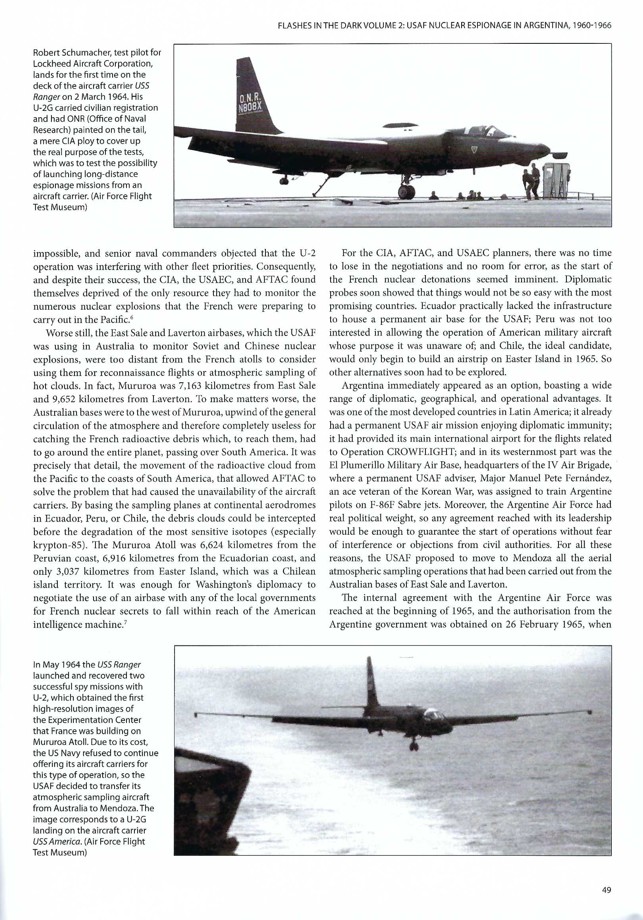
Monitoring French nuclear explosions in the Pacific and the difficulty in securing airbases led to Project Whale Tale. Two photographs of the U-2G are shown on Page 49 under Project Whale Tale. The top photograph is Bob Schumacher landing on the USS Ranger in N808X on March 2, 1964. Two U-2A Dragon Ladies [Articles 348 and 362] were modified to U-2G configuration with landing gear strengthened to cope with carrier landings, an arrestor hook was added, and lift dump spoilers were installed. The only operational use was on May 19, 1964, and May 23, 1964. where the U-2G was launched off of USS Ranger [CVA-61] to cover the Moruroa Atoll nuclear tests under Operation Fish Hawk. Article 348 [56-6681] was later modified to U-2C configuration, then to NASA N708NA, and is currently on display at Ames Research Center in U-2C configuration. Article 362 [56-6695] was later shot down by a SA-2 near Fujian, China, on July 7, 1964, killing ROCAF pilot, Lt. Col. Nan-Ping “Terry” Lee. The sections include:
- Abbreviations and Acronyms
- Introduction
- 1 Six Earthquakes for Two Presidents (1960-1961) [Page 09]
- 2 Cuban Missile Crisis: Argentina on the Frontline (1962-1963) [Page 31]
- 3 Transtage (1964-1965)
- Color Illustrations [Page 36ii]
- 4 Australians Asked Too Much (1965-1966) [Page 49 and 64]
- Endnotes
- About the Author
It was a pleasure to read this book as I finished it over three evenings. I found several fascinating topics, several of which are summarized above. Marón’s take on the Cuban Missile Crisis was revealing with a different perspective than what I was taught in university. Gustavo Marón delivers an interesting background on the US Cold War nuclear strategy that the USAF pursued from Argentina. I am looking forward to the release of Flashes in the Dark Volume 3 in this series. This third volume will analyze the USAF Nuclear Espionage in Argentina from 1967 to 1974 and is scheduled for release in late July 2026. If you own one of the previous releases in the Latin America @ War series, you know what you are getting. If this is your initial entry into this series, you will be quite pleased.
My thanks to Helion & Company, Casemate Publishing, and IPMS/USA for the chance to review this great book.
Highly recommended!
Reviewer Bio
Frank Landrus

Frank retired from the Ophthalmic industry with over thirty-six years of Research and Development experience. Frank's first model kit was a 1959 Hawk 1/72 US Marines Vought AU-1 Corsair and has been building models for over sixty years. Frank's first encounter with IPMS was attending a North Central Texas ScaleFest show in 1984. Frank soon became more involved in Make-N-Take activities and became the IPMS Western Coordinator for Make-N-Takes [West of the Mississippi River]. Make-N-Takes quickly became a local model contest and airshow staple reaching a high of reaching over 1,300 children before the COVID shutdown. Frank has volunteered to assist in contest judging since 1985 and is currently the Nationals Head Figure Judge until he is dead or they find someone better.
Comments
Add new comment
This site is protected by reCAPTCHA and the Google Privacy Policy and Terms of Service apply.
Similar Reviews