
Cross & Cockade International Spring 2026 Vol 57/1
The non-profit UK based group known as the Great War Aviation Society publishes their journal, Cross & Cockade International, four times a year. Issues are available in English as printed [Softbound, A4 (8.27” x 11.69”), 80 pages plus centerfold] as well as digital copies (or both). A new magazine, Contact!, is now available in both print and digital download. The Society also provides a free newsletter (sign up on their website) and occasionally publish WWI themed books like the Sopwith Dolphin monograph I reviewed earlier for IPMS USA. This Journal is the sister of the US Journal, Over The Front. The Great War Aviation Society also hosts a lecture series available through Zoom. If interested, you will need to register early as the call is limited in attendance. The Great War Aviation Society also is on Facebook and on X [Twitter].
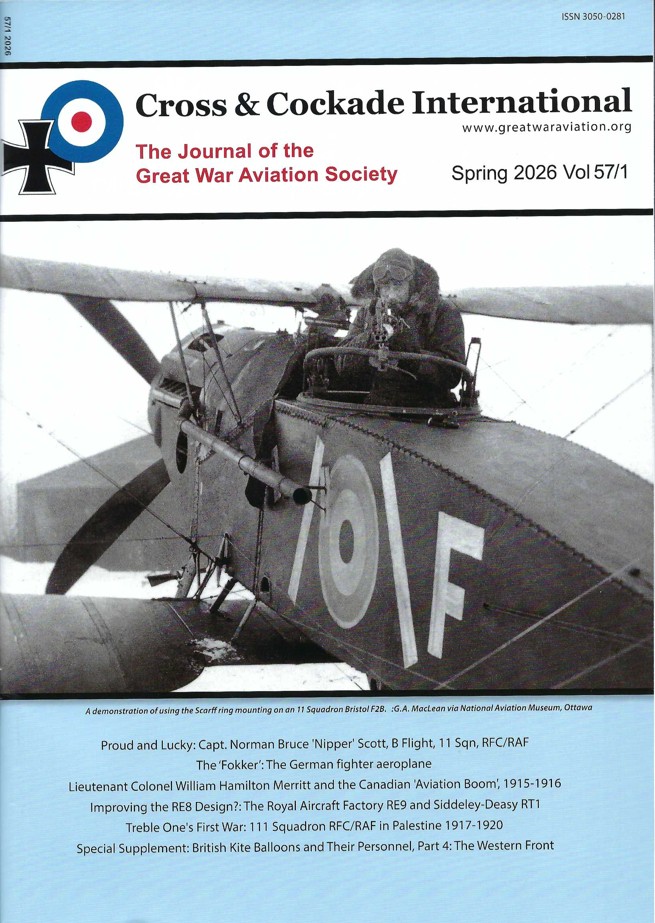
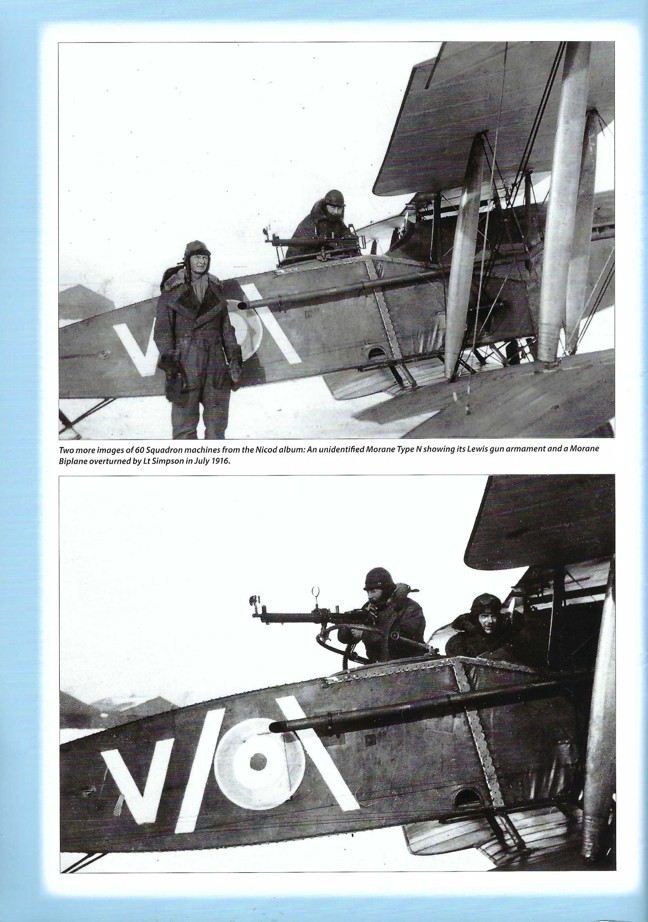
The Spring 2026 journal of Cross & Cockade International features a black and white photograph of a Bristol F.2B focused on the Scariff ring. The Scariff Ring was developed by Warrant Officer F.W. Scariff and incorporated a bungee cord to offset the weight of the Lewis gun. This .303 Lewis gun is pointed straight at the photographer of this 11 Squadron Brisfit. This ties in with the lead-off article on Captain Norman Brudce ‘Nipper’ Scott. The rear cover shows off two more photographs of a Brisfit from January 1918 of a Lewis gun mounted on a Scariff ring [although the caption claims it is a Morane Biplane of 60 Squadron, its evident the caption for the inside rear cover and the outer rear cover got swapped]. The pull-out center section presents Part 2 of a new series on British Balloons and Their Personnel by Trevor Henshaw. There are no photographs but there is a daily operations recap from June 23, 1917, to March 16, 1918, covering eight pages.
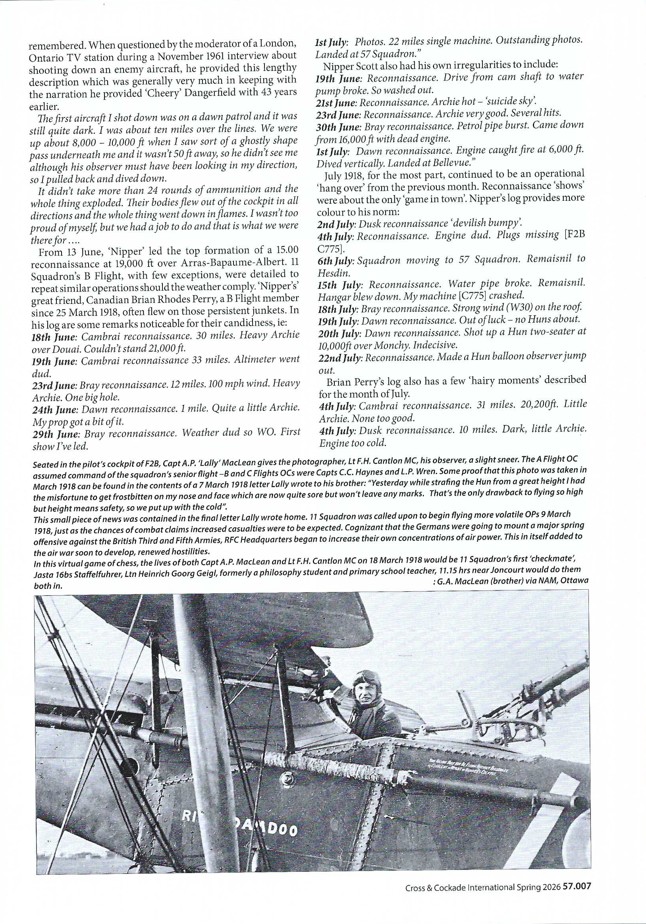
The late Stewart K. Taylor leads off with a biography of Canadian pilot, Capt. Norman Bruce ‘Nipper’ Scott. This is a 22-page feature that includes thirty-eight period black and white photographs. Scott would end up spending some eight months on the front line in France flying the Bristol Fighter. Scott would return to Canada with the rank of Flight Commander. Scott would get married in 1935 to the love of his life, Leslie. He tried to enlist as a pilot in WWII but was found to be color blind. As is often the case, Taylor includes shorter biographies of others that served with Captain Scott. One of these features 11 Squadron Capt. A.P. “Lally” MacLean and can be seen on Page 57.007. Taken in March 1918 by his observer, Lt F.H. Cantlon, sadly both would be shot down by Bavarian Ltn Heinrich Georg Geigl of Royal Bavarian Jasta 16bs near Jancourt. Ltn Geigl would die at the age of 26 in a midair crash with a Sopwith Camel for his 13th victory on April 4, 1918.
Philip Jarrett follows with a translation of Lt Jean Hugla’s 1916 article on The ‘Fokker’: The German Fighter Aeroplane.
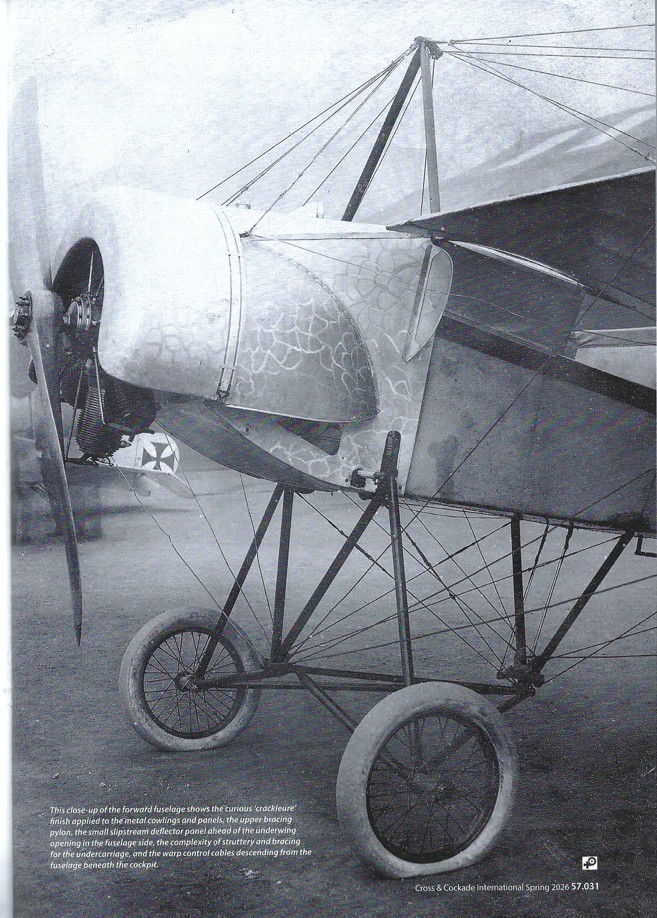
This seven-page tale has eight black and white photographs along with three black and white drawings. It’s apparent that Hugla was confusing the unarmed Fokker A.I two seat observation aircraft with the Fokker ‘Scourge’ single seat fighters. While both were similar in design, the A,I was a bit longer and had a wider wingspan, with a corresponding increase in wing area. A Fokker A.I that was on display in November 1915 at a Horse Guards Parade can be spotted on Page 57.031. Notable is the ‘crackleure’ finish applied to the metal cowling and the small wind deflector mounted in front of the cockpit opening under the wing mount.
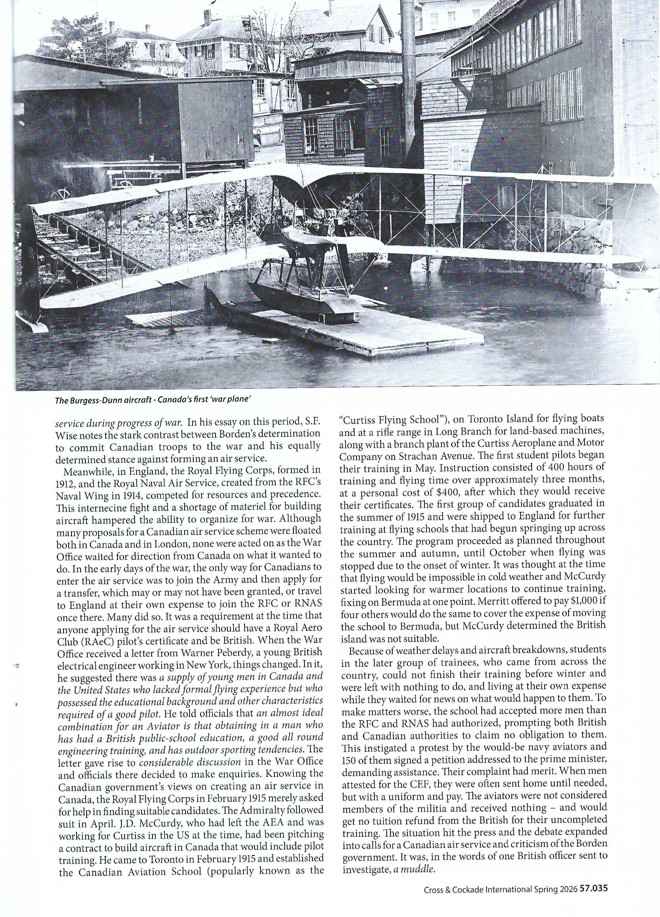
David Fuller is up next with Lieutenant Colonel William Hamilton Merritt and the Canadian ‘Aviation Boom’ 1915-1916. This ten-page feature has twenty black and white photographs. Merritt served in the Canadian military for 21 years and was an advocate on the need for compulsory military service in Canada. A visit to Switzerland in 1905 reinforced his ideals on military preparation, which led to the foundation of the Canadian Defense League. An additional visit to Switzerland in 1914 at the age of 59, provided an eyeful of the Swiss fundraising that would create the Swiss Air Force. The Canadian Aviation Corps was created on September 16, 1914, and consisted of the solitary re-conditioned two seat Burgess Dunne AH-10 that was purchased from the US Navy. This seaplane, as shown on Page 57.035, was built under license in America was flown to Quebec City as the Canadian First Contingent was forming. It would later be shipped to England where it was used by the First Canadian Contingent. Unfortunately, once reassembled in England, Canada’s first military plane was found to have been damaged in shipping never fly again and slowly rotted in the elements of the Salisbury Plain. It would be the first and last Canadian Aviation Corps aircraft. Merritt would found the Aero Club of Canada in 1916 but would succumb to the flu in 1918 before victory was secured in WWI.
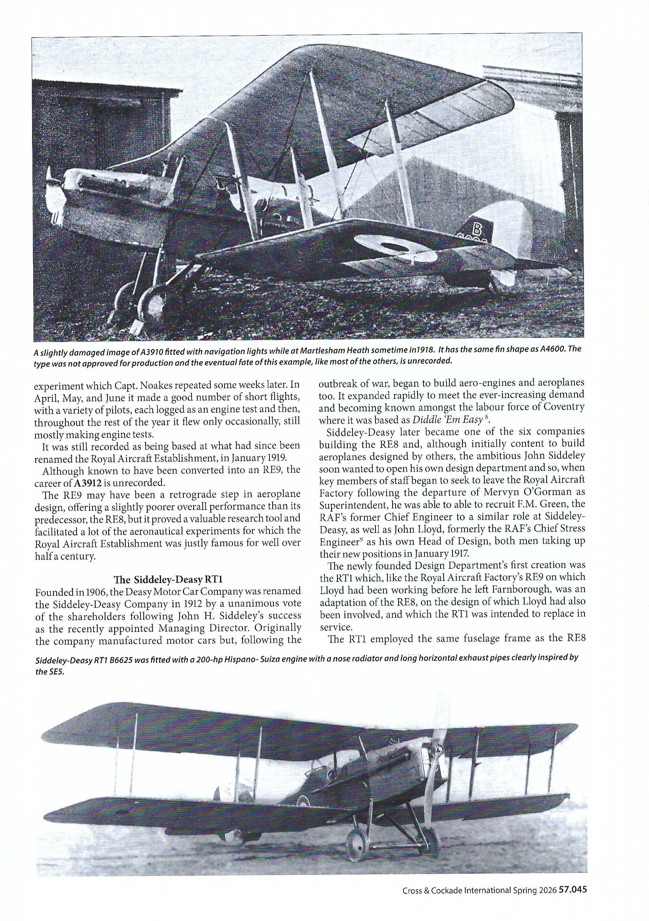
Paul Hare’s contribution is Improving the RE8 Design? This six-page article includes eighteen black and white photographs. Both the RE9 and the RT1 were modifications of the basic RE8 design, primarily by replacing the single-bay RE8 wings with the double-bay wings of the BE2d. The top of Page 57.045 shows off RE9, A3910, which achieved its first flight on October 14, 1917. Eight RE8s would eventually be converted to RE9s, but the expected increase in speed and climb was not achieved. All eight continued their service, becoming test machines with different engines and other minor changes. Siddeley-Deasy was one of the six RE8 manufacturers and the RT1 was an attempt at the next generation RE8. As with the RE9, essentially the RT1 replaced the RE8 wings with BE2d double-bay wings, plus a few additional modifications. Six RE8s were converted to the RT1 standard, and while top speed and climb rate was improved, it was not judged sufficient to mess with RE8 production. A Siddeley-Deasy RT1 can be spotted at the bottom of Page 57.045, fitted with a 200 hp Hispano-Suiza engine.
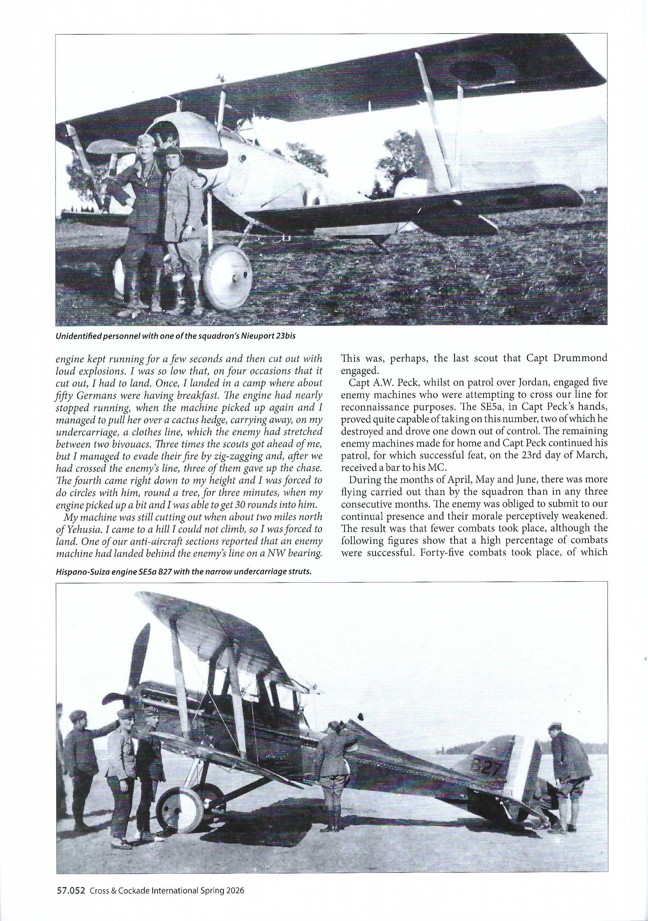
111 Squadron provides a direct transcript historical entry with Treble One’s First War: 111 Squadron RFC RAF in Palestine 1917-1920. This is an eighteen-page feature with thirty-four black and white photographs. Nicknamed ‘Treble One’, 111 Squadron was formed on August 1, 1917. at Deir el-Balah in the center of the Gaza strip and remained until it was renumbered as 14 Squadron in 1920. Deir el-Balah originally was an Egyptian Empire outpost during the reign if King Ramesses II [1303-1213 BC] and has remained a center of conflict since. The top of Page 57.052 depicts one of the ten 111 Squadron Nieuport 23bis aircraft. SE5a, 827, is shown at the bottom of the page sporting a Hispano-Suiza engine, with the narrow undercarriage struts. 827 served from December 21, 1917, to April 13, 1918. Eighteen black and white photographs populate From The Albums for four pages. An additional two photographs are included on the inside rear cover. These pictures are Part 3 from the Nicod Album via Alex Revell and feature personnel and a few aircraft. The Bookshelf section is a review of WWI aviation-specific books and magazines with this issue totaling eleven.
Topics:
- Editorial by Mick Davis
- Proud and Lucky: Capt. Norman Bruce ‘Nipper’ Scott by Stewart K. Taylor [Page 57.007]
- The ‘Fokker’: The German Fighter Aeroplane by Lt Jean Hugla, translated by Philip Jarrett [Page 57.031]
- Lieutenant Colonel William Hamilton Merritt and the Canadian ‘Aviation Boom’ 1915-1916 by David Fuller [Page 57.035]
- Improving the RE8 Design? by Paul Hare [Page 57.045]
- Treble One’s First War: 111 Squadron RFC RAF in Palestine 1917-1920 by 111 Squadron [Page 57.052]
- From The Albums: The Nicod Album via Alex Revell; Part 3
- Bookshelf – Edited by Paul R. Hare
This is another fantastic issue from The Great War Aviation Society, and I am always impressed with the quality of the articles, both from a research perspective and readability. I continue to enjoy the aircrew biographies along with the features on specific aircraft, as in this issue with the articles covering the Fokker A.I, RE9, and RT1. The period pictures, maps, and drawings in this journal come off looking great thanks to their printing on the journal's glossy paper. If you are into early / WWI aviation, this journal is an incredible source of information that will have you on the edge of your seat waiting for the next issue.
My thanks to The Great War Aviation Society and IPMS/USA for the chance to review this great issue.
Highly recommended!
Reviewer Bio
Frank Landrus

Frank retired from the Ophthalmic industry with over thirty-six years of Research and Development experience. Frank's first model kit was a 1959 Hawk 1/72 US Marines Vought AU-1 Corsair and has been building models for over sixty years. Frank's first encounter with IPMS was attending a North Central Texas ScaleFest show in 1984. Frank soon became more involved in Make-N-Take activities and became the IPMS Western Coordinator for Make-N-Takes [West of the Mississippi River]. Make-N-Takes quickly became a local model contest and airshow staple reaching a high of reaching over 1,300 children before the COVID shutdown. Frank has volunteered to assist in contest judging since 1985 and is currently the Nationals Head Figure Judge until he is dead or they find someone better.
Comments
Add new comment
This site is protected by reCAPTCHA and the Google Privacy Policy and Terms of Service apply.
Similar Reviews