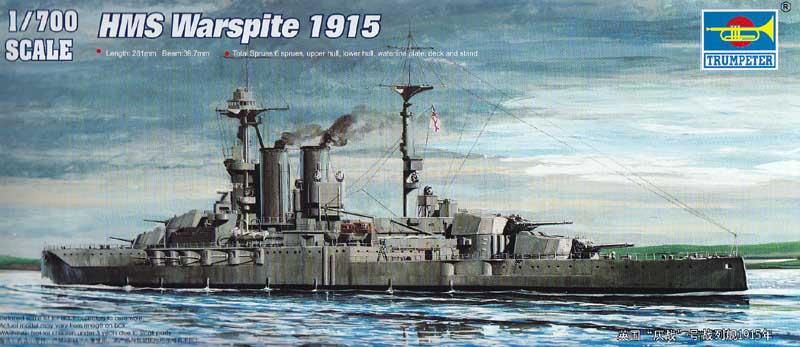
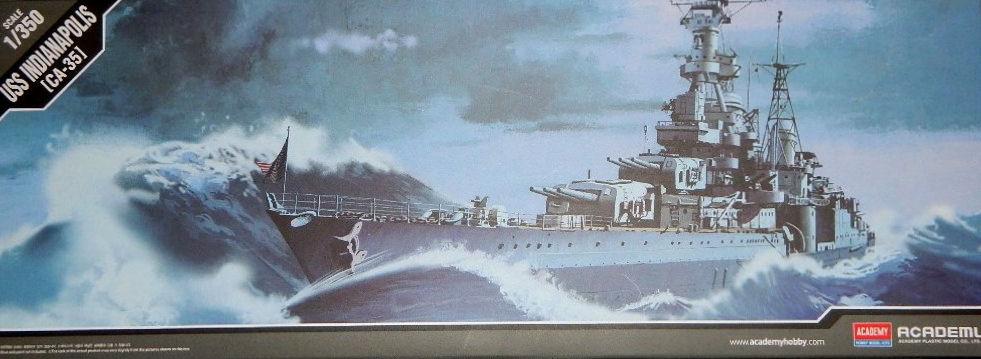
The HMS Warspite was one of the Queen Elizabeth class dreadnaughts launched during the First World War. These were the state of the art battleships of the time and the general soundness of their design shows in the fact that the last of them was not disposed of until the 1950's! They went through many refits that changed their appearance quite a bit over the years. The WWII Warspite has been modeled several times in several scales, most recently in the newly popular 1/350, but never in her WWI fit. The Trumpeter kit is of her appearance when she was launched, thus she joins a very small group of injection kits of WWI ships and I believe the only one as she was during that war. As I build ship models very slowly, this will be a two-part review. This first will be an in the box review and the second will be an actual build. Now, let's open the box and see what we have.
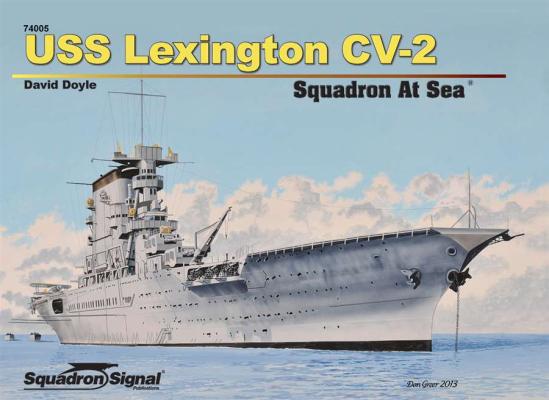
USS Lexington (CV-2) and her sister USS Saratoga (CV-3) played a critical role in the development of the modern naval aviation and the way the US Navy wields air power. Built on the hulls of battlecruisers cancelled in the 1920s under the terms of the Washington Naval Treaty, Lexington and Saratoga were far more different and innovative than the first US aircraft carrier, USS Langley CV-1, and any foreign contemporaries. They were the largest US carriers built until the Midway Class CVB. Both ships were quickly integrated into the battle fleet and participated in every major exercise in the 1930s and early 1940s. It was on these ships that the Navy envisioned, developed, and put in to practice the doctrine and procedures that would define an American way of Naval warfare and lead to victory at sea.
Being an avid fan of Imperial Japanese Navy (IJN) destroyers, I was eager to get my hands on this book. The Japanese had two major advantages on the US Navy during the early days of WWII: a superbly trained and equipped air arm and their excellently equipped and crewed destroyer flotillas that made themselves utterly terrifying weapons during engagements like the Battle of the Eastern Solomons. The first chapters of the book provide a good summary of Japanese doctrine and how it developed from the naval treaties and influenced design. The meat of the book specifically addresses the early post-WWI designs leading up to the legendary Fubuki-class destroyers and their successors up to the Shiratsuyu class. Finally, the author provides a summary, defining why these magnificent machines utterly failed to make a lasting impression on the results of the Pacific War.
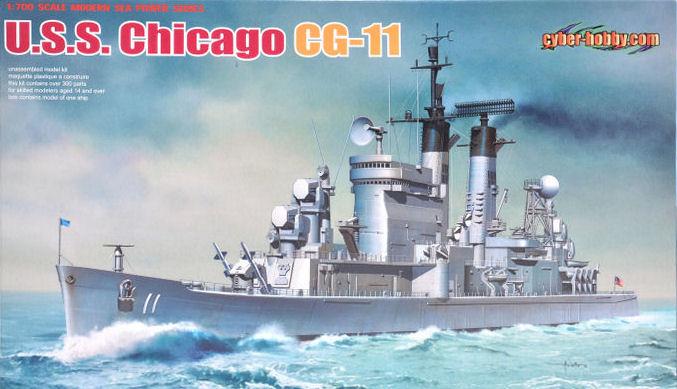
This is the second Cyber Hobby ship model that I have been privileged to build as a reviewer (the first being the USS Virginia), and I will say that this was just as enjoyable of a build, representing a cruiser that saw service over five decades. There were no real complications with the build itself, but know going in that there are several photo etch items to add, and there are many small parts in the kit. The most challenging part of building this kit for me was the decals that are applied on the deck. If you have a fondness for the USS Chicago, or want to build a Baltimore-class heavy cruiser, I would highly recommend this kit for you.
Once again, sincere to thanks Akiko at MRC for providing IPMS USA and this fortunate reviewer the opportunity to build and comment on a new kit… This was “a most excellent effort” and we appreciate it. (And thanks to Steve and Dick for sending the kit my way…hope I did it justice)
This was a kit that I did not expect to do a review on; I was going to spend the cash and just chill on the build until I could collect all the requisite PE sets and all that nonsense, and then have an AMS fit for about a month. “We can’t have no’ut that!” cried the elves…and when I threw my hat in the ring to review the kit, I was surprised. My criteria: if nobody else volunteered to do it, I would. Now, I know ships take a lot more time than a snap kit. But the USS Indy? Whoa! A famous cruiser worthy of the effort.
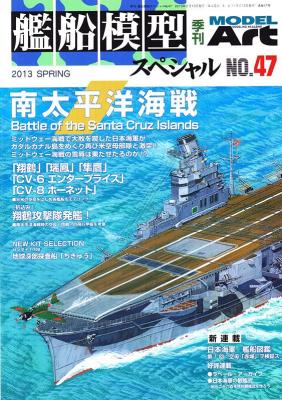
This is Model Art Magazine’s special quarterly issue that focuses on naval subjects. As with the regular Model Art Magazine, this is printed in Japanese with some English subtitles.
This special ship model edition focuses on the “Battle of the Santa Cruz Islands” and the naval vessels involved from both the U.S. Navy and the IJN.
The issue starts off with a two-page article about IJN anchor chain, clevises, and other fittings found on these vessels. The next eighty three pages are dedicated to the “Battle of the Vera Cruz Islands”. Within this article, they use photos of models, period photographs, line drawings, and color artwork for their illustrations.
Following this is a section called “Only Ships – New Items”. They devote several pages to this with a multitude of black and white photos showing all the new ship models and aftermarket that is coming out on the market.

This is Model Art Magazine’s Imperial Japanese Navy Warships Scalemodel Album. As with the regular Model Art Magazine, this is printed in Japanese with some English subtitles.
This special issue is chock-full of photographs of built scale models. It features ten magnificently built scale models. Some of them are a Yamato in 1/350th, Nagato in 1/350th, and Akagi in 1/350th, as a few examples. Each ship has several pages dedicated to it with a multitude of color photographs for each.
After the main gallery, there is a section devoted to some of the build notes of each model. These are highlighted with black and white photos of the models during their construction.
While the price may seem a little steep for a photo album of built models, if you have an interest in IJN subjects you would find this issue interesting.
I would like to thank Model Art and IPMS/USA for the opportunity to review this fine magazine.
- 16" - SM-700-033, $7.00 (9 barrels)
- 6" - SM-700-034, $5.00 (12 barrels)
- 4.7" - SM-700-035, $4.50 (16 barrels)
Master Models is a company in Poland that must employ elves, incredibly small tool and die makers, and/or people with exceptional eyesight. They make replacement gun barrels for aircraft and ship models out of brass, and some of these are incredibly small and all are exquisitely detailed. The subjects of this review were selected because they would enable a modeler to replace all the main weapon gun barrels on either a 1/700 HMS Nelson or Rodney. The 16" were only used on these ships, but the 6" and 4.7" could also be used on other Royal Navy ships with these weapons. For example, since 16 4.7" barrels come in a packet, you could replace all the main guns on up to 4 destroyers, depending on the class of the ships. Let me be clear, each caliber barrel packet is a separate item and is priced as such.
First off, I’d like to thank Osprey Publishing for offering this book up for review and to IPMS/USA for allowing me to do the review.
Many, many books have been written about the great warships of the two World Wars. The library shelves are full of stories about the great sailing ships as they traded and fought their way across the world’s oceans. However, not much has been written about the warships of the ancient world. That's simply because there's not much remaining in the way of artifacts to tell the story and very little remains of the written word of those times.
Adrian K. Wood, in his newly released book Warships of the Ancient World, tries to shed some light on this subject. He acknowledges the scarcity of verifiable resources and the confusion caused by sources that are thousands of years old. However, using what’s available, he makes an excellent case for the information he presents in his book.
Bottom Line
An ultimate and highly detailed modeler’s guide to building IJN Haruna in late 1944 fit. Targeted to 1/350 scale, but suitable for all other scales.
Kagero has produced over a dozen books on WW2 warships that use computer graphics in 3D to provide superb detail. This latest book on the Imperial Japanese Navy (IJN) battlecruiser/fast battleship Haruna is once again an ultimate resource for knowing what the ship looked like in late 1944. Other time periods are not depicted. This book is an ideal companion to 1/350 kits of the Haruna (Fujimi), but is also an ultimate guide to other scales.