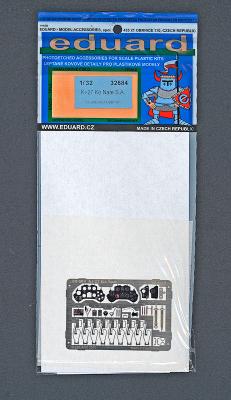
Since all the sets and decals mentioned below go to one aircraft model, I decided to combine all the reviews into one. Hopefully making it easier to follow. I will not review the Revell Ar 196A-3, but this has to be one of the nicest models I have ever built. The fit was very good with minimal putty required for the ever present (all model airplanes have it) nasty fuselage seam. Detail throughout is very nice but by adding the Eduard Photo Etch Sets greatly enhances an already outstanding model.
To briefly describe the aircraft, it was a single sweater pusher, bi-plane, powered by a 100 HP Gnome rotary engine. The lack of synchronizing mechanism made this necessary to have a forward firing machine gun allowing the pilot to "aim" with the aircraft and gun at the same time.
The kit is composed of 62 plastic parts, 36 photo-etched parts, a clear acetate sheet with a choice of two windscreens, depending on which version of the aircraft you choose to build; painting masks are also provided plus a decal sheet for four different aircraft. The detailing on the plastic parts is up to the usual superb Eduards standard.
Czech manufacturer Eduard continues expanding its “Brassin” line of detail parts for aircraft. This time they are offering the UB-16 and UB-32 rocket launcher which has seen widespread use in Soviet designed aircraft, like L-39, MiG-21/23/27, Su-7/17/20/22, and Yak-28/38.
The detail kit includes 10 resin parts (casted in two different resin colors) and a small PE fret with another 6 parts. Resin parts are nicely detailed with great surface detail and very cleanly casted, with small pour stabs. Photoetch parts are exquisitely thin and very easy to work with.
It took me a total of 30 minutes to get all four rocket launcher assembled. The assembly is simple and straightforward but releasing the parts R3 and R4 (rocket launcher back cones) from their pour stabs requires some dexterity and a very thin razor or saw. Those parts are most fragile parts of the whole detail set.
The Aircraft
The P-51 was the ultimate propeller driven fighter for the US in World War II. Fast, maneuverable, excellent range, plenty of punch, good load carrying ability, and it could be used for any mission the higher ups thought of. While it was superseded by jets, the P-51D was used for tactical bombing in Korea, and some air forces didn’t retire their Mustangs until the 1980s. There was much excitement in the Warbird community when the Dominican Republic decided to sell their P-51Ds in 1984.
The Kit
I thought I had built this kit before, but I was wrong. The older Minicraft/Hasegawa P-51 has raised panel lines; this one has recessed panel lines. It’s a new mold. This kit is issued with new markings for 44-64076, “Jumpin’ Jacques” of the 3rdFG and 44-14606 “Jan” of the 4thFG. There are 4 gray sprues and one clear. Everything is flash-free and clean.
Quickboost once again has come up with an unexpected resin aftermarket part that will add detail to a kit that most of us have in our stash. QB 48 357 provides three ready to install F4U-1 Corsair pitot tubes cast in a flexible resin that likely will survive the occasional bumps sometime experienced when a finished model is handled. The pitot tubes are molded on a casting block with extended bars that protect the parts from damage in the package. They exhibit a much better pointed tip than the kit part. A sharp #11 x-Acto blade is the only tool needed to remove each pitot tube from the casting block and to shave off a thin casting gate that is molded on the side of the part to protect the tip detail.
This part is a direct replacement for the kit part and, because it is resin, should be attached with super glue or epoxy cement.
Czech manufacturer Eduard has a great reputation for its aftermarket instrument panel and now it provides the modeler with the ultimate instrument panel: the ¼ scale Bf 110 instrument panel.
This kit was first available as a bonus for the Bf 110 Royal Class edition and now it is been released as a ‘stand-alone’ kit in a Limited Edition format. You get a whole instrument panel, a sprue full of bezels and levers, two sprues of clear parts, two fret of pre-painted PE and a set of vinyl instrument faces.
Plastic parts are molded in very accurate colors. Still I’ve decided to paint the instrument bezels in black and the back of the instrument panel in RLM 66.
I was somewhat familiar with the two opponents in this duel, having built the 1/72 Monogram F-105G a while back, and I’ve got the Gran kit of the SA-2 in the “to build some day” stash. I also have a copy of a video produced by the Air Force which features the development of the F-100 Wild Weasel mission, with interviews with the participants.
The Suppression of Enemy Air Defenses (SEAD) is a cat-and-mouse game. The aircraft tries to get the ground radars to come up so they can fire anti-radiation missiles. The ground systems try to get the aircraft to come in range of the missiles and anti-aircraft guns which surround the SAM site.
As I read this book, the question raised was, “exactly which player is the cat and which the mouse?” And what’s that ferret doing in there?
The book is divided into eight main sections, each covering the F-105 and then the SA-2.
Thanks to Jake of Reid Air Publications and to IPMS USA for giving me the opportunity to review this astonishing book.
I do not use the term astonishing lightly. I have quite a few built-up F-18A and later models in my collection, dating back to a highly modified and corrected Testors F-18 in 72-scale, ca. 1982. I swore at the Italeri kit, released and built about 9 or so years ago in 48-scale. I started research on an EA-18G recently. Every single question, concern, and nagging detail consideration on any Super Hornet kit I’ve wrestled with is answered by this book. A modeler in research mode will find answers less in the chapter text, but more in a very thoroughly documented or captioned series of photographs, often referencing back to page numbers in the text. Reproductions of some tech data are included, for example, weapons and stores loadout charts.
The Story
Thanks once again to Aires for providing IPMS/USA the opportunity to review yet one more of their excellent cockpit sets.
Included are 10 resin parts for the cockpit tub, seat, instrument panel, and a control stick; there are also a couple smaller resin parts to represent the whiskey compass on the forward canopy framing. A photoetch fret is included to provide realistic seat harness components, including buckles, etc.