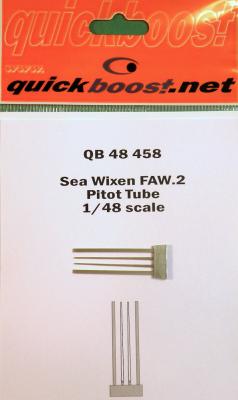
From Master Model comes an excellent and quick detail set for the Tamiya or Dragon He-162. Included in the set are two brass barrel ends for the MG151 guns, a replacement pitot tube, and a landing gear indicator.
This Special Edition kit of Academy's B-17G comes in a large [12” x 18” x 2-½”] heavy cardboard box – this helps when storing a large stack of kits (but who has a stack of kits? Certainly not me). Inside, you’ll find a crisply-molded kit with finely recessed panel lines, along with several extra parts which aren’t needed since they’re used on the B-17C and D series.
Besides the early model stabilizers, there are 2 types of props, cowls, top turrets, and nose glass – though not an E model one – and both a Cheyenne and stinger tail gun position.
This special edition has been issued in honor of the 15th Air Force and comes with decals for 5 aircraft: Betty Lou, KWITURBITCHIN VI, Miss Prissy, Sleepy Time Gal, and hell’s angel, all of which are natural metal airplanes. The kit comes with 500 lb bombs and has a detailed bomb bay if you want to pose it with the doors open.
The AH-1 Cobra had various versions that used the M-197 20mm cannon: the Army AH-1E, AH-1F, and the Marine Corp AH-1J, AH-1T, and AH-1W. Until now, the kit offerings of this prominent armament feature have been poorly molded in plastic. Well, fret (no pun intended) no more – Master Model has your cannon.
You get three turned metal barrels and one end barrel nut. There is a fret that has the mid-barrel clamp and the rear barrel clamp. The barrels are perfectly formed and are literally miniature gun barrels. Heck, I wouldn’t be surprised if there are grooves in the barrels. This set is absolutely gorgeous. The hardest part of this set will be not to lose the end barrel nut. Everything about this set is perfect.
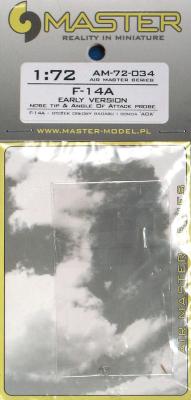
The early Phantoms had their pitot tube and ram air inlet mounted on the leading edge of the tails. It is hard not to break them off, especially when you are sanding the seam line, but now you don’t have to worry about it. Master Model provides you with three milled brass pieces: a pitot tube, a ram air inlet, and the angle of attack probe. Beautifully milled, they are flawless. You get three pieces of brass that require no cleanup. Adding them is as simple as drilling a .8mm and a 1.0mm hole and inserting the brass parts with super glue. The brass parts will provide you with plenty of strength and a realistic finish with no seam or mold lines to deal with.
Highly recommended.
Thanks to Master and IPMS/USA for the review copy and review space.
Master Model has entered the turned metal barrel scene with a flurry of excellent pitot tubes and gun barrels. Well, this latest release is no different.
As any of you who have built the F-4 Phantom know, you know that the pitot tubes on the nose and the tail ram air inlet are prone to breakage, particularly when you are handling the model. Well, now you don’t have to worry about that.
In the package you get three perfectly formed turned metal parts that include the pitot tube, ram air inlet, and angle of attack probe. These are all accurately shaped in brass with nothing to remove other than the kit parts, and then drill mounting holes. Adding the parts is done with super glue. The additional strength that the brass components as well as the to-scale appearance are exactly what I look for in my brass parts.
Highly recommended.
Thanks to Master Model and IPMS/USA for the review copy and review opportunity.
The Su-33 Flanker D is an all-weather carrier-based air defense fighter based on the Su-27. The airplane had a production run of 24 units. Hasegawa has produced a kit of this interesting aircraft for modelers. As usual, Quickboost has added several items to improve the accuracy of the basic Su-33 Flanker D kit.
This set consists of new horizontal stabilizers. The attached photo shows the Quickboost part compared to an Su-27 from my collection. The stabilizers are the correct shape for the model and are interchangeable with the kit parts. The level of surface detail of the resin parts is excellent. They are molded in a brownish-grey colored resin. They are smooth, seamless, and bubble-free.
I highly recommend this product if you want a really superior-looking model. Since these parts are interchangeable with the kit parts, they can be recommended for all levels of modelers.
I have built several Tamiya 1/32nd scale F-15's and thought the kit engine exhausts were quite adequate. Little did I know that they could be vastly improved by using these detail parts provided by Two Mikes. The resin exhaust nozzles are direct replacement pieces for the kit parts which are "Overly Long," as stated in the instruction sheet. They can be used on the F-15A/B/C/D/J and DJ version. You will still use some of the original plastic engine details but the major parts are included in this kit.
The instruction sheet is easy to read and understand. The details in the photos provide all the information you may require except painting instructions.
I have built several 1/32nd scale Phantoms, both Revell and the Tamiya versions, and have found the weakest and most fragile of all the parts are the pitot tubes and the tail probes (AOA). Thankfully, Master Model has come along with a very nice set of finely cast and turned items to replace these items.
In the short nose version set, you get three replacement detail parts to fit the F-4B, C, D, J, N, S, and all British versions of the Phantom. You get a pitot tube and RAM air inlet for the tail and an angle of attack (AOA) probe for the port side of the front fuselage. All appear to be turned brass of the highest quality.
I have built several 1/32nd scale Phantoms, both Revell and the Tamiya versions, and have found the weakest and most fragile of all the parts are the pitot tubes and the tail probes (AOA). Thankfully, Master Model has come along with a very nice set of finely cast and turned items to replace these items.
In the long nose version set you get three replacement detail parts to fit the F-4E, F, G, EJ, RF-4B, C, E and EJ version of the Phantom. You get a pitot tube for the pointy end of the nose, RAM air inlet for the tail, and an angle of attack (AOA) probe for the starboard side of the front fuselage. All appear to be turned brass of the highest quality.
This bimonthly magazine is a must for modelers (and aviation enthusiasts) interested in World War One aircraft. The magazine is published by Albatros Productions Ltd. in the UK, who also publish the great line of Windsock Datafiles and Specials.
The headline article in this issue covers an overview of various reproductions of actual World War One Aircraft. These include the OEF D.III, built in Austria, and the RAF RE8, the Albatros D.Va, the Fokker E.V, the RAF FE2b, and the Sopwith Pup, all built in New Zealand. Lots of great color photos of the aircraft are shown, including some valuable detail shots.
The next major article covers the scratchbuild of a 1/72 scale model of the Dornier RS.III Giant Flying Boat. This is a big, complex model with lots of rigging and struts, but the article does a great job of explaining how everything was done.