Matthew Willis was born in the historic naval town of Harwich, Essex in 1976. Matthew studied Literature and History of Science at the University of Kent, where he wrote an MA thesis on Joseph Conrad and sailed for the University in national competitions. He subsequently worked as a journalist for Autosport and F1 Racing magazines, before switching to a career with the National Health Service, where he wrote everything from press releases to consultation papers. His first non-fiction book, a history of the Blackburn Skua WW2 naval dive bomber, was published in 2007. He currently lives in Southampton with his University lecturer wife Rosalind, and writes both fiction and non-fiction for a living. This is Matthew Willis fourth book, and third with Mushroom Model Publications. He has also authored many feature articles in aviation and scale modeling magazines
The latest journal of Cross & Cockade International - Summer 2016, features a painting of ‘Halton Defenders’ by Michael Turner on the cover. Just taking off is a RFC Bleriot with a farman F.20 in the background. The rear cover shows a two side profiles of Contact Patrol RE.8s (A4267 and C2271) by Juanita Franzi. If you check out the web site link above, you can get additional sample pics of the current issue when they upload them.
Cross & Cockade International is a non-profit UK based group known as the First World War Aviation Historical Society that publishes their journal four times a year. They also provide a free newsletter (sign up on their website) and occasionally publish WWI themed books like the Sopwith Dolphin monograph I reviewed earlier for IPMS USA. This Journal is the sister of the US Journal, Over The Front.
The Messerschmitt Bf-109 has to be the most iconic aircraft of all time. It evokes primal feelings in the hearts of modelers everywhere. How else can you explain the outcry when Eduard first released their Bf-109G-6? There were scale issues, some shape issues, and accuracy issues. Coming on the heels of Eduard’s Spitfires and MiG-21s, there was high expectations. Those expectations were dashed and all hope was lost. Until Eduard decided to take the high road and retool the entire model. Is this latest incarnation from Eduard everything that we have come to hope for? Let’s find out.
Eduard has produced a 1/32 scale version of the Mk.84 2000 lb. general purpose bomb and it’s the largest common bomb used in the military. Looking through my kits, there isn’t a good representation of this weapon in this configuration (there are plenty of laser guided versions) so this is a welcome option for modelers.
Inside the package you will find parts to make two bombs. There are two front bomb halves and two rear fin sections. Also included are three different fuse options, a set of small photoetch rings for detailing the rear fin section of the bomb and a set of decals. Also included is a nice set of instructions in color. The decals come in either white markings or yellow. More on them later.
There are now (according to Hannants) three kits of the Vickers Valiant available in 1/144 scale. The oldest is the Welsh Models vac form kit, followed by the Anigrand. The newest is from Micro Mir.
This installation is on the Anigrand kit, because I don’t have a Micro Mir kit yet.
Installation
Installation instructions show 2 steps. I’ve expanded that to 4
- Cut off the plastic probe at the indicated spot. I then used a sanding stick to get a flat surface which I could drill.
- Drill a .25mm hole. Test fit a couple of times to be sure it’s deep enough. (NOTE the instructions call for .4mm. I think that’s a little too big.
- Use CA glue to hold the brass part.
- Paint the finished installation.
Then the other pitot tube, on the other wing. Follow the same 4 steps.
Luftwaffe ’46, Hikoki ’46 all have had many books and websites devoted to them, the paper projects, X-planes and wonder weapons of the enemy Axis Powers. Now there is a book that details all of the same from the US manufacturers.
We are given a nice hardback book filled with photos of those designs that actually were built or made it to the mock-up stage, and drawings of those that did not. Some of the drawings are just basic rendering of the aircraft, while others are more useful engineering drawings with dimensions and scale.
The chapter layout begins with USAAF single engine fighters. Here each manufacturer’s designs are discussed. From early Bell designs for what would become the P-39 to the XP-47H and J on to the XP-75 Eagle and beyond are all discussed. There are even drawings and a manufacturer’s model of the forward swept wing P-51.
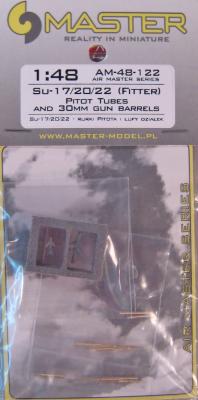
A feature that you can quickly notice on the Sukhoi Su-15 Flagon-F is the complicated nose pitot tube. Although Trumpeter made a valiant effort in molding the Su-15 TM pitot tube with its twelve separate vanes, the limits of the injection molding process come into play. I have used another set that used a combination of resin and photo-etch that was an improvement, but assembly was very difficult and the photo-etched vanes don’t really convey their 3-D nature. This Master Model set provides a quantum leap over any previous attempt to portray the Su-15 TM nose pitot tube. As a bonus, Master Model also provides the ability to build the slightly less complex Flagon-A nose pitot tube. I have also listed the Trumpeter Su-15 UM Flagon-G above, but I only have conflicting evidence that this set will help that kit. There should be no problem for the wing mounted pitot, but I have seen a variety of nose pitot tubes for the Flagon-G.
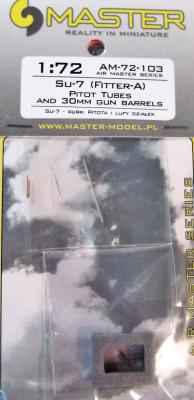
Here’s another of those useful little accessories from Master Model of Poland. These are finely done turned brass parts to replace those fragile and easily bent, broken, or lost parts from your lovely Victor.
In this case, it’s the pitots and the refueling probe. There’s a pitot at the end of both wings, and they’re right out there where the least bit of careless handling will either bend or break the pitots. The refueling boom is right out there in front, just inviting some disaster. More about my Airfix VC-10 tanker later.*
Installation
I did the refueling probe first. The instructions are VERY clear and easy to follow.
I must confess that I have been somewhat intrigued by the idea of using metal landing gear on my aircraft models for sometime now, but have just never followed through with a purchase. I initially felt the only time metal gear would be truly advantageous with a model that has spindly legs (like the F-105 Thunderchief) or if a particular model is quite heavy with the addition of resin parts or a good deal of nose weight. I am convinced those are the best reasons. However, I am open-minded on the issue.
When I had the opportunity to review a set of the SAC landing gear for the 1/48th scale Kinetic AMX I had to give it a go.
Contents Description
The parts are packaged in a clear blister pack and have no instructions. Many of the parts are cast as part of a metal sprue and will require cutting with side cutters or a fine saw to remove the metal parts.
This is a great Photo Etch set for the Kinetic Sea Harrier FRS.1Kit cockpit. This set adds a lot of extra detail to the cockpit of the kit and makes a great kit even better.
The photo etch parts are for the:
- Cockpit side panels
- Instrument panel and various control details
- Seat belts
- HUD parts
In the packet is:
- 1 colored photoetch sheet
- 1 instruction sheet
Summary
This is yet another great Photo etch set. Is a must for the Kinetic Kit as it makes it into a great model with all additional interior details for this aircraft. I would suggest that if would be worth consider the large interior set product number 49769 as you get a lot more detail parts for a small premium in cost but well worth it.
Thanks go to Eduard for providing this set to review and IPMS USA for allowing me to review it for them.