

Hub Plott
Reviews By Author

|
Early Soviet Jet FightersPublished:
This book covers the development, specifications and history of the first Soviet jet fighters. It is a massive tome that provides a great deal of detailed information on its subjects. The authors are certainly the current experts in the field of Soviet/Russian aircraft and after reading this book it is easy to see why. I had really wanted to review this book as I have in my possession an ultra rare 1/48 Russian resin kit of the Mig-9 by Airkits. Since material on the Mig-9 and other early Soviet jets has been few and far in between, this is a welcome addition! The book is broken down into 5 chapters by manufacturer. The order of their presentation is by their importance to the Soviet Union both in development and usage. The order of coverage is Mikoyan Migs, Yakovlev,… more |

|
Soviet and Russian Military Aircraft in AsiaPublished:
This book is the third in a series by these authors. It was preceded by volumes on the Middle East and Africa. In these pages the authors cover all Soviet/Russian built aircraft used by the various Asian nations from WWII to modern times. The book has twenty-one chapters and they are laid out alphabetically by country. With the start of the cold war, the Soviets began to try and influence the politics of the Asian continent. This was done in a large way by supplying arms to many other nations not only in Asia but worldwide, not only to their client states but to those that wanted to play both sides as well. We are treated to a nation by nation review of aircraft supplied to and used. Their combat records are covered as well as the service records for those not used in… more |

|
Hitler’s War: World War II as Portrayed by “Signal,” the International Nazi Propaganda MagazinePublished:
Signal was a propaganda publication by the German Wehrmacht stylized after Life magazine and published from 1940–1945. It was aimed at those in occupied, neutral, and allied countries, but it was never sold in Germany itself. Published in almost 30 languages, it was even available in the USA until December 1941! The magazine was kept under the control of the army and thus was independent of the Nazi Propaganda Ministry. This did not prevent it from being a propaganda laden publication. While it chronicled the conditions faced in combat by Germany and her allies, it also had a strong political message advocating for a “united Europe” under the “New Order” and for supporting the fight against the communists—even highlighting those former enemy combatants that chose to fight for the Nazis… more |

|
The Americans on D-Day, A Photographic History of the Normandy InvasionPublished:
This is a large, beautiful coffee table style photo-essay book. As the son of a D-Day veteran I was most anxious to read this book. 450 of the photos included are from the combat in Northern France. Some will seem familiar to the reader but many have never before been published. I especially like how in many cases the author has shown the original WWII photo and then beside or below that he has placed a modern photo of the same place taken at the same spot. The book is divided into eight chapters! The are: The Buildup, From the Air, From the Sea, On the Beached, Point du Hoc, La Fiere, Graignes and Aftermath. Each is filled with photos that show everything from the men, equipment and geography to the carnage of battle. I really liked this book. It shows to anyone who… more |
|
Gloster Javelin Landing GearPublished:
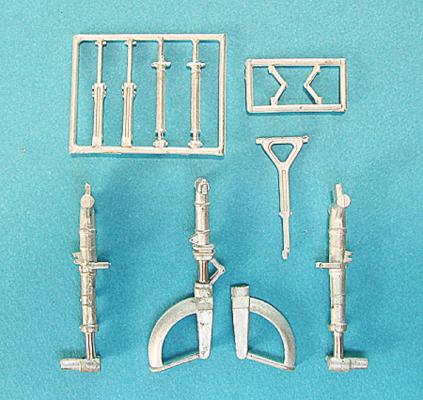
Scale Aircraft Conversions’ 1/48 Gloster Javelin landing gear set is a full replacement in white metal for both main gear legs and the nose gear. In many cases SAC will assemble some of the kit parts prior to casting; however, in this case they have cast the parts individually. Additionally, they have also cleaned up the gear and filled the sinkholes that were present on the original plastic parts. The main gear consists of four parts for each side: a main gear leg, two retraction arms and compression scissors. The nose gear consists of the gear leg with one side wheel-cover, the opposite side wheel-cover and a retraction arm. Detail is crisper on the metal gear than on the kit’s plastic parts. The replacement parts are a drop fit with no issues what so ever. The… more |

|
Model Art Modeling Magazine, #51, Spring 2014Published:
From the title one could conclude that the entire magazine is dedicated to these two ships. That would be incorrect! The book also covers the IJN Yuikaze, USS Ticonderoga, IJN Noshiro, Ice Breaker Shirase AGB 5003, JMSDF PG-824 Guided Missile Patrol Boat, JMSDF Defense Ship Akizuki, IJN Tanker Ashizuri, IJN Hiryu, S-100 German fast Attack and a section on the old Monogram/Revell 1/506 USS New Jersey! Eleven of the models are in 1/72 scale, two are in 1/350th and another in 1/72. Since the text is entirely in Japanese, so unless you read kanji the magazine is only for the pictures. But there are a lot of pictures and much useful information to be gained from them. Some of the ships are both photo essays of the model and the building process; others are of just the… more |

|
Convair Advanced Designs II - Secret Fighters, Advanced Aircraft, and Unique Concepts 1929-1973Published:
This book is a follow on companion book to the author’s “Convair Advanced Designs that I was also fortunate to review for IPMS/USA! This book covers 41 different aircraft, some that were built and some that were only designs each is given its own chapter. The list of aircraft covered is as follows:
|

|
French Wings No. 3: Breguet 27, Potez 39, and Mureaux 115/117Published:
This is the third book in the French Wings series and it continues to provide an interesting and informative look at some of the less famous French aircraft of the pre-WWII and WWII period. All three aircraft in this book were used in the observation and reconnaissance role by the French military. The book gives you information about both the process by which they were acquired and their actual operational use. In addition to the aircraft used by France, their use by China, Peru and Venezuela are also discussed. The book starts off with the Breguet 27, which is covered in the first 24 pages. I have always wondered why this aircraft was designed and looked the way it did. The authors clarify this early on! The reason for the rear fuselage’s unique look was that the specification… more |
|
Curtiss P-40 Snub-nosed KittyhawksPublished:
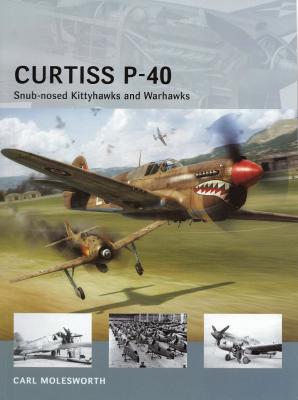
This book is number 11 in the Vanguard series and covers the later short nosed variants P-40D through P-40N. The book begins with the beginning of the end. By that I mean it shows the 15,000th Curtiss fighter built, a P-40-N-CU festooned with the emblems of each nation that flew them and a red, white and blue striped tail. This was the beginning of the end as around one week after this picture was taken a P-40 production ceased and the plants were shut down. And though Curtiss had tried throughout the war to design and produce new fighters as well as into the early years of the jet age, they would never again build another production fighter designed in house. The P-40 was ready and available at the start of WWII and continued on till the end of the war. This was not… more |
|
French Flying Boats of WWIIPublished:
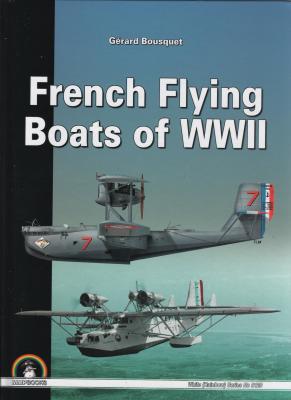
When one looks at French aircraft of the period immediately before and during World War Two, it is evident that there were two schools of thought when it came to aircraft design! One school was to design elegant, graceful and beautiful aircraft. The other was to see just how ugly they could make the airplane and it still fly and perform the duties it was designed for. This book is filled with examples of aircraft from both schools. The book begins with a discussion of the main categories of French flying boats and what these categories entail. The “Croisiere” category is the very long range maritime reconnaissance aircraft with a range of 2100 to 2800 miles. The “Exploration” category was the long range maritime reconnaissance with a range of 1200 to 1900 miles. The last… more |