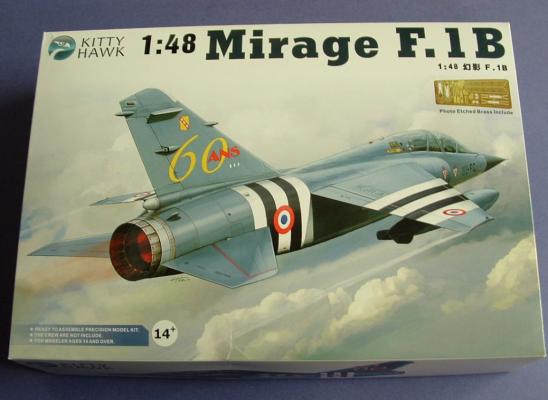
Kitty Hawk is a newcomer on the scene and seems to be filling a niche by releasing subjects not kitted before and new kits of older subjects previously kitted. The only previous kitting of the Mirage F.1B in 1/48 was the Fonderie Miniatures limited run multi-media kit. That is why, as a fan of the Armee de l’Air, I was pleased to see Kitty Hawk release this kit, especially in two colorful anniversary schemes, including the D-Day 60th anniversary scheme from 2004. Kitty Hawk has started to release single seat variants of the F.1 as an option to the elderly ESCI/Italeri Mirage F.1.
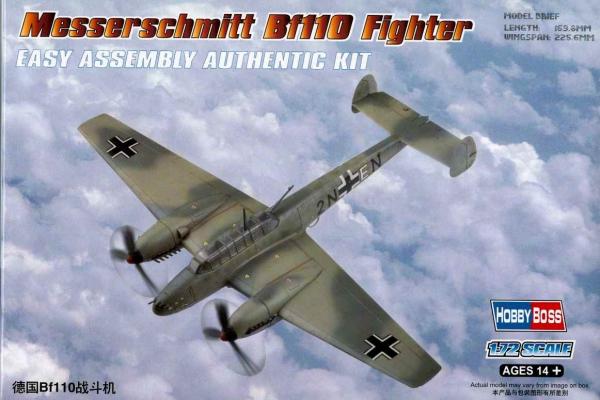
What's New
History
The Messerschmitt Bf-110 was an early attempt by the Luftwaffe to develop a long range strategic fighter for deep penetration missions. It was also intended as a long range escort for bombers, as an interceptor against enemy bomber formations, and as a light bomber and ground attack aircraft. The first prototype flew in 1936, but protracted engine development kept the Bf-110 from entering service until 1938 as the Bf-110B. In 1939, the Bf-110C went into production, and this was the first version produced in large numbers. The Bf-110C appeared in fighter, ground attack, reconnaissance, and “destroyer” versions. The Bf-110C was used to effect in the Polish campaign in 1939, and this gave Goring the impression that the type was unstoppable, the ultimate air weapon. After success in shooting down unescorted RAF Wellington bombers, the type was committed in Norway and Denmark, and later during the Battle of France.
History Brief
F4U-4: The last variant to see combat during WWII, the Navy took deliveries in late 1944 and had two fully operational squadrons by the end of the war. The type incorporated a lot of changes over the F4U-1D. Most notable is that it had a more powerful engine with a new four bladed prop.
F4U-4B: Designation for F4U-4s to be delivered to the British Fleet Air Arm but were retained by U.S. for its own use. The British received no F4U-4s.
The Product
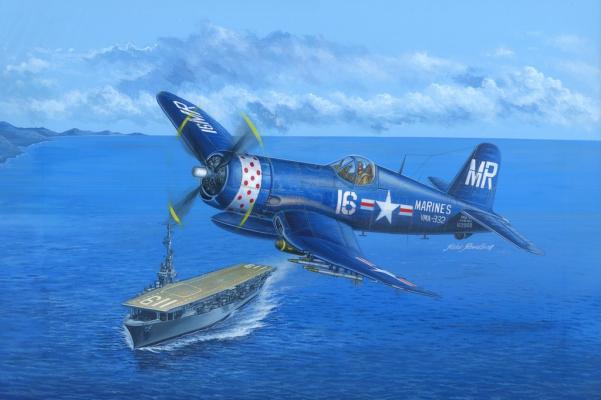
My sample came packaged in a large, sturdy corrugated box. The box art is very nice depicting a Marine Corsair circling the USS Point Cruz.
The Kit
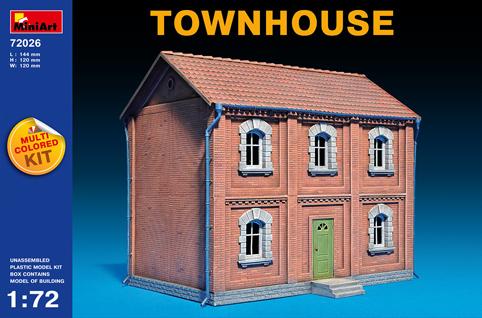
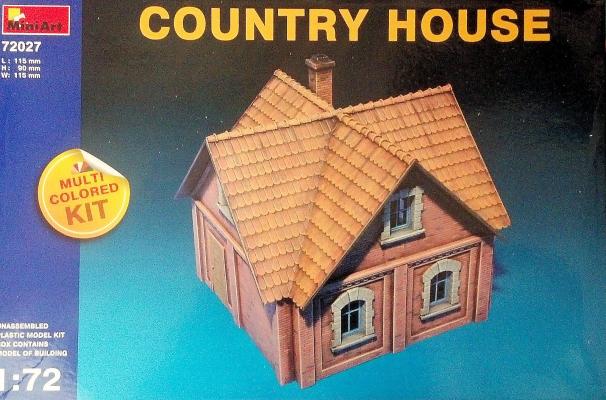
The kit is cleanly molded in 154 pieces of multi-colored plastic. These parts are the same parts used in constructing many of the other 1/72 offerings from MiniArt. No flash is apparent and detail is very crisp on all parts. A new part that I have not seen on this model was the introduction of a stone foundation.
Construction
Assembly of this kit was straight forward as all of the offerings before it. However, I took a different approach. On many of the other kits, I found that doing each wall with the end connectors tended to produce minor gaps at the corners. This time I decided to pre-build the corner assemblies and then add the walls. Also, I decided to paint parts separately before assembly. This approach offered a much cleaner look to the house, a departure from the worn down structures I had built in the past. The result was by far my favorite work of all of these kits I had done.
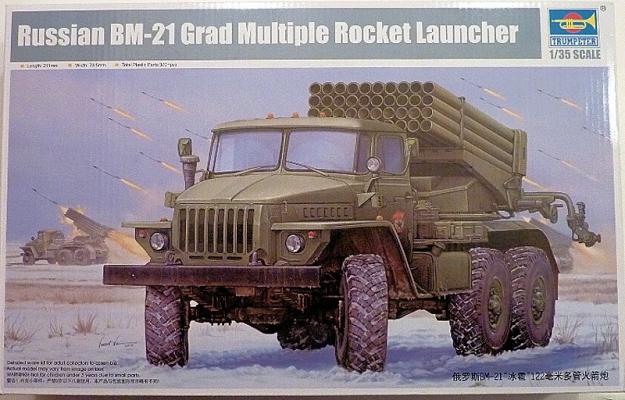
This was another item that had been on the review list for some time before I volunteered for it. As this vehicle comes with almost no external markings, Steve said I could do it as a Middle East Vehicle. I am thinking Syrian Militia based on a picture I came cross surfing the web. However, I do need to include some information about this particular kit as it might actually be a “What If”.
The Kit
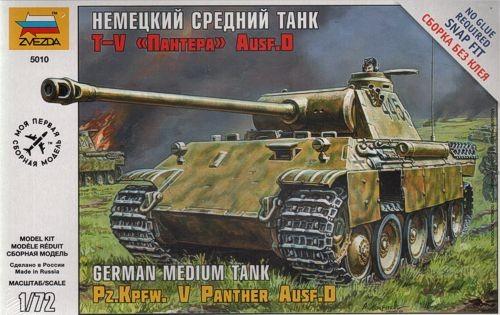
Nearly 100 injection molded parts in tan plastic plus 2 black plastic treads. All parts exhibit crisp detail and are flash free. The muzzle of the main gun is not slide-molded so will need to be drilled out. Being a snap kit, all parts had a number of locating pins. All of them fit together without modification.
Introduction
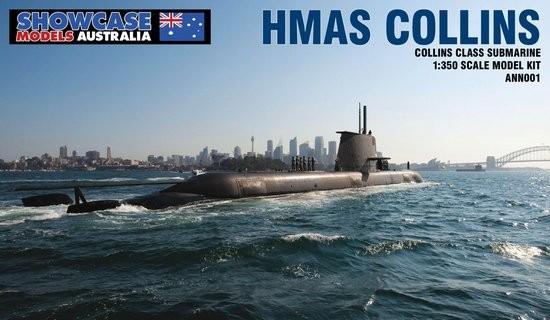
Showcase Models Australia is a relative newcomer as a model distributor in Australia (founded in 2011, according to their Facebook page) and has recently branched out into manufacturing their own kits. In May 2013, the production of the Collins Class subs was completed and the kit made it to the Showcase Models showroom and subsequently, other retailers and distributors.
A big Thank You goes to Dragon Models USA for providing this review sample to IPMS/USA.
The Kit
The kit consists of 110 injection molded parts in the standard MiniArt colors; orange, maroon, black and white. All parts are relatively free of flash (some may have just a small bit around the attachment points) and are very crisp in detail.
Construction
As with the kits before it, the Country House is very well made. Being a smaller kit, assembly should not take much longer than an hour or two. A few points worth mentioning on this kit centers around the roof. As with prior offerings, the thin roof pieces seem to have a slight bow to them. Given that all of these meet in the middle, there may be some considerable use of cement or CA to get them to remain. I was able to resolve this by tacking them with a little cement and then gap filling with CA.
History
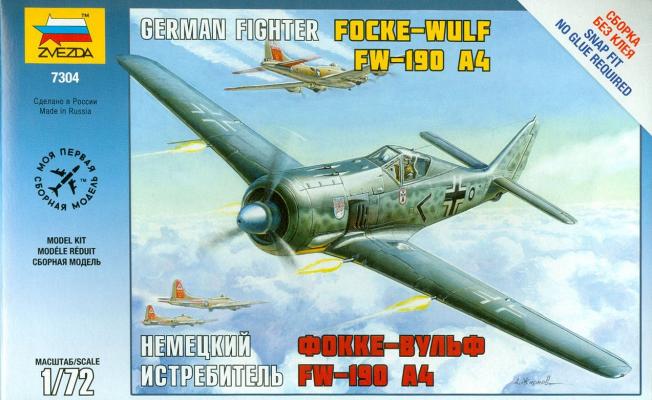
The Focke Wulf Fw-190 is probably one of the most modeled aircraft in any scale, mainly because it was such an excellent design and was produced in very large numbers during World War II. Although sources vary as to the number produced, slightly fewer that 1,000 of the A-4 type appear to have been manufactured during 1942 to replace the A-3, and subsequently being supplanted by the improved Fw-190A-5. Constantly upgraded during the war, the type held on until the final days, both as a fighter and as a ground support and reconnaissance aircraft. Most serious modelers are familiar with the type and its history, so I’ll refer you to other sources. There is certainly no lack of information on this aircraft, both in publication form and on the internet.
History
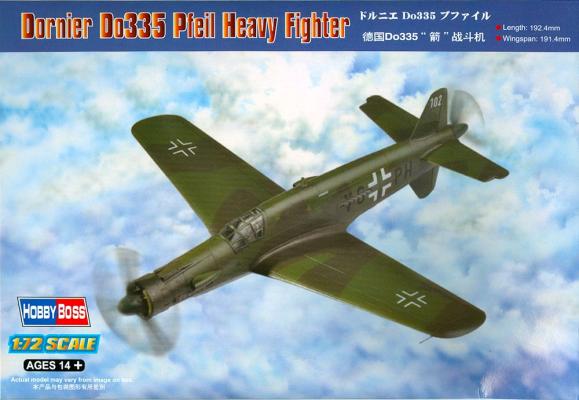
The Do-335, like many German aircraft of World War II, had a checkered development. It began its life, at Hitler’s insistence, as a high speed bomber, and only later, when Hitler was told that the Me-262 would be a better high speed bomber, was the plane’s basic mission changed to that of heavy fighter and reconnaissance.
First, Dornier used a scaled down (1/2.5) Do-17Z airframe (Goppingen Go.9) to test the feasibility of the rear mounted engine with a prop behind the tail unit. Tests showed the usefulness of the arrangement, so design began on the full size airplane. Featuring a tandem engine arrangement (which was not new to Dornier), the aircraft was a large, single seat, twin engine aircraft with two DB-603 liquid-cooled engines. The type began as a high speed bomber (Nov. 1943), reconnaissance fighter and night fighter (Jan. 1944), and ended finally as a heavy fighter (Mar. 1944). In July, 1944, the first prototypes were delivered as bombers.