MMP was founded in 1996 by Roger Wallsgrove, to publish "Mushroom Model Magazine". This quarterly modelling magazine was developed from "Mushroom Monthly”, a club newsletter which ran from 1985 to 1995, achieving a world-wide reputation for quality articles, fearless and honest reviews, and a great sense of humor. From 1997 the magazine was produced in collaboration with Robert Peczkowski and Artur Juszczak (Stratus), which meant a big leap in print quality and design. MMP expanded into book publication in 1999, and since then they have built up a list of books on aircraft and aviation, naval, military vehicles, and military history. MMP Books are distributed in North America by Casemate Publications.
What's New
Thank you to Phil and Bill for all that you do managing and providing review opportunities!
Recommended kit: Wingnut Wings
Reviewer’s Comments
I do not own any WW kits, and due to the high demand for the now defunct company, the prices have soared. A good friend was kind enough to loan me his Gotha G.1 kit for the purposes of comparing the SAC landing gear to the kit parts.
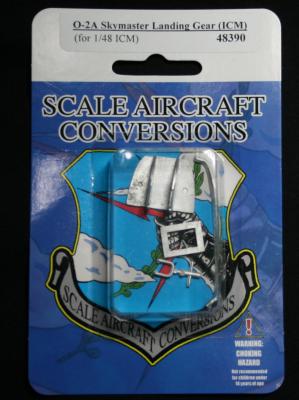
This landing gear set from SAC is a direct replacement for the kit parts. The white metal casting is superb as is usual for SAC, but a few parts did have a little bit of flash, which was very easy to remove. The kit consists of 12 parts. Three parts need to be removed from their pour rod (see photo).
Thank you to Phil and to Bill for all the work that you do!
History
In the end of the 60s the Mikoyan Design Bureau developed the world’s first interceptor fighter with a speed of Mach 3—the MiG-25. At the same time high-reconnaissance bomber modifications were developed and designated the MiG-25RB. Using the MiG-25RB frame, the strike anti-aircraft Mig-25BM was produced in 1977. It had a new nose with radar and four anti-radar X-58U missiles. These planes served in the Soviet (later Russian) Air Force. From ICM.
OKB Grigorov has provided a very unusual kit in the form of a British post war Paper Tank. The Nuffield Assault Tank A.T.3. Which was one of 9 various of a design proposed by Nuffield. As a Paper tank it was only a design and never left the drawing board.
Included is:
- 142 resin parts
- one photoetch sheet
- one instruction sheet
The detail quality is great; The parts are very delicate and need careful removal from the resin bases. The instructions need a lot of experience to work with to get a great model.
Some of the parts were a little twisted but can be corrected if you’re careful.
The assembly is good but needs a little patience and time to get the running gear built correctly. Also, the resin tracks are very fragile, so this needs a lot of accuracy to get them fitting and looking right.
There were a few gaps that needed filling.
OKB Grigorov has provided a very unusual kit in the form of a British post war Paper Tank. The Nuffield Assault Tank A.T.1. Which was one of 9 various of a design proposed by Nuffield. As a Paper tank it was only a design and never left the drawing board.
Included is:
- 128 resin parts
- one photoetch sheet
- one instruction sheet
The detail quality is great; The parts are very delicate that need careful removal from the resin bases. The instructions need a lot of experience to work with to get a great model.
Some of the parts were a little twisted but can be corrected if you’re careful.
The assembly is good but needs a little patience and time to get the running gear built correctly. Also, the resin tracks are very fragile so this needs a lot of accuracy to get them fitting and looking right. There were a few gaps that needed filling.
I would like to have seen some small decals.
The book is another in the great Casemate Images of War series. This book covers images from the invasion of Sicily through the invasion and progress up Italy until the wars end.
The images in the book are excellent and inspire ideas for dioramas for modelers.
The book is full of amazing photos of the Italian campaign, it is very much an overview as the subject is very large. It does tend to focus on the US forces.
I recommend this book to everyone with an interest in WWII.
Thanks go to Casemate Publishing for providing this book to review and IPMS USA for allowing me to review it for them
Some time after the end of World War 2 and the establishment of the U.N., one of the first opportunities for the fledgling organization to flex its peacekeeper muscles was on the heel of the 1956 Arab-Israeli war. This serious flare-up between Israel and its neighbors – the first really serious conflict of many to come – was seen by the world as a definite threat to the stability of the entire region. A multinational force of British, French and numerous other participants was hastily assembled and dispatched to try and create a safe zone between the hostile forces.
Tito of Yugoslavia, who was even then trying to establish international recognition and legitimacy for his communist government, looked on this multinational effort as an excellent prospect for increasing his country’s standing, and volunteered a small contingent of Yugoslavian troops to go to the Sinai Peninsula and help serve in this laudable effort.
This book is from the Italian Aviation Series and covers the T-33A/RT-33A mostly in Italian service. Like several other Italian aircraft book series this one too provides text and captions in both Italian and English.
Chapter one is an introduction to the design, where chapter two covers its design and beginnings with the USAF. Chapter three by far the book’s largest at 45 pages covers the Shooting Star’s (better known in the USA as T-bird) service to the Italian AF. The first T-33 was received in July of 1952 and the type served the IAF until March of 1982 a career of almost 30 years of uninterrupted service. Chapter four covers the use of Canadian built CT-133 in a hail preventing operation. Chapter five is a modeler’s note section with building the 1/72 Heller kit of this aircraft. The book concludes with technical data and acknowledgements.
In the aftermath of World War Two, the United States and the Soviet Union were not the only powers who pursued and developed nuclear weapons. Both France and England pursued the development of nuclear and thermonuclear weapons after World War Two. The problem came in developing reliable and effective methods of deploying these weapons. In the immediate aftermath of World War Two, prior to the missile age, the only option was the manned bomber. Unfortunately, as antiaircraft systems became more effective and sophisticated, questions began to arise with respect to the ability of the manned bomber to penetrate these defense systems and reach their targets with gravity bombs.
Some decades before Pakistan became a separate nation, India had its own armored corps serving as a colonial force. Realistically, it was more of an armored unit in name than in fact, as early on their British overlords put them right at the bottom of the list in terms of supplies, even as World War Two swept the globe. Unspoken (for the most part) at the time was the belief that Indian “natives” were, perhaps, a wee bit too unsophisticated to manage large mechanical devices like armored vehicles – colonial thinking at its best.