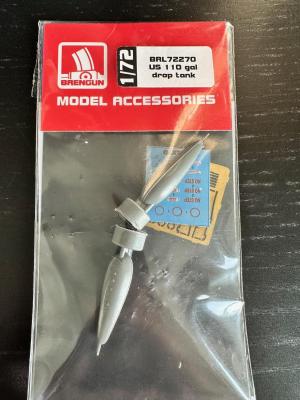
As the US Army Air Forces P-51 escorts ventured farther over Japan they required more fuel. Enter the 110 gallon drop tank. Similar in design to the 96-gallon tanks formed from stamped aluminum halves pinch joined at the seams, these larger tanks now held 660 lbs. of fuel. The sway braces used on the standard pylons were not up to the task. Fixing this problem took the form of plywood braces cross tied over the tank to each other. To keep the tanks hanging in the direction of gravity, the height of each was cut to account for dihedral of the aircraft’s wings. Brengun has duplicated this system in this kit. Resin cast tanks are detailed with photoetch parts and decals are provided for the stencils.
What's New
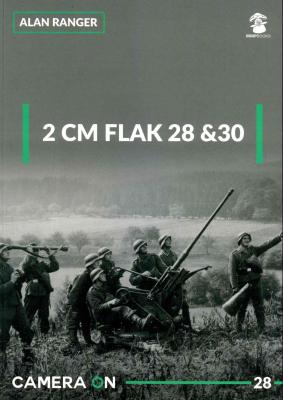
Alan Ranger is a former British Royal Engineer, engineer, collector of World War II militaria and original period photographs, and prolific author. Alan started his publishing days with Model Art of Japan this is his 28th book in the Camera On series (he already has another four in production), typically focusing on weapon systems and vehicles. The beauty of this book is the photos were taken by German soldiers during their wartime service, not typically posed and polished propaganda shots.
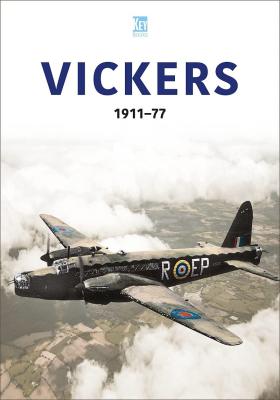
Anyone familiar with the Vickers name knows how critical their contribution to British industry has been. Starting in 1828 as a steel producer, the company diversified into arms, ships, railroad stock and aircraft. The aviation arm of the company got its start by building rigid airships and blimps. This experience not only gave them experience in building these types of structure, it also brought them Barnes Wallis as one of their designers. At the same time, they introduced the R.E.P. Type monoplane. This single seater had a steel tube frame and was used as the base trainer for a flying school Vickers opened. During the first World War, the “Gun Bus” series of pusher powered fighters were designed and built as well as the first multiengine military aircraft in the world, the E.F.B. 7, flown in August 1915. Vickers also built several other prototype fighter designs that contributed to the evolution of the type but were not produced in numbers.
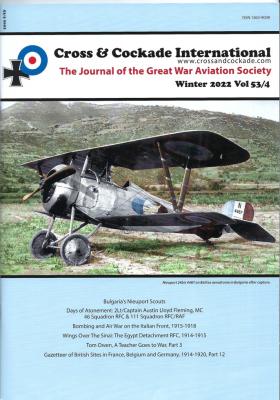
Cross & Cockade International is a non-profit UK based group known as the First World War Aviation Historical Society that publishes their journal four times a year. They also provide a free newsletter (sign up on their website) and occasionally publish WWI themed books like the Sopwith Dolphin monograph I reviewed earlier for IPMS USA. This Journal is the sister of the US Journal, Over The Front.
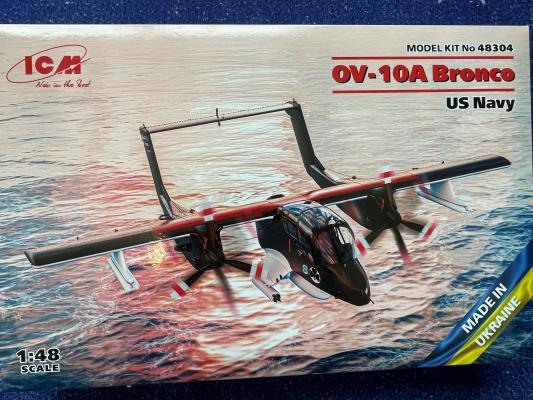
The OV-10A Bronco was a highly versatile aircraft and proved itself during the Vietnam War. Some aircraft operated by the US Navy were used in an anti-submarine training squadron, VS-41, Shamrocks. Some of these Bronco’s were painted in black or a very dark blue over white camouflage scheme. Interestingly, I could not find any pictures of OV-10A’s in this color. A number of Bronco’s were also returned to service during Desert Storm.
ICM seemingly defies all logic and continues to excite the modeling community with excellent model kits from the Ukraine. Keep them coming!! They have proudly added “Made in Ukraine” on their box tops.
The OV-10 arrived packaged in ICM’s typical superb box. All the plastic contents were protected in bags, along with a glossy instruction manual and two decal sheets.
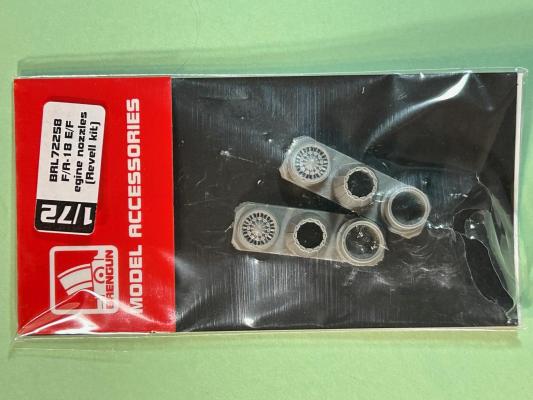
This set is designed to provide replacement engine nozzles for Revell’s 1/72 F/A-18E/F Super Hornet Dauntless kits. The package includes two complete nozzle sets consisting of the flameholder section, the exhaust tube and the nozzle.
As expected with Brengun, the resin parts are well cast and sharply detailed and are intended to be a complete replacement for the kit’ engines. As with any resin set, the first set is to wash the parts to remove and release agent residue. I then used a razor saw to remove the parts from the casting stubs. I have always struggled with this step as I can never quite seem to keep the blade straight all the way through, so I end up having to do some remedial sanding to even the parts up after removal.
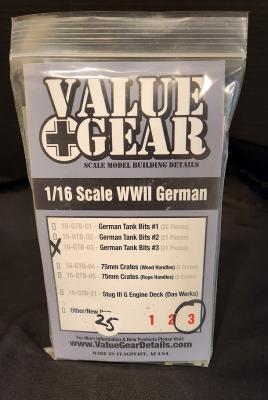
Value Gear Details, based in Flagstaff, Arizona, produces a wide range of high-quality resin accessories for most common model scales. Many of the accessories and stowage sets are universal, which is a nice advantage. This allows the model builder to customize the look they want by mixing sets or you can use one sets intended for specific subjects, such as the “German Tank Bits” family of accessories.
The set featured in this review has 21 pieces. Also available is set German Tank Bits #1 consisting of 22 pieces, and German Tank Bits #2 with 21 pieces.
The detail of these is stellar. I never cease to be amazed at the level of fine detail Value Gear achieves!
Reviewer’s Comments:
“- I also want to go fishing, Uncle Aliu!
You cannot, Abdulai, because it’s dangerous.
Uncle, I’m not afraid of the crocodiles!
You know, now there aren’t just crocodiles,
There are also the colonialists who drop bombs on the canoes,
[but] I cannot fear the crocodiles or the bombs.
This is my mission, as a militant of our Party.”
Thus opens the introduction of book, in the aptly named Introduction: Crocodiles and Bombs. Each chapter opens with a great quote that ties in with the chapter name – kudos to the authors for this additional nice touch. This book, while it covers Portugal’s war in Guinea (now Guinea Bissau, and not to be confused with the Republic of Guinea) is primarily focused on the Portuguese Air Force (Força Aérea Portuguesa-FAP) in its operations in Guinea supporting the counter-insurgency.
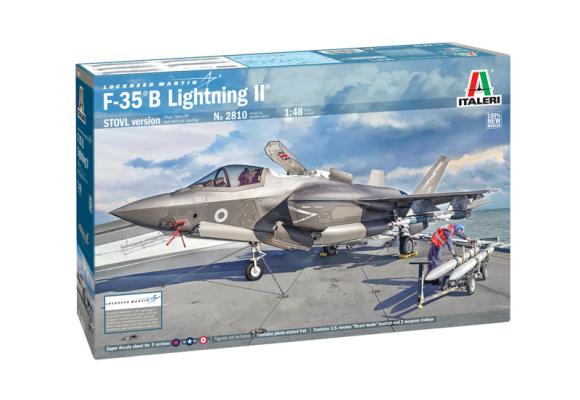
Italeri has released a brand new mold F-35B, the STOVL (short-take-off and vertical landing) version of the F-35 family currently in use by the Italian Navy, Royal Navy and US Marine Corps.
Current military planning assumes that in any conflict, stealth capabilities are needed during the first few days of combat which will see action against enemy radars and later on aircrafts can trade-off “stealthness” for payload by using external pylons. When the F-35B is carrying a full payload -ie with external pylons-, it is known as “Beast” mode and Italeri provides you everything you need to have your model in “Beast” mode, even adding a couple of trolleys to show the extra ordnance in a mini-diorama or vignette, but no figures are included.
The origin of Pen and Sword Books is closely linked with its sister company, the Barnsley Chronicle; one of the UK's oldest provincial newspapers – established in 1858 – and one of the few weeklies still in private ownership. The first books published by the company were in response to public demand following of a series of articles published in the newspaper: Dark Peak Aircraft Wrecks told the story of crash sites in the Dark Peak area of the Peak District National Park, and a further weekly feature on the history of two Kitchener battalions, known as the Barnsley Pals, aroused a thirst for more information. Following on from the success of Dark Peak Wrecks and Barnsley Pals books, a number of local history paperbacks were produced along with a series of battlefield guidebooks. Battleground Europe proved immediately successful, and as more and more titles were produced the company made the decision to launch a book publishing arm of the group.