Reviews

Review Author
Tom Moon
Published on
Company
Trumpeter
Scale
1/35
MSRP
$189.95

Roadbed parts come in a separate box and will make a roadbed long enough to hold the completed model.

This kit is a representation of the Br 57 Armored Locomotive. There was extensive use of armored trains by the Germans to provide rail security and to suppress partisan activities. Trumpeter has produced almost everything required to assemble an armored train except the tank carrier. This is only made by Ironside.

Review Author
Ben Guenther
Published on
Company
Dragon Models
Scale
1/35
MSRP
$63.00

Once again Dragon has taken a previously released armor kit and has added Zimmerit, re-releasing it as a new kit. This is a good thing if you don’t feel you want to try to apply the Zimmerit using various types of putties and tools. To achieve this Dragon provides us with 26 plastic sprues of varying sizes. Two Brummbar sprues, four STUG III G sprues and only a few specifically for the STUG IV, most of the sprues are for the Panzer IV. Total part count comes to 751 parts; the number of unused parts is 207 leaving 544 parts to build the model. Several sprues have the same letter; Dragon gets around this by having one letter in black and the second same letter in blue. I mark the outside of the bags to make it easy to find the right sprue when I need it.

Review Author
Ken McDevitt
Published on
Company
Dragon Models
Scale
1/6
MSRP
$18.99

Description and History

Quoting from Dragon's web sitde product description:

“The kurzer 8cm Granatwerfer 42 (abbreviated to kz 8cm GrW 42) was developed as a lighter version of the standard 8cm GrW 34 mortar. It was commonly referred to as Stummelwerfer (“stump-thrower”) by troops. The smaller size made it particularly useful for German paratroopers who needed a weapon that was easier to move around, but still offered more punch than the diminutive 5cm leGrW 36.

It had a shorter tube than the standard 8cm mortar (tube length is 747mm), but it could still fire a round weighing 3.5x the earlier 5cm mortar weight, two times as far. Furthermore, at 26.5kg, it was half the weight of the leGrW 36. Maximum range was in the order of 1100m. Produced from 1941-45, the kz 8cm GrW 42 could be broken down into three loads for transport. Its effectiveness meant it served with Wehrmacht and other units as well as the airborne users it was originally intended for."

Book Author(s)
Eduardo Cea, (English translation by Sally-Ann Hopwood)
Review Author
Roger Rasor
Published on
Company
AF Editions
MSRP
$30.00

This 104-page soft cover book is the fourth title in Casemate’s AIR COLLECTION series about Japanese military aircraft. Like its predecessors, it is an English translation of a Spanish title originally published in Spain in 2008. The book includes 170 full-color aircraft profiles, beginning with a twin-seat 1913 Nieuport NG and continuing up to such naval aircraft in service at the end of the war as the Yokosuka D4Y2 Judy and Model 11 Koo Nakajima J1N1-Sa Gekko. It is obvious the author/illustrator has a great knowledge of the subject and the artistic talent to present it visually. Sixty-nine different aircraft types are represented and the nicely rendered illustrations display the variety of color schemes and national markings that were used by the Imperial Japanese Navy during the period. There are no photographs, but they are not necessary.

Book Author(s)
Eduardo Cea
Review Author
David Goudie
Published on
Company
AF Editions
MSRP
$30.00

This is a very interesting publication. First of all, the title is misleading. This may be caused by the translation from the original Spanish and my lack of ability to do the same. If the word “Aircraft” is changed to “Aviation of the Japanese Imperial Navy” it would be more accurate.

Secondly this book is a continuation of Volume I. The interesting thing here is that the book apparently begins where the previous volume left off. By this I mean no preliminaries, such as a table of contents, publication data, or an index in the back. There is not even a prolog or introduction. It's like walking in when the movie is half over.

Review Author
Paul Bradley
Published on
Company
Aires Hobby Models
Scale
1/32
MSRP
$38.99

The Revell 1/32 Panavia Tornado is a nice kit, but now approaching 20 years old, it is somewhat lacking in detail. Various resin and PE detail sets have been created for it, but until now, no-one has tackled the complex exhaust area – Aires have come to the rescue with this new set.

The exhaust detail in the kit is not bad, but the jet pipes are a bit short and the detail overall is a bit soft. The Aires set solves both these issues and then some! Each exhaust comes in three parts – the burners, the jet pipe and the can and externals. Detail is excellent, even deep down in the internals of the afterburners. The jet pipes are at least half as long again, and the external detail is excellent.

Review Author
Roger Rasor
Published on
Company
Quickboost
Scale
1/32
MSRP
$6.50

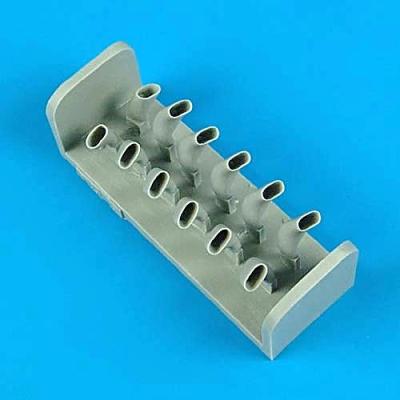
Quickboost now offers 1/32 scale builders a set of resin exhaust pipes for Hasegtawa’s Ki 44 Tojo kits. They are accurately sized, cast in Quickboost’s typical gray resin and feature remarkably thin sidewalls that capture the appearance of the Prototype’s exhausts quite nicely.

Unlike the kit parts that require modelers to glue together two halves to end up with a single hollow pipe, the Quickboost exhausts are already hollow and ready to use without any assembly. They are cast so they may be painted while still on the casting block. After removing them from the casting block, they will fit in place with absolutely no modification required. Just remember, because they are resin, they will need to be attached with super glue or an epoxy adhesive.

This set is recommended. My thanks to Quickboost and IPMS/USA for the review sample.

Book Author(s)
Ian Robinson, MBE
Review Author
Paul Bradley
Published on
Company
Grub Street
MSRP
$39.95

The Handley-Page Halifax was one of Britain’s best 4-engined bombers but, like the Hurricane to the Spitfire, was overshadowed by the Avro Lancaster as a media darling. It didn’t help that no original Halifax airframes existed in the world, outside of a sorry example pulled from a Norwegian fjord in the early 70’s and displayed in an un-restored state at the RAF Museum in London – a pitiful state of affairs.

Review Author
Mark Aldrich
Published on
Company
Italeri
Scale
1/35
MSRP
$53.00

This is the Academy “Achilles” kit put into an Italeri box and marketed. The sprues all say Academy and the only difference is the decals and instruction sheet. The Academy kit is a gorgeous representation of the British version of the American M10 “Wolverine”. There are a few interior issues with stowage and rounds but it builds into a great model just the way it is.

What you get is the ten Academy sprues done in beautiful tan plastic, two vinyl T-62 riveted tracks, a 16-page instruction booklet, length of twine (for tow cable), and decal sheet to mark four vehicles. The vehicles are two Polish Division machines and two British vehicles. One of the British vehicles has a neat looking black and green camouflage pattern. The only first look issues are the interior turret plates. These are littered with ejector pin sink marks that are going to need to be cleaned up. The worst part is that these are mostly oblong instead of round ejector pits.

Review Author
Andrew Birkbeck
Published on
Company
Tamiya
Scale
1/48
MSRP
$33.00

Back in the mid 1970’s, the 1/48th armor scene was dominated by Bandai Corp., who released a series of WW2 Allied and German military vehicle kits, together with a number of figure and accessory sets. Included among these kits was a late war German Jagdtiger, a true monster of a “tank”. Despite their “state of the art” nature at the time of release, the Bandai range is now showing its age. Also, Bandai stopped manufacturing these military vehicle kits in the mid-1970’s!

To remedy the “need” for a Bandai replacement, Tamiya has come to the modeler’s rescue with a lovely rendition of the Jagdtiger in their own 1/48 Military Vehicle range. As per usual with Tamiya’s German military vehicle kits, the model is produced in a tan plastic, which has been the norm over the past year or so in this range, Tamiya has chosen to move away from the relatively poorly detailed metal lower hull unit, and have moved to much better detailed injection plastic lower hull parts.