
Warpaint 152 - Junkers Ju 86
Guideline Publications Guideline Publications is the UK's leading publisher of modeling and hobby-related magazines. With a world-class portfolio of titles and an international Social Media presence, Guideline Publications has a dedicated readership that is constantly expanding into new areas. This English language book, Warpaint 152, Junkers Ju 86, is authored by Daniel Kowalczuk with scale drawings by Sam Pearson. The latest Guideline’s Warpaint series, 152, was published in 2026. A digital edition will soon be available. News on Guideline’s publications can be found on Facebook.
Daniel Kowalczuk is a Polish analyst of post-colonial wars around the Globe, with special interests in Biafra, the Congo, Sub-Saharan Africa and Indochina since 1945. He has published dozens of related articles in the specialized press and is widely acknowledged for his often-pioneering work. Furthermore, he has researched and authored studies of several other little-known conflicts, including the Coconut Revolution (Bougainville, 1980-1988), and the Noumea Hostage Crisis (New Caledonia, 1988), the commercial use of helicopters during the Biafran War, the ‘Brown Water Navy’ operated by France during the I Indochina War (1945-1954), and the history of the Katanga Air Force. This is Daniel’s second book in Guideline’s Warpaint series, with the first being the 2024 release of Warpaint 147: Nakajima Ki-43 Hayabusa / Oscar.
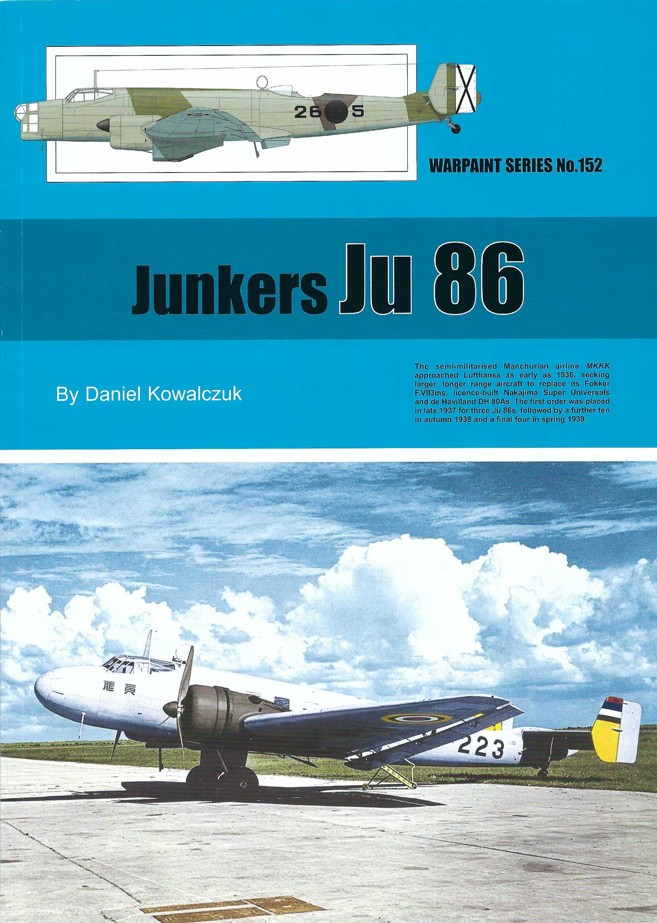
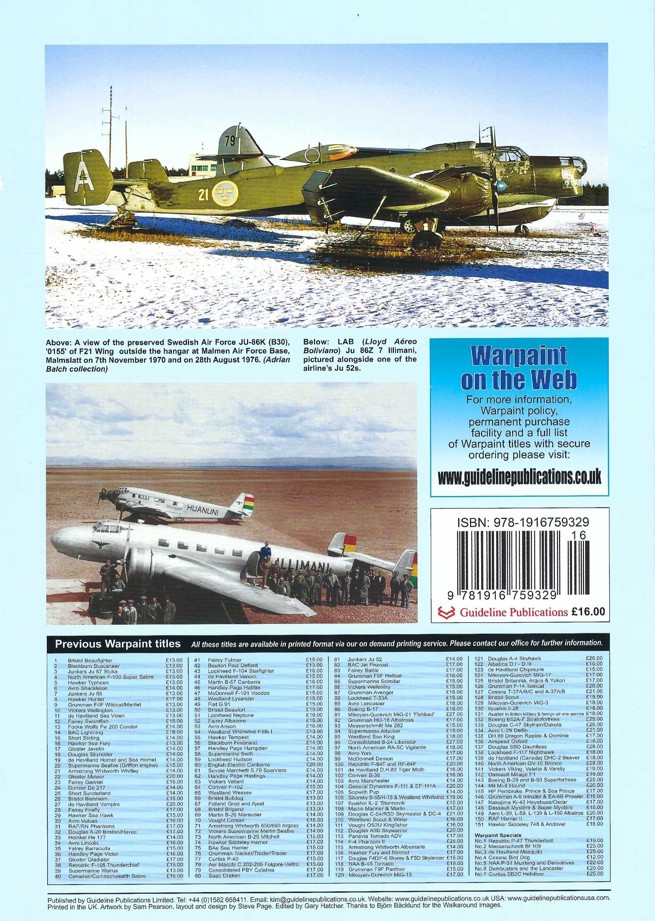
Warpaint's latest is their standard portrait A4 [8.25” x 11.75”] format square-back softbound publication that is 48 pages, including the covers. Sam Pearson contributes eight pages of color illustrations that include 48 color side-profiles along with two pages of 1/144 line drawings showing top, bottom views, and nine side profiles. I counted 43 color photographs, 60 black and white photographs and three maps. The front cover features a Sam Pearson color side profile of a Junkers Ju 86D, 26-5, of Versuchsbomberstaffel 88 of the Condor Legion in 1937. This was the fifth Ju-86D delivered to VB/88 as an attrition replacement in July 1937. She was transferred to Tablada airfield in Seville before VB/88 was redesignated Staffel 4.K/88 on August 14, 1937. The color [possibly colorized] photograph at the bottom of the cover is of the Manchurian Aviation Company Ju 86Z-2, M-223. This is one of seventeen Ju 86Z airliners received from Germany between 1937 and 1939. The Ju 86Z-2 had a longer tail cone section than the Ju 86Z-1 matched with the BMW 132H radial engines of the Ju 86E. The Manchurian Aviation Company ceased operations in August 1945 when the Soviet Union invaded Manchuria. The rear cover features two color photographs. The top of the rear cover features a Swedish Junkers Ju 86K-4 or the B 3 as it served in the Swedish Air Force. Here it is shown in November 1979 at Malmen Air Force Base, but it is now housed inside at the Swedish Air Force Museum near Linköping and is the only Junkers 86 still in existence. The color photograph at the middle of the rear cover shows off a Junkers Ju 86Z-7 of Lloyd Aéreo Boliviano (LAB) Airlines. “Illimani” was a new Ju 86Z-7 ten passenger civilian airliner ordered by LAB with Pratt & Whitney Hornet engines. Three additional Ju 86A-1K bombers were also ordered that were primarily used as military transports. Illimani, named after the second-highest mountain in Bolivia, was later transferred to the military where it was renamed Capitán Beltrán. Capitán Beltrán would remain in service until scrapped in 1948.
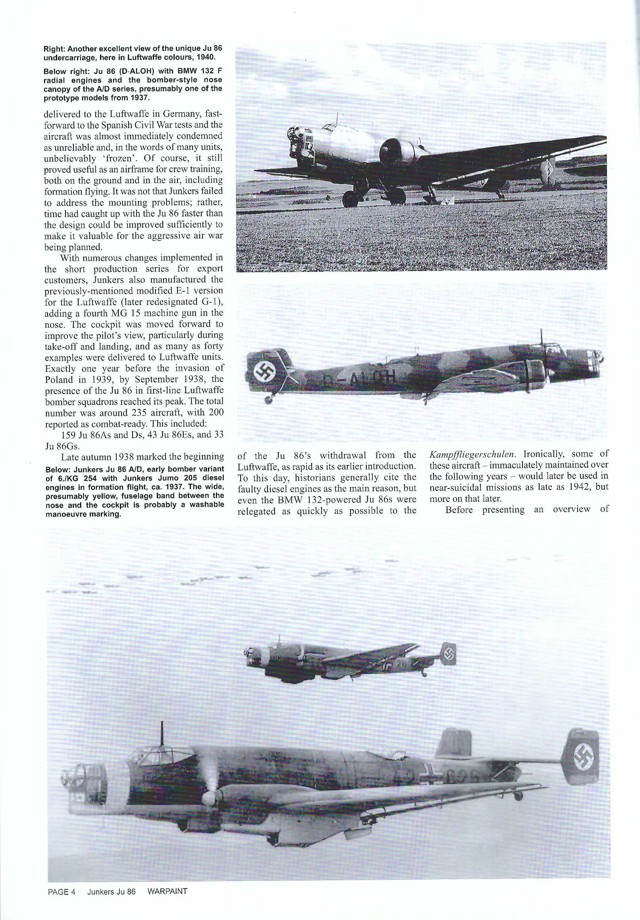
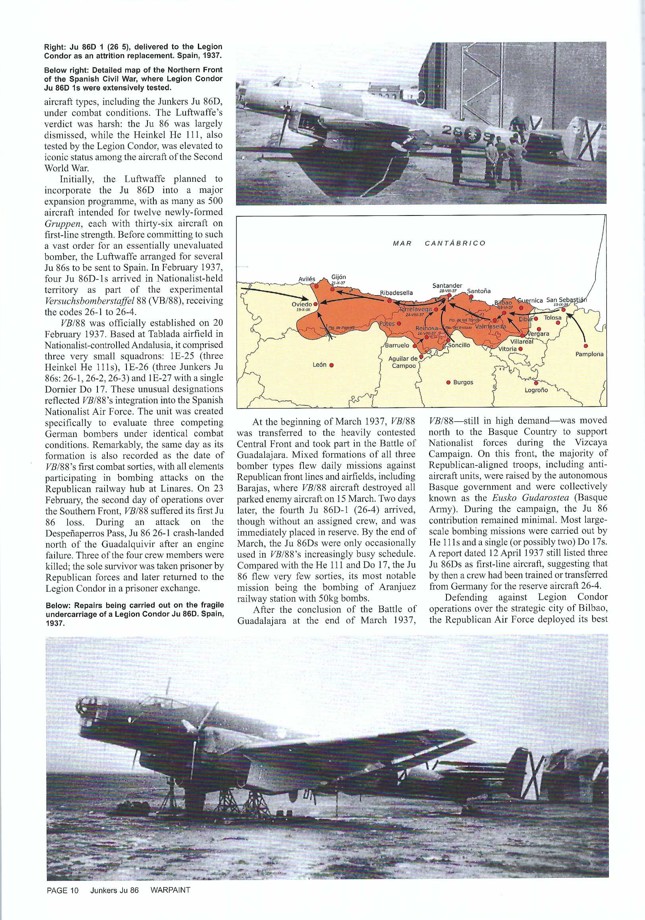
Daniel Kowalczuk opens with an introduction to the development of the Junkers Ju 86 in the mid-1930s as a successor to the Junkers Ju 52. First flight of the bomber variant was achieved on November 4, 1934, with Swedish variants serving till 1958. The civilian variant, the third prototype achieved its first flight on April 4, 1935. The bomber variant saw military service in the Spanish Civil War but the Jumo 205 diesel engines proved to be problematic and soon lost favor to the Heinkel He 111. The radial BMW engined Ju 86E and Ju 86G models were transferred to bomber training schools while the Jumo diesel engined Ju 86A and Ju 86D bombers were retried soon as of 6.fter the invasion of Poland. Two black and white photographs of the BMW radial engined bombers can be spotted at the top of Page 04. Notable is the top photograph that displays the narrow retractable undercarriage that folded outwards into the wing. The bottom of the page features two Jumo 205 diesel engined Junkers Ju 86 bombers of 6./KG 254. The Ju 86D at the forefront is coded 42-C26 and was based at Eschwege from April 1, 1937, through April 1, 1938. Additional Legion Condor Ju 86D-1 bombers are depicted on Page 10. The top of the page shows off a black and white photograph of Ju 86D-1, coded 26-5, whose color profile is featured on the front cover. Just below is a color map of the Spanish Civil War Northern Front where the Ju 86D-1 bombers saw extensive testing. The Ju 86D-1 at the bottom of the page is having its main landing gear repaired, a common occurrence due to its narrow track.
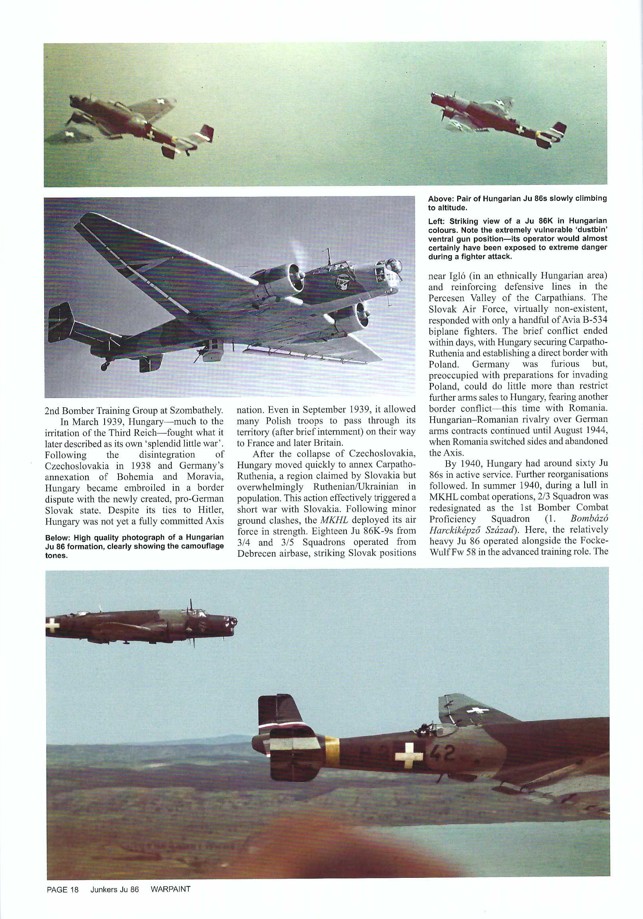
The Kingdom of Hungary was a significant operator of the Junkers Ju 86 bomber. Two color photographs of Hungarian Junkers Ju 86K-2 bombers can be found on Page 18. The first of 63 Ju 86K-2 bombers were received in early 1938 that were quickly put to use during the Slovak-Hungarian War in March 1939. Hungary also fielded their Ju 86K-2 bombers in the German led invasion of the Soviet Union, but severe losses forced the withdraw of them from frontline service in 1942. The black and white photograph of the airborne Ju 86K-2 at the middle of the page shows off the retractable ventral defensive gun position. The Ju 86 carried three defensive 7.92mm gun positions in the nose, dorsal, and ventral positions.
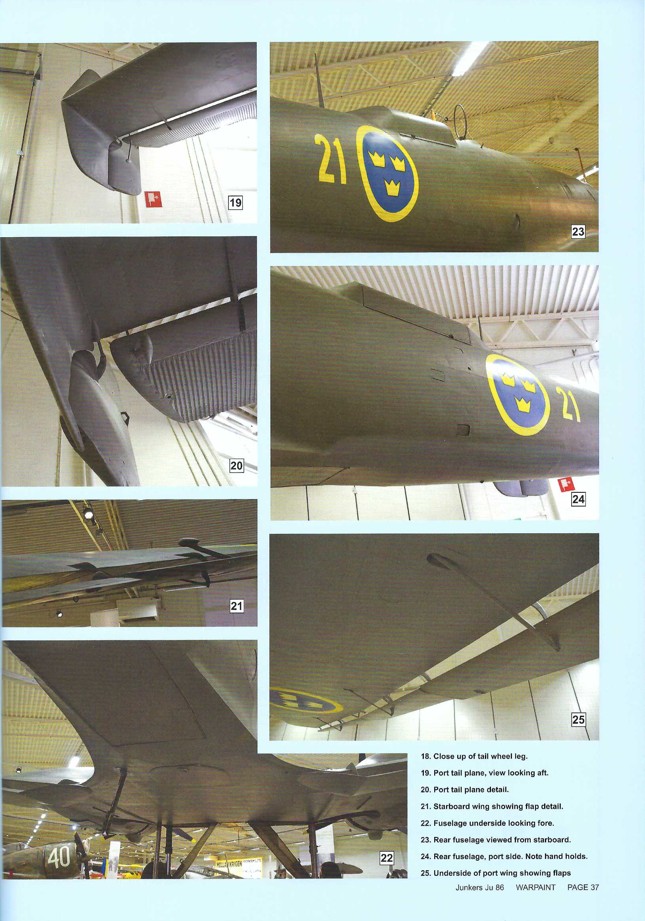
One of the standard features of Warpaint is the In Detail section as seen on Page 37. Fortunately, Sweden has preserved the only remaining Junkers Ju 86, in this case the Junkers Ju 86K-4, Werknummer 0860412, which was built in Germany in 1938. Here you have four pages consisting of 25 excellent color photographs of her at the Swedish Air Force Museum near Linköping. Delivered to F1 Västmanland Wing in June 1938, she saw her final years of service as a transport for F21 Norrbotten Wing. This Swedish Ju 86K-4 served until 1958, accumulating 2,086 hours, before being put on static display. She was featured in a 1955 West German black and white movie, Des Teufels General [The Devil’s General]. The Swedish Ju 86K-4 [in Swedish service known as the B 3A] was powered by Bristol Pegasus III radial engines.
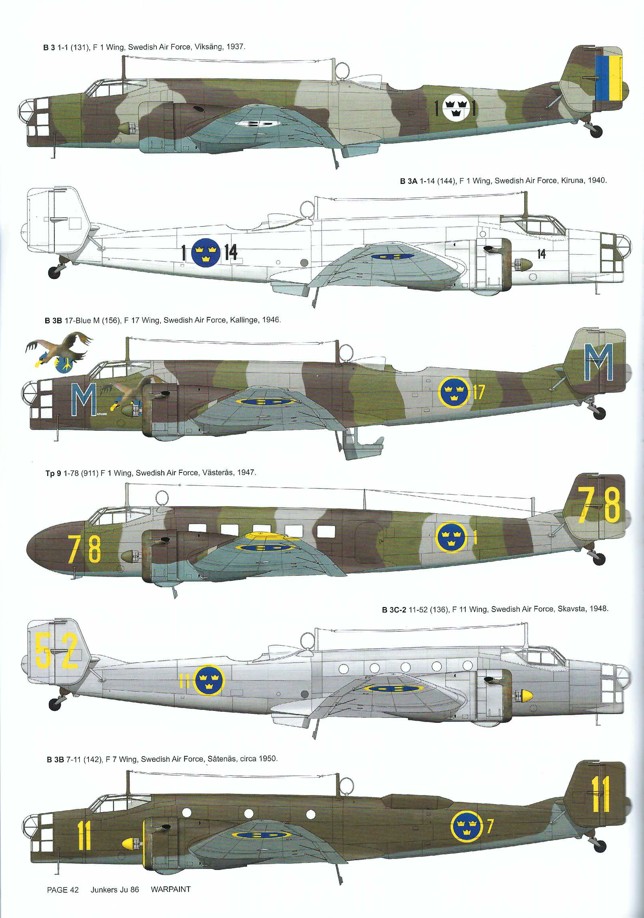
Six examples of the color side profiles by Sam Pearson can be viewed on Page 42. In this case, these are six variants of the Swedish Ju 86. The top color profile is of B 3, coded 1-1, serving with F1 Västmanland Wing, circa 1937. This was the first B 3, a German manufactured Ju 86K-4 that was delivered December 18, 1936. Notable is the first three aircraft [s/n 131, 132, 133] were powered by a pair of 750hp Pratt & Whitney Hornet S1 E-G nine-cylinder radial engines which can be differentiated from later variants with the Bristol Mercury radial engines by the lack of the copper colored [burnt steel] forward edge of the cowling that was the steel exhaust collector ring for the Mercury engine [as displayed by the next five color profiles]. The second color profile is of a B 3A, still a German manufactured Ju 86K-4, but powered by Bristol Mercury III engines. This aircraft [s/n 144, c/n 0860363], serving again with F1 Västmanland Wing is shown in 1940 when she was flying out of Lake Luossajärvi ice airfield near Kiruna Sweden, the northernmost city in Sweden. She was painted white [FS 37925] on top with the lower surfaces painted RLM 65 Hellblau [FS 35352].
The third color profile is B 3B [s/n 156, c/n 0860413] that was originally delivered as a B 3A to F1 Västmanland Wing on May 17, 1938. She was later modified to the B 3B standard with a pair of 820hp Bristol Mercury XII engines and would serve with the F 17 Kallinge Wing until June 23, 1947. The Swedish Air Force operated one Ju 86Z-7 [s/n 911, c/n 0860959] as a Junkers Tp 9 as a military transport with F1 Västmanland Wing and is shown as the fourth color side profile. Originally operated by AB Aerotransport [ABA] as a mail transport with the code SE-BAE, she joined the Swedish Air Force in August 1940 and served until October 1958. She was named “Svalan” [The Swallow] when flying with ABA and was originally delivered with 750hp Pratt & Whitney S-1 E-G radial engines. Due to reliability issues, they were soon replaced by Bristol Mercury XXIV engines licensed built by NOHAB in Trollhättan. The fifth color profile is of a F17 Södermanland Wing B 3C-2 [s/n 136, c/n 0860345] that was originally delivered on January 29, 1938, as the sixth B 3 bomber. She was later upgraded to B 3B standards with a pair of NOHAB manufactured Bristol Mercury XII engines and then to B 3C-2 standards with a pair of NOHAB manufactured Bristol Mercury XXIV engines. Here she has had her camouflage removed and is sporting bare aluminum, saving some 80 kg in weight. The final color profile is of a F 7 Såtenäs Wing after WWII, circa 1950., camouflaged in Olive Green 325 [FS 24079] and Light Blue Grey 058 [FS 25190]. This B 3B [s/n 142, c/n 0860359] was originally delivered March 14, 1938, to the Swedish Air Force as a B 3A and was later upgraded to a B 3B with NOHAB manufactured Mercury XII engines. She served until September 3, 1957, accumulating 2,381 hours. Notable is that the dorsal gun position has been covered by a dome, indicating this B 3B was now serving as a transport. The Chapters include:
- Introduction
- Junkers - Empire From the Ashes
- Luftwaffe Beginnings and the End of the Original Bomber Variants [Page 04]
- Lufthansa – Flying Advert and Testing Ground
- Ju 86P and R Reconnaissance / Bomber Variants – The Second Coming
- Last Gasp
- Legion Condor [Page 10]
- Australia
- Austria
- Bolivia
- Chile
- Hungary [Page 18]
- Manchukuo
- Portugal
- Romania
- South Africa
- Spain
- Sweden
- Switzerland
- Last Word
- Appendix I – List of Variants [Table]
- Appendix II – Example Specifications [Table]
- Junkers Ju 86 In Detail [Page 37]
- Junkers Ju 86 1/144 Scale Drawings by Sam Pearson
- Colour Side Profiles by Sam Pearson [Page 42]
The Junkers Ju 86 has been widely released in 1/72-scale with a single kit released in 1/48-scale and none that I could find in any other scales [1/144, etc.]. Planes Resin released a 3D printed limited edition kit of the Royal Hungarian Air Force Junkers Ju 86K-2 in 2022. Pilot Replicas has announced that they will be re-releasing this kit for the Swedish variants, B 3A through B 3D with the appropriate cast resin and 3D printed parts for 2026. Italaerei released an injected plastic new tool Junkers Ju 86D-1 in 1973 that has been re-released under Revell, Italeri, and Testors since then. This basic model has been released since as a Ju 86E-1, Ju 86E-2, Ju 86K-1, Ju 86K-2, Ju 86K-6. Revell released an injected plastic new kit of the civilian variant with a revised fuselage sprue in 1993 with the Ju 86Z-1 and Ju 86Z-2 that was subsequently released by Italeri as the Ju 86B-0, Ju 86Z-1, Ju 86Z-2. RS Models released a new tool kit with the Ju 86P-1 and Ju 86P-2 in 2011 followed by the Ju 86R-1 with the addition of new parts. Kora Models came out in 2010 with an entire series of resin conversion parts with decals that would convert the Italeri kit to nearly any other variant, including the Swedish B 3A, T 3B, B 3C, and T 3D variants.
Daniel Kowalczuk delivers a nice monograph on the Junkers Ju 86 that I was able to read easily in three evenings. Daniel does cover the development of the high altitude reconnaissance / bomber variants, the Ju 86P and Ju 86R and includes the Junkers Ju 49 and Ju EF 61 aircraft that helped prove the concept of pressurized cabins. Still, there remained many issues to be resolved involving high altitude flight. These included altitude sickness, wing icing, and of course the British soon found ways to get their Spitfires up high enough to attack at higher altitudes. The text is well supplemented with very clear photographs with good captions. Sam Pearson provides well executed color side profiles and the 1/144-line drawings. This is a nice reference on the Junkers Ju 86 and would be a handy addition to your reference library. If you are building any of these model kits, I would consider this edition essential as an aid to your build. If you own any of the previous releases in the Warpaint series, you know what you are getting. If this is your initial entry into this series, you will be quite pleased.
My thanks to Guideline Publications and IPMS/USA for the chance to review this great monograph.
Highly recommended!
Reviewer Bio
Frank Landrus

Frank retired from the Ophthalmic industry with over thirty-six years of Research and Development experience. Frank's first model kit was a 1959 Hawk 1/72 US Marines Vought AU-1 Corsair and has been building models for over sixty years. Frank's first encounter with IPMS was attending a North Central Texas ScaleFest show in 1984. Frank soon became more involved in Make-N-Take activities and became the IPMS Western Coordinator for Make-N-Takes [West of the Mississippi River]. Make-N-Takes quickly became a local model contest and airshow staple reaching a high of reaching over 1,300 children before the COVID shutdown. Frank has volunteered to assist in contest judging since 1985 and is currently the Nationals Head Figure Judge until he is dead or they find someone better.
Comments
Add new comment
This site is protected by reCAPTCHA and the Google Privacy Policy and Terms of Service apply.
Similar Reviews