
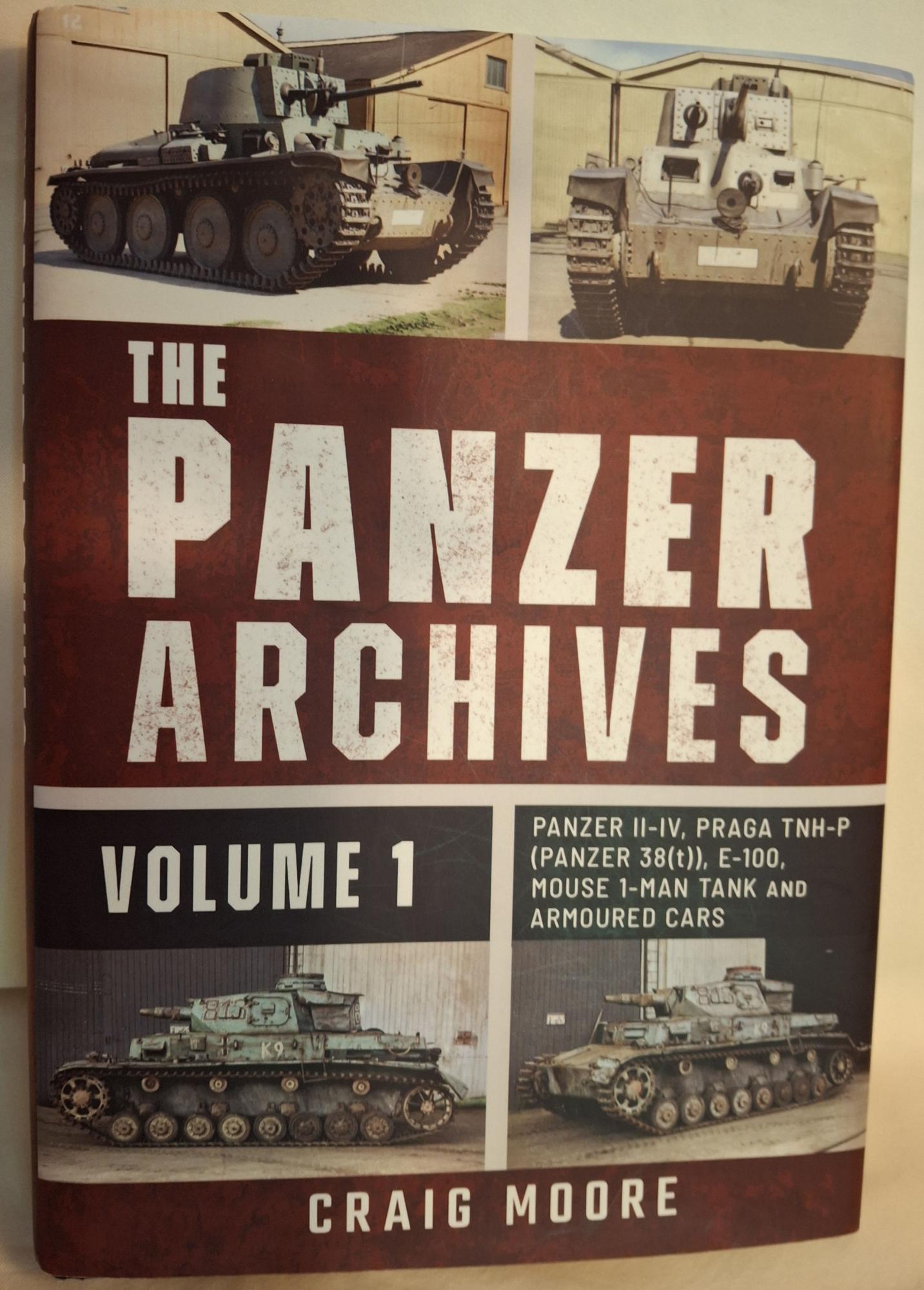
The Panzer Archives, Volume 1
About the Author
The following is taken from the jacket cover.
Craig Moore has had a passion for military history since he was a child. He is chiefly interested in the two world wars, in which eight of his close relatives fought, and two died. One of his uncles lost a leg in Normandy in 1944 when his Sherman tank was hit by a shell. In 2010 Craig retired from London’s Metropolitan Police after 30 years of service. He lives in south-west London where he makes regular contributions to military history magazines. He also often visits museums and military events around the world. This is his tenth book on topics pertaining to the world wars.
What You Get
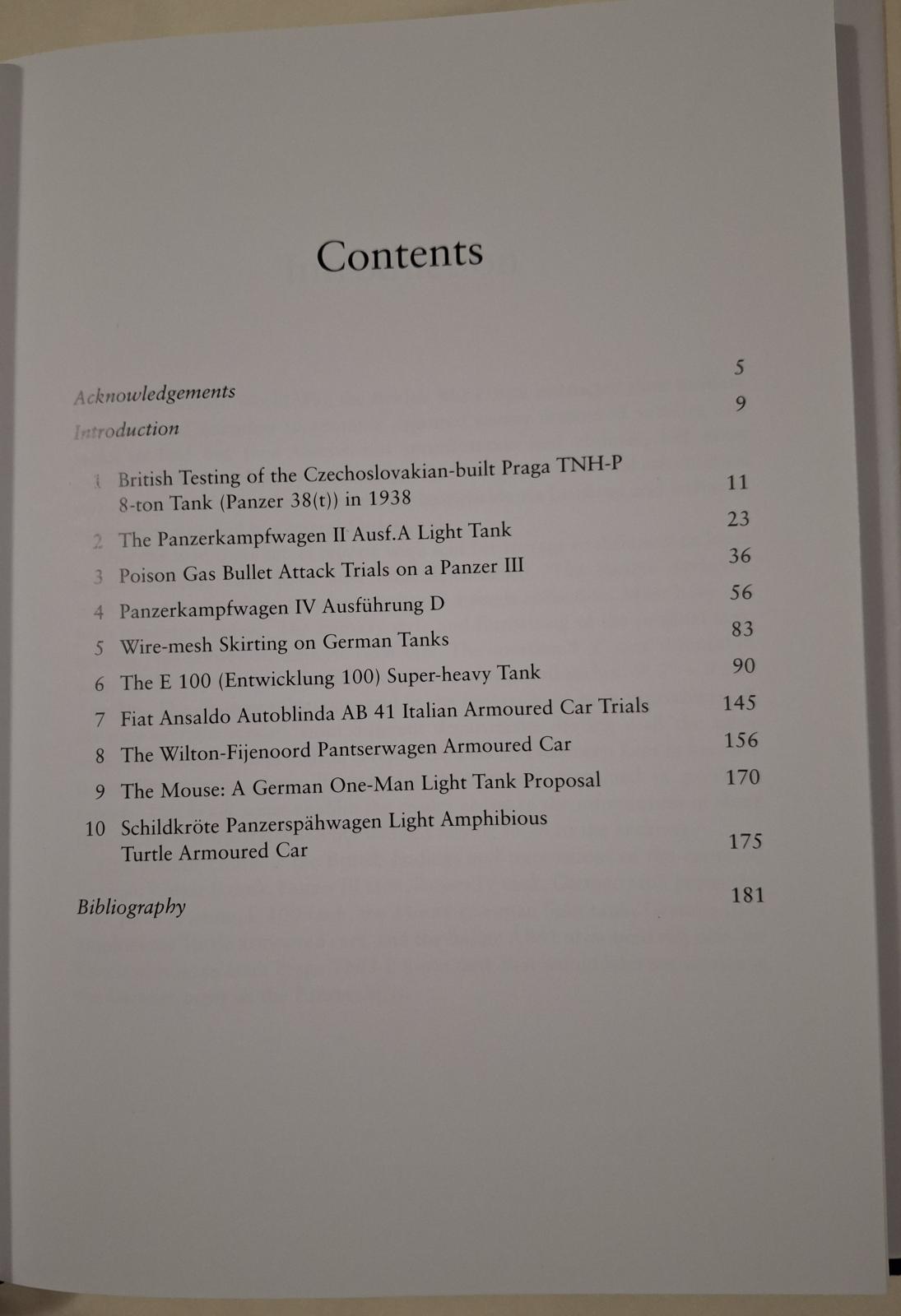
This is a hard bound edition in standard 7⅛ by 10 format with 182 semi-glossy pages. The book contains Acknowledgements, Introduction, 10 Chapters, and a Bibliography.
The Introduction discusses where the information presented in this book was obtained. Mainly from the National Archives in Kew, England.
Chapters 1, 2, 4, 7, and 8 cover British field testing and assessment of various tanks and armored cars.
Chapter 3 discusses field trial on poison gas bullets against a Panzer III.
Chapters 5, 6, 9, and 10 present British intelligence assessments of wire-mesh skirting, and three “paper panzer,” the E-100, a one-man light tank named “the mouse,” and an amphibious light armored car named “the turtle.”.
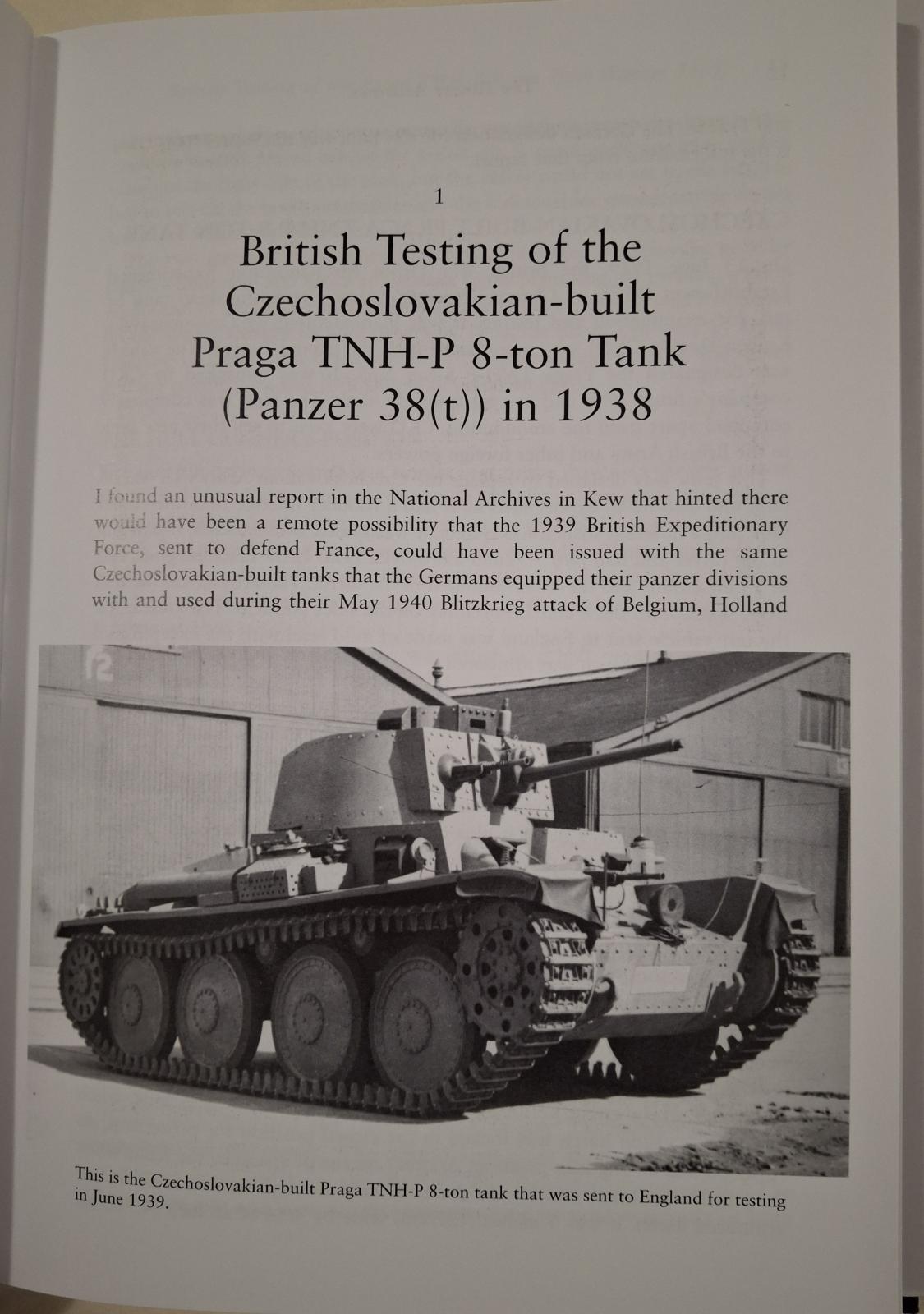
Chapter 1 - British Testing of the Czechoslovakian-built Praga TNH-P 8-ton Tank (Panzer 38T) in 1938
“On 13 June 1939 the British War Office Mechanization Experimental Establishment (MEE) at Chertsey received a new Czechoslovakian tank by rail, for examination and testing.” Evaluations were made of the driver’s position, hull gunner’s position, turret gunner, the hull, and the engine. The tank also underwent road and cross-country field trials.
In the end, the British rejected purchasing the TNH-P 8-ton tank, finding it inferior to the current British Crusader tanks. All positions had limited views, particularly to the side. There was also limited headroom and inadequate ventilation. It was also too thinly armoured for use in an infantry support role, and the Skoda 37mm gun was less powerful than the equivalent British 2-pounder gun.
Following the test are five pages of black and white photographs. Three pictures of the tank tested in 1938 and seven photos of existing TNH-P (Panzer 38T) tanks.
Chapter 2 - The Panzerkampfwagen II Ausf. A Light Tank
The chapter begins with a brief history of development of the Panzerkampfwagen II. During development, the Ausführung (models) were lower case letters ‘a’, ‘b’, and ‘c’ to designate changes in the vehicle. Production models were given capital letters, ‘A’, ‘B’, and ‘C’ for the same reason.
A PzKpw II Ausf. A was captured in Libya during the North African campaign and sent back to England for evaluation of its reliability and performance. After this brief introduction, the author presents a field trial report as found in the national archives. The report covers the obvious items one would expect during a wartime evaluation: condition of the vehicle, vehicle dimensions, armour thickness, armament, and engine. The report then goes into more detail on the ignition, cooling, and lubrication systems, methods of starting the vehicle, fuel system and carburation, transmission, gearbox, steering, final drive, and track and suspension. It also covers the driver’s control, instruments, and the fighting chamber as well as the fabrication of the hull (welded vs riveted).
Following the text are eight black and white photographs of the tank evaluated. There are three interior and one exterior picture that have lines on them. Unfortunately, the descriptions have been cropped from the images to make them larger. As a modeler, it would have been nice to have those callouts included.
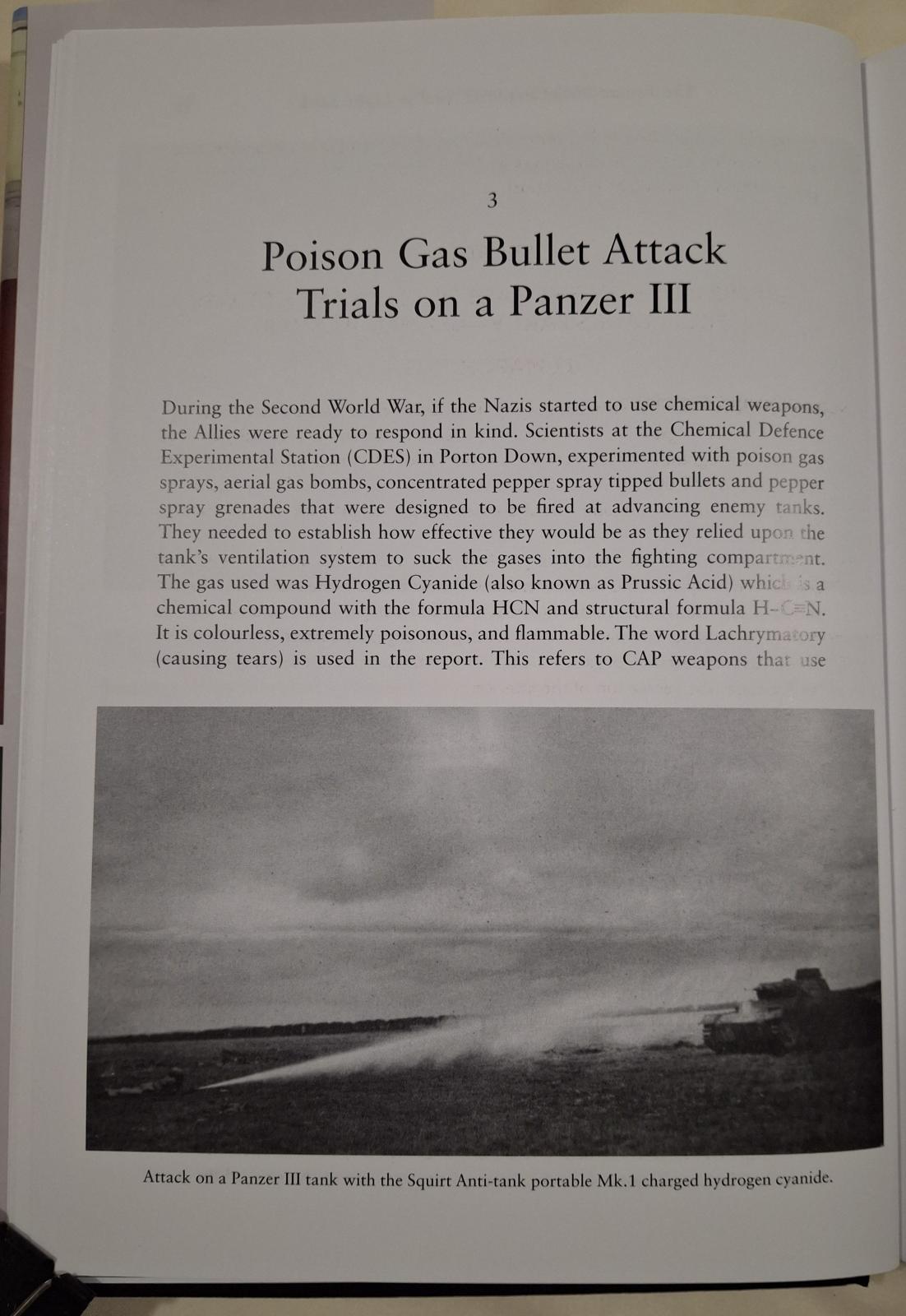
Chapter 3 - Poison Gas Bullet Attack Trials on a Panzer III
Because of the devastating effects from the use of poison gas during the First World War, the Allies were concerned that the Nazis might again fall back on the use of chemical weapons. As a result, the Allies wanted to be prepared in kind. Scientists experimented with different ways of delivering chemical weapons, from sprays, to bombs, grenades, and bullets.
This chapter has the results of six tests at the Chemical Defense Experimental Station in England that tested the vulnerability of the PzKpw III to different types of specialized anti-tank chemical weapons. Six tests were conducted: Squirt, Anti-Tank Portable Mk. 1, an LC 65lb aircraft bomb, an experimental aircraft bomb charged with hydrogen cyanide, a hand grenade with tear gas, and a .303/CAP special ammunition. The vehicle used was a PzKpw III captured in Libya in 1942.
The other test presented in this chapter was to determine the rate of gas clearance from a tank. Most of the chemical weapons developed for use against armoured vehicles relied on the vehicle ventilation system to pull the gas into the tank. Thus, if the tank's ventilation were able to clear the gas before a lethal concentration could be built up, the weapon would effectively have no effect. The text has charts of ventilation clearance times and gas concentrations for the PzKpw III compared to allied tanks for the turret and fighting compartment.
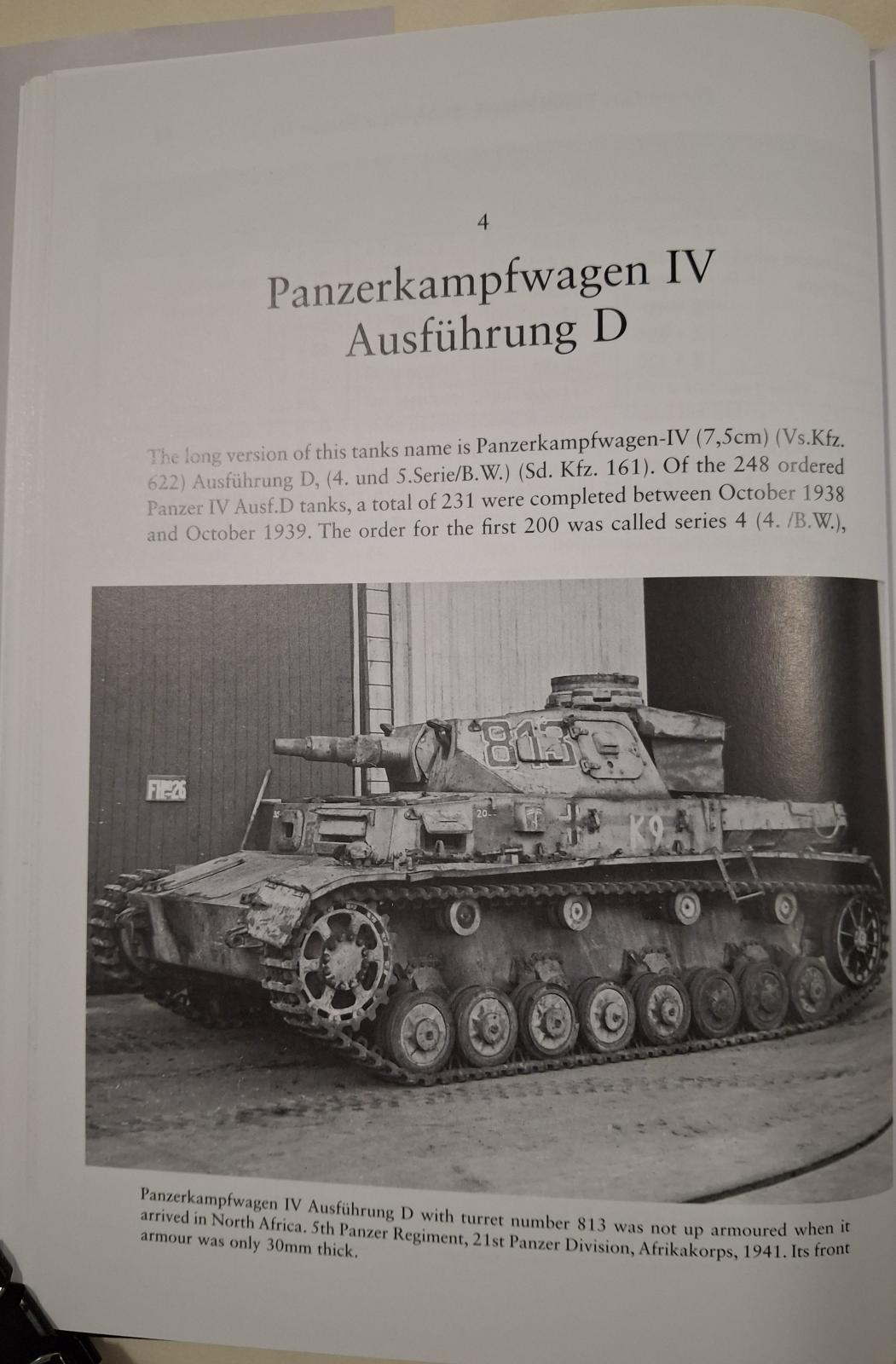
Chapter 4 - Panzerkampfwagen IV Ausführung D
In late 1941 a Panzerkampfwagen IV Ausführung D that had been captured in Libya arrived at the English Department of Tank Design for evaluation. The remarks start with noting that the machine arrived in such a damaged state that no running trials were initially possible. The evaluation included typical vehicle characteristics, length, width, height, engine, track dimensions, etc. The text then presents a more detailed investigation of the interior, transmission, armament, and fire control system.
The second portion of this chapter is a report on field trials of the PzKpw IV. The vehicle had been repaired by Leyland motors. The report starts with general observations about the vehicle, then goes into details on the vehicle characteristics, interior, transmission, armament, and fire control system.
The final part of Chapter 3 is an operational history of the Panzer IV used for the testing, turret number 813. After this short section, there are twenty-two black and white photographs of the vehicle at testing and in during active deployment.
Chapter 5 - Wire-mesh Skirting on German Tanks
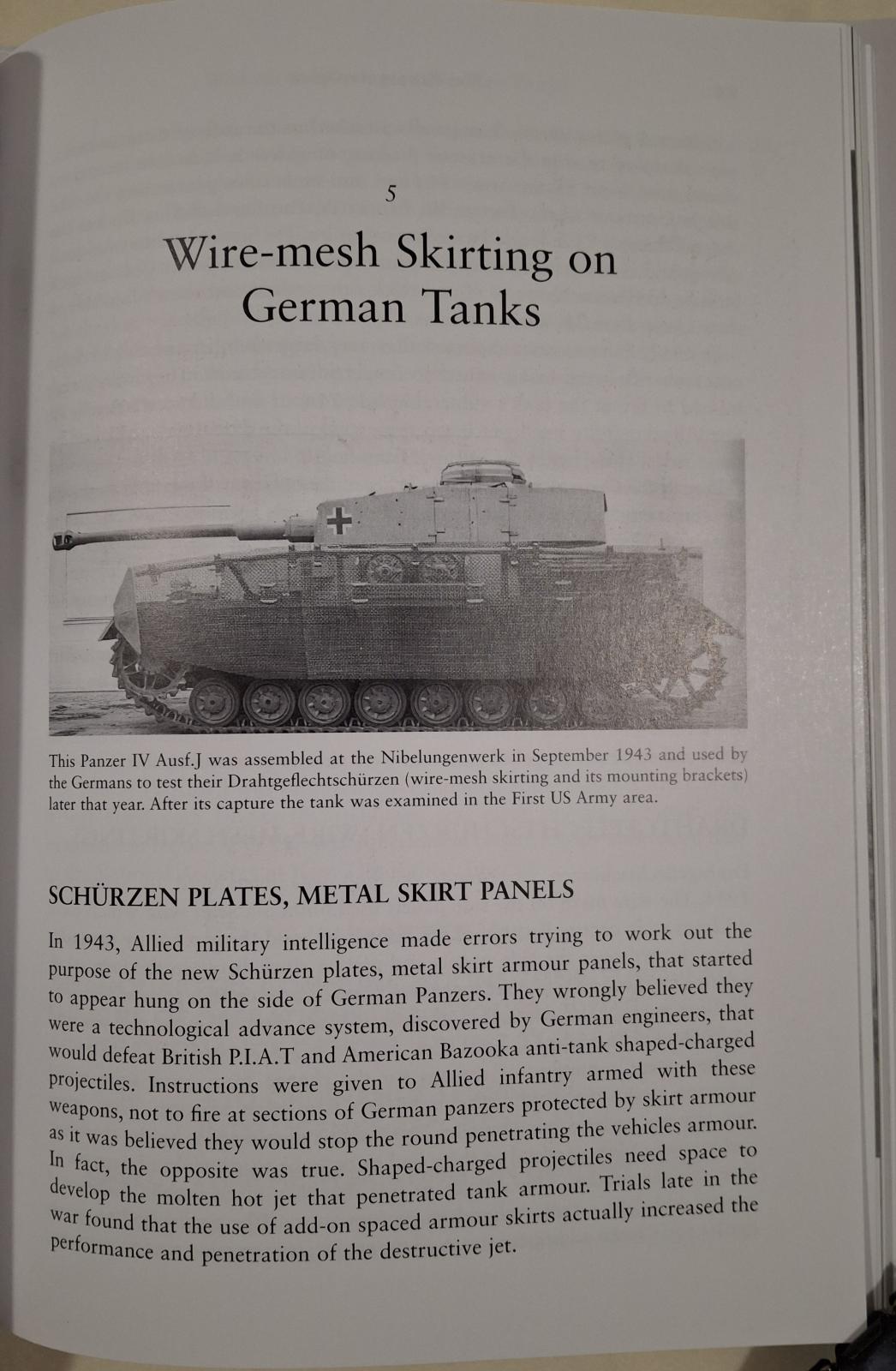
In 1943, Allied military intelligence had made errors trying to determine the purpose of the metal skirting (Schürzen) that was appearing hung on German armour. This introductory section goes into detail about what the American and British believed the armour was for, and for what use it was actually developed.
In September 1944, a new type of skirting, made of wire-mesh, began appearing. This section describes the make-up and use of the Drahtgeflechtschürzen (wire-mesh skirting).
The last section of Chapter 5 is a European Theater of Operations (ETO) Technical Intelligence Report of the wire-mesh skirting on German tanks. It is a brief technical description of the wire-mesh skirting. This report is followed by six black and white photographs of wire-mesh skirting on a vehicle in the field and in museums.
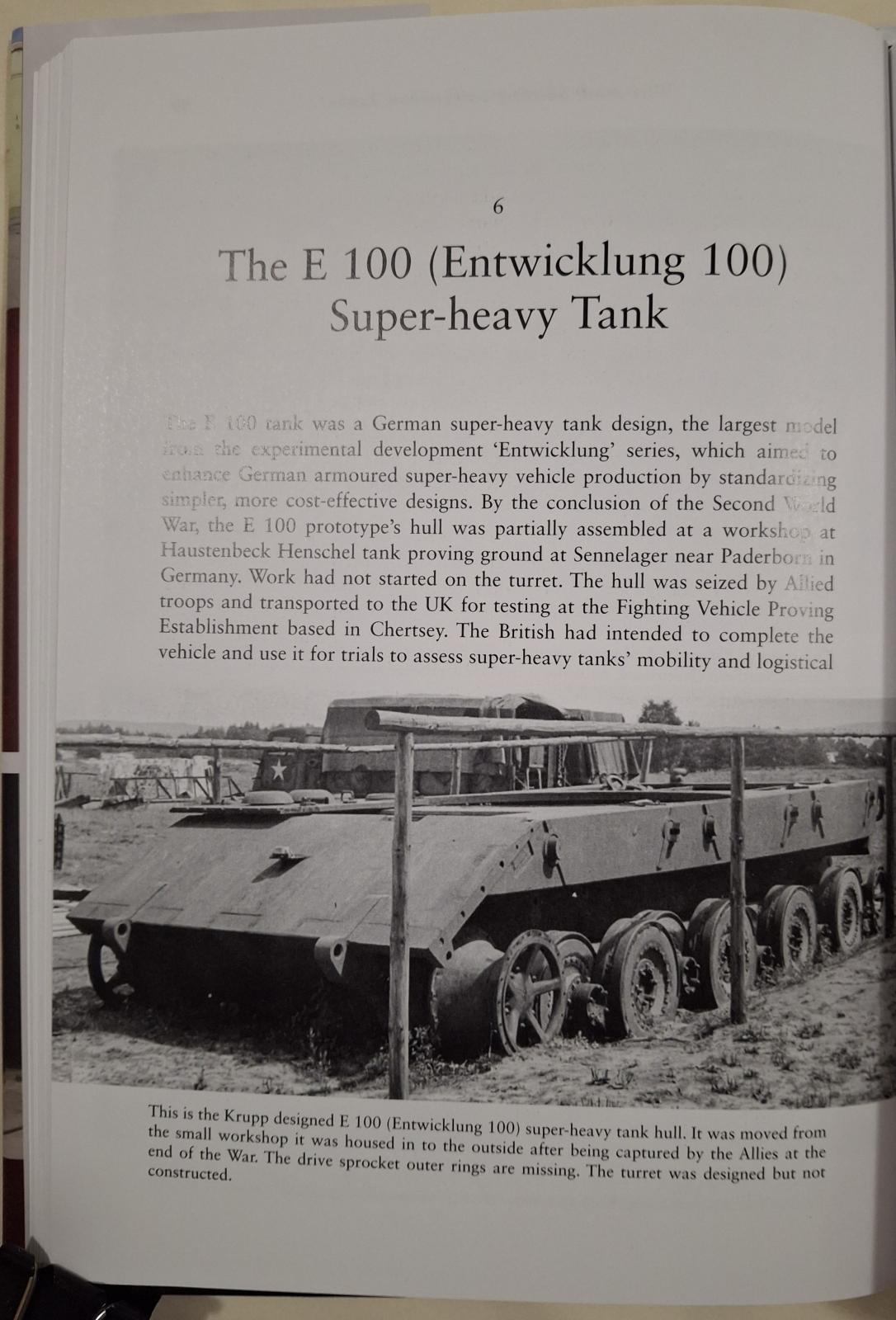
Chapter 6 - The E-100 (Entwicklung 100) Super Heavy Tank
Chapter 6 starts with an introduction covering the development and intended use of the E-100 super heavy tank. This is followed by an interrogation report of an unnamed German engineer and Army Officer Heinrich Ernst Kniepkamp about the E-Series tanks conducted in August 1945.
The Engineer is asked three questions and provides general background on the E-Series vehicles. Herr Kneipkamp adds history and characteristics of the various E-Series tanks. This section is accompanied by four black and white technical drawings.
The next section of this chapter is an ETO Ordnance Technical Intelligence Report on vehicles and materials captured at the Henschel Proving Ground near Sennerlager, Germany. This short report is followed by seventeen black and white pictures of vehicles and parts at the proving ground. These include photos of an unfinished E-100 and the self-propelled 17 cm artillery piece, “Grille.”
The last section is a translation of a German progress report on development of the E-100 tank from January 1945 63 black and white pictures of the subject vehicle taken at the Henschel Proving Ground.
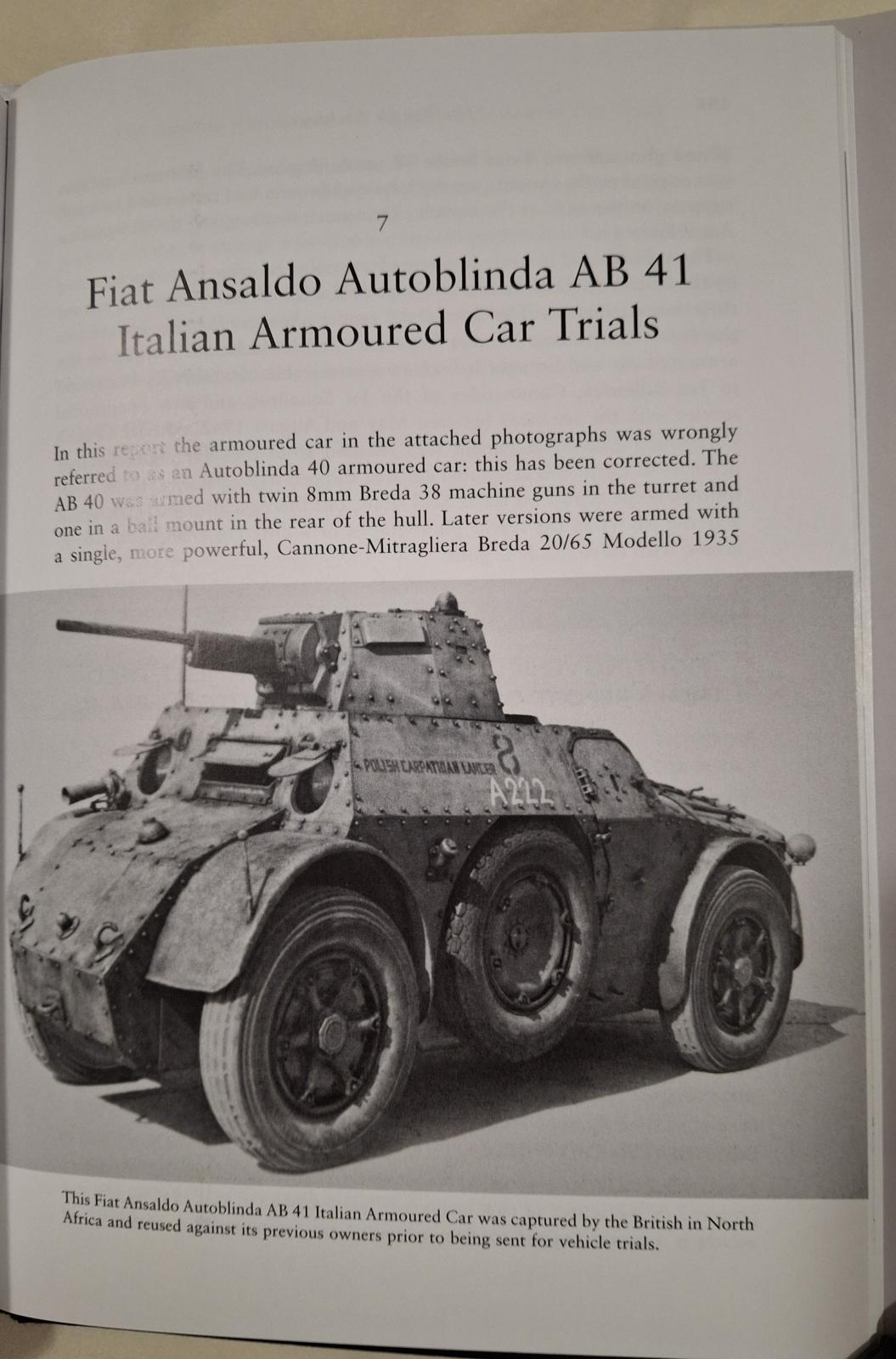
Chapter 7 - Fiat Ansaldo Autoblinda AB41 Italian Armoured Car
After a brief introduction about the vehicle described in this chapter is a field trial report from the Fighting Vehicle Proving Establishment. The report starts with a description and observations of the vehicle. This section is followed by in-depth performance trial details. There are four black and white pictures at the end of the chapter and one at the introduction.
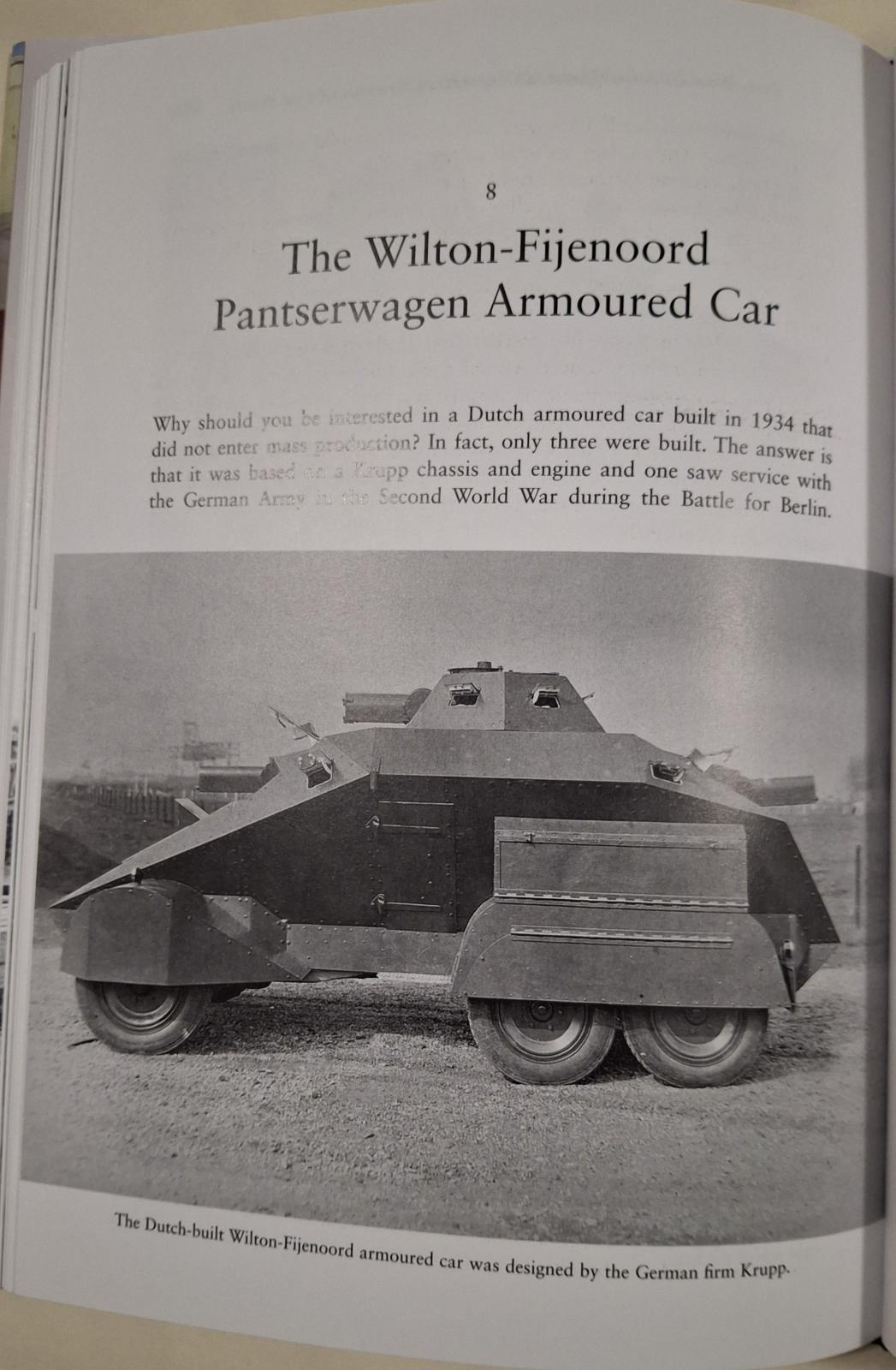
Chapter 8 - The Wilton-Fijenoord Pantserwagen Armoured Car
In 1934, the Dutch manufacturer Wilton-Fijenoord designed an armoured car for use against rebels in the Dutch East Indies (modern-day Indonesia). The reason it appears in a book on German vehicles is that this armoured car was designed on a Krupp chassis and engine. So, in the early years of the Nazi regime, they evaluated this vehicle for use by their growing military.
This chapter is all prepared text detailing the development, testing, and deployment by the Dutch and the German armies. It is also interesting to note that in late 1933 the British Mechanization Experimental Establishment was testing six-wheeled lorries that could be fitted with tracks around the two rear wheels, a feature the Wilton-Fijenoord Pantserwagen armoured car was designed with. The British found it lacking.
The chapter ends, like all others, with black and white pictures, fourteen in all, of the vehicle in various areas. There is also a photo at the start of the chapter.
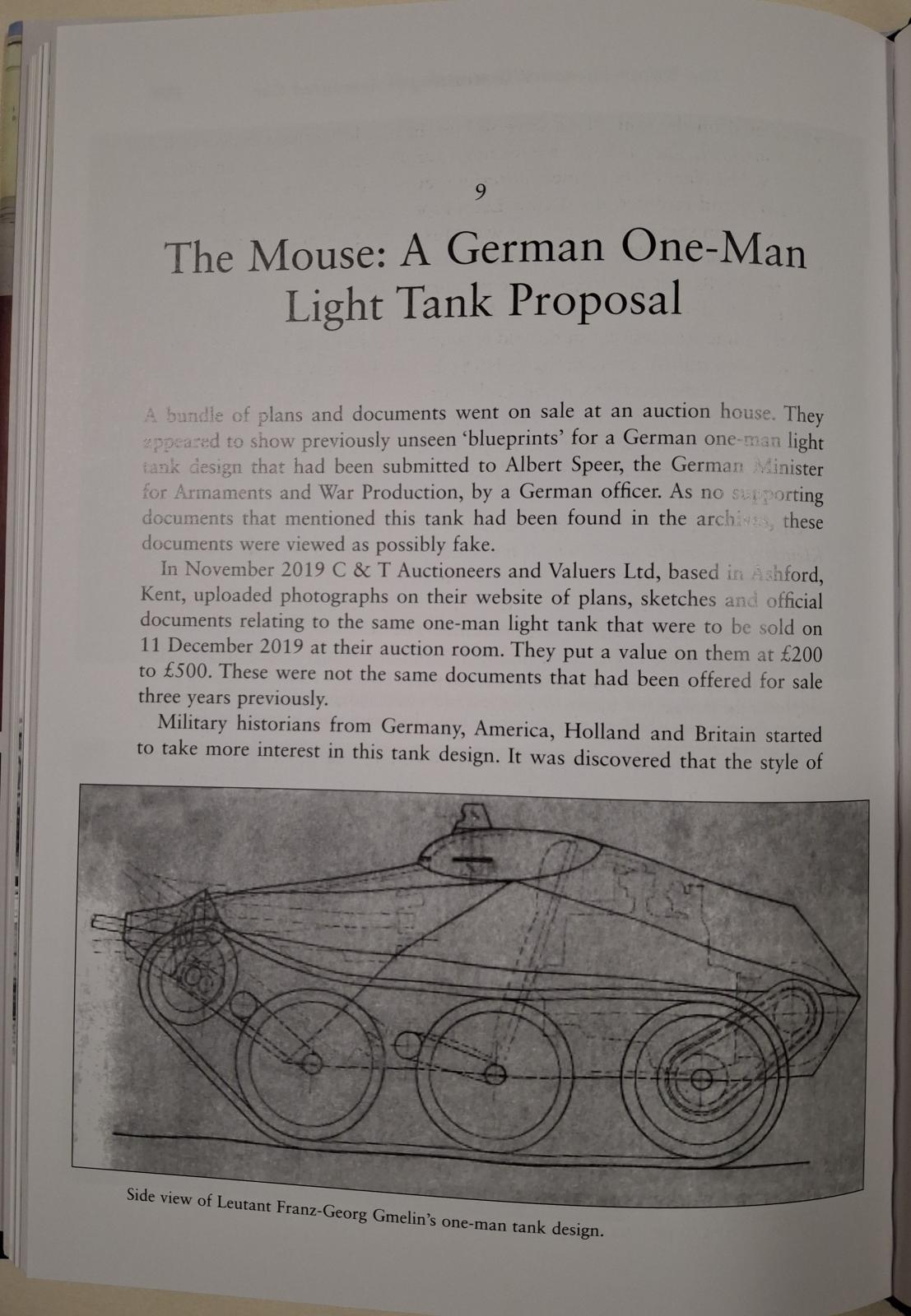
Chapter 9 - The Mouse: A German One-Man Light Tank Proposal
Chapter 9 presents text and five technical drawings of a one-man tank (tankette) designed in 1941 by Leutnant Franz-Georg Gmelin and submitted to the Albert Speer, German Minister for Armaments and War Production. The design was rejected in November 1944, primarily because the Sd.Kfz 251 half-track had proven itself for the reconnaissance role.
Of particular interest is that the document was put up for auction by C&T Auctioneers and Values, Ltd, Ashford, Kent. Four of the five drawings appear to be close-up photographs of the four-view technical drawing.
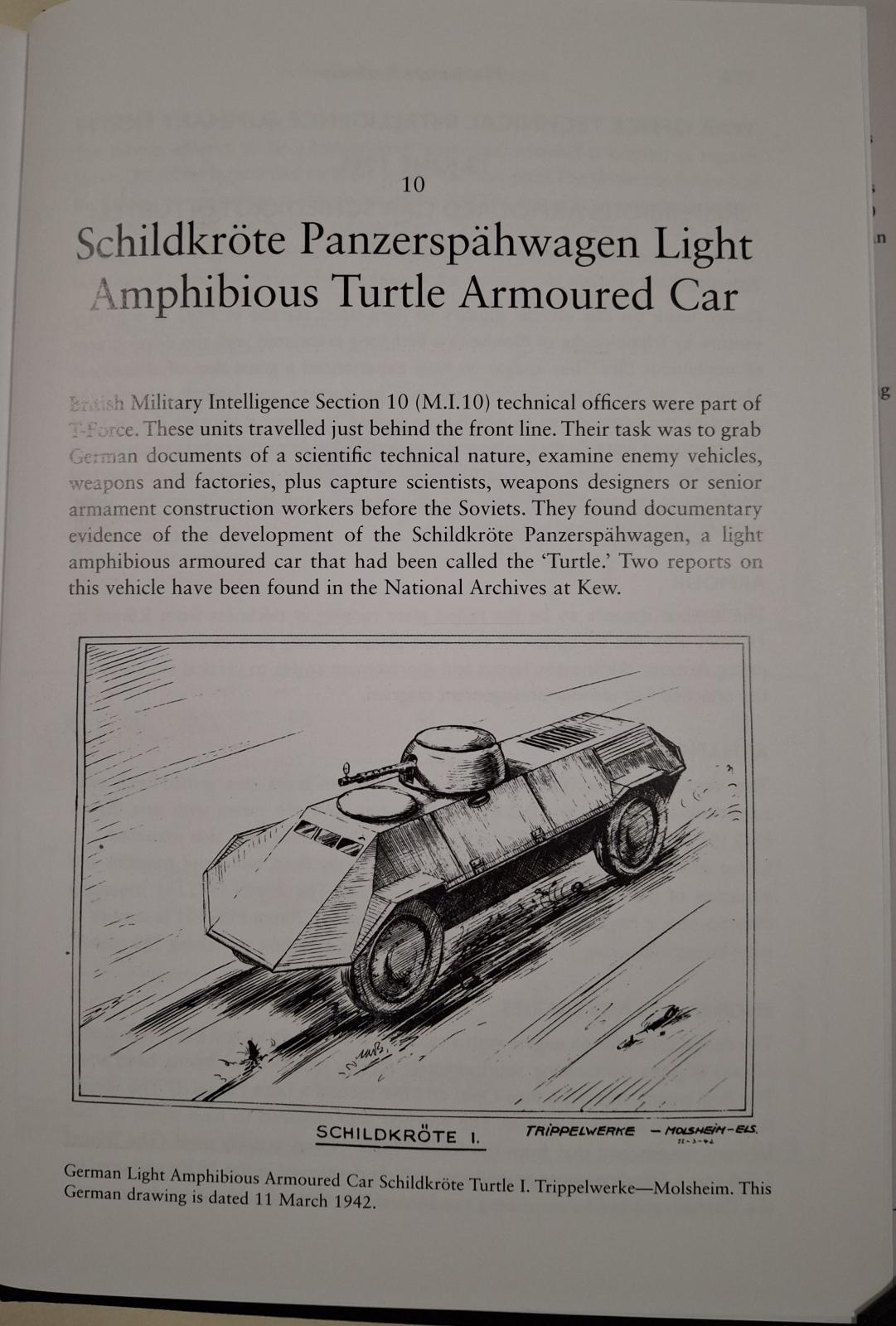
Chapter 10 - Schildkröte Panzerspähwagen Light Amphibious Turtle Armoured Car
The final chapter is an introduction and two War Office Technical Intelligence Summaries of the Schildkröte Panzerspähwagen amphibious armoured car. The Schildkröte Panzerspähwagen amphibious armoured car, called the “Turtle,” was manufactured by Trippelwerke - Molsheim. There is one drawing in this section.
The first technical intelligence summary describes the armour, armament, engine, auxiliaries, and internal layout of the vehicle. This report is accompanied by two drawings. The second summary is a discussion of the development of the “Turtle.” This section includes two black and white photos of the vehicle undergoing water tests.
Bottom Line
From a modeler’s standpoint, there is little of interest, unless one prefers scratch-building paper vehicles from design drawings. From a historical perspective, the text is extremely interesting given that it presents all historical documents as they appeared. The author’s introductory section is well written and provides a useful set-up for the subject of the chapter. I would recommend this to anyone with a bent for interesting and out-of-the-ordinary military history of World War II.
I would like to heartily thank Pen and Sword Books for providing the book for review, and to IPMS USA for giving me the opportunity to review it.
Comments
Add new comment
This site is protected by reCAPTCHA and the Google Privacy Policy and Terms of Service apply.
Similar Reviews