
Hitler's Headquarters in the West, Then and Now
Publisher’s Introductory Notes
“Führer Headquarters were Nazi command centers used by Hitler and his officials during World War II.
The Führer Headquarters, Führerhauptquartiere abbreviated FHQu in German, were headquarters used by Nazi leader Adolf Hitler and his close circle of commanders and officials. As Hitler directly controlled much of the German war effort, the FHQu were de facto military headquarters.
At the beginning of the war, Hitler's railway train served as Führerhauptquartier, for example during the Balkans campaign in the spring of 1941, but the construction of Führerhauptquartiere, Hitler's Headquarters, was entrusted to the Organisation Todt, the Nazi civil engineering body.
'Wolfsschanze' in East Prussia is well known, not least because of 'Operation Valkyrie', Oberst Claus von Stauffenberg's attempt to kill Hitler by detonating a bomb under a conference table on July 20, 1944. It was one of the largest Führer headquarters, and the one where Hitler remained the longest period but by the end of 1944, 16 headquarters had been built throughout Europe and three more were still under construction. Many were never used.”
Reviewer's Notes
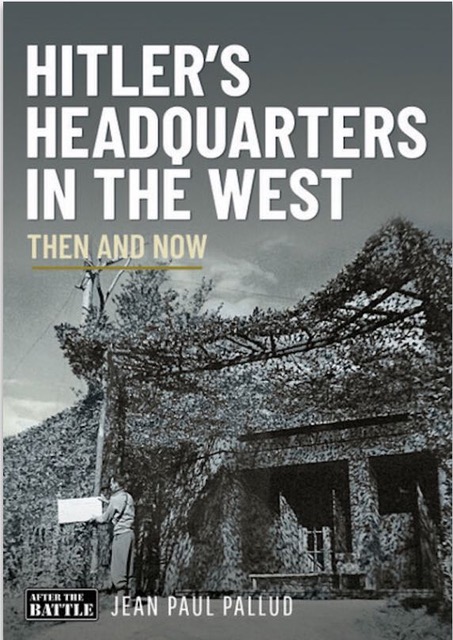
In this book, the latest After the Battle (ATB) publication, Jean Paul has published an extensive and beautiful book chronicling the multiple locations of the Führerhauptquartiere, officially abbreviated FHQu. Like myself, I had labored under the impression that there were only one or two such fortified headquarters. I was really off base in my assumption,as there were at least 16 headquarters designated for the Fuhrer.
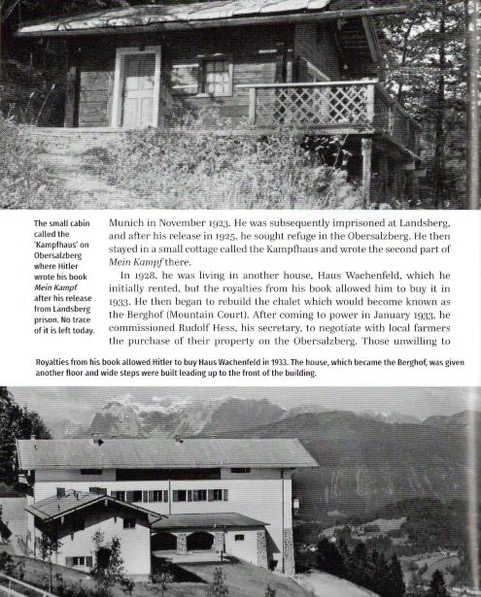
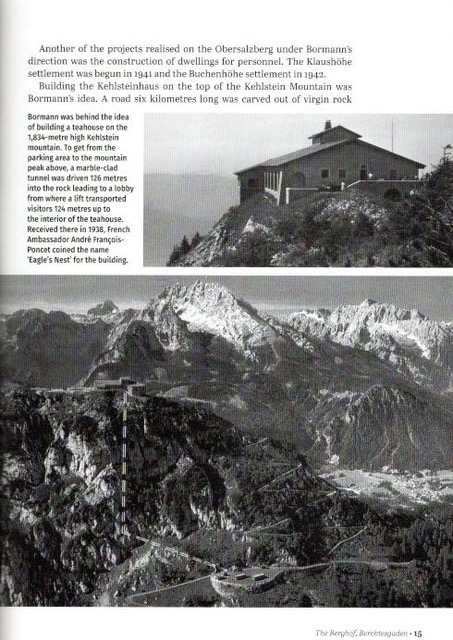
This book is a hardback format and uses a heavy gloss paper, permitting the reader to better view the books’ images. It contains at least 20 color images and (what I estimate) over 100 black and white photographs and sketches and drawings throughout the book. Many of these images provide the perspective of the ‘then and now’ comparisons the ATB series is well known for.
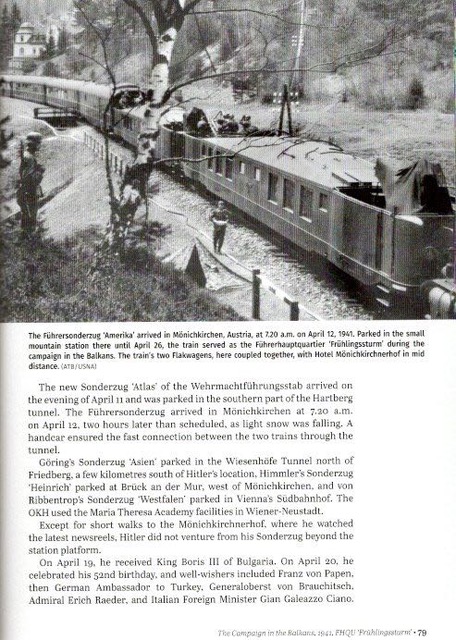
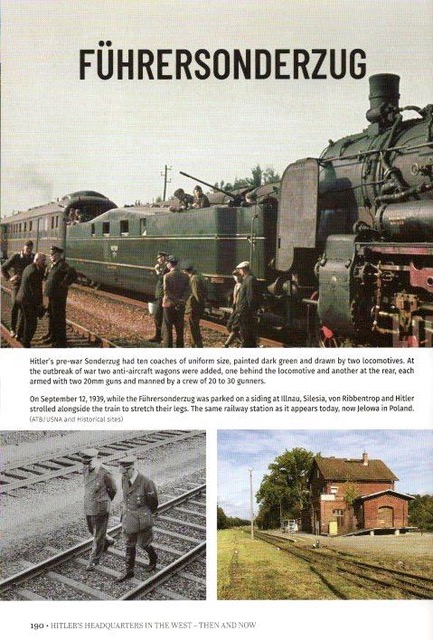
In the section covering the Balkans campaign ‘Frühlingssturm’, I was especially interested in his discussion about the “America”. As the lengthy and fully armored train the Fühersonderzug was described in photographs. Another personal observation: there are many German names and abbreviations used through this book. Having studied German in both high school and university, that allowed me to interpret and better understand the German pronunciations and word.
This book’s Contents covers the following sectional layout:
- Introduction 6
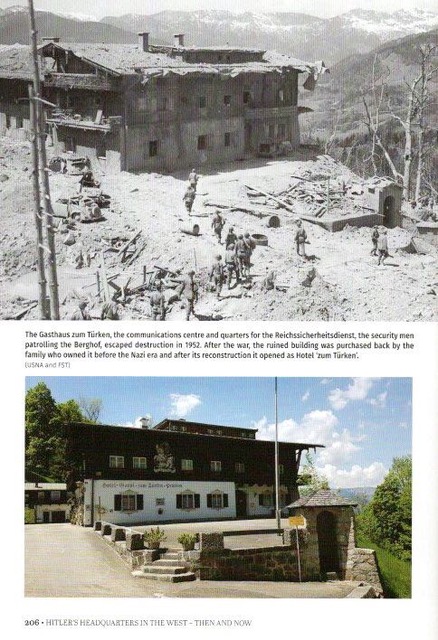
- The Berghof, Berchtesgarden 8
- The Invasion of Poland, 1939, Fühersonderzug 22
- The Blitzkrieg In the West, 1940, Five FHQU 27
- The Campaign In the Balkans, 1941,
- FHQU ‘Frühlingssturm’ 79
- 1941, 1942 and 1943, Occasional Stays At Berghof 96
- FHQU ‘Wolfsschlucht 2’ 103
- FHQU ‘Wolfsschlucht 3’ 135
- Two FHQU Never Used, 1944 152
- The Ardennes Offensive, 1944 FHQU ‘Adlerhorst’ 159
- The Capture of the Berghof, 1945 165
- FHQU Then and Now In Color 185
As a sample of Jean Paul Pallud’s writing, I am quoting from his book:
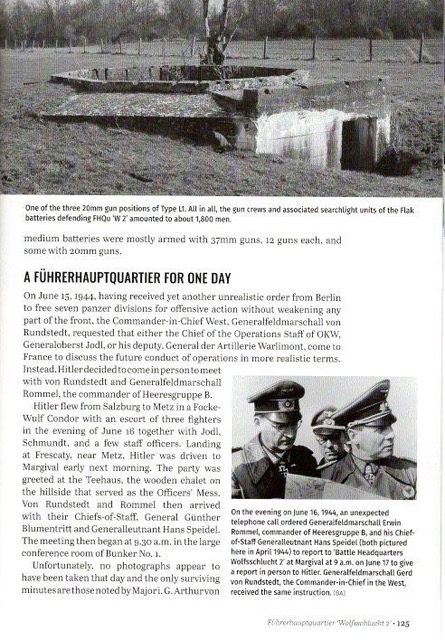
By a queer twist of fate, General Speidel then returned at Margival. After the war, he had served for some time as Professor of Modern History at Tübingen University, his book referred to above being published in October 1950. One month earlier, the three Western occupation powers - Britain, France, and the United States - had accepted in principle that West Germany could contribute military forces to the security of Europe and Speidel became involved in the development and creation of the Bundeswehr. West Germany joined the North Atlantic Treaty Organisation (NATO) in 1955 and in April 1957 Speidel was appointed Commander Allied Land Forces Central Europe. In June, he was promoted to four-star rank just as the first three German divisions joined NATO forces. He immediately brought new perspectives, challenging the Allies to think innovatively about the relationship between conventional and nuclear forces in the conduct of land operations. Speidel remained at this post until September 1963, an impressive achievement considering he had been a general under Hitler only 15 years before!
Recommendation
This is yet another terrific book and serves as a great resource for those searching for more information about Hitler’s World War II various secret and fortified headquarters.
I want to thank Casemate and Pen & Sword, as well as IPMS/USA, for the opportunity to review this book.
Reviewer Bio
Bob LaBouy
I started my modeling adventure in 1951 with an Allen kit. As a ‘Navy Brat’ our family was constantly on the move and I rarely had an opportunity experience modeling as we can today. I was a co-chairman for three national conventions in Seattle. I the opportunity to serve as a Society officer for twelve years, as Treasurer, Historian and President. I live with my wife Helen and our cat Mini in Redmond, Washington. My other interests include my 72 years in Scouting, film and digital photography and Apple computers.
Comments
Add new comment
This site is protected by reCAPTCHA and the Google Privacy Policy and Terms of Service apply.
Similar Reviews