
Cross & Cockade International Winter 2025
The non-profit UK-based group known as the Great War Aviation Society publishes its journal, Cross & Cockade International, four times a year. Issues are available in English as printed [Softbound, A4 (8.27” x 11.69”), 80 pages plus centerfold] as well as digital copies (or both). A new magazine, Contact!, is now available in both print and digital download. The Society also provides a free newsletter (sign up on their website) and occasionally publish WWI themed books like the Sopwith Dolphin monograph I reviewed earlier for IPMS USA. This Journal is the sister of the US Journal, Over The Front. The Great War Aviation Society also hosts a lecture series available through Zoom. If interested, you will need to register early as the call is limited in attendance. The Great War Aviation Society also is on Facebook and on X [Twitter].
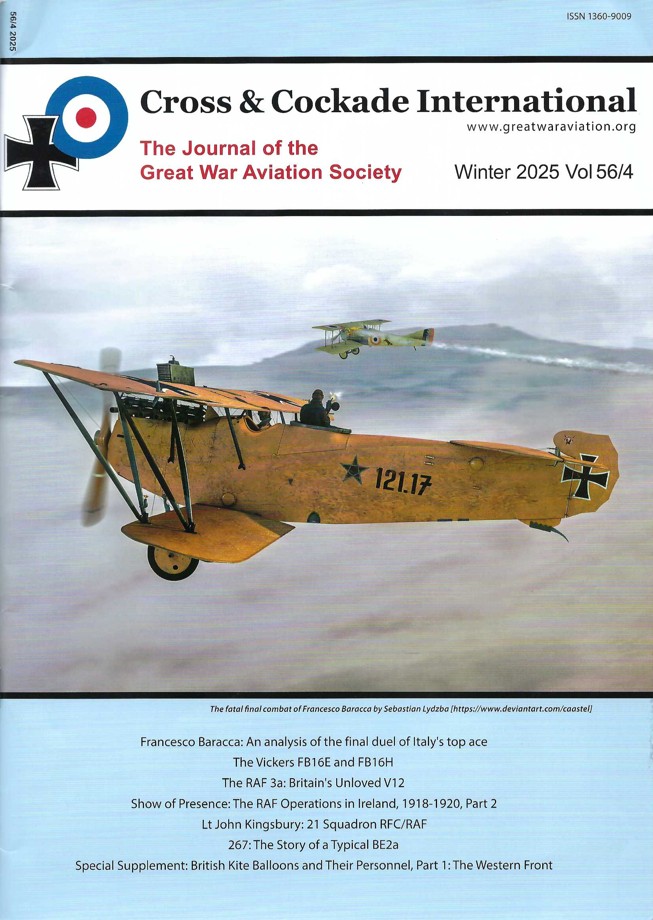
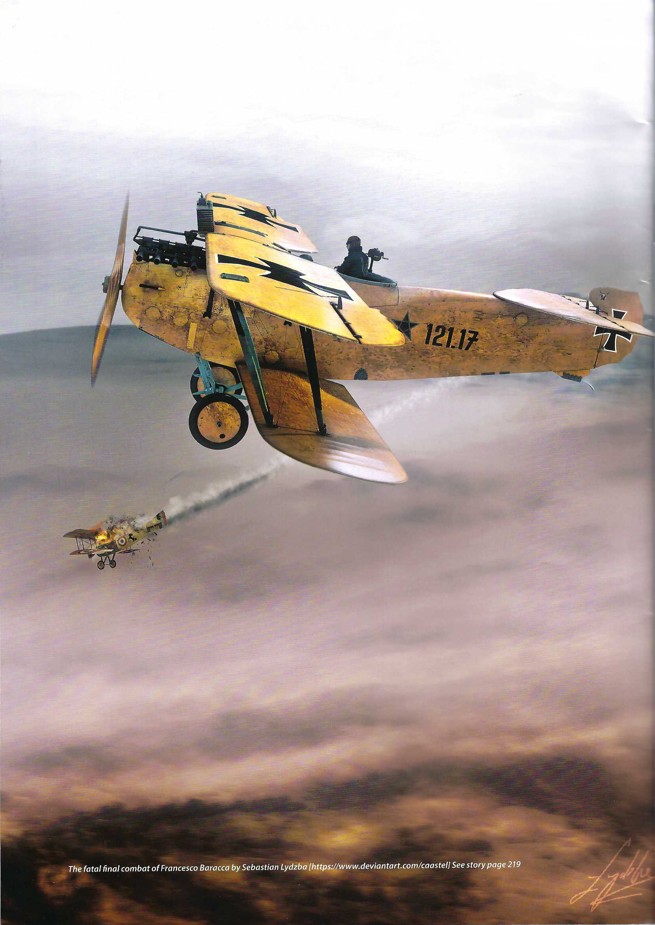
The Winter 2025 journal of Cross & Cockade International features a color illustration of Flik 28 Phoenix C.I shooting at Francesco Baracca’s SPAD VII by Sebastion Lydzba. More of Sebastion’s artwork can be found on www.deviantart.com The rear cover shows off another color illustration of this scene after Baracca was hit. Both the front and rear cover are in conjunction with the article by Fabio Iezzi on Italy’s Top Ace. The pull-out center section opens a new series on British Balloons and Their Personnel by Trevor Henshaw. Part 1 addresses the Western Front with one black and white photograph of a Drachen-type kite balloon of 2 Kite Balloon Section, covering eight pages.
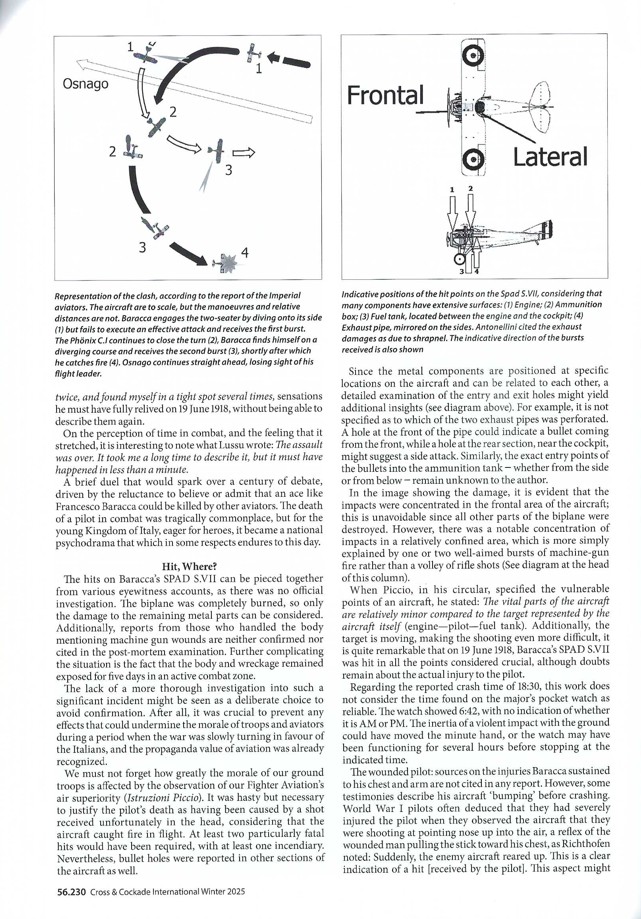
Fabio Iezzi leads off with an analysis of the last day of Italian ace, Major Francesco Luigi Giuseppe Baracca. Credited with 34 aerial victories, his prancing horse emblem was adopted as the logo by Enzo Ferrari after meeting Francesco’s parents in 1923. This eighteen-page feature has 23 black and white photographs, ten black and white illustrations, four tables, two black and white maps, along with the additional color paintings on the front and rear covers. Two of the illustrations are shown on pages 56-230. The upper left drawing shows the path of the three aircraft involved. This includes Francesco Baracca in his SPAD S.VII; his wingman, Tenente Franco Osnago in his SPAD S.XIII, and the crew of the Phonix C.I: Zugsfűhrer Max Kauer and his observer, Oberleutnant Arnold Barwig. The upper right illustration depicts the hits on Baracca’s SPAD S.VII metal components as the rest of the aircraft was completely burned.
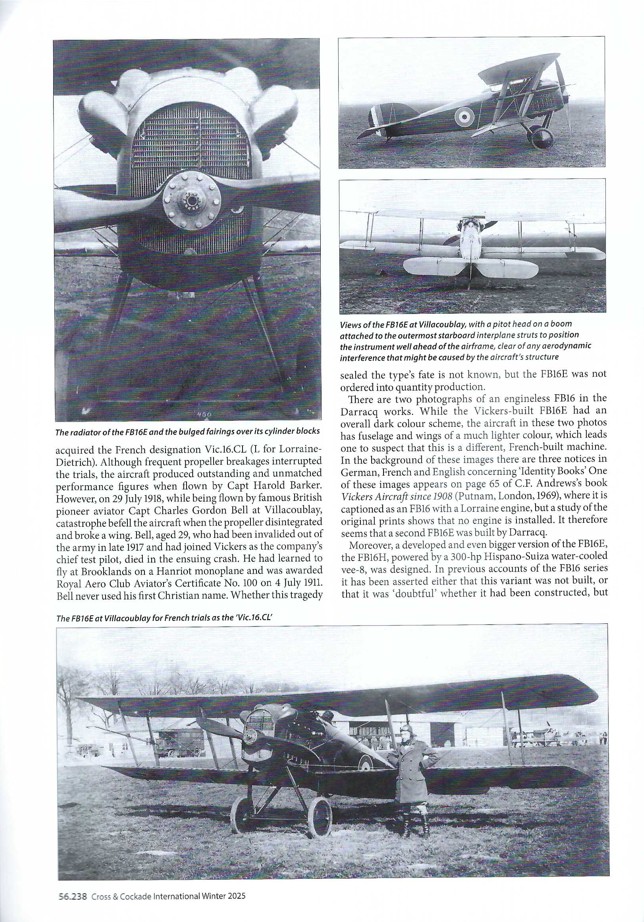
Philip Jarrett follows with The Vickers FB16E and FB16H. This four-page tale has sixteen black and white photographs along with a table. Originally envisioned as a radial-engined fighter, the FB16E was a larger airframe [single bay to two-bay wings] than the FB16A, FB16C, and FB16D. The FB16E was designed to use a French 275hp V-8 engine manufactured by Lorraine-Dietrich and can be seen on Page 56-238 while under French evaluation at Villacoublay. This prototype was destroyed when the propeller disintegrated. The larger FB16H, believed to have been built by Darracq, was built around a 300hp Hispano-Suiza V-8 engine.
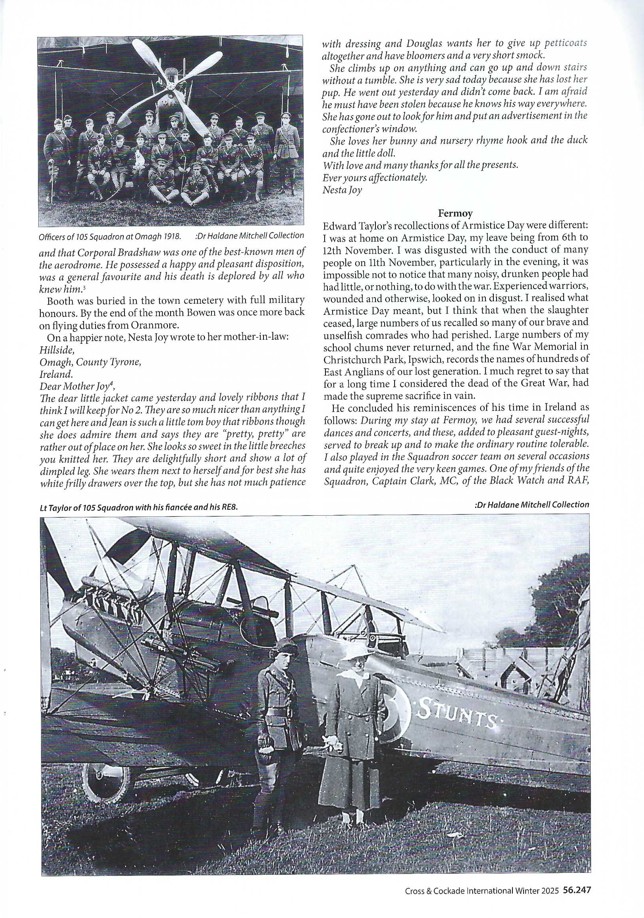
Peter Ewer is up next with The RAF 3a: Britain’s Unloved V12. This five-page case study has five black and white photographs along with four drawings from the National Archives. The Royal Aircraft Factory RAF3a water-cooled V12 engine was built by D. Napier and Son. It went into service with 18 and 49 Squadrons, powering their de Havilland DH4 bombers. Supposedly able to produce 260hp, 260 examples were built by D, Napier and Son with 29 built by Armstrong Whitworth. Additional pictures of RAF3a powered de Havilland DH4 aircraft in service with 19 Training Squadron operating in Ireland in Guy Warner’s article that follows. The second part of Guy Warner’s history of the Show of Prescence: The RAF Operations in Ireland, 1918-1920 spans twenty-five pages and includes fifty black and white photographs and three black and white maps. Two black and white pictures of 105 Squadron can be found on Page 56.247. The upper photograph features 105 Squadron officers in front of a Royal Aircraft Factory designed R.E.8. The picture at the bottom of the page shows Lt. Edward Taylor posing with his fiancée in front of his R.E.8.
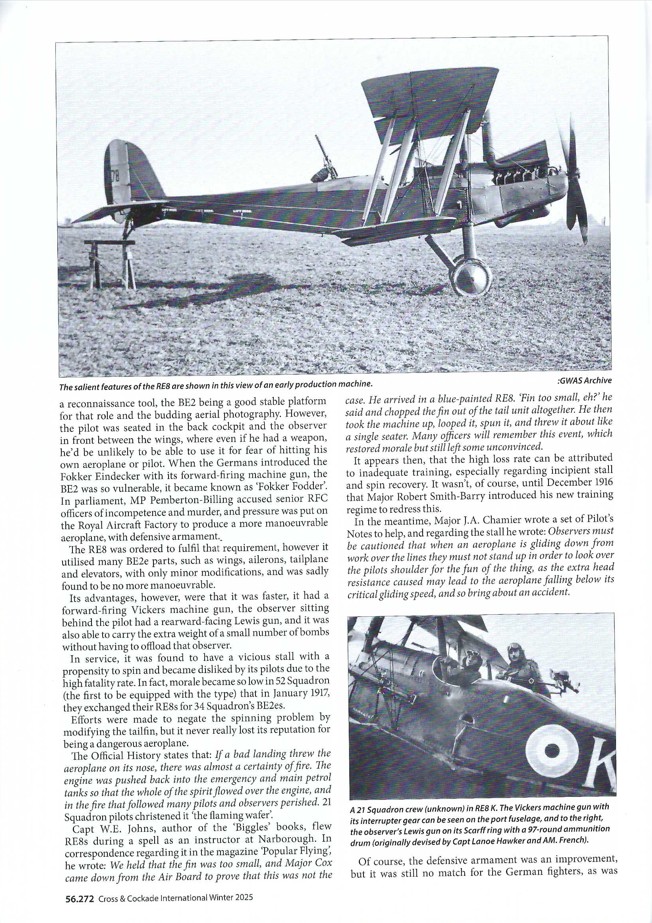
Peter Brand’s entry is Lt John Kingsbury: 21 Squadron RFC/RAF. This is a nine-page biography with seventeen black and white photographs based on his personal diary, photograph albums, and flightlog supplied by his daughter. John was posted to 21 Squadron with the R.E.8 on August 25, 1917. An early R.E.8’s side profile is shown at the top of Page 56.272. Another 21 Squadron crew is depicted in their R.E.8 at the bottom of the page. Kingsbury was finally sent home to be an instructor on May 22, 1918, providing new pilot training on Avros, DH4s, DH6s, BEs, and R.E.8s. John flew his last flight on January 25, 1919, having accumulated at total of 499 hours of flight time. A career change saw him entering medical school, where he would matriculate as an Ear, Nose, & Throat surgeon.
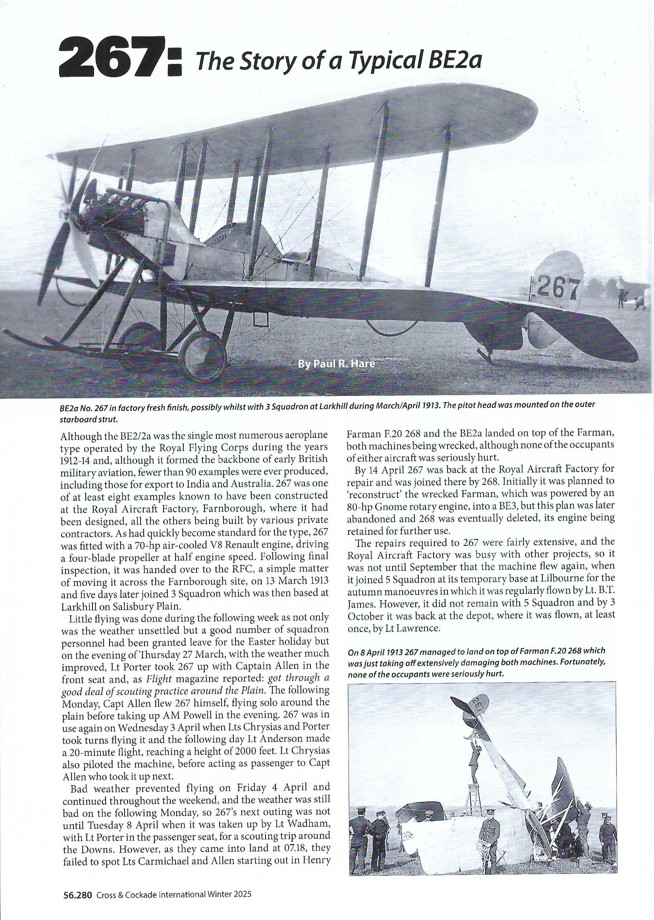
Paul Hare’s contribution is 267: The Story of a Typical BE2a, following a single aircraft. This three-page article includes seven black-and-white photographs. A factory fresh 267, one of the few [8 airframes] built by the Royal Aircraft Factory, can be found at the top of page 56.280 with a second photograph broken up after landing on top of a Farman F.20 [268[. Surprisingly, 267 was repaired and did fly again. The Farman F.20 was also sent to the Royal Aircraft Factory for repair as well, but it ended up never being repaired. Fifteen black and white photographs populate From The Albums for three pages. These pictures are Part 2 from the Nicod Album via Alex Revell and feature Morane Type N Monoplanes and crew from 60 Squadron at Vert Galand [Vert Galant]. The Bookshelf section is a review of WWI aviation-specific books and magazines, with this issue totaling seven.
Topics:
- Editorial by Mick Davis
- Francesco Baracca: An Analysis of the Final Duel of Italy’s Top Ace by Fabio Iezzi [Page 56.230]
- The Vickers FB16E and FB16H by Philip Jarrett [Page 56.238]
- The RAF 3a: Britain’s Unloved V12 by Peter Ewer
- Show of Presence: The RAF Operations in Ireland, 1918-1920: Part 2 by Guy Warner [Page 56.247]
- Lt John Kingsbury: 21 Squadron RFC/RAF by Peter Brand [Page 56.272]
- 267: The Story of a Typical BE2a by Paul Hare [Page 56.280]
- From The Albums: The Nicod Album via Alex Revell; Part 2
- Fabric by Mick Davis
- Bookshelf – Edited by Paul R. Hare
This is another great issue from The Great War Aviation Society, and I am always impressed with the quality of the articles, both from a research perspective and readability. I was pleasantly surprised to see the lead essay on Francesco Baracca and its analysis of his last flight. The inclusion of aerial fighting rules by several WWI luminaries was great to see. The period pictures, maps, and drawings in this journal come off looking great thanks to their printing on the journal's glossy paper. If you are into early / WWI aviation, this journal is an incredible source of information that will have you on the edge of your seat waiting for the next issue.
My thanks to The Great War Aviation Society and IPMS/USA for the chance to review this great issue.
Highly recommended!
Frank Landrus, IPMS# 35035
Reviewer Bio
Frank Landrus

Frank retired from the Ophthalmic industry with over thirty-six years of Research and Development experience. Frank's first model kit was a 1959 Hawk 1/72 US Marines Vought AU-1 Corsair and has been building models for over sixty years. Frank's first encounter with IPMS was attending a North Central Texas ScaleFest show in 1984. Frank soon became more involved in Make-N-Take activities and became the IPMS Western Coordinator for Make-N-Takes [West of the Mississippi River]. Make-N-Takes quickly became a local model contest and airshow staple reaching a high of reaching over 1,300 children before the COVID shutdown. Frank has volunteered to assist in contest judging since 1985 and is currently the Nationals Head Figure Judge until he is dead or they find someone better.
Comments
Add new comment
This site is protected by reCAPTCHA and the Google Privacy Policy and Terms of Service apply.
Similar Reviews