
Cross & Cockade International Autumn 2026 Vol 57/3
Mick Davis, Managing Editor
Annual subscription is $114 for 4 issues
The non-profit UK based group known as the Great War Aviation Society publishes their journal, Cross & Cockade International, four times a year. Issues are available in English as printed [Softbound, A4 (8.27” x 11.69”), 80 pages plus centerfold] as well as digital copies (or both). A new magazine, Contact!, is now available in both print and digital download. The Society also provides a free newsletter (sign up on their website) and occasionally publish WWI themed books like the Sopwith Dolphin monograph I reviewed earlier for IPMS USA. This Journal is the sister of the US Journal, Over The Front. The Great War Aviation Society also hosts a lecture series available through Zoom. If interested, you will need to register early as the call is limited in attendance. The Great War Aviation Society also is on Facebook and on X [Twitter].
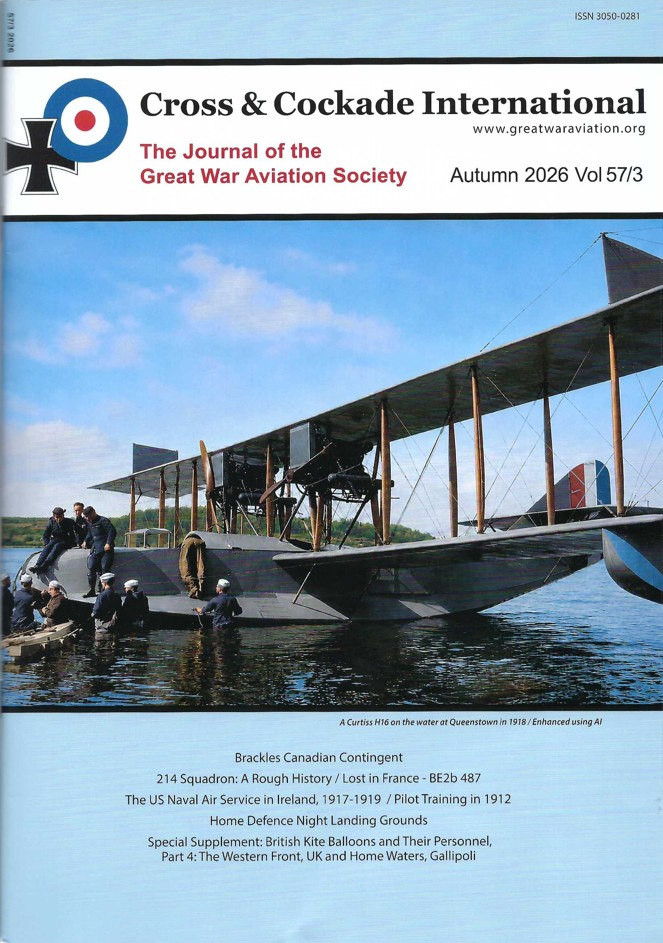
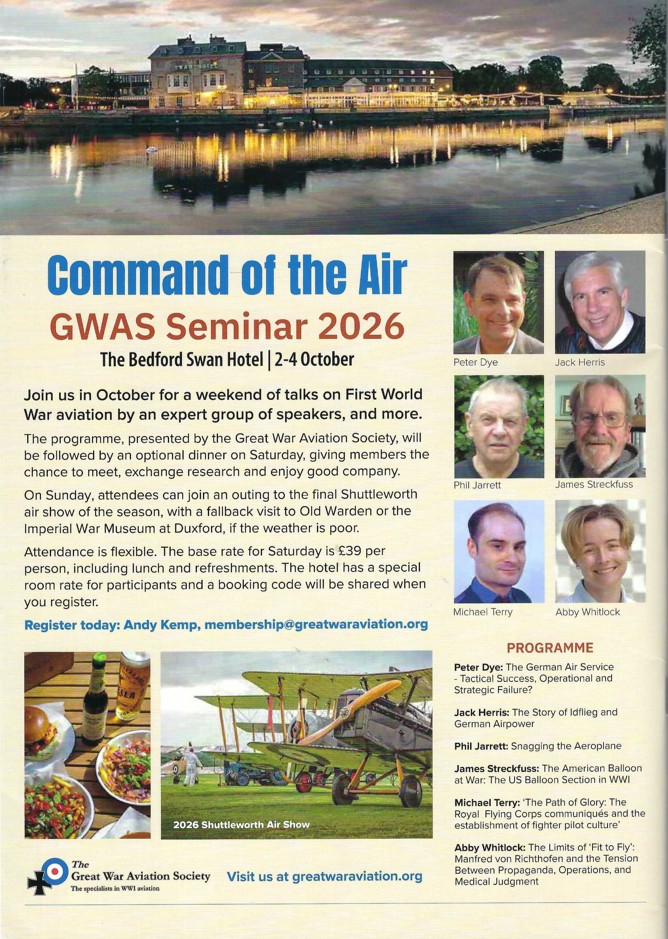
The Autumn 2026 journal of Cross & Cockade International features an AI enhanced color photograph of a Curtiss H 16 at Queenstown in 1918. Queenstown, known as Cobh since 1920, is located on the south coast of County Cork, Ireland, and was the final port of call for the Titanic. This photograph is related to the article by Guy Waner, The US Naval Air Service in Ireland, 1917-1919. The Curtiss H 16 [aka Model 6C] was the last in the line of Model H long range flying boats and was introduced in 1917. It was an enlarged version of the Curtiss Model H 12 with 334 manufactured by Curtiss and the US Naval Aircraft Factory. The US Navy operated Curtiss H 16 flying boats from US Naval Air Station Queenstown during the last months of WWI. The rear cover features an advertisement for the Great War Aviation Society 2026 Seminar at the Bedford Swan Hotel in early October. The pull-out center section presents Part 4 of the current series on British Balloons and Their Personnel by Trevor Henshaw. There are no photographs or maps but there is a daily operations recap from September 24, 1918, to May 1919, covering eight pages.
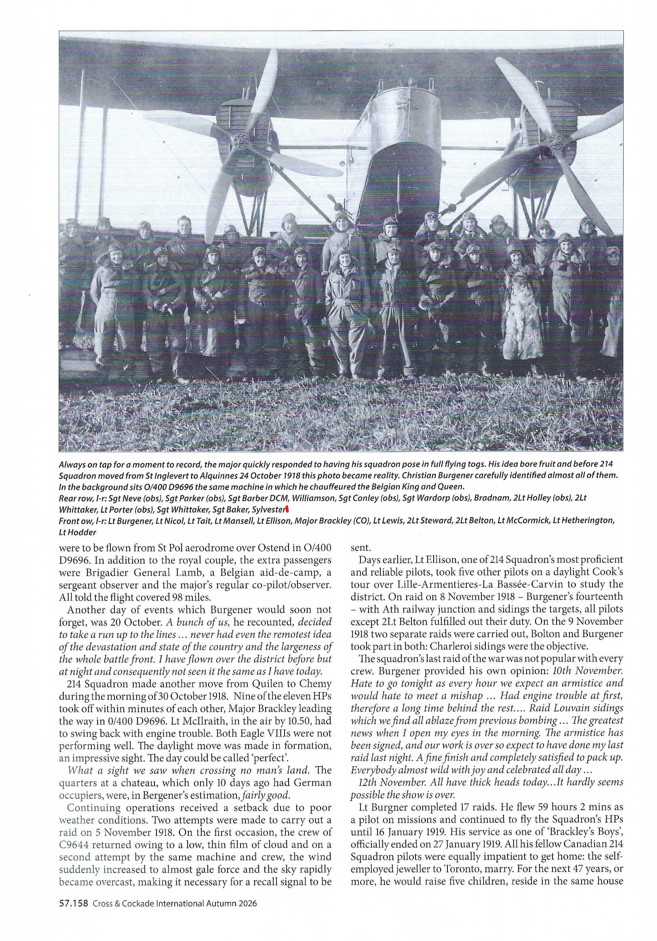
The late Stewart K. Taylor kicks things off with the biographies of Canadians, all pilots, that served with 214 Squadron in Brackles Canadian Contingent. This thirteen-page article includes 23 black and white period photographs. Created on April 1, 1918, from RNAS No. 14 Squadron, it was originally equipped with Handley Page O/100 [HP.11] bombers before integrating O/400 [HP.12] bombers in mid-1918. Both Handley Page Type O bombers serving with RAF 214 Squadron primarily served in tactical night bombing of targets in occupied Belgium and France. RAF 214 Squadron strategic bombing reached Germany for transportation and industrial targets. The Handley Page O/100 achieved its first flight on December 17, 1915 and entered service in late 1916 with 7 Squadron based at Dunkirk flying daytime missions until enemy aircraft forced night operations. Major Brackey managed to get 214 Squadron to pose in front of Handley Page O/400 D9696 on October 24, 1918, as seen on Page 57-158. Stewart K. Taylor’s interview with Canadian 214 Squadron pilot Lt Christian Burgener was able to identify everyone in the photograph.
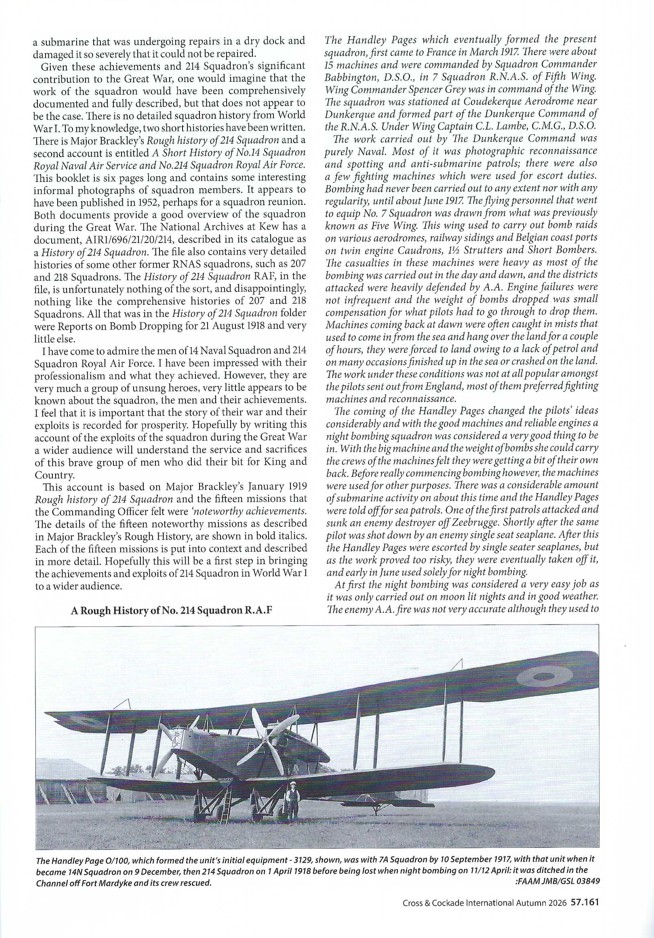
David Hearn follows the opening article with 214 Squadron: A Rough History. This is based on a nine-page account written in the field by 214 Squadron commander Major W.G. Brackey just two months after the Armistice. His focus was the “noteworthy achievements” and described fifteen different missions. David Hearn includes Brackey’s input and expands upon it with more detail. This twenty-one-page feature includes 33 black and white period photographs. Squadron 214’s Handley Page O/100 3129 is displayed at the bottom of Page 57-161. Unfortunately, 3129 was lost in the Channel off of Fort Mardyke on April 12. 1918 after a night bombing raid. Luckily the crew was rescued. There are no complete examples left of a Handley Page Type O, although the are pieces of both O/100 and O/400 airframes. Five O/400 wing sections were rescued in 2013 where they had been re-purposed for a shed roof in Flintshire.
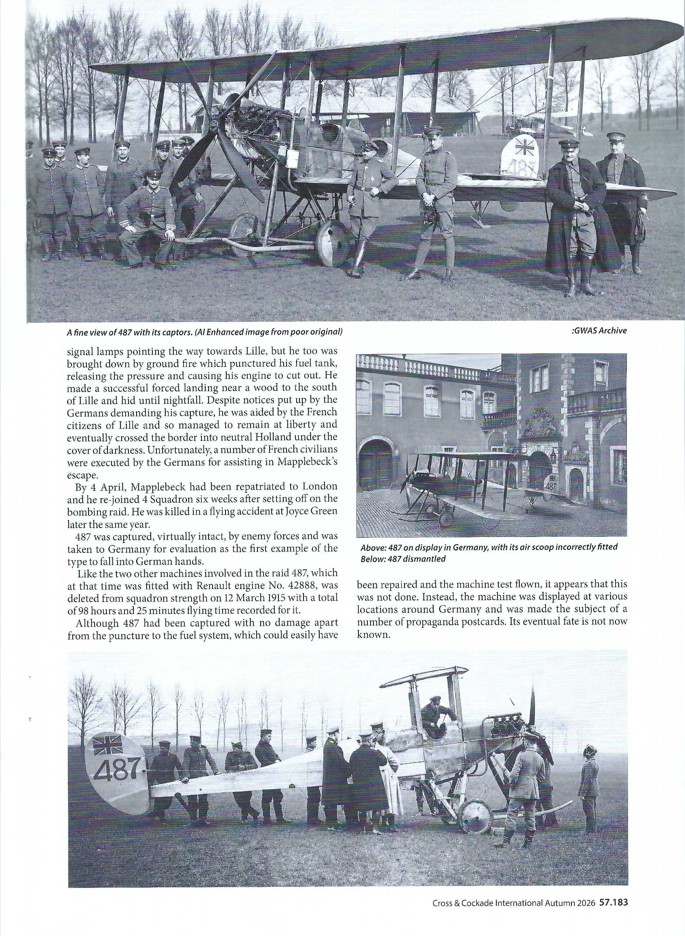
Paul R. Hare is up next with Lost In France – BE2b 487. This four-page history features ten period black and white photographs. All three black and white photographs on Page 57-183 depict 487 after she was downed by ground fire just south of Lille, France. The pilot, Lt Gilbert William Mapplebec, was able to escape capture and eventually return to London, but the French citizens were not as lucky with several being executed by the Germans. Although the damage was minor, a bullet through the fuel tank, 487 would never fly again. Instead, she was inspected and paraded around for propaganda purposes. She was the first BE2b that the Germans had captured. Notable is the top photograph that has been enhanced by AI from a poor original photograph.
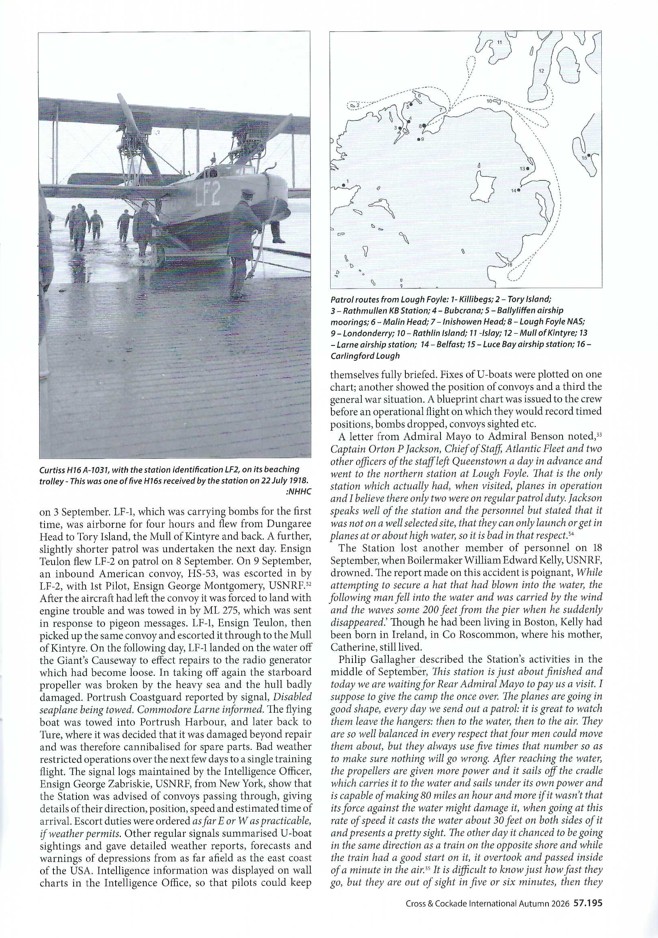
Guy Warner brings us Part 1 of The US Naval Air Service in Ireland, 1917-1919. This eighteen-page feature includes 43 period black and white photographs and four black and white maps. Sixteen of the anti-submarine patrol routes from Naval Air Station Lough Foyle [aka Loch Foyle] on the north coast of Ireland are shown at the top of Page 57-195. The station was closed down on February 22, 1919, however, the concrete beaching slip and the control tower still are present. One can also spot one of five Curtiss H 16s that were received at the station on July 22, 1918. Bearing the code ‘LF2’, this is Curtiss H 16, A-1031. Elimor Makevet provides some additional information to the Spring 2026 Volume 57, Issue 1 article on Treble One’s First War: 111 Squadron RFC RAF in Palestine 1917-1920. This includes four period black and white photographs over three pages. Lorne Borne provides some insight on Pilot Training in 1912 next. This covers three pages and includes eight photographs.
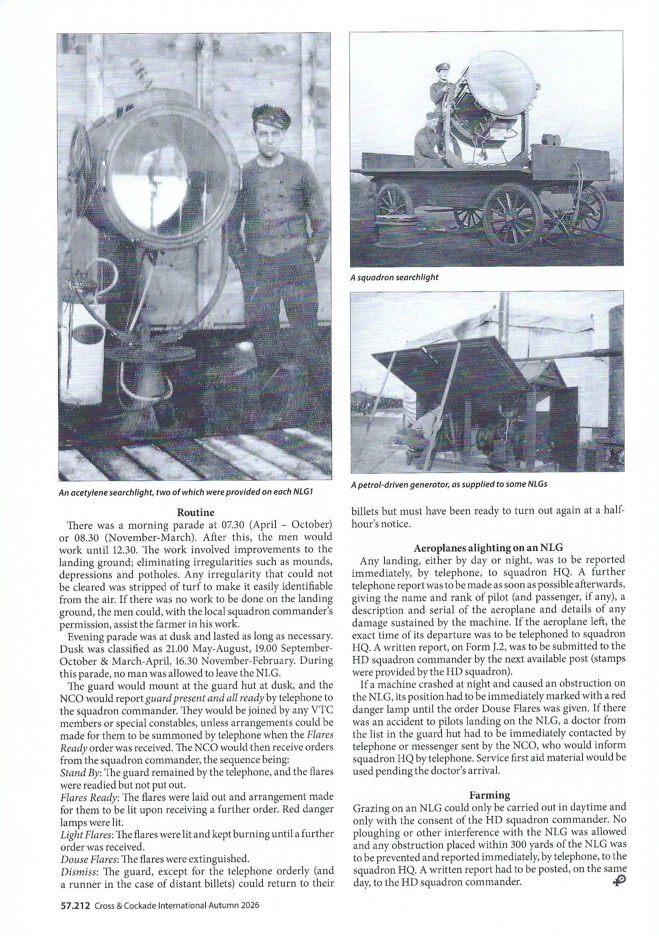
Mick Davis contributes four pages on Home Defence Night Landing Grounds. There are five black and white photographs, four black and white maps, and three drawings. Two searchlights can be seen on Page 57-212, along with a petrol generator. The larger photograph depicts one of two Lyons acetylene gas searchlights that each Night Landing Grounds [NLG] would have. The smaller photograph shows off a searchlight on a four-wheel wooden wagon. Ten black and white photographs populate From The Albums for three pages, although two of those are found on the inside rear cover. The pictures are Part 5 from the Nicod Album via Alex Revell and feature personnel and a few aircraft. The Bookshelf section is a review of WWI aviation specific books and magazines compiled by Paul R. Hare with this issue totaling nine.
Topics:
- Editorial by Mick Davis
- Brackles Canadian Contingent by Stewart K. Taylor [Page 57.158]
- 214 Squadron: A Rough History by David Hearn [Page 57.161]
- Lost In France – BE2b 487 by Paul R. Hare [Page 57.183]
- The US Naval Air Service in Ireland, 1917-1919 by Guy Warner [Page 57.195]
- Treble One’s First War: Feedback From Elimor Makevet
- Pilot Training in 1912 by Lorne Borne
- Home Defence Night Landing Grounds by Mick Davis [Page 57.212]
- From The Albums: The Nicod Album via Alex Revell; Part 5
- Bookshelf – Edited by Paul R. Hare
This is another fabulous issue from The Great War Aviation Society, and I am always impressed with the quality of the articles, both from a research perspective, and readability. I especially enjoyed the first-person accounts in the articles on 214 Squadron by Stewart K. Taylor and David Hearn. It provided the impetus to do additional research on the Handley Page Type O series and keeps me wondering what happened to the Wingnut Wings 1/32 tooling for both the O/100 and O/400 kits that were displayed at IPMS Nationals. The period pictures, maps, and drawings in this journal come off looking great thanks to their printing on the journal's glossy paper. If you are into early / WWI aviation; this journal is an incredible source of information that will have you on the edge of your seat waiting for the next issue.
My thanks to The Great War Aviation Society and IPMS/USA for the chance to review this great issue.
Highly recommended!
Reviewer Bio
Frank Landrus

Frank retired from the Ophthalmic industry with over thirty-six years of Research and Development experience. Frank's first model kit was a 1959 Hawk 1/72 US Marines Vought AU-1 Corsair and has been building models for over sixty years. Frank's first encounter with IPMS was attending a North Central Texas ScaleFest show in 1984. Frank soon became more involved in Make-N-Take activities and became the IPMS Western Coordinator for Make-N-Takes [West of the Mississippi River]. Make-N-Takes quickly became a local model contest and airshow staple reaching a high of reaching over 1,300 children before the COVID shutdown. Frank has volunteered to assist in contest judging since 1985 and is currently the Nationals Head Figure Judge until he is dead or they find someone better.
Comments
Add new comment
This site is protected by reCAPTCHA and the Google Privacy Policy and Terms of Service apply.
Similar Reviews