
Cross & Cockade International: Autumn 2025
The non-profit UK-based group known as the Great War Aviation Society publishes their journal, Cross & Cockade International, four times a year. Issues are available in English as printed [Softbound, A4 (8.27” x 11.69”), 80 pages plus centerfold] as well as digital copies (or both). A new magazine, Contact!, is now available in both print and digital download. The Society also provides a free newsletter (sign up on their website) and occasionally publishes WWI-themed books like the Sopwith Dolphin monograph I reviewed earlier for IPMS/USA. This Journal is the sister of the US Journal, Over The Front. The Great War Aviation Society also hosts a lecture series available through Zoom. If interested, you will need to register early as the call is limited in attendance.
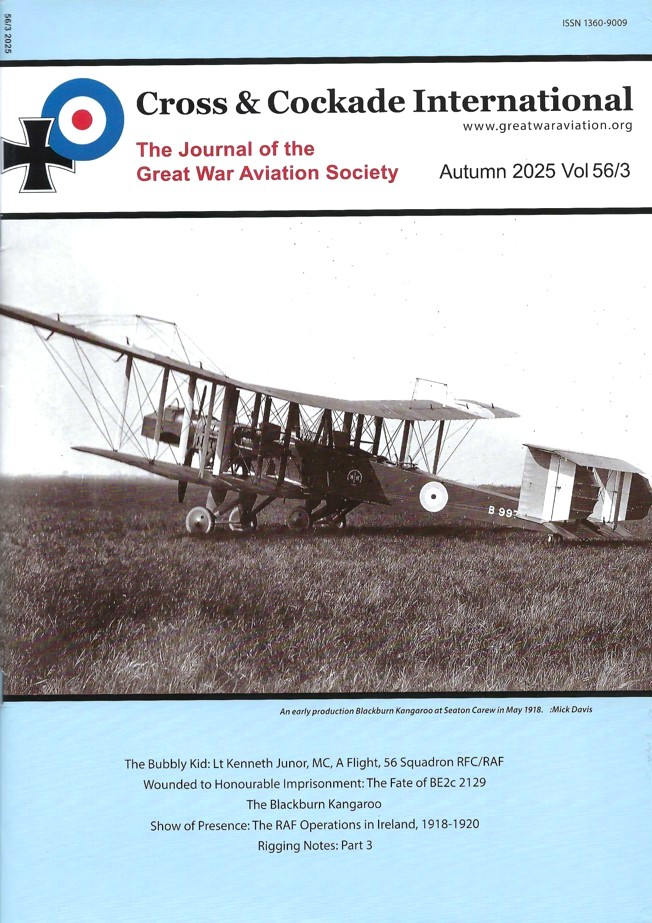
The Autumn 2025 journal of Cross & Cockade International features a black and white photograph of an early production Blackburn Kangaroo during May 1918 on the front cover. Kangaroos were based at the RFC/RAF airstrip just south of Seaton Carew to cover the North East War Channel, then considered to be one of the two most dangerous areas for British shipping. Seaton Carew is now a seaside resort in County Durham, England. This photo is in conjunction with Mick Davis’ article on The Blackburn Kangaroo.
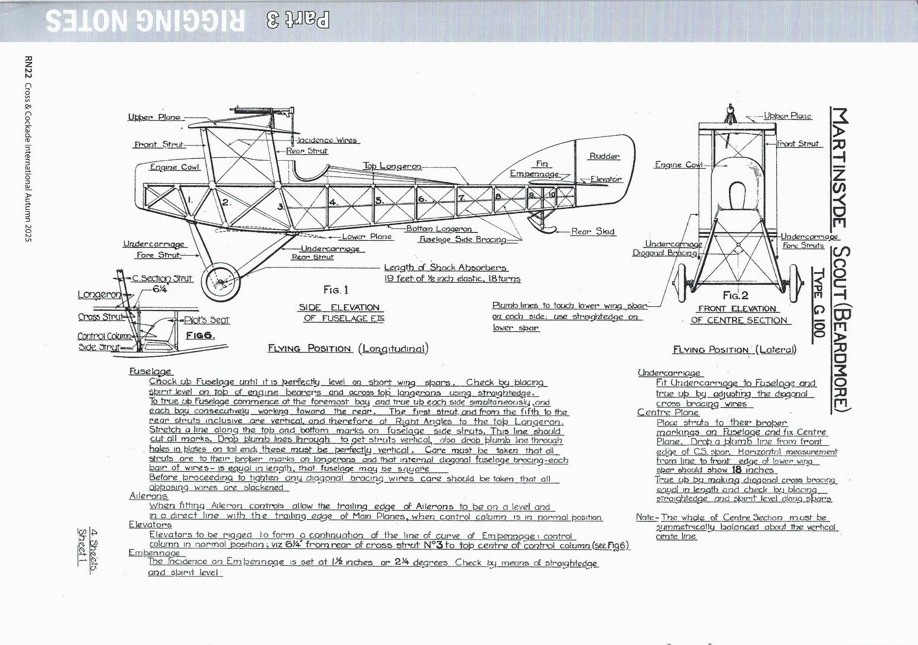
The eight-page pull-out center section continues the series on Rigging Notes. Part 3 addresses the Royal Aircraft Factory BE2c, the Maurice Farman Shorthorn (Type 1914), and the Martinsyde Scout [Beardmore] Type G 100. Sheet—One of the Rigging Notes for the Martinsyde Scout “Elephant” are shown on Page RN22. The nickname ‘Elephant’ was due to the Martinsyde’s relatively large size and poor maneuverability. This led to the Martinsyde Scout being used more as a bomber and photo reconnaissance platform due to its inherent stability. I found it interesting that the empennage note is checked with a straight edge and a spirit level. A spirit level is what today we refer to as a bubble level (or simply a level). The term spirit level refers to the liquid inside the vial that is commonly alcohol instead of water to prevent freezing and less friction for the bubble.
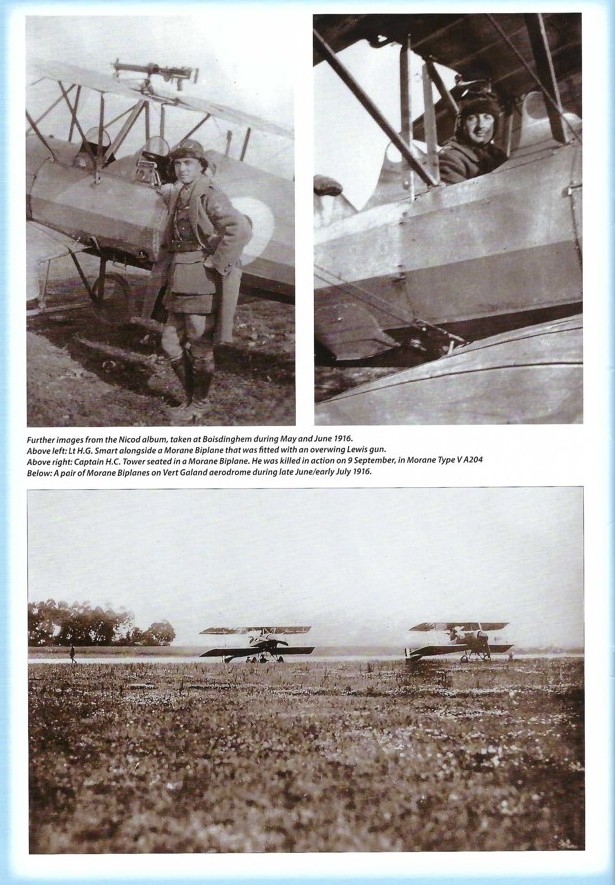
The rear cover shows off three black and white photographs of Morane-Saulnier BH of 60 Squadron. These pictures are associated with three more images on the inside cover and Alex Revell’s From The Albums: The Nicod Album. The Morane-Saulnier BH was a two-seat observation/fighter single-bay aircraft. Originally envisioned to be powered by 110-hp Le Rhone 9J rotary engines, most were delivered with 80-hp Le Rhone 9C rotary engines due to shortages. Note that the upper left image taken at Boisdinghem, France in May 1916 shows off an over wing Lewis gun.
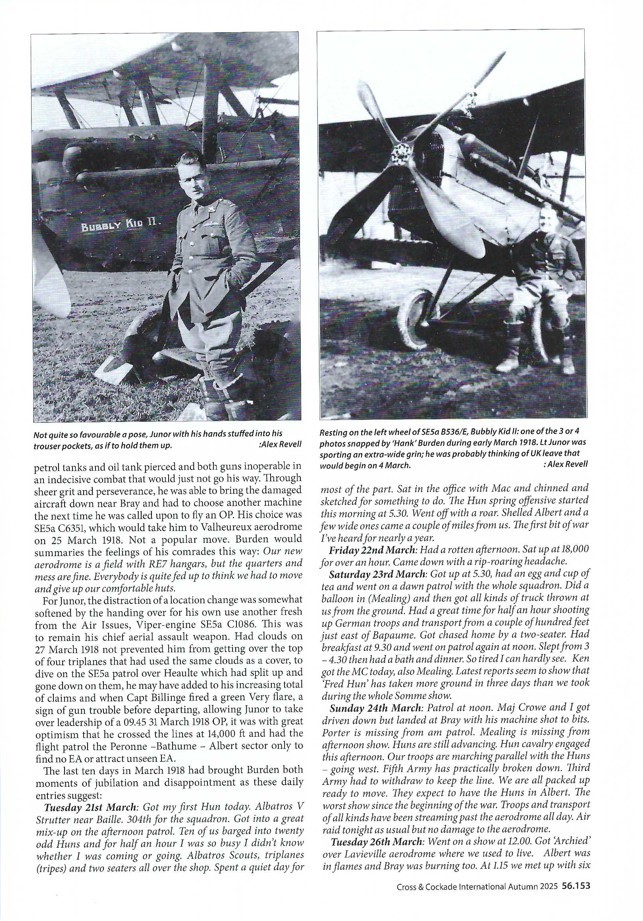
The late Stewart K. Taylor leads off with a biography of Canadian ace, Lt. Kenneth William Junor. This is a 14-page feature that includes twenty-five period black and white photographs. Officially credited with eight kills, he was awarded the Military Cross on the day of his last flight, April 23, 1918. He was shot down flying Bubbly Kid IV (SE5a C1086) by German ace Ltn Egon Koepsch of Jagdstaffel 4, flying top cover in a Fokker Dr.1 triplane. This was Koepsch’s second aerial victory of an eventual nine claims. He would later fly Fokker D.VIIs with Jasta 4 and 11. Lt Kenneth Junor can be viewed on Page 56.153 next to his second SE5a mount, Bubbly Kid II (B536/E). These images were taken in early March 1918 by his close friend and fellow 56 Squadron ace, Lt. Henry John ‘Hank’ Burden, DSO, DFC, who would end up with sixteen victories. Burden would become an architect and would marry Kenneth’s sister, Helen Junor. He served as an RCAF group captain during WWII and died on March 28, 1960, at the age of 64.
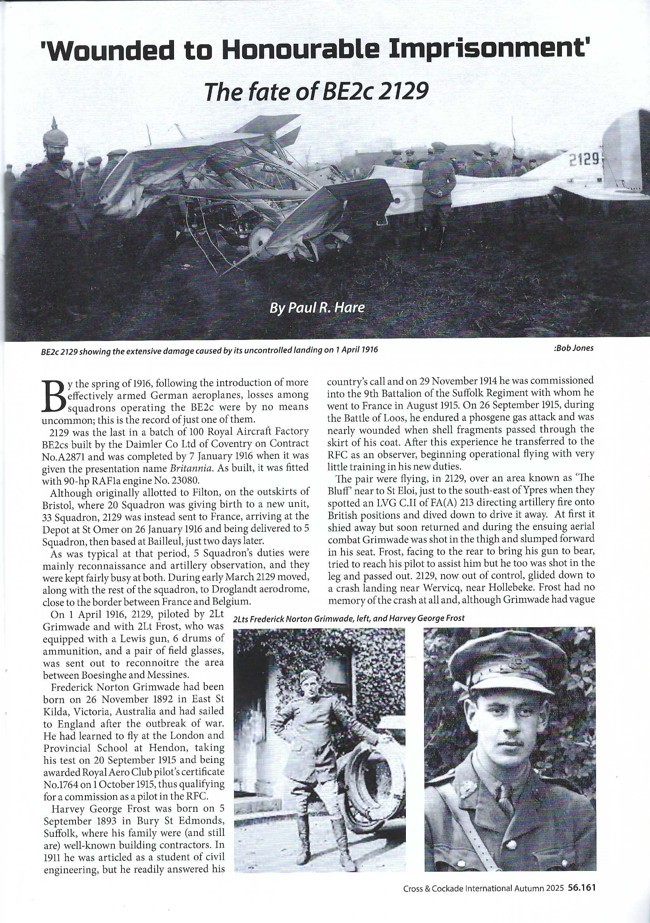
Paul Hare’s contribution is "Wounded to Honourable Imprisonment: The Fate of BE2c 2129" following a single aircraft. This four-page article includes nine black and white photographs. Short biographies are included of Australian Pilot 2Lt Frederick Norton Grimwade and observer 2Lt Harvey George Frost and a history of their mount, BE2c, 2129. Both somehow survived an engagement with an LVG C.II of FA(A) 213 that was directing German artillery [the LVG C.II crashed as well]. Images of 2129, Grimwade, and Frost can be spotted on Page 56.161. 2129 was later moved to possibly a museum where an attempt to reassemble the BE2c was attempted. Of note in the crash of 2129 at the top of the page is the soldier in the Pickelhaube, a spiked helmet worn by German and Prussian soldiers of all ranks [as well as firefighters and police]. The Pickelhaube is still in use today around the world as part of parades and ceremonial uniforms.
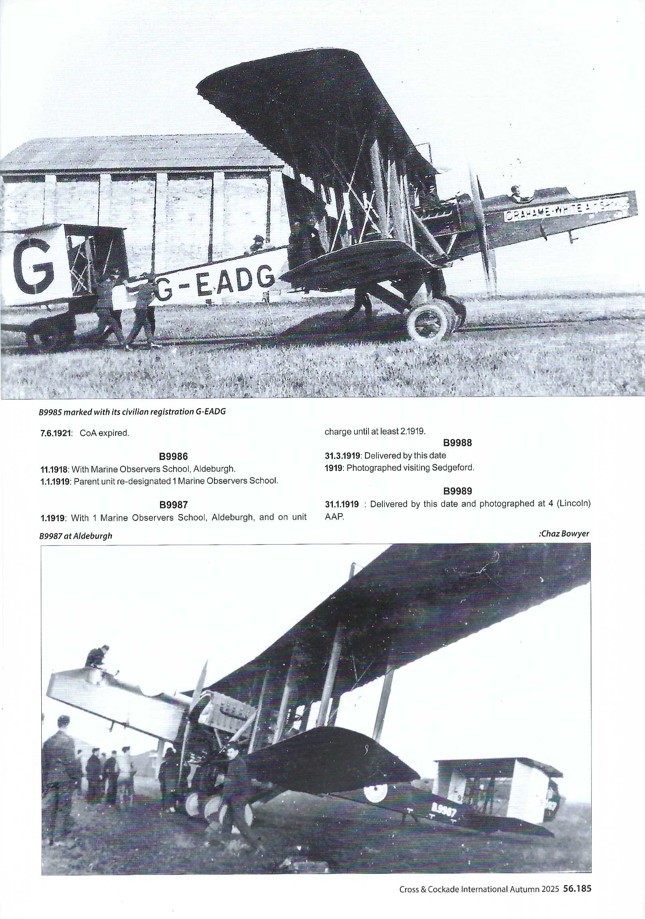
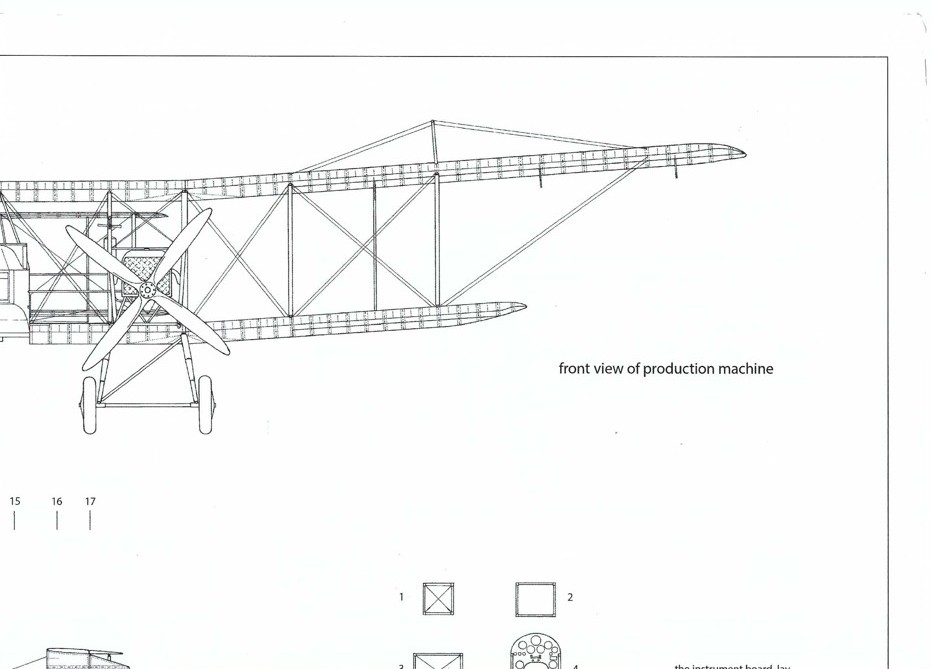
Mick Davis is up next with a feature on The Blackburn Kangaroo. This includes 24 pages with eighty-six black and white photographs, along with the cover shot and two A2 sheets (16.5” x 23.4”) of Mick Davis drawings. The Blackburn R.T.1 (Reconnaissance Torpedo Type 1) Kangaroo was a land-based development of the Blackburn G.P. (General Purpose) seaplane of 1916. The RAF ordered fifty Kangaroos based on the Blackburn GP, but that was reduced to twenty aircraft once the prototype was received and tested in 1918. The prototype was later upgraded to production standard by stiffening the rear fuselage and replacing the landing gear struts. The first five aircraft were powered by two 253-hp Rolls-Royce Falcon II 12-cylinder liquid-cooled engines, with the remaining fifteen upgraded to the 285-hp Rolls-Royce Falcon III powerplants. Despite carrying the R.T.1 designation, the Kangaroo never carried torpedoes but would be armed with either four 230-lb bombs or a single 520-lb bomb. Mick Davis proceeds with a history of each serial number where known, resulting in some with minimal details and many with an abundance of history. B9985 can be spotted in civilian markings at the top of Page 56.185, where she wore G-EADG and was registered on June 8, 1919, to Grahame White Aviation Company of Hendon. Her CoA expired on June 7, 1921. The previous page includes several photographs of B9985 in RAF service. The bottom of the page features B9987 at 1 Marine Observers School, Aldeburgh, where she served till at least February 1919. Additional images are available on the next page of B9987. Several Kangaroos were later converted to dual control trainers and served with the RAF Reserve School in Brough until 1929.
The first part of Guy Warner’s history of the Shon Augusow of Prescence: The RAF Operations in Ireland, 1918–1920 spans twenty-two pages and includes thirty-four black and white photographs and four black and white maps. The Fabric section is compiled by Mick Davis and covers queries and feedback on prior issues. This section covers two pages and six black and white photographs. The Bookshelf section is a review of WWI aviation-specific books and magazines with this issue totaling seven.
Topics in this issue include the following:
- Editorial by Mick Davis
- The Bubbly Kid: Lt Kenneth Junor, MC, A Flight, 56 Squadron RFC/RAF by Stewart K. Taylor (Page 56.153)
- Wounded to Honourable Imprisonment: The Fate of BE2c 2129 by Paul Hare (Page 56.161)
- The Blackburn Kangaroo by Mick Davis (Page 56.185 and Sheet 3b)
- Rigging Notes Part 3 (Centerfold RD22)
- Show of Prescence: The RAF Operations in Ireland, 1918-1920: Part 1 by Guy Warner
- From The Albums: The Nicod Album via Alex Revell; Part 1
- Fabric by Mick Davis
- Bookshelf – Edited by Paul R. Hare
This is another great issue from The Great War Aviation Society, and I am always impressed with the quality of the articles, both from a research perspective and readability. I really enjoyed the Stewart K. Taylor article on Lt. Kenneth Junor as it included first-hand letters and combat notes from both Junor and Burden that placed you in their shoes. Mick Davis’ feature on the Blackburn Kangaroo was also fascinating as little has been written about this aircraft since the 2009 Windsock Datafile 137 by Colin Owers. The period pictures, maps, and drawings in this journal come off looking great thanks to their printing on the journal's glossy paper. If you are into early/WWI aviation, this journal is an incredible source of information that will have you on the edge of your seat waiting for the next issue.
My thanks to The Great War Aviation Society and IPMS/USA for the chance to review this great issue.
Highly recommended!
Reviewer Bio
Frank Landrus

Frank retired from the Ophthalmic industry with over thirty-six years of Research and Development experience. Frank's first model kit was a 1959 Hawk 1/72 US Marines Vought AU-1 Corsair and has been building models for over sixty years. Frank's first encounter with IPMS was attending a North Central Texas ScaleFest show in 1984. Frank soon became more involved in Make-N-Take activities and became the IPMS Western Coordinator for Make-N-Takes [West of the Mississippi River]. Make-N-Takes quickly became a local model contest and airshow staple reaching a high of reaching over 1,300 children before the COVID shutdown. Frank has volunteered to assist in contest judging since 1985 and is currently the Nationals Head Figure Judge until he is dead or they find someone better.
Comments
Add new comment
This site is protected by reCAPTCHA and the Google Privacy Policy and Terms of Service apply.
Similar Reviews