
Contact! Summer 2026
The non-profit UK based group known as the Great War Aviation Society publishes A new magazine, Contact!, is now available in both print and digital download. The first two issues of Contact! are available for a free digital download on their website. Their journal, Cross & Cockade International, is also published four times a year. Issues are available in English as printed [Softbound, A4 (8.27” x 11.69”), 72 pages [Including Covers] as well as digital copies (or both). The Society also provides a free newsletter (sign up on their website) and occasionally publish WWI themed books like the Sopwith Dolphin monograph I reviewed earlier for IPMS USA. This Journal is the sister of the US Journal, Over The Front. The Great War Aviation Society also hosts a lecture series available through Zoom. If interested, you will need to register early as the call is limited in attendance. The Great War Aviation Society also is on Facebook and X [Twitter].
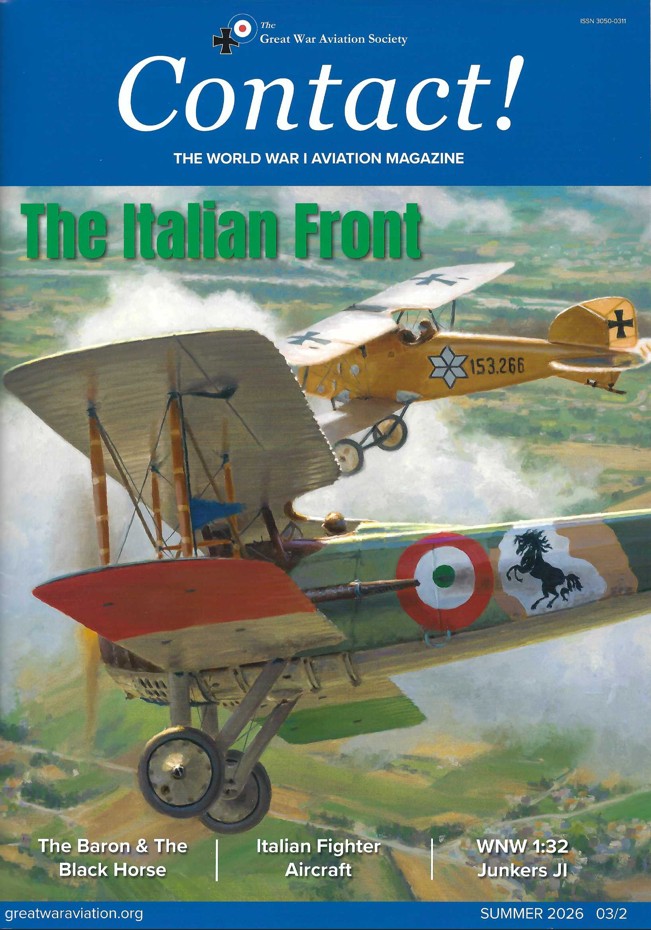
The Summer 2026 of Contact! [Volume 3, Issue 2] features a color illustration by Russell Smith of Major Francesco Baracca three days before his death in his SPAD XIII. The cover is related to several articles on Italian aviation in WWI, including The Baron & the Black Horse: The Fight That Was Never Was by Paolo Varriale, Italian Aircraft: Why Did Italy Rely on French Fighters During the First World War by Gregory Alegi, A Camel Pilot in Italy by Andy Kemp, An Escadrille in Venice by David Méchin, The HD 1 Baracchini Project: Rebirth of a Great War Icon by Ermete Grillo, and Macchi’s Magnificent M5 by Jon Guttman. There are four pages of Great War advertising, including the inside front and rear covers and the rear cover. I counted 82 color photographs / illustrations and 78 black and white photographs / illustrations.
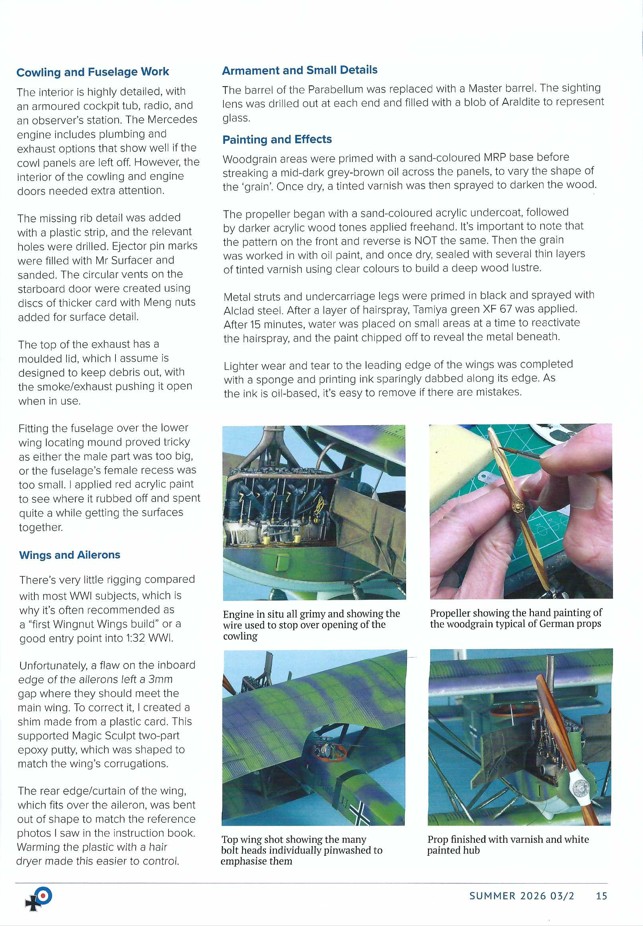
Great War modeling was a standard feature in the Journal that has now moved to Contact!, taking full advantage of color photographs. David Lane presents a build review of the Wingnut Wings 1/32 Junkers J I kit, part of which can be seen on Page 15. David has toured the European shows and has been awarded several awards, including a gold medal at the Moson Show. Key to this build were upgrading the 200-hp Benz Bz.IV 6-cylinder inline engine [See Page 15] and the Parabellum MG14 machine gun. David clearly explains his correction of one of the few errors on this kit with the inboard aileron 3mm gap with card stock and Magic Sculpt putty.
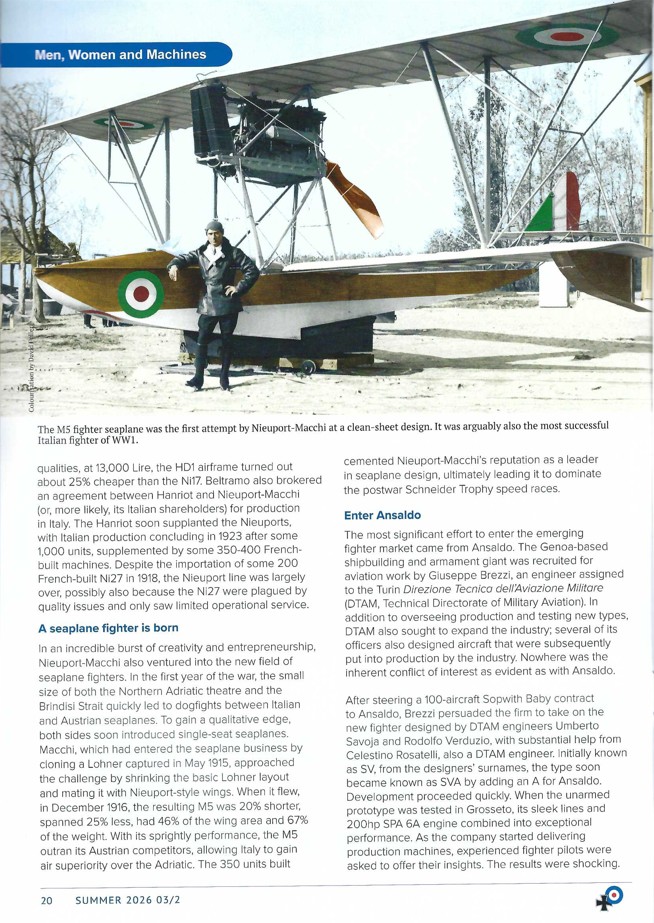
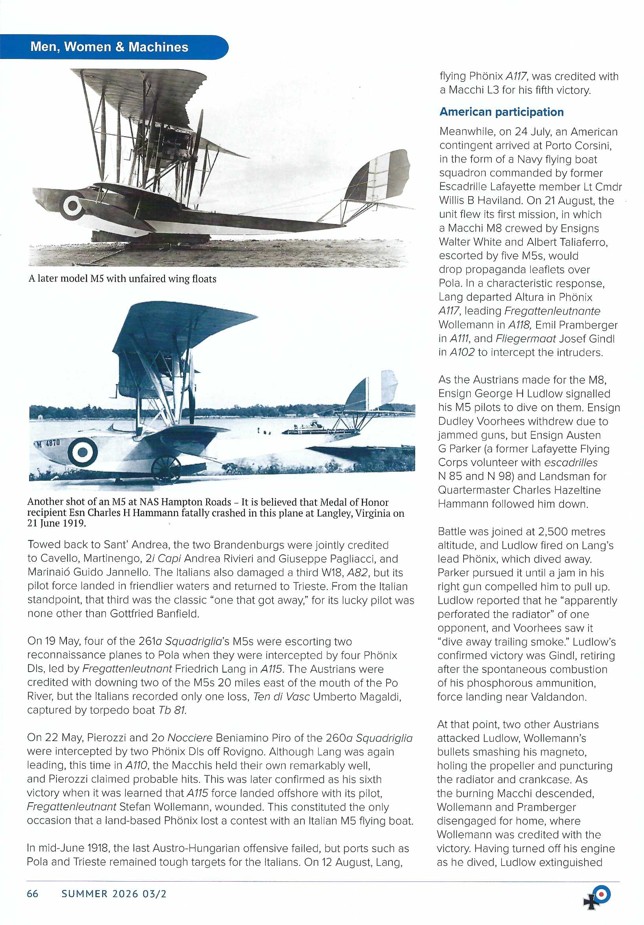
Gregory Alegi contributes an Italian aviation article with Italian Aircraft: Why Did Italy Rely on French Fighters During the First World War. This six-pager contains eight period black and white photographs, a colorized period photograph, and a color side profile. Nieuport 11s and 17s, along with the Hanriot HD1, were license-built by Nieuport-Macchi. The Nieuport-Macchi M5 seaplane fighter at the top of Page 20 was their first original design and ended up being the most successful Italian fighter of WWI. Here you can clearly see that it is a colorized black and white photograph that clearly shows off the Isotta Fraschini V.4B engine. The M5 was armed with two fixed forward facing 7.7mm [.303] Vickers machine guns and combined with its performance it proved to be superior to its Austrian competition.
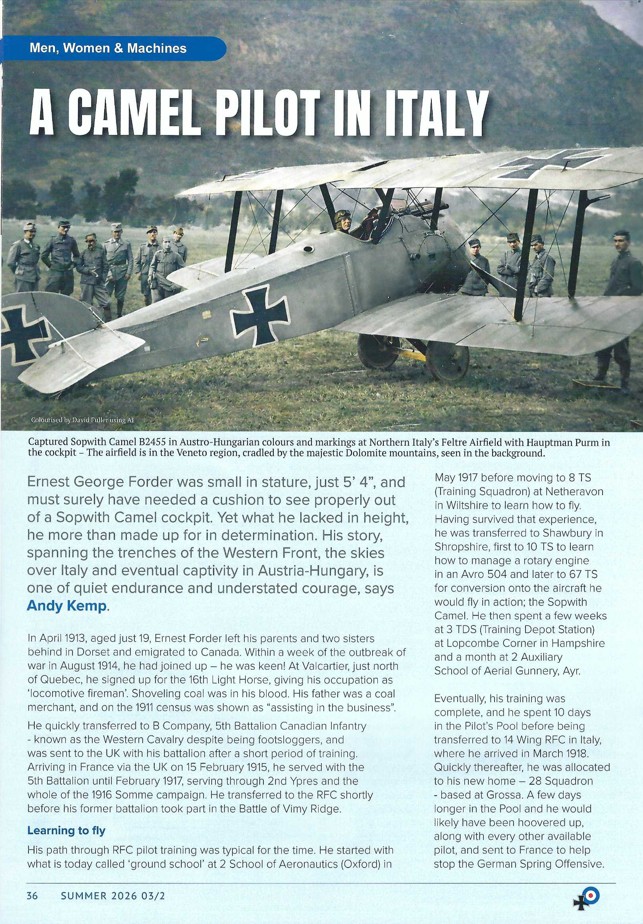
Andy Kemp delivers A Camel Pilot in Italy, a tale of Lt Ernest George Forder’s exploits in Italy. Flying with 28 Squadron while based at Villaveria Aerodrome, Italy, George took a bullet to his engine while pursuing a “Albatros” over Feltre and had to land. The Austrians sent Forder to POW camp and repaired his Sopwith Camel, repainted in Austro-Hungarian markings for evaluation as shown in the colorized photograph on Page 36. The end of the war saw Forder released and he returned to join 75 Squadron based at Elmswell. Unfortunately, Forder died in a flying accident in a Camel on February 25, 1919, while flying inverted. Whatever the reason, he was unable to flip his Camel, and he rode it into the ground upside down.
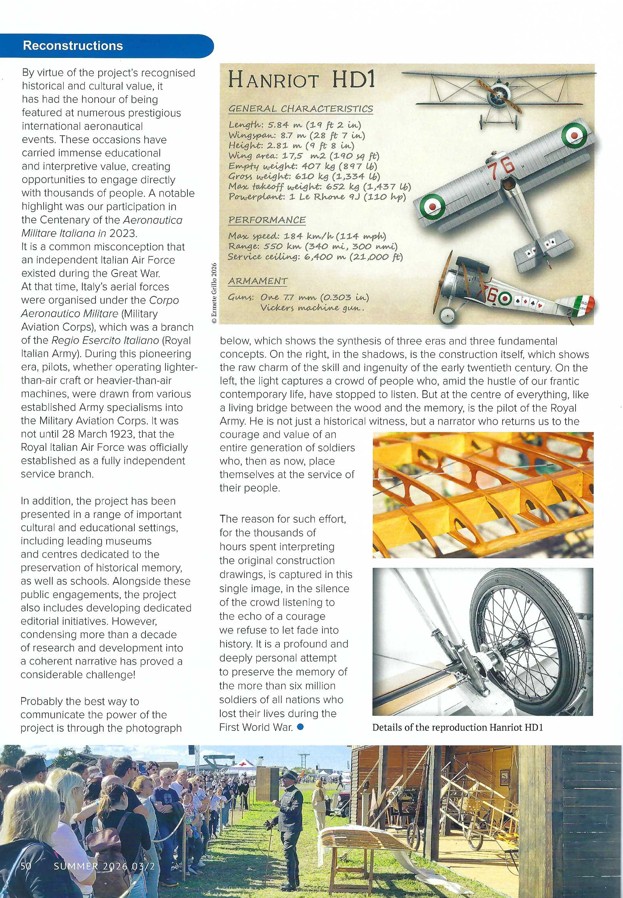
Ermete Grillo provides an update on The HD 1 Baracchini Project that is targeting the reproduction of a flying Macchi-Hanriot HD 1. There are five original HD 1 aircraft preserved out of some 1,200 originally manufactured. Chino California based Planes of Fame Museum’s Hanriot was originally built as a HD 2 seaplane where it conducted coastal patrols out of Dunkerque, France. After the war, it was transferred to the Naval Aviation Factory in Philadelphia where it was converted from a seaplane to a land-based fighter. This aircraft gained more fame when Charles Nungesser restored it in 1923 for his U.S. exhibition team. It would then see movie screen time as a movie star in Wings [1927], Hell’s Angels [1929], and the Sky Raider [1931. The markings of Italian ace Lieutenant Flavio Torello Baracchini [31 victories claimed] are being pursued to join with an original 130 hp Le Rhône 9JB rotary engine [A bit of an upgrade over the original 110 hp Le Rhône 9JA engine]. Detail color photographs of the wing and landing gear are displayed on Page 50. The bottom of the page shows off the current progress on the wing and fuselage while one can follow the build progress online at their website and Facebook page.
Jon Guttman chimes in with Macchi’s Magnificent M5 that had the performance to match land-based aircraft of the era. This four-page article includes four period photographs and coordinates with the earlier article overview of Italian Aircraft, with a color profile of an M5 and a colorized period photograph of an M5. The top of Page 66 depicts the late model M5 identified by the un-faired wing floats as compared to an earlier model immediately below. The late model M5 was designated M5mod and utilized a more powerful [250-hp] Isotta Fraschini V.6 engine, and improvement of the earlier 160-hp V.4B six-cylinder inline engine. This photograph one of two M5 seaplanes tested at NAS Hampton Roads. This aircraft is 4870 that of Medal of Honor winner, Ensign Charles Hazeltine Hammann, who died in it at a crash at Langley Field on June 21, 1919. The contents of this issue include:
Topics:
- Editor’s Letter
- The Briefing Room
- The Signals Office
- The Baron & the Black Horse: The Fight That Was Never Was by Paolo Varriale
- Modeling: Junkers J I 1:32 by David Lane [Page 15]
- Italian Aircraft: Why Did Italy Rely on French Fighters During the First World War by Gregory Alegi [Page 20]
- How Alan Jerrard Won the Victoria Cross by James Streckfuss
- Soccer and Aviators: A Competitive Relationship by Peter Dye
- Sport, Service and the SARD at Farnborough by Steve Mills
- A Camel Pilot in Italy by Andy Kemp [Page 36]
- An Escadrille in Venice by David Méchin
- Canada’s Zeppelin Killers by Graham Mottram
- The HD 1 Baracchini Project: Rebirth of a Great War Icon by Ermete Grillo [Page 50]
- The Development of WWI Aircraft Cockpit Design by Paul R Hare
- The Engine That Powered the Sopwith Camel by Graham Mottram
- To Take Up Arms Part 8 by Paul Hare
- Macchi’s Magnificent M5 by Jon Guttman [Page 66]
- The Best First World War Aviation Books of All Time? by Michael Terry
Contact! emphasizes more color than is common in the Cross & Cockade International journal that features period photographs. The articles are also more numerous and shorter than seen in the journal, but no less enjoyable.
I really enjoyed seeing an Italian theme in this issue of Contact! With six articles. There are still plenty of other topics, including two articles addressing WWI aviators and soccer with the FIFA World Cup front and center. The overall goal of adding Contact! to the Great War Aviation Society appears to be grabbing some of the younger crowd with a digital product and more color. I certainly hope this works for the younger crowd, but there is material here for all ages. If you are into early / WWI aviation, this magazine is for you!
My thanks to The Great War Aviation Society and IPMS/USA for the chance to review this great issue.
Highly recommended!
Reviewer Bio
Frank Landrus

Frank retired from the Ophthalmic industry with over thirty-six years of Research and Development experience. Frank's first model kit was a 1959 Hawk 1/72 US Marines Vought AU-1 Corsair and has been building models for over sixty years. Frank's first encounter with IPMS was attending a North Central Texas ScaleFest show in 1984. Frank soon became more involved in Make-N-Take activities and became the IPMS Western Coordinator for Make-N-Takes [West of the Mississippi River]. Make-N-Takes quickly became a local model contest and airshow staple reaching a high of reaching over 1,300 children before the COVID shutdown. Frank has volunteered to assist in contest judging since 1985 and is currently the Nationals Head Figure Judge until he is dead or they find someone better.
Comments
Add new comment
This site is protected by reCAPTCHA and the Google Privacy Policy and Terms of Service apply.
Similar Reviews