
American Secret Projects
Established in 1997, Crécy Publishing is one of Europe’s leading publishers of transport and military history titles. We have a strong emphasis on aviation titles and, since the acquisition of the Ian Allan Publishing list, we are also the world’s leading railway book publisher. Starting with the publication of a single book, our company has grown through a mixture of organic growth and the acquisition of quality publishing lists. Today, Crécy Publishing imprints include ABC guides, Classic, Goodall, Hikoki Publications, OPC (Oxford Publishing Company) Pilot’s Notes. Imprints we have absorbed into our list include Air Data, Flight Recorder, Ian Allan, Noodle Books and Nostalgia Road. Crécy Publishing Ltd. Books are distributed in North America by Casemate Publications. Check out their Facebook page for additional information.
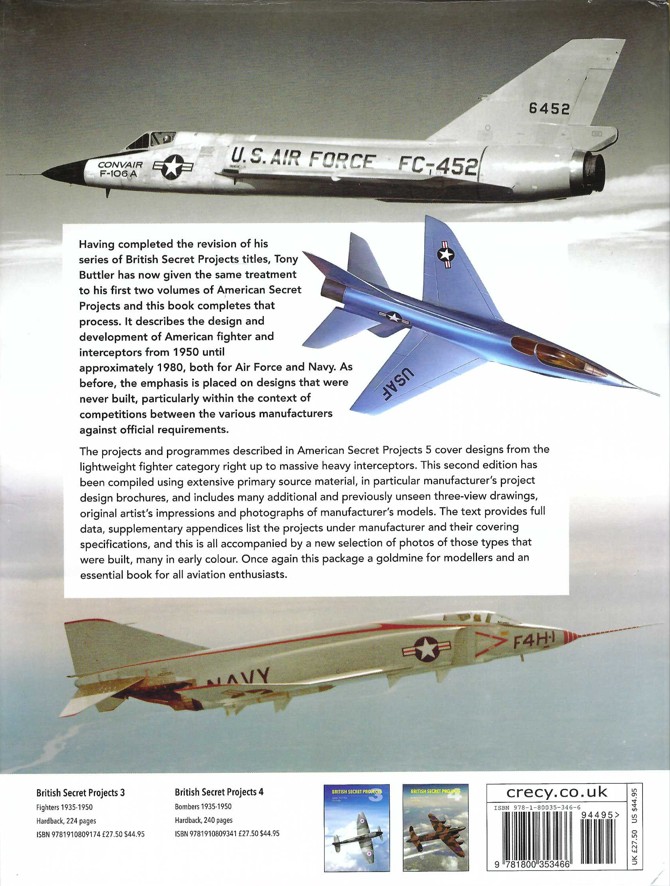
This English language book, American Secret Projects 5: Fighters and Interceptors 1950 to 1980. is authored by Tony Buttler. It is a revised and expanded edition that was published in the U.S. This book is a revamp of earlier books: American Secret Projects: Fighters & Interceptors 1945-1978 [2008], Early US Jet Fighters: Proposals, Projects and Prototypes [2013[ and American Secret Projects: Fighters, Bombers, and Attack Aircraft, 1937-1945 [2016] in the Secret Projects series. This new volume includes plenty of additional material and newly discovered designs.
Tony Buttler was born in 1956 and joined High Duty Alloys in Redditch in 1974 as a metallurgist. For nearly 20 years he was closely involved in the testing of aluminum and titanium airframe and engine components for many of the world’s most important airplanes. It was during this timeframe that his interest in military aircraft grew into a passion. Since 1996, Tony has been a freelance aviation historian. This includes hard cover books on British Secret Projects, American Secret Projects, Secret Soviet Projects, and X-Planes of Europe. He has also written many titles for the Warpaint series of monographs as well as many articles for most of the popular historical aviation magazines. In 2017, Buttler became a member of the Royal Aeronautical Society’s Historical Group Committee, and in November 2022 he received the Society’s Aeronautical Heritage Specialist Group Award for that year in recognition of his contribution to aviation history.
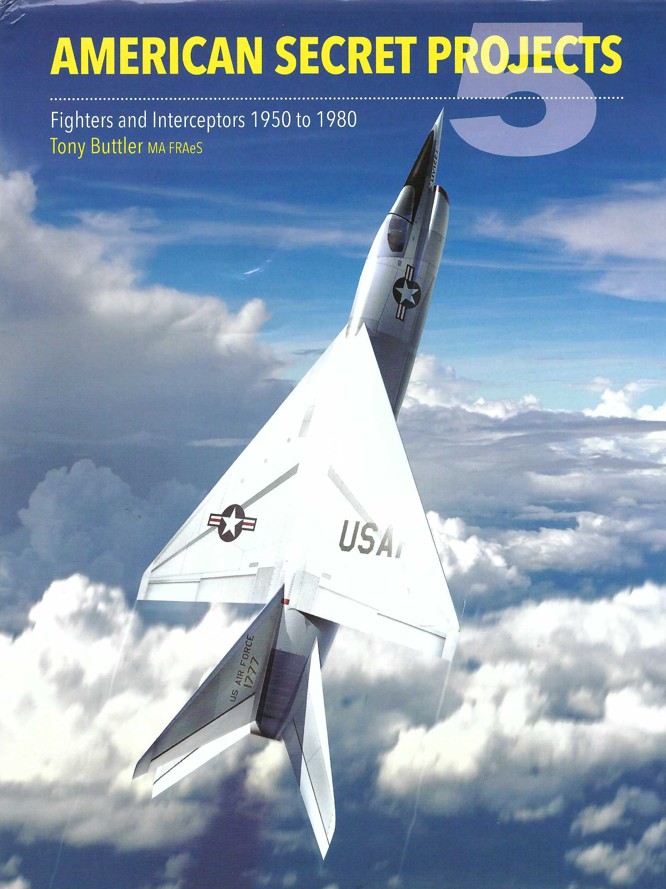
This full-size square back hard cover book [A4: 11.5” by 8.3] comes in at 383 glossy pages. The front cover features a color illustration by Daniel Uhr of North American’s proposal for the MX1554 USAF Requirement, the North American D-160-2. This requirement was initiated in 1949 and finally developed in 1950 for a new supersonic interceptor that would lead to the Convair F-102 Delta Dagger. The Request for Proposal [RFP] was issued on June 18, 1950, calling for a single seat interceptor capable of exceeding Mach 1 and carrying only missiles and rockets for armament. Additional information on the North American Model D-160 proposals can be found starting on Page 26. I counted 413 black and white photographs / illustrations along with 304 color pictures / illustrations. There are also 161 specification tables for most of the design proposals.
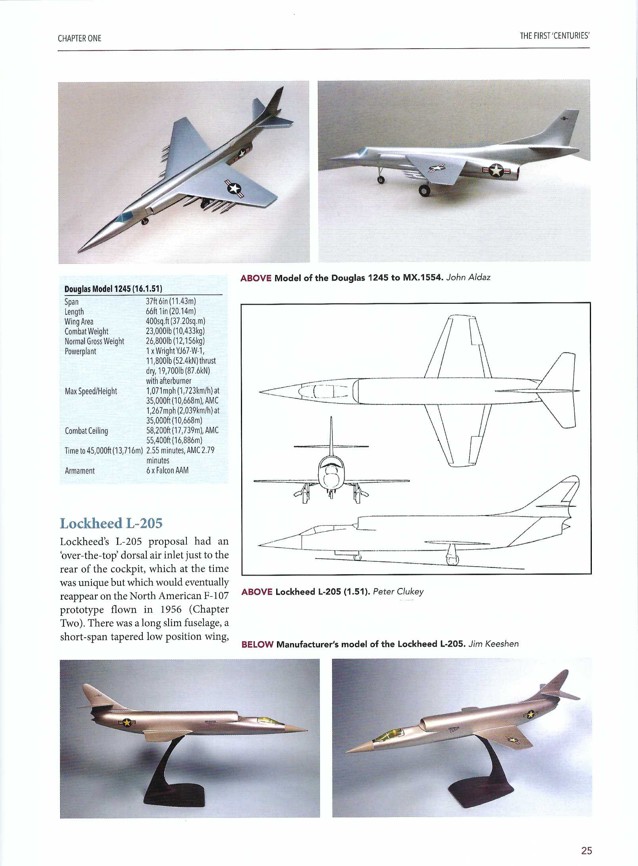
Tony Buttler kick off this tome with a one-page Introduction discussing the parameters of this revised edition. Then its off to Chapter One covering “The First Centuries” fighter projects with a focus on the MX1554 USAF Requirement. Two of the competitors for MX1554 can be spotted on Page 25. At the top of the page, two color photographs of a model of the Douglas 1245 proposal along with a table of the proposed specifications. The Douglas 1245 would be powered by the Wright YJ67-W-1 engine and would carry all armament on wing pylons instead of an internal bay. Interestingly, the pilot entered the cockpit through the ejection seat which would be lowered to just in front of the nose wheel and then be raised back into the cockpit. The center and bottom of the page start a description of the Lockheed L-205 [Model 99] proposal. Lockheed would be declared a winner of the MX1554 competition on July 2, 1951, along with the Convair Model 8 [YF-102] and the Republic AP-57 [XF-103]. Lockheed was awarded a development contract only to have it subsequently cancelled due to USAF budget constraints before it received a military designation. Lockheed’s loss was not total, as design elements of the L-205 would later appear in the F-104 Starfighter. This proposal would have an internal armament bay that would carry six air-to-air Falcons amidst twenty 2.75” folding fin High Explosive [HE] rockets on the sides of the bay. Notable is the dorsal engine intake just behind the canopy.
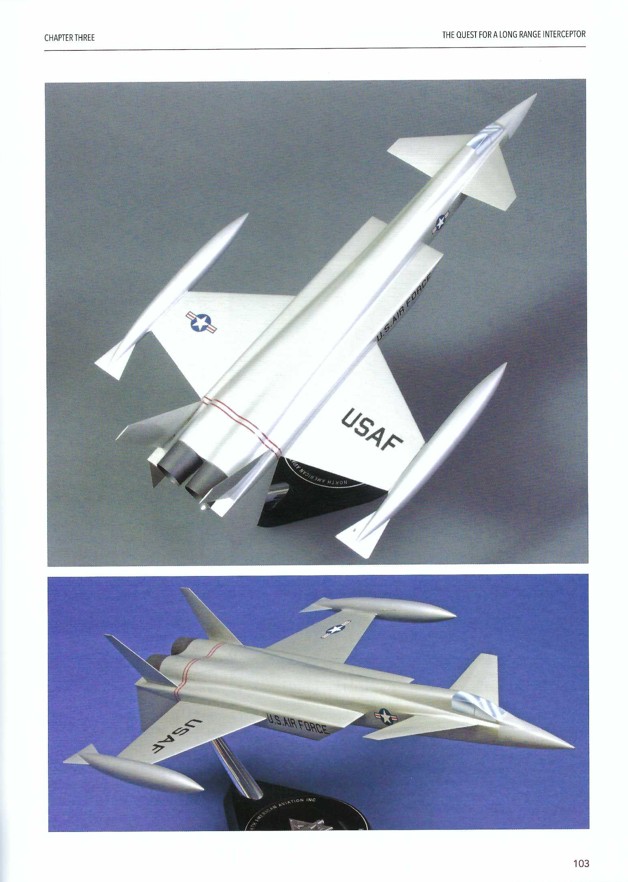
Chapter Two continues the ‘Century’ series development leading with the Lockheed Starfighter through the North American F-107A. Chapter Three details the USAF search for a longer-range interceptor that would lead to the North American XF-108 Rapier and the Lockheed YF-12A. North American would end up winning the competition for a Long Range Interceptor in February 1956 with the NA-266 design, but it was then cancelled. A new program for the LRI was created under WS 202A with the North American Project Number D-266 with some minor changes as is displayed on Page 103. Notable are the nose canards and wing tip fuel tanks, but again the Air Force dithered. Finally the requirement for a LRI was re-instated and North American was once again North American was declared the winner with a contract on April 11, 1957, to build the XF-108 Rapier. Interestingly, the earlier D-266 design morphed substantially to the NA-257 project, and then again to the XF-108 Rapier mockup. Unfortunately, despite the Rapier’s potential, the Department of Defense did not have the budget to push this design forward and it was again cancelled in September 1959. Lockheed would see three aircraft built with a first flight achieved on August 7, 1963. A production order for 200 Lockheed F-12B was placed, but Robert McNamara refused to release the funds for three consecutive years, effectively cancelling the order. The sole surviving intact YF-12A, 60-6935, is now on display at the National Museum of the USAF in Dayton, Ohio, while the rear half of 60-6934 is part of the SR-71C that is on display at the Hill Aerospace Museum in Utah.
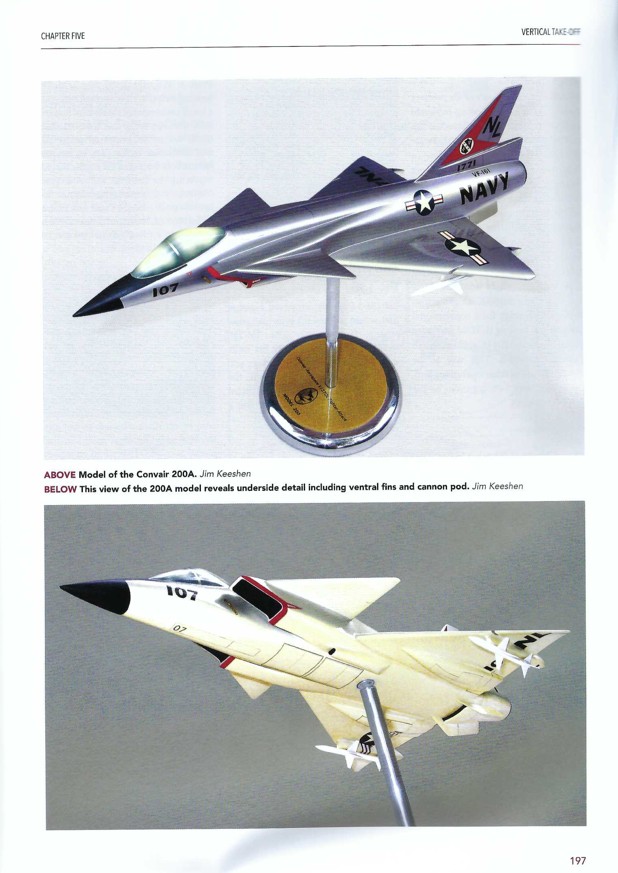
Chapter Four covers Naval developments leading up to the McDonnell F4 Phantom II and the Vought XF8U-3 Crusader III. The following chapter covers Vertical Take Off Projects. This chapter kicks off with the Ryan Model 69 [X-13] tail-sitter jet. One of the interesting designs was the Mach 2 VTOL Convair Model 200A with a desk model shown on Page 197. A combination of a canard with a delta wing, this design featured two mid fuselage lift engines combined with a Pratt & Whitney JTF22A-30A jet engine with a vectoring nozzle that could tilt ninety degrees. This was a project proposed for the US Navy’s small aircraft carriers’ program, the Sea Control Ship, and a full-scale fuselage mock-up was built. The JTF22A-30A engine’s nozzle design would support a future nozzle design for the Lockheed Martin F-35B. The Bell D-188A twin turbojet mock-up is addressed, along with the North American Rockwell XFV-12A prototype supersonic jet fighter for the US Navy.
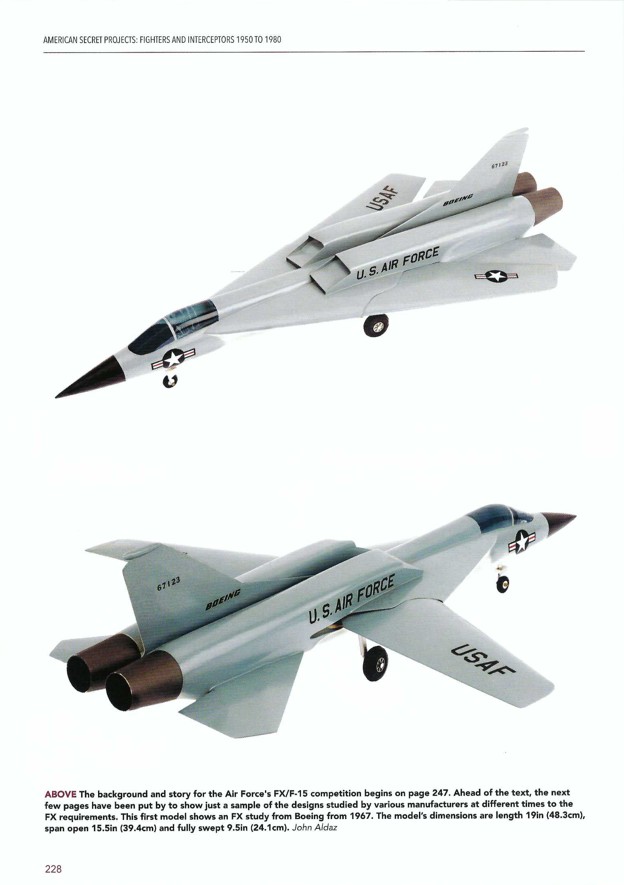
“Into the Sixties” addresses the competitive programs for the US Navy’s Grumman F-14 Tomcat and the USAF’s McDonnell Douglas F-15 Eagle. The Boeing entry into the USAF’s Fighter Experimental [FX] competition can be spotted on Page 228. This was a single seat swing wing fighter as were all other entrants in the FX bidding were except for Northrop. Notice the serial number of 67123 on the single fin and rudder nestled in between the two engines. Chapter seven covers the Lightweight Fighters competition that led to the General Dynamics F-16 and the Northrop YF-17 Cobra [later the McDonnell Douglas F/A-18 Hornet]. Appendix Three covers the Avro Arrow program that in many ways paralleled development of interceptors in the US. In the end, the Avro Arrow lost out to politics and budget constraints. One of the outtakes was a proposal for a Long Range Avro Arrow as seen on Page 371 that was presented on September 9, 1957. This represented a Mach 3 capable interceptor with two ramjet engines in a pod under each wing. Another feature was a retractable canard to provide additional control at supersonic speeds. The sections include:
- Introduction
- Acknowledgements
- Chapter One: The First ‘Centuries’
- North American’s Supersonic Sabre
- North American D-169/NA-180 Sabre 45
- North American F-100 Super Sabre
- McDonnell F-101 Series
- McDonnell F-101A Voodoo
- Northrop Interim Escort Fighter
- Northrop N-81, N-82 and F-89X
- McDonnell F-101B Voodoo
- Interceptor Developments
- Douglas Model 1187
- Lockheed L-190
- North American D-103
- Northrop N-53
- The ‘1954’ Interceptor
- Chance Vought V-371
- Convair MX1554
- Douglas Model 1245
- Lockheed L-205 [Page 025]
- North American D-160
- Republic AP-54
- Republic AP-55
- Republic AP-57
- Convair F-102 Delta Dagger
- Republic XF-103
- Chapter Two: Later ‘Centuries’ and Variations
- Lockheed Starfighter
- Douglas X-3 Stiletto
- Lockheed L-227
- Lockheed L-246
- North American Rapier Series
- Republic AP-55
- Northrop PD-1590 and N-102 Fang
- Lockheed Model 83 and F-104 Starfighter
- Republic’s Fighter Bomber
- Chance Vought V-382
- Martin Model 288-8
- North American D-222
- Republic MX1764
- North American WS-300A Fighter-Bomber
- Republic AP-77
- Republic AP-63 and F-105
- Convair F-106 Delta Dart – The ‘Ultimate Interceptor’
- Early Developments
- Convair F-106C
- Convair Advanced F-106 and F-106-30
- General Dynamics Convair Advanced F-106 1960s
- The Final Sabre
- North American F-100B/D-221/NA-212
- North American F-100I/NA-211
- North American F-107A
- Chapter Three: The Quest for a Long Range Interceptor
- Long Range Interceptor
- Northrop N-103
- Northrop N-126 Delta Scorpion
- Boeing Model 712
- Douglas Model 1355
- Lockheed CL-288
- Martin Model 302
- Martin Models 308 and 314
- Martin Model 109
- McDonnell Model 110
- McDonnell Model 111A
- North American D-235
- Northrop N-144
- Northrop N-149
- Republic AP-75
- Grumman G-107
- Lockheed CL-320
- North American D-264 (and D-266 API) [Page 103]
- Northrop N-167
- North American NA-257 (F-108) Rapier
- Medium Range Interceptor
- Convair Medium Range Interceptor
- Northrop Medium Range Interceptor
- Northrop N-176
- Republic Medium Range Interceptor
- Lockheed YF-12A
- Chapter Four: Naval Developments
- Grumman F11F Tiger
- Douglas F3D-1 Skylancer
- Carrier Based Day Fighter
- Chance Vought Models V-383 and V-384
- Douglas Model 652
- Grumman Model 97
- Lockheed L-242
- McDonnell Models 90, 91 and 93
- North American D-214
- Northrop N-94 Series
- Temco Model 38T
- Chance Vought F8U-1 Crusader
- Independent Lines
- Grumman G-98 Developments
- North American Super Fury
- A New Heavy Fighter/Interceptor
- Grumman G-118
- McDonnell F3H-G/H and YAH-1
- McDonnell Model 98R/F4H-1 Phantom II
- Chance Vought V-401/XF8U-3 Crusader III
- Patrol Interceptor
- Boeing Model 835
- Chance Vought V-434
- Douglas Missileer
- Grumman Missileer
- McDonnell Missileer
- North American Missileer
- Chapter Five: Vertical Take-Off
- Tail Sitters
- Ryan Model 69/X-13
- Ryan Model 38
- Convair
- Lockheed CL-293
- Ryan Model 84
- Temco Models 39, 43 and 44
- Specification TS-140
- Bell D-109
- Bell D-139
- Avro Canada
- Bell D-188
- Lockheed CL-349
- Ryan Model 112
- Bell D-188A
- Air Force Requirement
- Lockheed CL-346
- Ryan Models 115 and 115C
- Note on Lift Jets
- Sea Control Ship
- Boeing Model 908-535/D-180
- Convair Model 200A [Page 197]
- Fairchild Republic FR-150
- Grumman Design 607 and 607A
- LTV V-517
- LTV V-520
- LTV V-521
- McDonnell Douglas Model 262/AV-8C
- North American Rockwell NR-356
- North American Rockwell XFV-12A
- Chapter Six: Into the 1960s
- All-In-One TFX
- Navy Programs
- McDonnell F-4 Phantom Developments
- Boeing 959-001
- Grumman G-303
- McDonnell Model 199-302
- LTV (Ling Temco Vought) Model V-484
- LTV Model V-505
- General Dynamics (Convair) Model 44
- Grumman Model 303E and 303F
- LTV Model V-507
- McDonnell Douglas Model 223A
- North American Rockwell (Columbus) NA-323
- Grumman F-14A Tomcat
- Air Force FX (F-15)
- Boeing FX Study [Page 228]
- Grumman Model G-399 FX
- Fairchild Hiller (Republic) FX
- LTV Aerospace Model V-483 FX
- Lockheed CL-1000 FX
- General Dynamics FX Studies
- McDonnell Douglas Model 199
- North American Rockwell D-490 (NA-335)
- McDonnell Douglas F-15 Eagle
- Other Projects
- North American Rockwell NR-349
- Chapter Seven: Lightweight Fighters
- Northrop N-156
- Northrop N-156F/F-5A Freedom Fighter
- Lockheed CL-1200-1 Lancer
- LTV V-1000
- Northrop F-5E Tiger II
- The USAF’s Lightweight Competition
- General Dynamics Advanced Day Fighter
- Northrop N-300
- General Dynamics Studies
- Northrop P-530 Cobra
- Boeing Model 908-618-2
- Boeing Model 908-909
- General Dynamics Studies
- Lockheed X-27 Lancer and CL-1200-2
- Vought Aeronautics V-1100
- Northrop N-321/P-600
- Northrop N-322/P-610
- General Dynamics YF-16 and Northrop YF-17
- The US Navy’s Lightweight Fighter Competition
- General Dynamics (Convair) Model 23
- Vought Aeronautics V-523
- General Dynamics (Convair) Model 218
- General Dynamics Model 18
- Grumman G-623
- McDonnell Douglas Model 263
- North American XFV-12A Development
- Northrop P-630
- Vought Aeronautics V-526 (and X-100)
- McDonnell Douglas/Northrop Model 267
- Vought Aeronautics Model 1600 Series
- McDonnell Douglas F-18A Hornet
- Further Projects
- Vought Aerospace V-2000
- Grumman Advanced Design Composite Aircraft (ADCA)
- Appendices
- Appendix One: American Fighter Project Summary
- Appendix Two: Fighter Specifications
- Appendix Three: Avro Arrow
- Avro Canada C-104 Long-Range All-Weather Fighter
- C-104/Delta All-Weather Fighter
- C-104/1 and C-104/2 Supersonic All-Weather Fighters
- C-105 Supersonic All-Weather Interceptor
- Avro Arrow
- Long Range Avro Arrow [Page 371]
- Glossary
- Bibliography and Source Notes
- Index
- Index of People
American Secret Projects 5 is a tour de force by Tony Buttler. I was quite impressed with the number of color photographs of company models to match the drawings and text descriptions. It took me a full week to plow through this tome and it makes a special reference of fighter aircraft development in the US. There are a lot of highlights provided by Tony Buttler and one of those is Appendix One: American Fighter Project Summary. This Appendix lists all fighter program models by manufacturers from post WWII through 1980. This is not just text, but includes ample drawings, illustrations, and photographs. This volume, along with others in this series is an essential resource for aviation enthusiasts.
My thanks to Crécy Publishing Ltd., Casemate, and IPMS/USA for the chance to review this great book.
Highly recommended!
Reviewer Bio
Frank Landrus

Frank retired from the Ophthalmic industry with over thirty-six years of Research and Development experience. Frank's first model kit was a 1959 Hawk 1/72 US Marines Vought AU-1 Corsair and has been building models for over sixty years. Frank's first encounter with IPMS was attending a North Central Texas ScaleFest show in 1984. Frank soon became more involved in Make-N-Take activities and became the IPMS Western Coordinator for Make-N-Takes [West of the Mississippi River]. Make-N-Takes quickly became a local model contest and airshow staple reaching a high of reaching over 1,300 children before the COVID shutdown. Frank has volunteered to assist in contest judging since 1985 and is currently the Nationals Head Figure Judge until he is dead or they find someone better.
Comments
Add new comment
This site is protected by reCAPTCHA and the Google Privacy Policy and Terms of Service apply.
Similar Reviews