
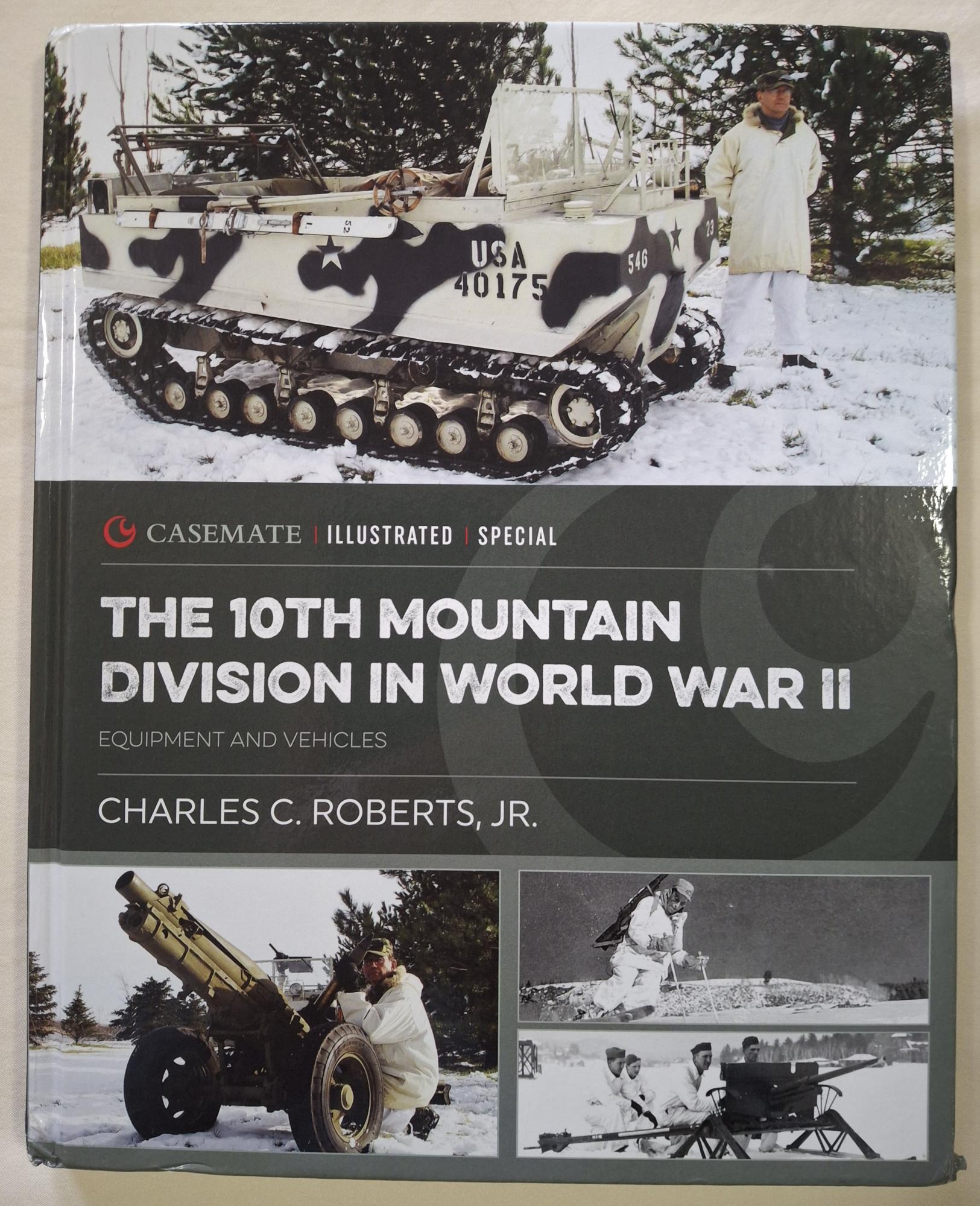
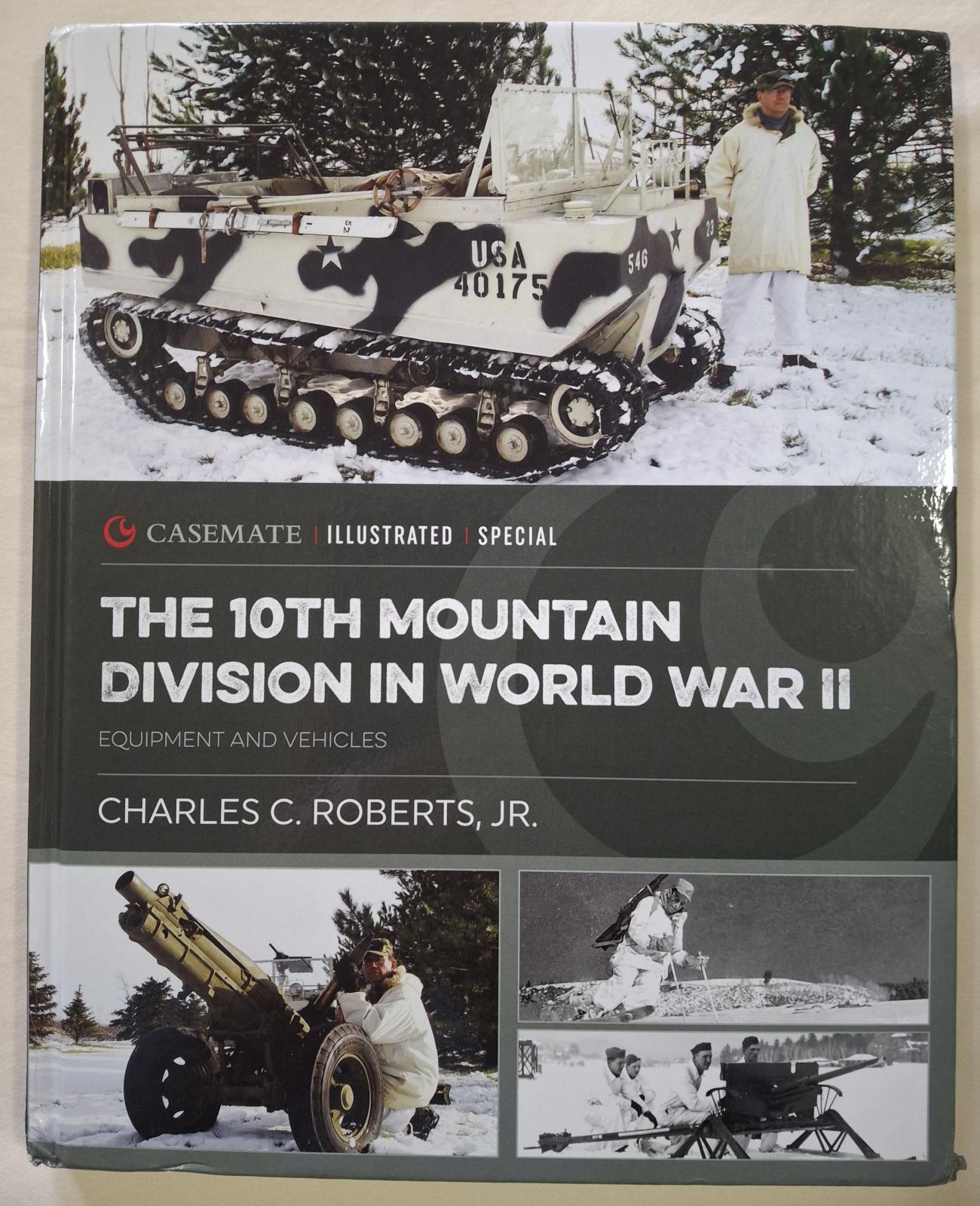
The 10th Mountain Division in World War II: Equipment and Vehicles
Background
From Review Insert
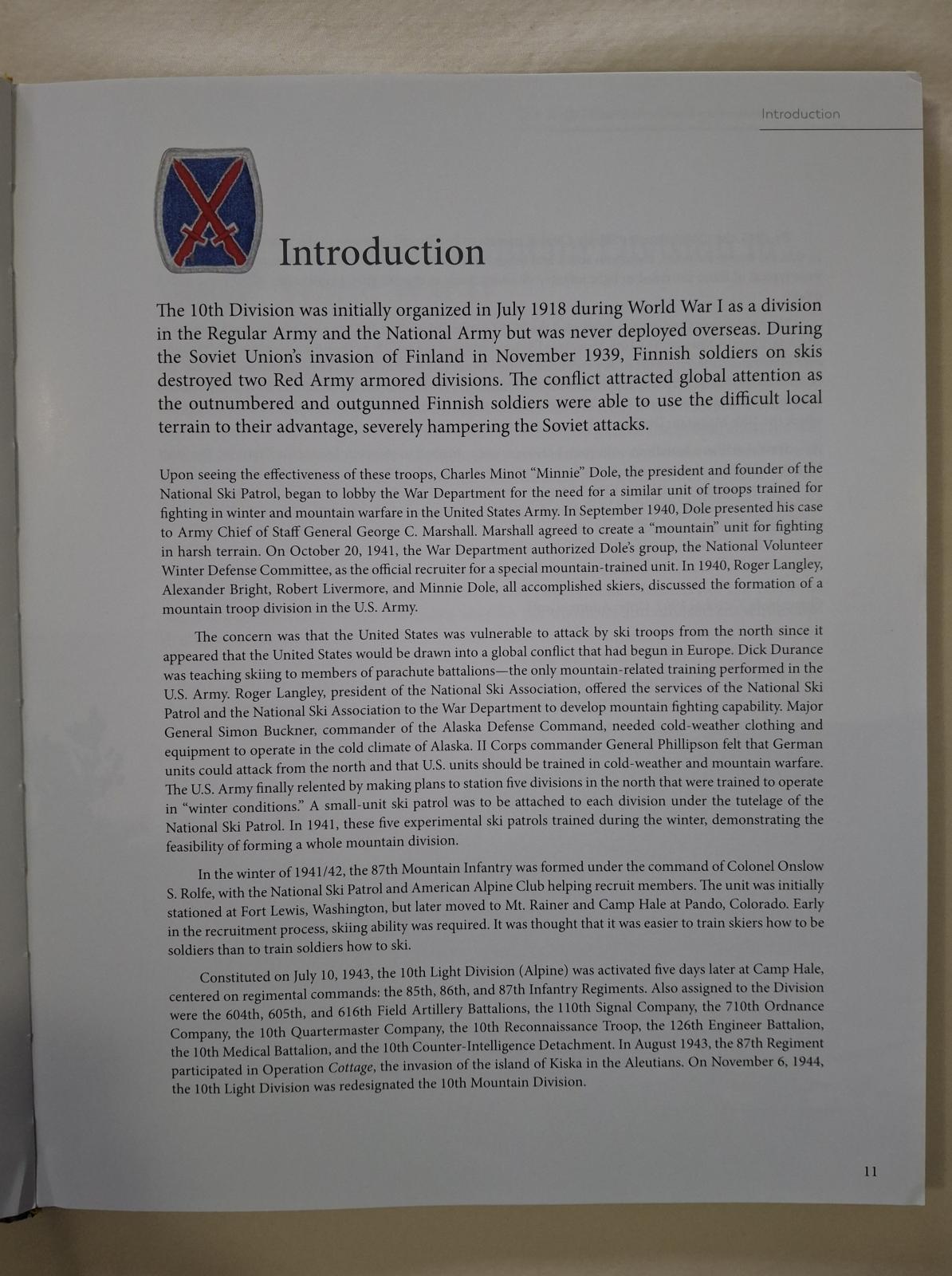
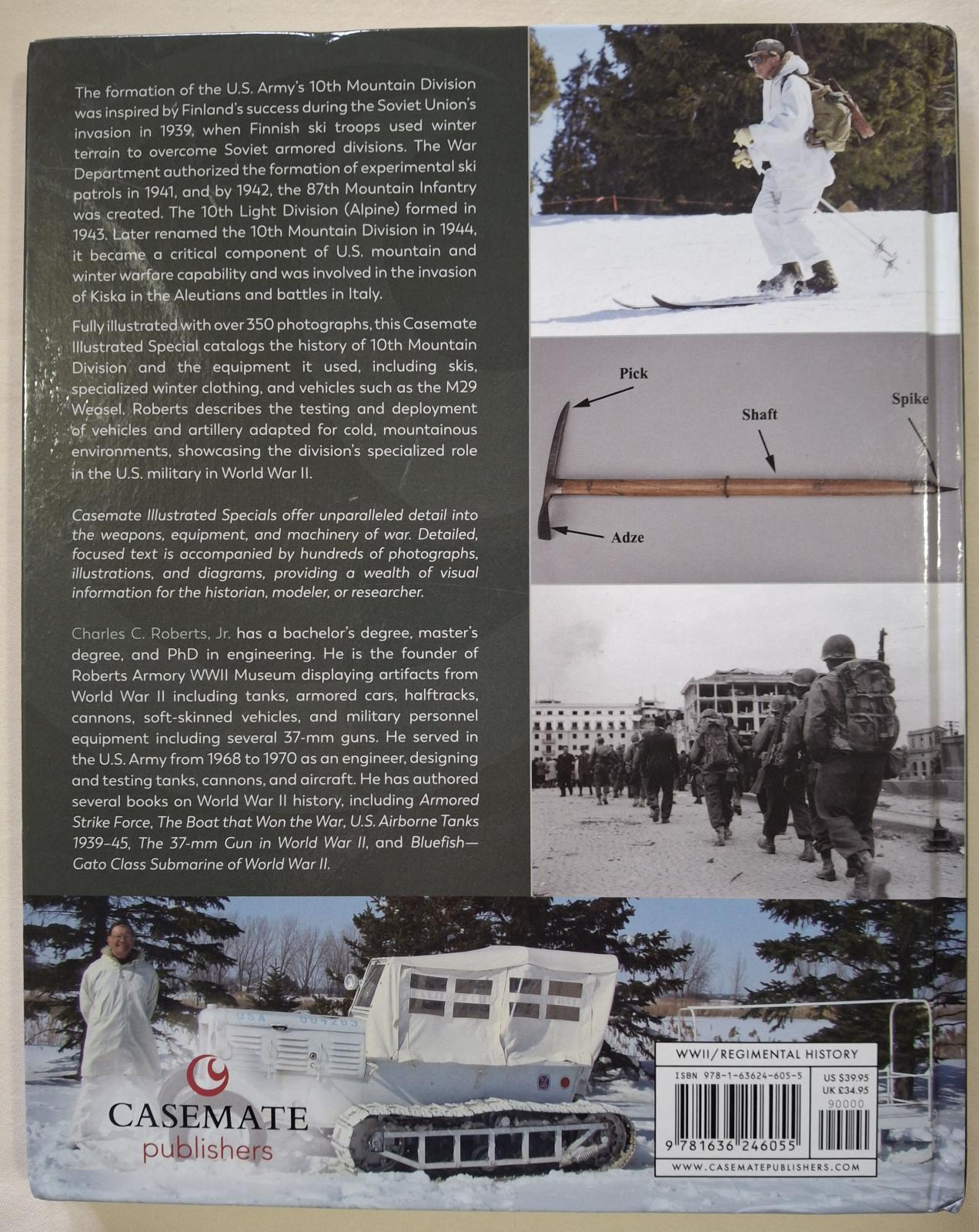
The formation of the U.S. Army's 10th Mountain Division was inspired by Finland's success during the Soviet Union's invasion in 1939, where Finnish ski troops effectively used winter terrain to overcome Soviet armored divisions. Recognizing the strategic value of such a unit, Charles Minot "Minnie" Dole, founder of the National Ski Patrol, lobbied for a similar division in the U.S. Army. His efforts eventually led to the formation of specialized mountain warfare troops. In 1941, the War Department authorized the formation of experimental ski patrols, and by 1942, the 8Zth Mountain Infantry was created. Recruited primarily from skilled skiers, this unit was stationed at Camp Hale in Colorado. The 10th Light Division (Alpine) was formed in 1943. Later renamed the 10th Mountain Division in 1944, it became a critical component of U.S. mountain and winter warfare capability. The division was involved in key operations, including the invasion of Kiska in the Aleutians and battles in Italy.
Fully illustrated with over 200 photographs, the book catalogs the history of the 10th Mountain Division unit and the equipment it used to undertake its unique mission, including skis, specialized winter clothing, and vehicles such as the M29 Weasel, designed for mountain and snow operations. The book also highlights the testing and deployment of various vehicles and artillery adapted for cold, mountainous environments, showcasing the division's specialized role in the U.S. military in World War II.
About the Author
Charles C. Roberts, Jr. has a Bachelor's degree, Master's degree, and PhD in engineering. He is the founder of the Roberts Armory WWII Museum, displaying artifacts from World War II including tanks, armored cars, half-tracks, cannons, soft-skinned vehicles, and military personnel equipment including several 37-mm guns. He served in the U.S. Army from 1968-1970 as an engineer, designing and testing tanks, cannons, and aircraft. He is an expert on World War II military history and equipment, having authored several books on the subject.
What You Get
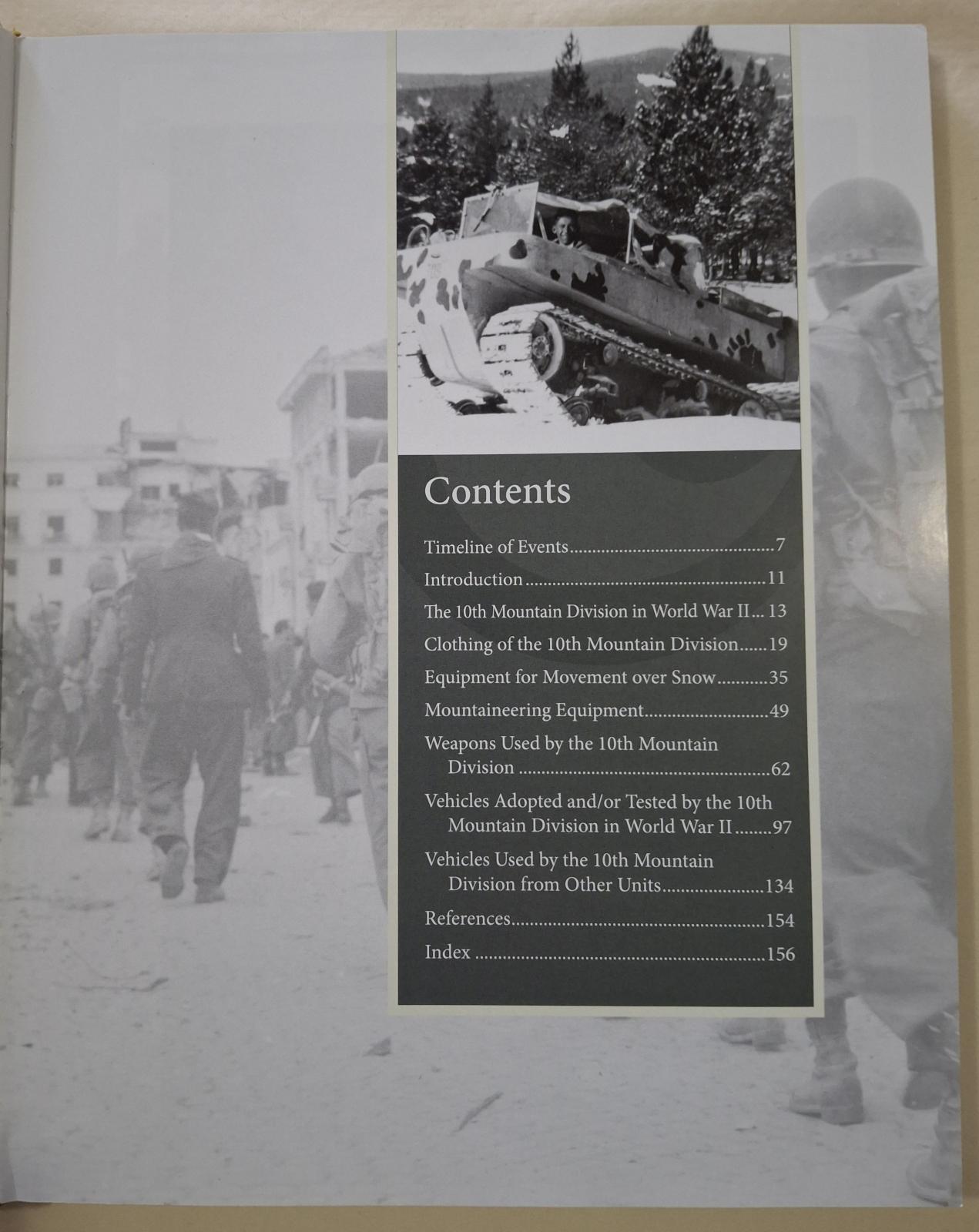
This is a hard bound edition in standard 8¼ by 11 format with 160 glossy pages. The book contains a Timeline of Events, an Introduction, seven chapters, references, and an index.
The first three pages are a timeline covering the formation and combat actions of the division spanning from November 1940 to May 1945. The Introduction presents a short, concise history of it.
Chapter 1 covers the history of the 10th Mountain.
Chapters 2 through 7 cover clothing (chapter 2), equipment (chapters 3 and 4), weapons (chapter 5) and vehicles (chapters 6 and 7).
Chapter 1 gives a detailed history of the formation, training, and military actions of the 10th Mountain Division. Initial formation was in November 1940 when the War Department formed ski units as part of the 1st, 3rd, 5th, 6th, 41st, and 44th Divisions. The 1st started training in Plattsburg and Lake Placid, New York that month. In April 1941, Colonels Walker and Hurdis were charged with finding a training location capable of supporting 15,000 troops. Initial members of the 10th Mountain were drawn from experienced skiers and mountaineers. It was decided that it would be far easier and faster to train skiers to be soldiers than to train soldiers how to ski.
In November 1941, the unit was activated as the 87th Mountain Infantry Regiment at Fort Lewis, Washington. After December 7, 1940, enlistments soared, leading to the creation of the 2nd and 3rd Battalions of the 87th. In November 1942, the 87th moved to Camp Hale in Pando, Colorado.
In June 1942, Japanese forces invaded and occupied the Aleutian Islands of Kiska and Attu. In December 1942, the 99th Infantry Regiment began training in mountain warfare alongside the 87th. In June 1943, the 87th Regiment moved to Fort Ord, California to begin amphibious training in anticipation of a landing on the Aleutian Island of Kiska.
The island of Attu was taken by the 7th Infantry Division in May 1943 to stiff resistance, with 500 soldiers killed in action. The 87th Mountain Infantry Regiment’s first combat action was the retaking of Kiska Island in August 1943. Unlike the operation against Attu, the operation met no resistance as the Japanese had already evacuated the island, leaving behind much of their equipment. Even so, the unit saw 300 casualties from Japanese booby-traps.
After Kiska, the 87th Infantry became the core of the 10th Light Division (Alpine, Pack). In November 1944, the 10th Light became the 10th Mountain Division. And in December 1944 they were assigned to the Fifth Army and embarked for Italy.
The Division's first significant action came in February 1945 with an assault on Riva Ridge. This was followed by a series of mountain actions moving north along the central ridges of northern Italy.
On April 20th, the 10th Mountain broke out of the Apennines in the Po River Valley and the associated much flatter terrain. On April 23rd, the Division, as part of Task Force Darby, reached and crossed the Po River. By this time, the Germans were in full retreat. By April 26th, the Task Force had captured Lazise on the shore of Lake Garda. On April 28, 1945, the Division had reached the tunnels on the Gardesana Road, the main route to Torbole. In their retreat, the Germans had destroyed the tunnels to stall the American advance. Using the amphibious DUKW’s, the Task Force moved along the shoreline, passing the blocked tunnels. On April 29, the Task Force captured Torbole at the north end of the Lake.
During the day, the 10th Mountain took Mussolini’s country home in Gargano. On May 2, 1945, all German troops in Italy surrendered, followed by the unconditional surrender of all German troops on May 7. Thus, ending the war in Europe.
On July 14, 1945, the 10th Mountain Division was recalled to the United States to prepare for the invasion of Japan. The 10th was to take the island of Kyushu in November 1945. However, with the dropping of the atomic bombs in early August, the war ended before that action was needed.
On November 30, 1945, the 10th Mountain Division was officially deactivated.
At war's end of the 22,000 men who served with the 10th Mountain Division, 1,000 soldiers were killed in action in Kiska and Italy, while a further 3,683 were wounded.
Chapters 2 through 7 cover the clothing, equipment, weapons, and vehicles used by the 10th Mountain Division.
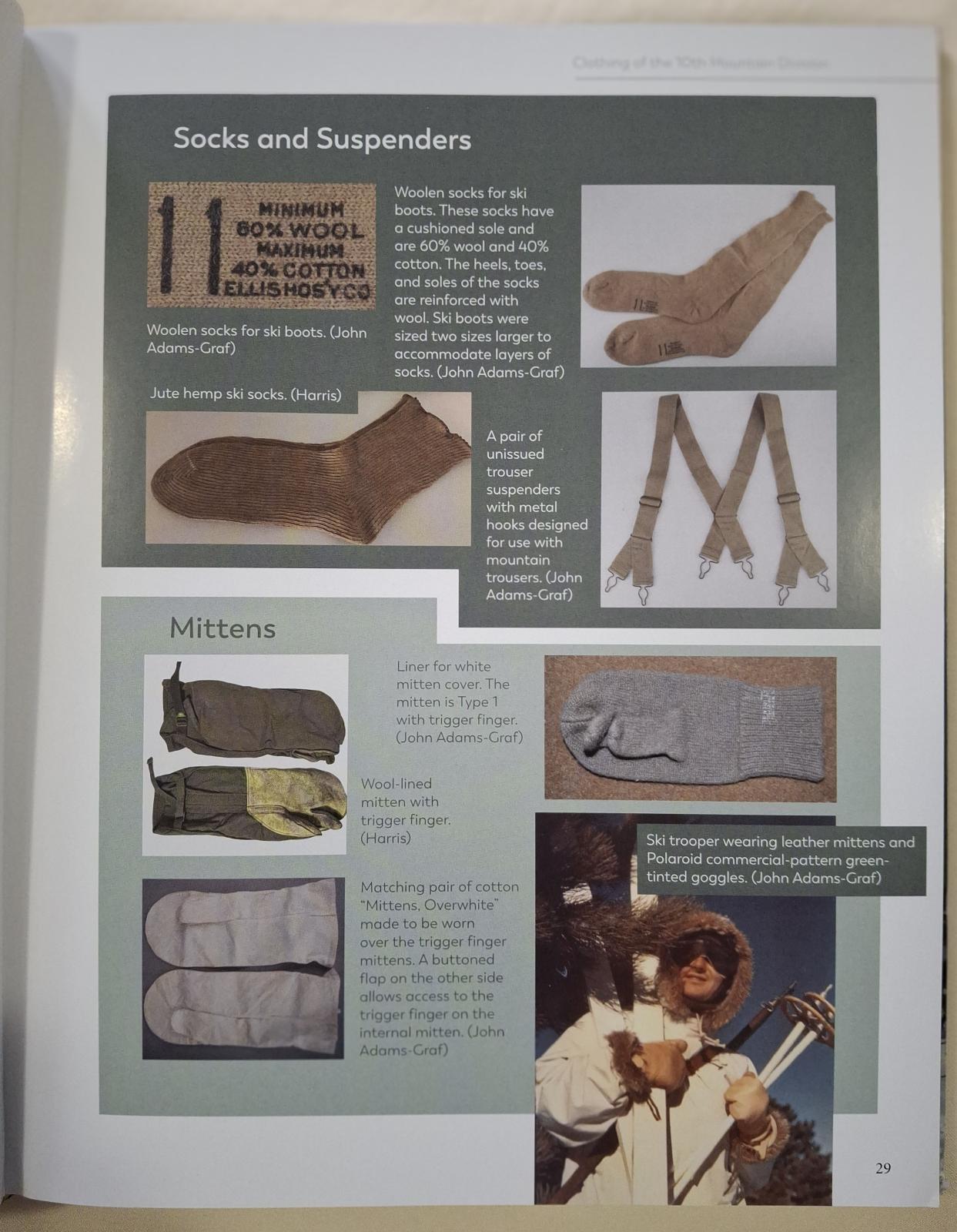
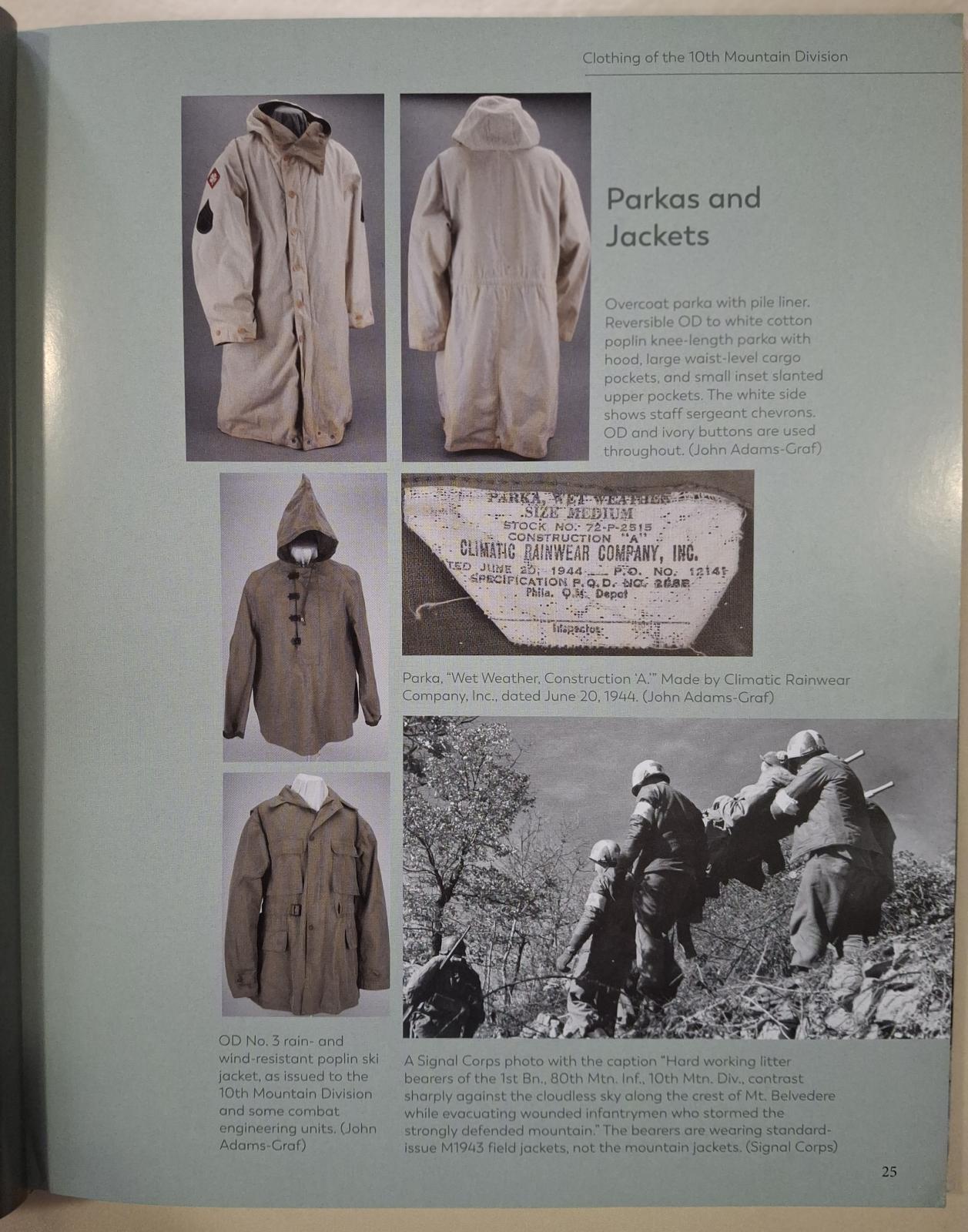
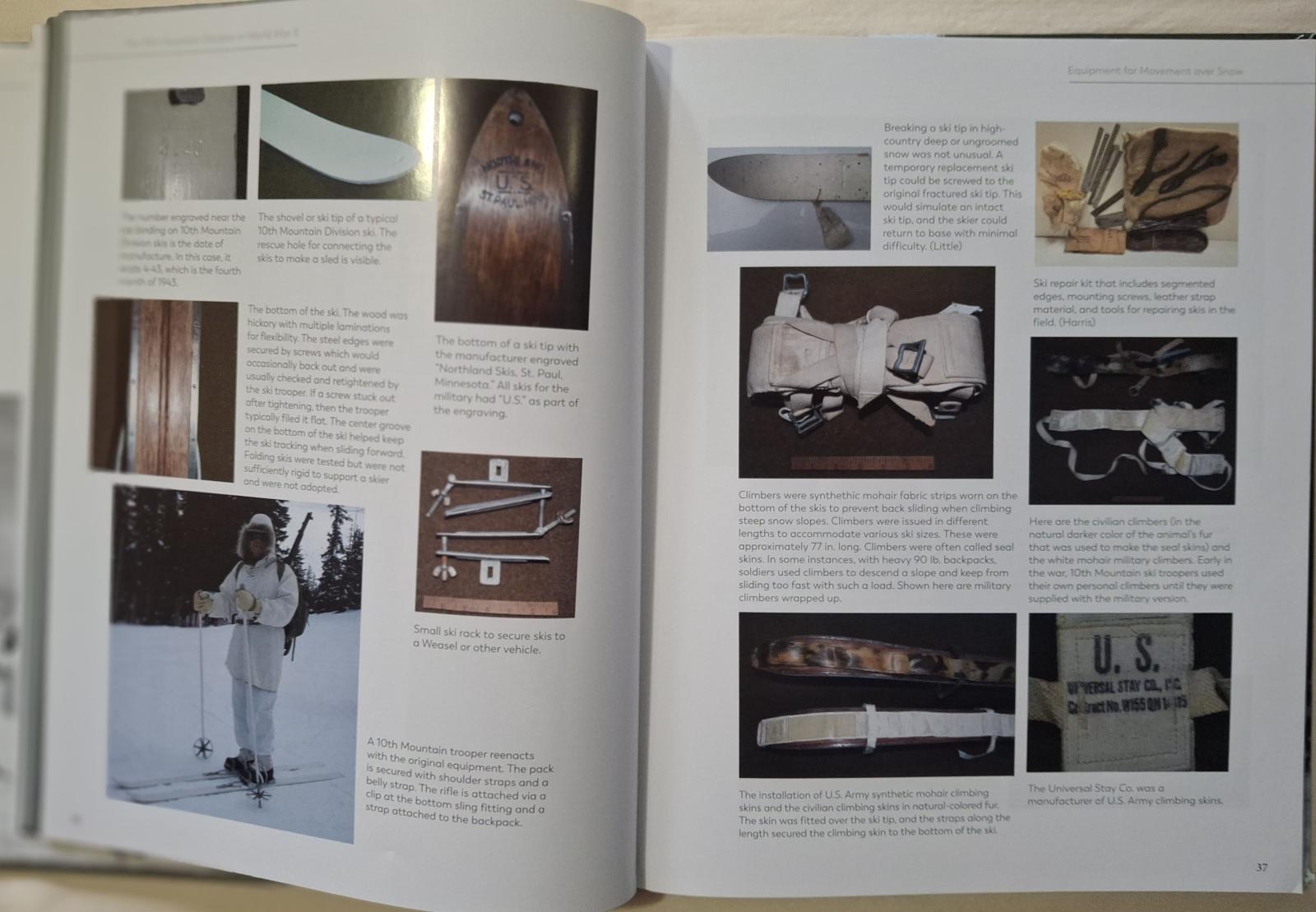
Through a series of brief descriptions and captioned photographs, Chapter 2 covers clothing and Chapter 3 covers equipment for movement over snow. Chapter 2 covers clothing used by the 10th Mountain from head to toe, including boots, socks, caps, sunglasses, helmets, parkas, pants, gaiters, and service uniforms.
Chapter 3 does the same for snow equipment. Equipment covered includes skis, ski boots, poles, bindings, and snowshoes. This chapter also devotes a few pages to skiing techniques used by the troops. Troops had to learn about balance with the extra weight of a 90-pound pack.
Chapter 4 goes over mountaineering equipment with the same brief description and captioned photographs. Equipment covered includes tents, pitons and piton hammer, crampons, ice axes, and other equipment like backpacks and cooking gear.
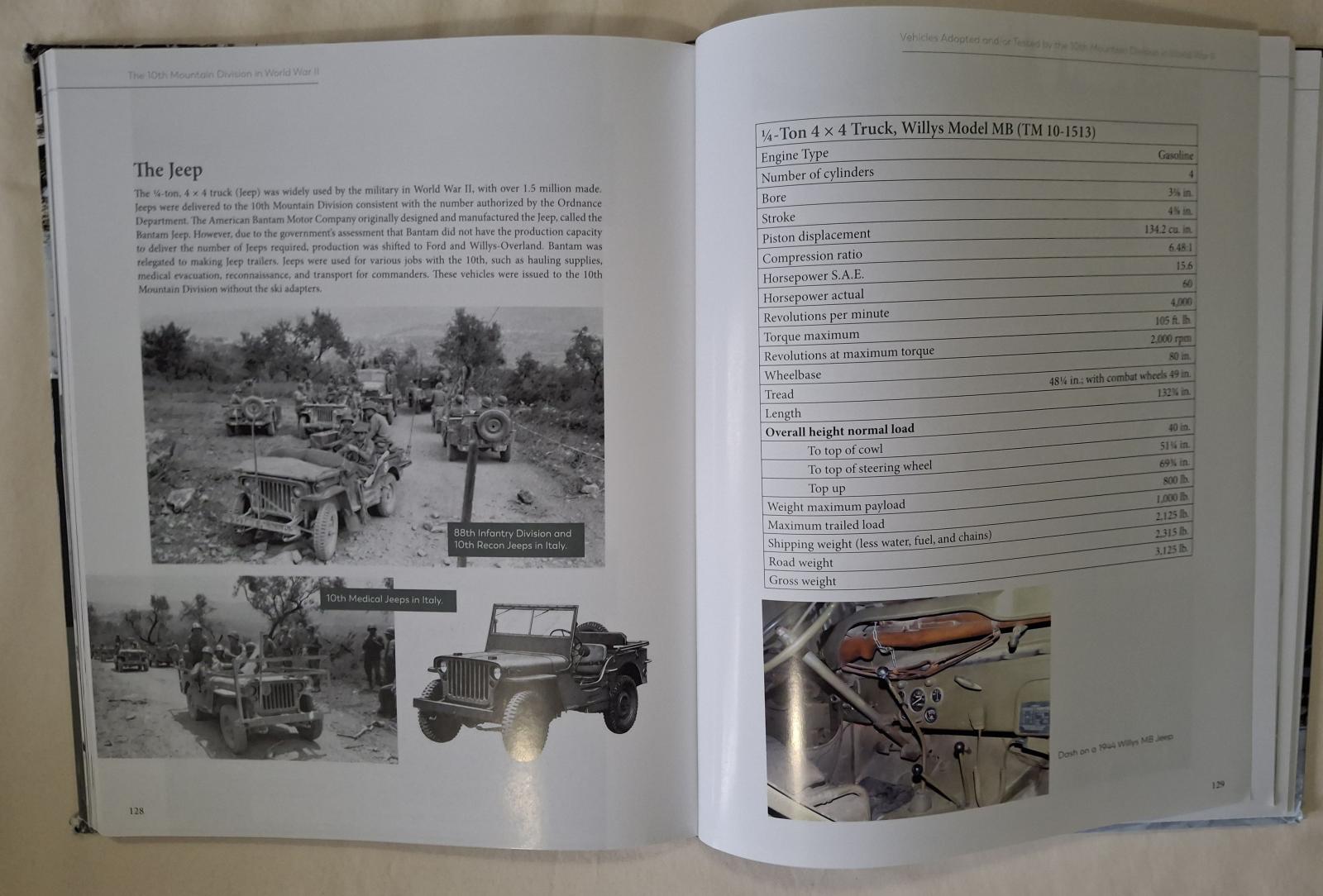
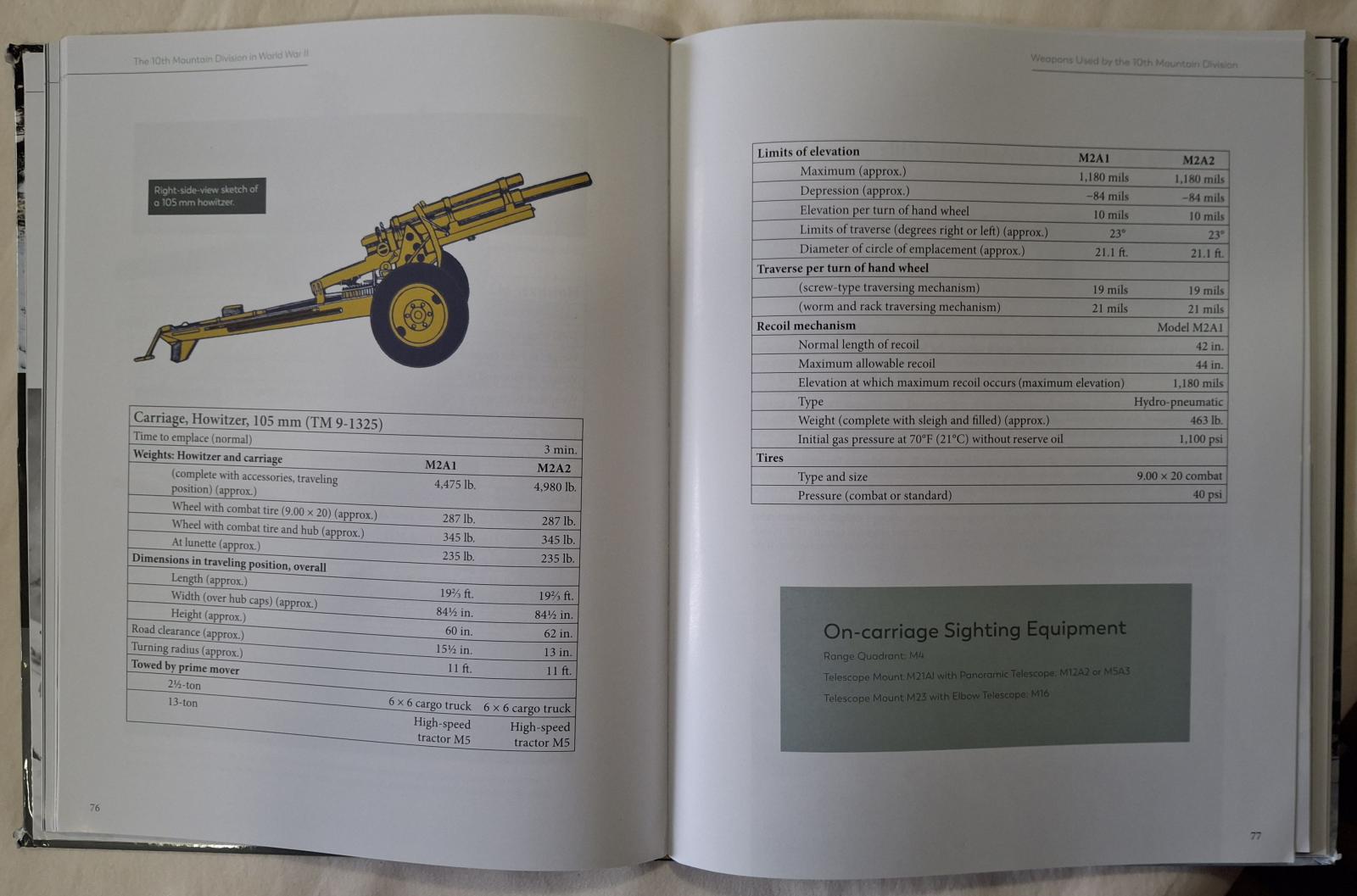
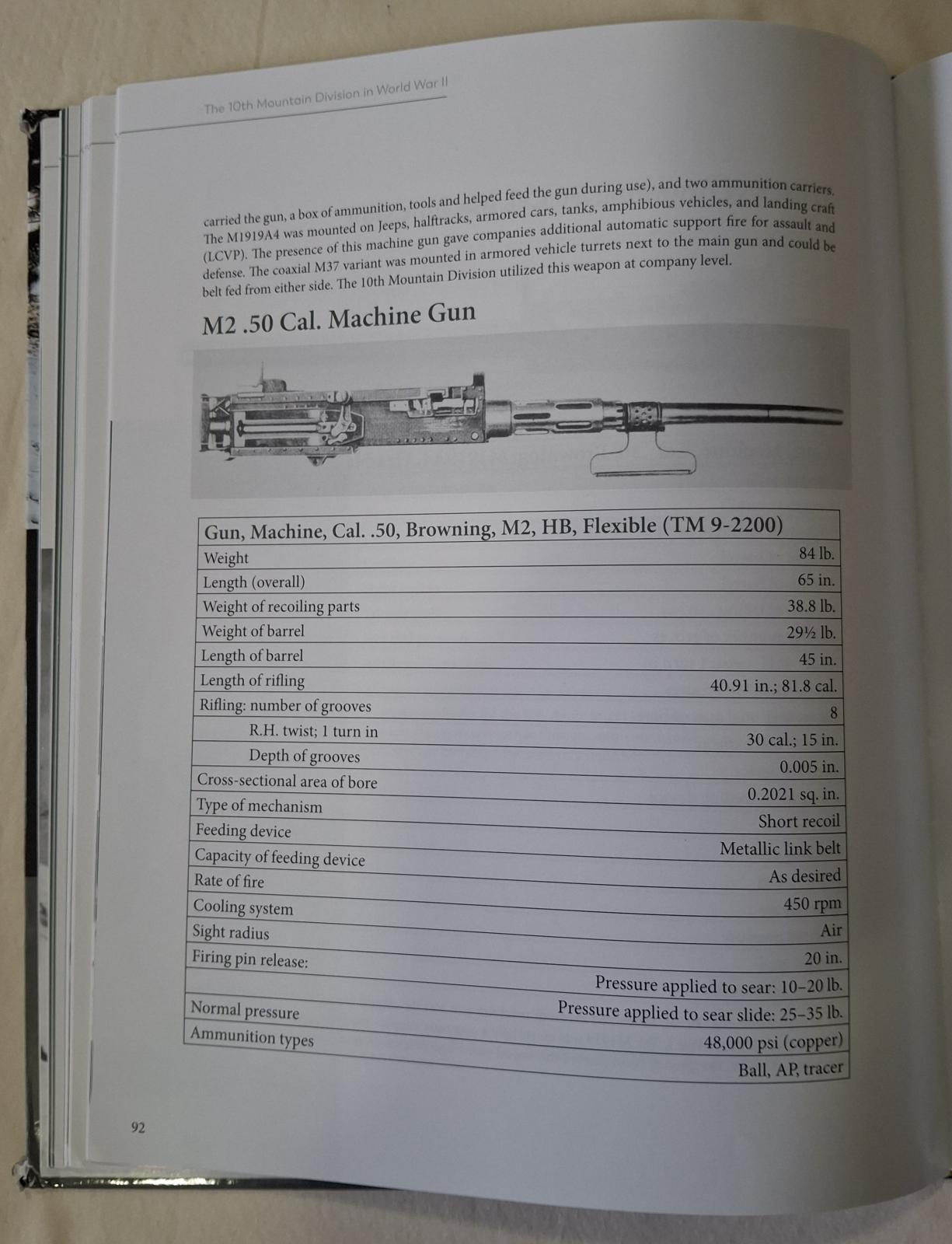
Chapter 5 introduces the reader to the weapons used by the 10th Mountain Division. Weapons cover everything from the 75mm Pack Howitzer to the .50 caliber M1911 semi-automatic pistol. Like the previous chapters, the weapons are presented with a description of the weapons and their use by the Division. An interesting addition to this and later chapters is an extremely detailed table of information on the weapon. These tables cover everything from the usual weight, length, width, height of the weapon down to detail such as muzzle velocity, rate of fire, and type of firing mechanism. One notable item missing a descriptive table is the M3 .45 caliber submachine gun or “grease gun.”
Chapter 6 provides descriptions of the vehicles used by the 10th Mountain Division, and, because of the Division's unique mission requiring movement over snow, a good number of snow traversing vehicles that were tested, but never adopted by the Division.
The Chapter starts with the vehicle most used by the Division in both training and combat operations, the M28 and M29 Weasel. The M28 was developed in 1942 as a design to transport men and equipment over snow in a planned operation to destroy heavy water plants in Norway. The M28 had a number of issues; it was limited to only two men and had limited storage. But the biggest problem was that it had only four pairs of road wheels per side that were canted. This led to the vehicle easily throwing a track during a turn. The next version of Weasel was the M29. It was large enough to carry three troopers and their equipment. The four canted road wheels were replaced by eight non-canted road wheels, thus solving the track throwing problem. Also, the engine went from a rear mount in the M28 to a front mount in the M29. In addition to these changes, the M29 could be fitted with flotation cells in the front and rear, making it capable of amphibious operations. The 10th Mountain used the M29 Weasel extensively as it operated well in snow, even powdery conditions. One drawback was that the vehicle was slightly top heavy and would roll over if it approached an embankment at an angle instead of straight on.
Most of the remainder of the chapter is dedicated to vehicles tested by the 10th Mountain at Camp Hale in Colorado but never adopted by the Division. The first of these vehicles is the M7 Snow Tractor. Designed by the Allis Chalmers tractor company, it was essentially a farm tractor with a half-track rear. The front wheels could be easily removed and replaced with skis if needed. The M7 was under powered and again was only capable of carrying two men. Allis Chalmers also designed a dedicated trailer for use with the snow tractor. The M19 Snow Trailers had fenders that doubled as skis by being lowered under the wheels.
The next vehicle discussed is the M36 Snow Tractor. Manufactured by the Iron Fireman Company, three M36’s were delivered to Camp Hale for testing. The vehicle had several shortcomings, not the least of which was its inability to operate in snow greater than two feet deep. In snow over two feet deep, the tracks would lose contact with the ground and “float” in the snow.
The Eliason Motor Toboggan was just what it sounded like, a 12-foot-long by 3-foot-wide wooden sled with a 2-cylinder Indian motorcycle engine that powered single-belt-type track, similar to those on today’s snowmobiles. The vehicle had problems with “sinking” in deep snow and the engine overheating at high altitudes in the Colorado mountains.
As a result of testing the above vehicles, the Army was able to establish a set of specifications for an ideal snowmobile. The best design was from Allis Chalmers and was designated the T27. Unfortunately, the T27 had problems with the engine overheating at altitude and poor performance in deep powder snow.
The next three vehicles discussed small one-man designs. These are the T26 Sno-Cat, the T28 Snow Tractor, and the T30 Snow Tractor. Although none of these vehicles met the needs of the 10th Mountain Division, the T26 Sno-Cat became one of the popular snow vehicles after the war and could be found at several ski areas around the country.
The other vehicle used extensively by the 10th Mountain Division was the ubiquitous Jeep. Originally designed by the American Bantam Motor Company, the government felt that American Bantam lacked sufficient production capacity to meet the needs of the military. Production was therefore shifted to the Ford Motor Company and Willys-Overland. It is interesting to note that the Jeep could be equipped with ski adapters; the 10th Mountain never used this feature. Along with the Jeep, the M100 Jeep Trailer is described. The M100 is a ¼-ton towed trailer. Also discussed with Jeep is the T29 Snow Tractor. The T29 is basically a half-track version of a Jeep. The rear axle is replaced with three-wheel track, and the rear area of the jeep is replaced with a simple box.
The final vehicle discussed is the Crosley Pup. Crosley was a small, independently owned automobile company. The Pup was offered as an alternative to the Jeep. However, due to its small size, anyone over 6 feet could not fit in the vehicle. Thus, it was never adopted for use.
The last chapter covers vehicles used by the 10th Mountain Division but supplied by other units. These include the General Motors DUKW, the 2½-ton truck, the WC-51 Weapons Carrier, and the Higgins Boat (LCVP). Much of this chapter is devoted to the tragic loss of 25 soldiers on the night of April 28, 1945.
As part of the mission to advance from Torbole to Riva del Garda across Lake Garda. The plan was to sail across the middle of the lake rather than along the shoreline to avoid German sniper and artillery fire. The mission was to be carried out on April 30, 1945.
Batteries B and C of the 605th Field Artillery Battalion were attached to the 10th Mountain at this time. Three DUKW’s were assigned to transport men and equipment from these batteries. Equipment included a 75 mm pack howitzer and ammunition.
The maximum load capacity for a DUKW was 5,000 pounds. However, in emergency conditions the DUKW could be loaded with up to 7,500 pounds. Both these load limits assumed calm water conditions. But on the night of April 30, one of the DUKW’s was loaded at over 6,900 pounds. The DUKW operator voiced concern about being over the weight limit. Some equipment was transferred to other vehicles but only reduced the weight by about 200 pounds. This left only about a foot of free board.
As the convoy approached the center of the lake, a storm blew up, causing rough water conditions. Because of the low free board, the overweight DUKW took on water that stalled the engine. This had the further unfortunate consequence of also stopping the bilge pump. As a result, the vehicle quickly took on water. The soldiers onboard did their best to keep the vehicle afloat by throwing their equipment overboard, but to no avail. Several of the soldiers could not swim and drowned. Of the remaining men in the water, all but one succumbed to hypothermia before they could be rescued.
After going into detail on the above-outlined tragedy, there is a detailed analysis of how the DUKW sank. In 2011, a group of Italian volunteer divers located the sunken DUKW. In 2018, a team of professional archaeologists and marine professionals worked with local authorities to preserve the sight as a military grave site.
Bottom Line
The book has been comprehensively researched, and the photographs are well captioned with relevant information. I would strongly recommend this latest addition to the Casemate stable to those interested in World War II unit history and the was in Italy.
I would like to heartily thank Casemate Publishers for providing the book for review, and to IPMS/USA for giving me the opportunity to review it.
Comments
Add new comment
This site is protected by reCAPTCHA and the Google Privacy Policy and Terms of Service apply.
Similar Reviews