For modelers building scale models of the Space Shuttle one of the more difficult challenges has been to replicate the thermal shielding on the spacecraft, whether the tiles or the blankets. In the smaller scales, this can be a real challenge and as a result one of the most sought after after-market sets has been thermal tile decals. Meteor Productions, in their Cutting Edge decal line, was the first company to offer tile decals. These deals proved extremely popular. That company has been gone for nearly 5 years and the decals have become very hard to find, usually commanding high prices. Enter Warbird Decals, a new company in the real space market. They have introduced a new line of thermal tile decals in the scales of 1/72, 1/100, and 1/144 to meet the ongoing demand.
Reviews of products for scale space and science fiction vehicle models.
Thunderbirds are GO!!!!! For those of my generation, that was a great call tag! For the younger crowd, I am sure they have still heard about International Rescue. Gerry and Sylvia Anderson created one of the greatest series ever to be broadcast! There were only two 50 episode seasons created. However, those two seasons spawned two movies and tons of different merchandising items to include plastic and die-cast models. Bandai, Imex and Aoshima are the ones I can remember. I have seen several others over the years adding their twist to the old classic which just proves the greatness of the original models used in the series.
Aoshima’s website is not super user friendly but as near as I can tell they offer at least 12 different Thunderbird models. Six are part of their MINI series and six in their other line. The mole has currently two different versions in their inventory. One of the kits is in 1/72 and I believe is a copy of the older Imex kit and this other MINI mole.
Spacecraft History
Perhaps unknown to many, the Apollo program was planned as a series of methodical steps, leading up to the first landing on the Moon. Each mission type, labeled A-J, built on the success of the previous steps towards the initial goal of a G-Mission, landing a man on the Moon, achieved by Apollo 11, and then moving on to further goals, culminating in the J-Missions, which saw a 3 day stay on the Moon and the use of the Lunar Rover. Apollo 17, crewed by Eugene Cernan, Ronald Evans, and Harrison Schmitt (a Geologist), was the third and final J-Mission, after Apollo 15 and 16, and was the last manned mission to the Moon.
Those of us of a certain age remember April 13, 1970, as a “worst nightmare come to reality” day. On that day the crew of Apollo 13 radioed those famous words, “Houston, we’ve had a problem.” The mission ended with the successful and safe return of the astronauts, and gave the world an iconic moment revealing just how dangerous space flight can be.
The author of Apollo 13 Owner’s Workshop Manual is Dr. David Baker, who worked for NASA during the Gemini, Apollo, and Shuttle programs. Dr. Baker was part of the team within Houston Mission Control throughout the Apollo 13 mission and, therefore, speaks with a considerable authority. He has written more than 80 books on spaceflight technology, and this is his fourth Haynes manual, following the NASA Mars Rover Manual, International Space Station Manual and NASA Space Shuttle Manual.
Warbird Decals is known for its aircraft decal line, and now it is making new strides into real space subjects.
Upon opening the ziplock bag, you find two letter-size decal sheets which includes lower surfaces and upper surface/rudder tiles, and one single page with a 4-view drawing of the Space Shuttle with a decal map. The decal sheets provide extra decals, but the instructions do not tell you what for (more on this later).
I built the Tamiya Space Shuttle a few years back. You can find a review of the kit at http://web.ipmsusa3.org/content/space-shuttle-atlantis. It is a nice kit, but certainly has room for improvement, mainly due to the lack of tile detail in the lower surfaces.
These decals are very glossy and conformed to the surface perfectly, without needing to use any decal solution. They were easy to move around for good alignment, too.
A direct descendant of the German V-2, NASA's Saturn V rocket was – and still is – the most powerful rocket in the world. It was developed over a period of seventeen years, with its final name and design being accepted in 1963.
Apollo 11, the subject of this Dragon kit, was in some peoples’ estimation the greatest achievement of mankind. The mission itself was the fifth in the Apollo program and the second with an all-veteran crew. Neil Armstrong, Michael Collins, and Edwin "Buzz" Aldrin comprised the crew, and Apollo 11’s LEM landed on the moon on July 20th, 1969. The first to step on the moon was Neil Armstrong who said, "That's one small step for man, one giant leap for mankind.. The command module is currently located in the Smithsonian Air and Space Museum.
Today there are three Saturn V’s which survive, one in Huntsville, Alabama, the second at the Kennedy Space Center in Florida, and the third at the Johnson Space Center in Houston, Texas.
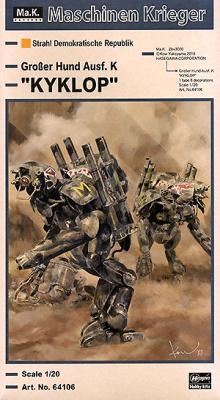
As a bit of background, and from Wikipedia, the Maschinen Krieger universe is a science fiction universe created by Japanese artist and sculptor Kow Yokoyama in the 1980s. The franchise originally began as the science fiction series SF3D which ran as monthly installments in the Japanese hobby magazine Hobby Japan from 1982 to 1985. To develop the storyline, Kow Yokoyama collaborated with Hiroshi Ichimura as story editor and Kunitaka Imai as graphic designer. The three creators drew visual inspiration from their combined interest in World War I and World War II armor and aircraft, the American space program, and films such as Star Wars, Blade Runner, and The Road Warrior. Inspired by the ILM model builders who worked on Star Wars, Yokoyama built the original models from numerous kits including armor, aircraft, and automobiles.
History Brief
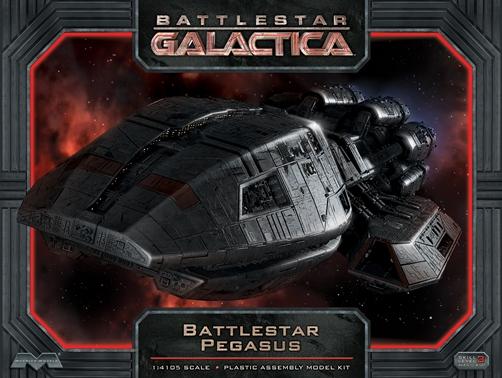
The Pegasus is either a Mercury class Battlestar or a Pegasus class Battlestar, depending on where you source your information; she is newer, larger, and more powerful than Galactica. In the re-imagined series, the Beast, as she known by her crew, is a survivor unexpectedly found by Galactica in the 10th episode of the 2nd season. She’s almost twice the size of Galactica but only needs about half the support crew, relying on more advanced automation systems. Utilizing these automation systems, the Pegasus could manufacture her own Vipers and Raptors, plus replenish stocks for the Galactica.
Her Captain, Admiral Helena Cain, and her crew were battle-tested and wanted payback after escaping the Cylon invasion. They were entirely motivated by bloodthirsty revenge and didn’t want to be tied up aiding the Colonial survivors, and, yes, this made great television entertainment. Sadly, the Pegasus was destroyed a few episodes later… or was she?
History Brief
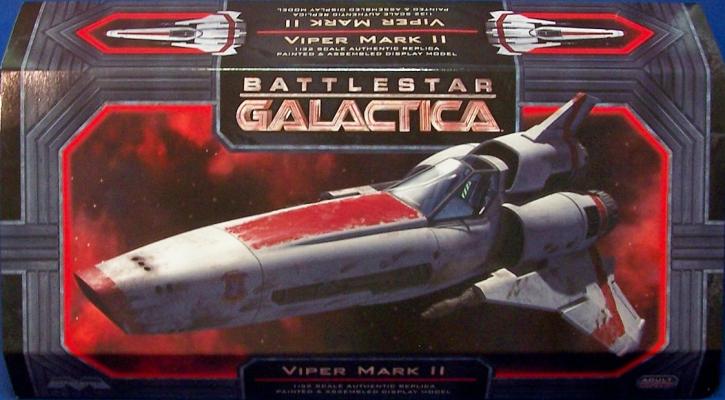
From the re-imagined television series, the Mk II Viper was a space superiority fighter/attack craft of the Colonial Fleet during the first Cylon War. It was then called back into service 40 years later onboard the aging Battle Star “Galactica” to defend against the more advanced Cylon fighter during the exodus from the holocaust of the 12 colonies.
The Product
It’s a prebuilt and fully finished kit ready to display. It’s packaged in a custom box that’s representative of the launch/flight tube. The model is accurate, nicely done, and looks pretty decent for a pre-built. It has a very nice old-school 2-piece display stand that needs assembly. “Husker,” the pilot figure, looks great and seems to be comfortable…check six! According to Moebius, Apollo and Hot Dog will be also represented, which is good to know if you are a collector.
History Brief
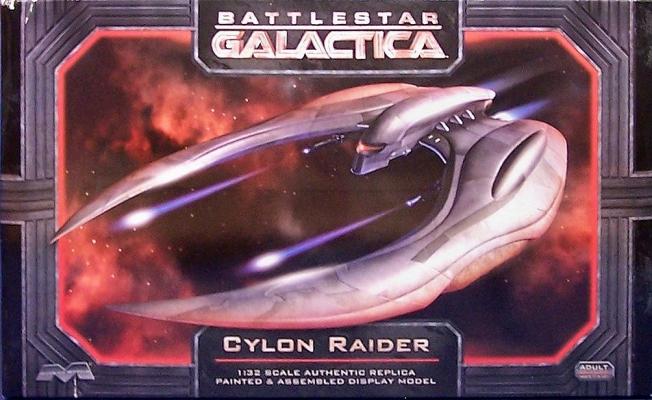
The Cylon Raider is a space superiority fighter. This modern Raider is the CGI version designed by Eric Chu used in the re-imagined television series. Called Sparrow by the Colonial pilots, these were first encountered 40 years after the first Cylon War. This thing is a living biomechanical being, spacecraft and pilot rolled into one; truly a strange nemesis.
The Product
It’s a prebuilt and fully finished kit ready to display. It’s packaged in a colorful box that’s representative of space flight. The model is accurate, nicely done, and looks pretty decent for a pre-built. It has a very nice old-school 2-piece display stand that needs assembly. However, I found this type of display stand to be unbalanced and wobbly for this application.
The Bottom Line
My wife, who is a huge BSG fan, loves this thing. Two thumbs up. Thanks to Moebius and IPMS/USA for the review opportunity.