The Akagi is arguably the best known of Imperial Japan’s aircraft carriers. Like the American carriers Saratoga and Lexington, she was laid down as a battle cruiser, and then converted to carrier as a consequence of the Washington Naval Treaty. Commissioned in 1922, Akagi was Japan’s second aircraft carrier (after the diminutive Hosho). Initially built with three separate flight decks, Akagi was updated in the 1930s to handle larger and heavier aircraft. Gone were the three separate decks in favor of a single flight deck running the length of the ship, together with an island structure added to the port side.
Merit quietly issued a 1/35 X-craft submarine and once I got my hands on it, I was impressed with both the molding and size of the kit. Still, there was some room for add-ons and improvements and Eduard has issued a photoetch sheet to help address some of the issues.
Eduard’s sheet is composed of a single sheet with 30 superb parts. The sheet addresses the hatches on the top of the ship by replacing 6 individual parts and adding detail and texture. A little removal of the hinges and these go on smoothly. There are slight folds on four of the parts but this is easy to accomplish with a new #11 blade.
Next, the kit propeller is undersized and Eduard uses the kit hub but has you wrap three individual blades around a dowel and add them to the hub. This takes a little patience but the result is a larger and more accurate prop.
History
USS Lake Erie (CG-70) is a Ticonderoga-class guided-missile cruiser of the United States Navy, named after the U.S. Navy's decisive victory in the Battle of Lake Erie during the War of 1812. She is the first U.S. Navy ship to be commissioned in Hawaii. The USS Lake Erie is a baseline 4 Ticonderoga class ship, with integrated AN/UYK-43/44 computers (in place of UYK-7 and UYK-20) and superset computer programs originally developed for the Arleigh Burke-class guided missile destroyers. The Lake Erie also has an improved UYS-20 data display system and various decision aids, as well as the SQS-53C sonar and the SQR-19 sonar data processor.
Round Two revival of the Lindberg Line of table top ships offers an opportunity along a couple of different fronts. The first of these, and this is mentioned on the box, is the in-expensive way for table-top gamers to get their hands on a couple of ships that they might not be able to get their hands on. The kits are easy to build with minimal parts and while many-a-modeler will probably turn their nose up at such a prospect (as many do with Lindberg) these are perfect for handling and moving around a large map without too much worry of breakage.
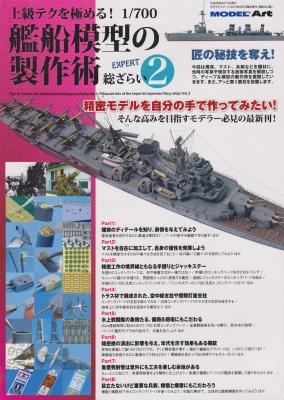
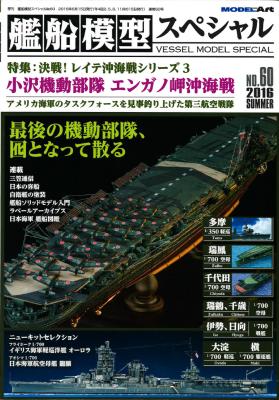
Model Art Issue 59 is typical of other Model Art magazines in that it is written entirely in Japanese, with occasional English words, usually in article titles or in captions. The Vessel Model Special is a quarterly issue that focuses on naval subjects. Advertising comprises the inside covers (and back cover) along with another four pages showing what is available and new, always useful for building up that wish list. I counted 596 photos (mostly in color) along with 17 side view or top view drawings. Additionally there are a lot of color scrap drawings highlighting details in the Ship Construction series.
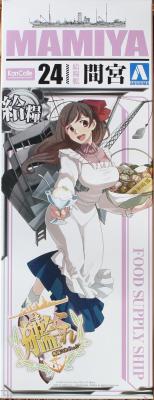
Since April of 2013 when Kodakawa games released their free browser game Kantai Collection (aka Kancolle), featuring cute anime girls each of which represent ships from the Second World War IJN, there has been an increased interest in ship modeling in Japan. Tamiya, Hasegawa and Aoshima, have long worked in harmony releasing a sizable number of 1/700 warships represented by the waterline series of kits. These three companies as well as Fujimi are capitalizing on the popularity of the game and anime series by re-releasing many of these kits, as well as creating new kits, with extra decals of the girls as well as game specific box art.
Admittedly, because of the game as well as the anime series, I too have become a bit more interested in ship modeling. When I saw the Model Art issue covering up for grabs I knew that I wanted to give it a good look. Based on other Model Art magazine reviews and the few that I already own it I knew I would not be disappointed.
Tsesarevich (Russian: Цесаревич) was a pre-dreadnought battleship of the Imperial Russian Navy, built in France at the end of the 19th century. The ship's design formed the basis of the Russian-built Borodino-class battleships. This set represents what she carried prior to an attack in the night of February 9, 1904, in the Russian-Japanese war. She was one of three ships to be struck by Japanese torpedoes and limped back to Port Arthur. There she lost four of her 75mm, two of her 47mm, and two of her 37mm guns to reinforce the port defenses. After the Russian-Japanese war, Tsesarevich, helped suppress the Sveaborg Rebellion. Around 1906, her fighting top was removed and her superstructure was cut down, in the process losing more guns, mainly most of her 75mm guns. In time, ~ 1914, all of her 75mm guns were removed.
History
An Essex-class carrier commissioned in 1943, she set more records than any other Essex Class carrier. The Lexington was the oldest working aircraft carrier in the United States Navy when decommissioned in 1991. The Lexington was originally named the USS Cabot but while final construction was being completed at Massachusetts’ Fore River Shipyard word was received that the original carrier named USS LEXINGTON, CV-2, had been sunk and the new carrier’s name was changed to LEXINGTON. The nickname ‘Blue Ghost’ came about due to the Japanese claiming to have sunk the ship 4 times.
Academy is one of the most eclectic kit manufacturers on the market. Not only do they make traditional models in a range of scales, they also make educational kits such as this one. It’s nice to see a mainstream company try a variety of strategies to entice younger modelers into the hobby.
The Kit
There are four sprues, all of translucent plastic that are of different colors. The plastic is on the soft side, but certainly strong enough to meet the demands of moving the kayak through the water. For those of us not mechanically inclined, the motor and gear box are pre-assembled, so no fears of trying to trying to become an electrician or mechanical engineer. There is a small sheet of stickers for the little robot man, but that’s about it.
This is Ampersand’s first nautical book, a new series that promises to focus on US capital ships of World War II. It follows the format as David Doyle’s “Flying Wings” and “Consolidated B-36” books, but is in hard cover. Ampersand got their start in 1993 when Pat Stansell distributed a free issue of Military Miniatures in Review at the IPMS Nationals in Atlanta. Ampersand joined forces with HobbyLink Japan in 2008 and have continued to expand their military AFV publications ever since.