Based out of Austria, Harpia Publishing specializes in the more esoteric aspects of military aviation, and boasts some of the most knowledgeable authors in their respective fields. The result is a catalog of books with very detailed accounts of Egyptian, Iranian, Iraqi, Syrian, Asian, and various African air forces.
The HK B-17F & G are really nice kits. Much nicer than the venerable Monogram B-17G and the Revell B-17F, however there are some areas where I prefer the older kit. One of those areas is the engines.
There are a variety of companies that have made update sets for the engines. For me the best and easiest to use is this Aires set.
Packaged in the typical Aires cardboard box are four beautiful engines. The detail is exceptional with the cooling fins on the cylinders being the deal cincher for me. Included in the box are the four engines and four ‘banks’ of push rods with plenty of extras. There are also four spacers included. Also in the box is a fret of brass ignition leads for the cylinders. Illustrated instructions are also included.
A quick way to add detail to your FW-190A-5 through D-11 is to open up an access hatch or two. These are often found open or missing on crashed or abandoned aircraft. Aires provides you a way to do that now on your late FW-190.
Packaged in a self-contained baggie with a cardboard backing to prevent damage are three light grey resin pieces. They show exquisite detail and are flawlessly cast. A fret of photo etch pieces is also included. The instructions are printed on light blue paper with easy-to-follow directions. The first part of the addition is the parts prep, which is easy to do. This will just take some painting to bring alive.
The ICM Do-217N-1 is a nice kit but it could use some updates. One of the big ones is in the propeller blades and prop hub. The kit offering is not quite correct in shape and the prop blade profile is off slightly with the propeller tips being a little too pointy.
Quickboost recognized this and offers up this easy and convenient prop set. Included in the typical resealable bag with card stock backing are eight propeller blades and two spinners. The only thing missing is a tool to set the angle of the blades. Removal of the parts is simple enough. You will have to drill a center hole to mount the spinner with the props installed. This will require some brass, not included, or some other form of support. You could always just mount the prop spinners directly to the cowlings.
The Do-217N-1 is a unique night fighter variant of the Do-17/215/217 series. This set is an easy addition to the ICM model. The set is packaged in typical Quickboost fashion. A resealable package with card stock backing to protect the parts. The parts are flawlessly cast in light grey resin. There are four exhausts and four exhaust ends. The exhausts feature hollow ends with beautiful molded on detail. The four separate front portions have exquisite detail in the front. It is just a simple matter of removing them and adding them to the front of the exhaust parts. One of mine exhausts was slightly out of round but a quick bath in hot water allowed me to straighten it.
Adding them to the kit is simple and easy enough to do. The important thing is to pay attention to what you need to remove. Leave the exhaust stacks on the underside on the part. It would be easy enough to cut them off, so pay attention.
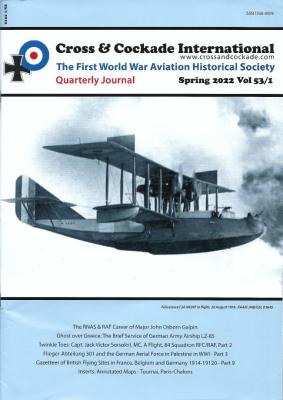
A note about the price of the calendar; The C&C website shows the price in Pounds Sterling and not in Euros.
The 2022 issue of the Cross & Cockade calendar continues the well-established tradition of past year’s calendars: that being of high quality with excellent artwork. As in past years, you are advised to order your copy now, and not wait. There may be a limited supply of these calendars and you do not want to miss out because you waited until the supply ran out.
According to Roger Tisdale of Cross & Cockade the profits from the sale of these annual Cross and Cockade International Calendars go to assist in the upkeep of the British Air Services Memorial at the St-Omer airfield in northern France”. This is a very worthy cause and deserving of your support. One can check out the St-Omer Memorial.
The HK B-17s are really good kits. They could use some details added here and there. One of those places is the props. They are slightly misshaped. They are wider than they should be at least to my eye and to obviously Quickboost as well. Judge for yourself with the photos.
There are four prop hubs and 12 prop blades. They are all packaged in the resealable packaging that Quickboost uses with a card stock backing to protect the parts. There are 16 flawlessly cast light grey resin pieces included, four hubs and 12 blades. The blades are keyed to the hubs so there is no need for an alignment tool. The detail on the hubs is flawlessly executed and the blades are suitably thin and correctly shaped.
The only real work is to drill out the back of the hub and insert your own mount or wire.
Painting is easy enough with the yellow tips and the hubs and blades being flat black. You will have to supply your own decals as none are provided.
Lifelike Decals from Japan has released its 4th installment in a series of Ki-27 “Nate”. There are a total of 9 aircraft, with 7 of them being of the Japanese “Gray Green” color, which the instructions suggest to replacing with German RLM 02. The other two aircraft are painted in Japanese Dark Green over Gray-Green.
The decals provide squadron codes and fuselage art for all aircrafts. However, you don’t have enough national markings for all aircraft. This is not a big problem as you can use the national markings and stencils from the decal sheet in the original Hasegawa kit. The set also provides templates -in regular paper- for masking of cowlings
Decals have been printed by Microscale and they have a well-earned reputation for thin decals and in-register sheets. These are no exception. Decals are glossy, look thin, and likely will adhere well to a gloss surface.
Lifelike Decals from Japan has released its 5th installment in a series of Ki-27 “Nate”. You get a total of 8 aircraft, with 6 of them being of the Japanese “Gray Green” color, which the instructions suggest replacing with German RLM 02.
One of the other two aircraft is painted in Japanese Dark Green over Gray-Green, while the last one is an attractive disruptive camouflage of dark green, green and brown over Grey-Green.
Decals are provided for squadron codes and fuselage art for all aircraft. However, there aren’t enough national markings for all aircraft. This is not a big problem as the national markings and stencils from the decal sheet in the original boxing from the Hasegawa kit can be used.
Decals have been printed by Microscale and they have a well-earned reputation for thin and in-register decal sheets. These are no exception. Decals are glossy, they look thin, and likely will adhere well to a gloss surface.
It had to end eventually. After nearly a 40-year run in the Japanese Air Self Defense Force’s (JASDF) venerable Phantoms were finally retired in 2020. Several model companies re-released their RF-4 / F-4 kits to commemorate the myriad of markings worn by these Phinal Phantoms at the end of their JASDF careers. Platz was no exception and one such release included the RF-4E Recce Phantom with the forest camouflage. Markings for 3 different machines in the squadron were included in the kit.