Reviews of products for scale aircraft models.

Review Author
Brian R. Baker
Published on
Company
Airfix
Dutch Profile Publications
Scale
1/72
MSRP
$10.00

Background

Several months ago, I was asked to review an excellent publication dealing with the Brewster 339’s operated by the Netherlands East Indies Air Force in the Malaya-Dutch East Indies theatre of operations at the beginning of World War II. It was entitled Brewster B-339C/D/-23 History of Camouflage and Markings by Gerard Casius and Luuk Boerman, and appeared on the IPMS site a while back. There was a set of decals for Brewster Buffaloes in Dutch, RAAF, American and Japanese markings in both 1/72 and 1/48 scale. These looked very good, and John Ratzenberger wrote a review on the decal sheet, but I decided to actually build some of the models and use the decal sheet, and as usual, the project got a little bit out of hand, resulting in six new Buffalo models that I need to find space for in my model display cabinets.

Review Author
Bill Hollis
Published on
Company
Loon Models
Scale
1/32
MSRP
$23.00

Loon Models bills this set as a “No Cut” conversion. It comprises a small number of tan resin pieces of moderate quality to directly replace styrene counterparts in Roden’s 1/32 scale Siemens-Schuckert D-III kit.

Included are two cowls, one a replacement for the “standard” number supplied in the kit and the second a later “cut back” version. Along with these are a “non vented” propeller hub, a separate engine frame assembly and a horizontal stabilizer/elevator assembly with the shorter span, narrow chord control surface of the earlier production D-III’s.

The parts come packaged in a zip lock bag inside a thermoform plastic box. There is a single sheet of written instructions with no pictures or diagrams, construction sequences, in-progress illustrations or references.

Review Author
Dave Koukol
Published on
Company
Eduard
Scale
1/48
MSRP
$39.95

Background

Arguably one of Germany’s premier fighters in World War I, the Fokker D.VII quickly became won acceptance by its adoptive aircrews as it began to enter service in the summer of 1918. A well-balanced and stable gun platform, with exceptional maneuverability and reliability, the D.VII demonstrated significant performance improvement over prior Germany types, including its famed older brother, the Fokker Dr.1 triplane.

In order to meet wartime demand, Fokker licensed production of the D.VII to Albatross. Albatross cranked out the D.VII at its Ostdeutsche Albatros Werke (OAW) facility. Multiple models were manufactured, incorporating running changes and three distinct powerplants – two of Mercedes origin and one from BMW.

By war’s end 2,800 D.VII’s rolled off of the production lines.

Book Author(s)
Paul Bradley
Review Author
Jim Pearsall
Published on
Company
SAM Publications
MSRP
$30.00

Thanks to SAM Publications and Paul Bradley for the review copy.

During the IPMS National Convention in Columbus, I bought the Modeler’s Datafiles 12, 13 and 14, on the F-4 Phantom. I was impressed with these books, and I’m impressed with this one too. This book has all the information a modeler needs to build a Hawker Hunter, including a kit listing, a decal listing and an accessory/conversion listing. I find I spend a lot of time looking for info on aircraft I build, and this book will save me on research next time I build a Hunter.

The table of contents is as follows:

Review Author
Roger Carrano
Published on
Company
Eduard
Scale
1/32
MSRP
$19.95

Eduard is right on par with this Photo Etch Set for Tamiya’s Mk. IX Spitfire. The Tamiya kit is just about the best Spitfire kit out there in any scale and they have already done a superb job with the cockpit. So how does Eduard come back with a product that adds a little more detail to this well thought out cockpit? They’ve done it buy adding just a little extra to Tamiya’s parts by pushing up the detail a few notches. The instrument panel is as superb as always and is done in the usual Eduard manor. But parts, such as the gun sight mounting bracket, are exchanged for Eduard’s more realistic holding bracket. This detail adds a realistic subtleness that wouldn’t be noticed until both parts are compared. The throttle boxes are made more realistic just by the fact that less is more. Instead of a clump of plastic formed to have the general outline, it’s made to look like the throttles can actually be moved back and forth.

Review Author
Ben Guenther
Published on
Company
Master Model
Scale
1/72
MSRP
$6.29

I think most of us realize that if we want more detail we will often find it in resin sets, and if we really want the best barrels we’ll find them made for of us out of brass. The Polish company, Master Model, has been producing excellent brass barrels in 1/32 and 1/48 scales for the aircraft modeler and 1/700 and 1/350 brass barrels for the ship modelers. Recently, they have started a line in 1/72 scale and the first product is one that everyone can use – Browning M2 aircraft .50 caliber barrels. Just think of all the Allied aircraft that mounted the M2 .50 caliber machine gun and you can see how popular this could be.

Book Author(s)
Jon Proctor, Mike Machat, Craig Kodera
Review Author
Phil Pignataro
Published on
Company
Specialty Press
MSRP
$29.95

Aptly titled, this decade in the history of commercial aviation was initially dominated by “luxury airliners” like the Douglas DC-7C, Boeing Stratocruiser, and Lockheed Constellation. That was until the arrival of jets - the Boeing 707 and Douglas DC-8. The authors, Proctor, Machat, and Kodera who have long been associated with the U.S. airline industry take us back to this transitional period through their personal experiences, photographs and paintings.

Review Author
Jim Pearsall
Published on
Company
Dragon Models
Scale
1/144
MSRP
$14.95

The US Navy had a winner in the SH-3 Sea King. But like all good things, the Sea King became obsolete, and the Navy had to find a replacement. The answer was that the US Army was looking for a replacement for their UH-1 Iroquois (Huey). Robert McNamara would have been so proud, as the Army and Navy chose the same basic helicopter, Sikorski’s S-70, which became the Army’s UH-60 Blackhawk and, because the Navy’s just, well, different, the SH-60, HH-60 and MH-60 for the elder service.

The Navy version has the tail wheel moved forward, and doubled. This allows the tail on the ship-based helos to be folded, saving deck space. Navy missions include surface warfare, undersea warfare, anti-submarine warfare, SEAL insertion, replenishment, troop landings, search & rescue and Medevac.

Review Author
Roger Rasor
Published on
Company
Wingnut Wings, Ltd
Scale
1/32
MSRP
$59.00

Part I

Wingnut Wings has released two 1/32 scale Sopwith Pup kits, one containing parts and multiple markings for the Royal Navy version and one containing parts and markings for the Royal Flying Corps version. The subject of this review is the RFC version.

If you build plastic model airplanes and have not heard of this kit manufacturer before, you must have been spending a year or so under a rock somewhere. Wingnut Wings is a New Zealand-based company with a passion for World War I subjects in general and aircraft in particular. This new company made a big splash in the hobby last year when they released their first four World War I kits and created an even bigger wave this year when they released four more. Everything is 1/32 scale and produced at a level that leaves most other kits in the dust. The almost overwhelming response to the release of the first kits was a wide-eyed Wow andthe latest kits deserve the same response.

Review Author
Floyd S. Werner Jr.
Published on
Company
Quickboost
Scale
1/48
MSRP
$6.50

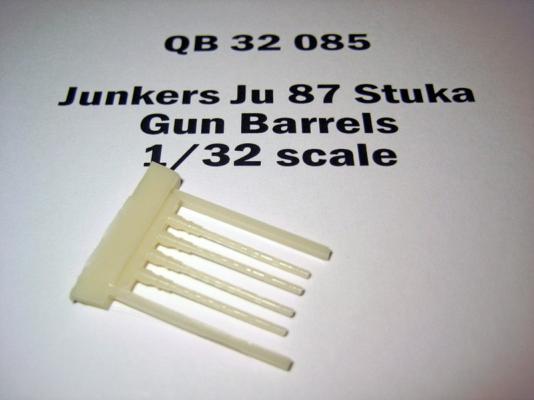
The Hasegawa Stuka kits are really nice. They could use some help when it comes to the night bomber variants. That is where Quickboost comes in. They offer three different variants of the night bomber exhausts. This particular exhaust, Type C, is shaped at an angle with beautiful detail inside the front and rear parts. Molded in bubble free light grey plastic with exquisite detail, these exhausts will add to the unique look of your Stuka.

Simply cut the parts from the pour stub and paint. Easy and effective. Of course you’ll have to check your references to determine which exhaust is right for your aircraft.

I recommend you read over “Ghost Bombers”. (ISBN-13:978-1903223154). This provides plenty of motivational reading and drawings.

Highly recommended

Thanks to Quickboost for the review copy.