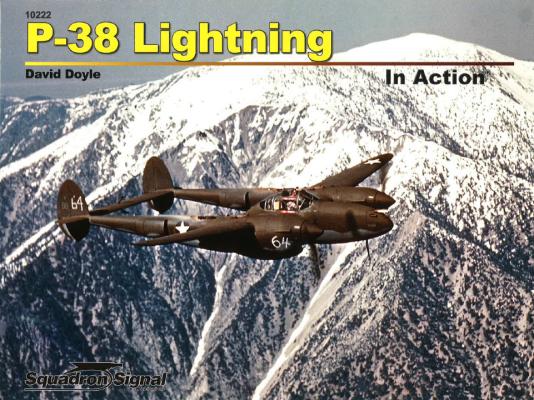
David Doyle’s latest book continues to expand on Squadron Signal’s long standing In Action series that initiated back in 1971.This is a completely updated and expanded edition over Squadron’s earlier Aircraft In Action number 25, a 50-pager on the Lightning by Gene B. Stafford that was published in 1976. That first release was followed by Squadron’s In Action number 109, a 58-pager on the Lightning by Larry Davis that was published in 1990. A third release came in 2011 from David Doyle with 72 pages as Squadron In Action number 1222. This 2017 release adds an additional eight pages and includes many new photographs.
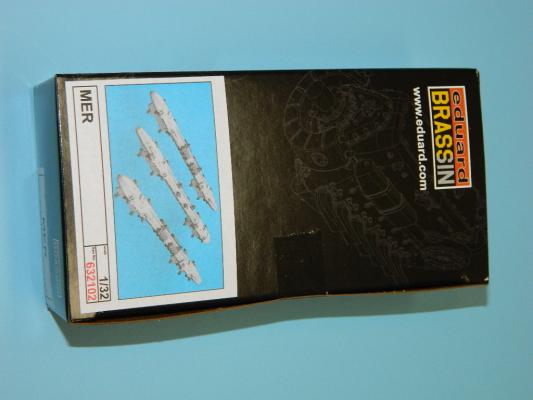
Sincere appreciation from IPMS USA goes to Eduard for their having once again provided a sample copy of a long-awaited product, the Multiple Ejector Rack, and the usual wave of thanks to the IPMS USA leadership for ensuring I received it!
First off: when someone develops a B-52F/D for a Vietnam diorama, I’ll be ordering an extra two of these sets… because the external weapon pylons on some B-52’s used four of these!
The MER was developed along with TER’s to increase the number of weapons carried by A-4, F-4, A-6 and others… it uses many common parts with the TER to increase carry from three to six weapons.
This set contains 75 parts for three MER’s; the resin bodies and beams in two parts, Sway braces with ejector pins, Two types (early and late) MER hanging lugs and braces to put them on the aircraft carrying beams, and PE Switch plates to put in the hollow end of the MER itself. To finish, you are also provided with a small decal sheet.
Robert Pęczkowski is part of the Wydawnictwo Stratus publishing group as a co-owner, publisher, and author. Robert attended Politechnika Rzeszowska from 1983 to 1988. Robert has written a number of books including the major work in English on the Polish air Force of WW2. He is married with two children.
Thank you to the Eduard Company for sending this detail set for review, it is always a pleasure to see what your new products bring to the scale modeling world. Thank you also to the IPMS Reviewer Corps staff members who do the hard work in getting us modeling products to review, the reviews posted, and the news spread to the world.
Overall Summary
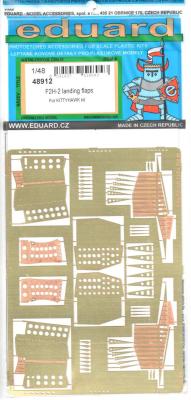
The polished brass photo-etch fret arrived in a standard cellophane envelope with the colorful Eduard label and cardboard backing. A color assembly guide was neatly folded inside, with bilingual labels. The fret is about 5.65 x 4 inches, hosting 8 major pieces and numerous hinges, pins, and ribs, with the larger parts crisply relief-etched. Kit areas to be modified are indicated in the instructions.
Thank you to the Eduard Company for sending this detail set for review, it is always a pleasure to see what Eduard’s new products bring to the scale modeling world. Thank you also to the IPMS Reviewer Corps staff members who do the hard work in getting us modeling products to review, the reviews posted, and the news spread to the world.
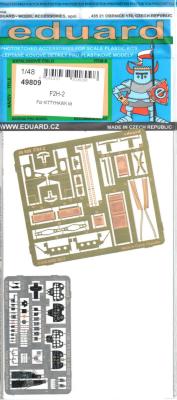
The photoetch frets arrived in excellent shape in a sealed plastic package with the distinctive Eduard knight logo. One cockpit fret is 2.75 x 1.6 inches on polished metal with color-etched laminated details, and the other fret is 3.1 x 2.75 inches on polished brass. Side consoles and instrument panel parts are provided for either a F2H-2 or F2H-2P. Internal and external details for one model are on these two frets. I particularly appreciate having three clear HUD pieces included on the film part. Only one is required, but I need two of them to complete the set. You can speculate why! I worked up the fighter version for this review.
Extreme appreciation from IPMS USA goes to Eduard for their having once again provided a sample copy of a long-awaited product, the Triple Ejector Rack, and the usual wave of thanks to the IPMS USA leadership for ensuring I received it!
This set contains 50 parts for five TER’s; the resin bodies, Sway braces with ejector pins, TER hanging lugs to put them on the aircraft carrying beams, and PE Switch plates to put in the hollow end of the TER itself. To finish, you are also provided with a small decal sheet.
Detail on this set is, as usual, almost incomprehensible. Every rivet, joint, screw and bolt is on the set.
Continuing our appreciation from IPMS USA goes to Eduard for their having once again provided a sample copy of a long-awaited product, the SNIPER Targeting Pod, and the usual wave of thanks to the IPMS USA leadership for ensuring I received it!
This set contains 7 parts for one SNIPER pod: the resin main body, the forward seeker head, three clear windows for the seeker, a mount with sway braces for the pod, the aft mounting brace and interface for later pods, a PE fret with details such as seeker eye vents, and aft plates, and small decal sheet.
Detail on this set is stunning; you can show the pod head stowed or in operation, and every rivet, joint, screw and bolt is on the pod.
Guns and pitot probes on most plastic model aircraft leave a lot to be desired. There is often a mold seam down the center of the guns or pitot probe. Another set of problems are that the same parts, once cleaned up, are usually oval shaped in diameter, and the guns do not have that proper “hollowed” look of a real gun barrel. In some scales, such as 1/72, it would be difficult if not impossible to drill out these plastic gun barrels and pitot tubes.
Master Model has solved this problem with an aftermarket kit for the A-1 Skyraider. This kit consists of five metal parts, four gun barrels with flash hiders and a pitot probe to replace the kit’s pitot probe. Each gun barrel is realistically hollow on the inside, with the thickness of the barrel in scale with the model. Master Model’s parts are not unique to a specific A-1 kit, but are compatible with any 1/72 scale A-1 Skyraider kit, no matter which variant it is.
The Kits
The molds for these kits were originally produced by Impact in the early 60s as part of a series of British fighters that included the Bristol Bulldog, Fairey Flycatcher, Hawker Fury and the Gloster Gladiator. The molds have changed hands from Impact through Lifelike, Pyro and Lindberg and now are the property of Lindberg/Round 2. This double kit is a reissue by Lindberg Round 2 with improved instructions, one additional decal option per plane and two 36" lengths of rigging wire (not included in any of the previous issues).
Included in the box are:
The first mockup of the F2H was actually completed before the end of WWII. A continuation of the FH-1 Phantom program, the F2H was a progressive step in the Navy’s effort to develop jet aircraft for carrier operation. The Banshee, as it was called, entered service in 1948, served in the Korean War, and wasn’t retired until 1961. It was also operational with the Canadian Navy until 1962.