Speed Hunter Graphics is a part of the Reid Air Publications family and that means Jake Melampy whose owner as wells as chief cook and bottle washer. That’s a great thing for all of us who love the wonderful A-10 Thunderbolt II. I have had a love affair with this plane since I first saw one fly in an air show here in Cleve. Anything but sleek, it is a workmanlike flying tank whose appearance may be different but it also the last thing you would ever want to see if you are in an armored vehicle on the wrong side and it’s the best thing to see if you are looking for close air support.
Master Model of Poland produces small brass parts for detailing models, be they aircraft or ships. They have parts for aircraft in 1/32, 1/35, 1/48, 1/72, and 1/144, mostly pitot tubes, refueling probes, and gun barrels.
The pitot part is a very fine piece of brass. The piece is much finer than the kit part.
I didn’t have a 1/144 Hunter on the shelf, so this review required that I build the Revell Hunter. As long as I’m building it, I may as well do it as part of my “Suez 1956” project. That’s why the Hunter has those red and yellow stripes, negating any camouflage effect.
Pitot Installation
Once the kit was almost finished, I got out the Master Model pitot and took the pictures. It was an easy installation. Revell gives you a little notch at the wing tip, and the CA provides a bit of filler. I then painted the pitot silver. No drilling, just a bit of CA and accelerator.
Overall Evaluation
Highly recommended.
With the recent releases of the special edition F-104 kits from Eduard in 1/48 using Hasegawa plastic, Eduard has released the F-104 C2 ejection seat as a separate kit. The Lockheed C2 ejection seat was the most commonly used ejection seat for the F-104 in US service. It is a downward firing rocket propelled ejection seat.
This seat set is very simple. It contains the main seat frame, two seat options, rails, a small photoetch set and a small decal set. As this is a drop in replacement seat for the kit seat the assembly is very straight forward. Everything in the kit replaces the equivalently parts in the F-104 kit. The first step in the assembly is to remove the three large resin parts from the casting blocks, using a razor saw for this step. If you are careful minimal clean up will be needed. After clean up, wash the parts to remove the mold release agent that is often on resin parts.
With the recent releases of the special edition F-104 kits from Eduard in 1/48 using Hasegawa plastic, Eduard has released the F-104 C2 ejection seat as a separate kit. The Lockheed C2 ejection seat was the most commonly used ejection seat for the F-104 in US service. It is a downward firing rocket propelled ejection seat.
This seat set is very simple. It contains the main seat frame, two seat options, rails, a small photo etch set and a small decal set. As this is a drop in replacement seat for the kit seat the assembly is very straight forward. Everything in the kit replaces the equivalently parts in the F-104 kit. The first step in the assembly is to remove the three large resin parts from the casting blocks, use a razor saw for this step. If you are careful minimal clean will be needed. After clean up, wash the parts to remove the mold release agent that is often on resin parts.
Twobobs always makes great decals and when this scheme popped up on the review list and included and arctic scheme aggressor, I knew I wanted to review it and build and F-16 in those colors. Inside the package are markings for two 1/48th scale F-16’s from 57th Wing at Nellis AFB. This group continues making aggressor schemes to mimic the newest schemes from our potential adversaries. In this case, the two schemes involved are the Arctic scheme with light gray/medium gray/very dark gray in bands around the jet for the first scheme and the second is the splinter scheme in blues and gray. Both jets are really nice looking but I wanted to focus on the Arctic bandit scheme.
With the recent releases of the special edition F-104 kits from Eduard in 1/48 using Hasegawa plastic, Eduard has released the F-104 MB. 7 ejection seat as a separate kit. The Martin-Baker Mk. Q7(A) ejection seat was a replacement ejection seat for the F-104 in European service. It replaced the original downward firing seats with the newer upward firing design. The reason for this change is that in foreign service the role of the F-104 was expanded and in low altitude flight with heavy wing loads there was a very high rate of failure with the original downward firing seats.
The CBU-87 was developed on behalf of the US Air Force and became operational in the mid-1980’s replacing earlier cluster bomb munitions. The CBU-87 is designed to be a multi-purpose weapon effective against armor, soft-skinned vehicles and troops.
Eduard’s set consists of twelve resin parts, 6 canister bodies and 6 tail units. The hardest part of the whole build is cutting the parts from the casting blocks. Despite my best efforts, only about half of my cuts were straight, resulting in the need for some careful aligning of canisters and tail units in order to keep them properly lined up and then filling the resulting gaps with filler or Mr. Surfacer, depending on the size of the gaps.
Thankfully the units are overall Olive Drab, which as a dark color helps to hide some of the seams and miss-cuts.
The Mil Mi Hind is an awesome and feared gunship/attack/transport helicopter. Its first flight was in September 1969 and introduced into service in 1972. It is still operating today.
Master Models is a Polish company that specializes in producing some of the finest turned brass and resin aftermarket parts I have seen!
This resin/brass set can be used on any 1/72 scale Hind D/E, but I have the Hasegawa kit to compare it to. While the gun and DUAS probe straight from the kit is very good, the detail on the Master Model set has to be seen to be believed! In this 1/72 scale, I needed a magnifier to fully appreciate the work that has gone into making these parts.
If you want to add some neat detail to your Eduard Bf-109F you may want to consider leaving off the prop spinner and exposing the propeller hub assembly. This certainly will add visual interest and add to any aircraft maintenance diorama.
Packaged in a blister package, protected by foam inserts, these seven light grey resin pieces are all that you need to do it. A small fret of two photo etch circular rings are included. The resin is blemish free. One of the pieces is an alignment tool to aid in drilling the centering hole and also setting the proper pitch angle.
This set is nearly identical to the EARLY version. The only difference is the propeller blades themselves. This set replicates the VDM 9-12010 type of blade which is slightly larger than the earlier VDM 9-11207. This type was typically found on the Bf-109F-4.
The Bf-109F had a very unique flap setup when compared to the Emil version. The split flaps required extensive engineering. The outer portion was the traditional flap style, but the inboard flaps were different. The inboard flaps had two functions, one was to act as a flap but the other was as a cooling flap for the glycol radiators. The Friedrich had a unique style as well with a boundry layer being channeled through the upper portion of the inboard flap. This caused the F to have a ‘space’ between the two layers on the upper inboard flap. This is impossible to mold in plastic effectively.
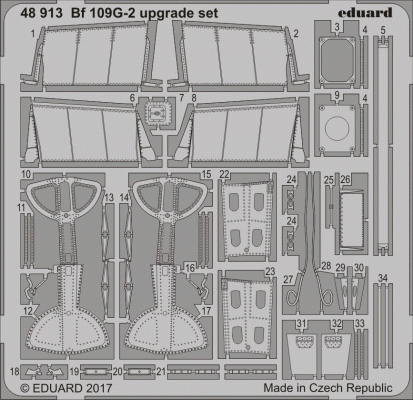
Eduard has offered a complete photo etch version of this which works well but required a lot of bending. This new set offers the best of both worlds, resin and photo etch. This set comes in a blister pack with six pieces of grey resin with no blemishes. And one fret of photo etch with 14 pieces of brass to add. Most of these are stiffeners.