

Doug Cole
Reviews By Author
|
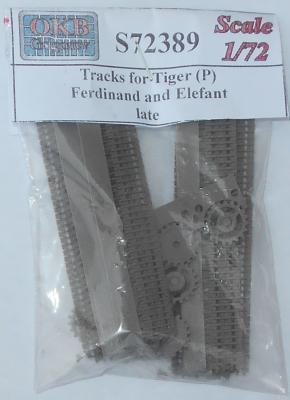
Tracks for Tiger (P), Ferdinand/Elefant, late (Late)Published:
About the Subject (from Wikipedia)“The Ferdinand was intended to supplant previous light panzerjägers, such as the Marder II and Marder III, in the offensive role. A similar gun was used in the lightly armored Hornisse (later known as Nashorn) tank destroyer, built at the same time. The Ferdinand/Elefant may have been the most successful mass produced tank destroyer employed during the war in kills per loss, reaching an average claimed ratio of approximately 10:1. During the Battle of Kursk, sPzJgrAbt 653 claimed to have knocked out 320 enemy tanks, for the loss of 13 Ferdinands. This impressive average ratio was due to its superior firepower and protection, which gave it an enormous advantage when used in head-on combat or a static defensive role (however note that… more |
|
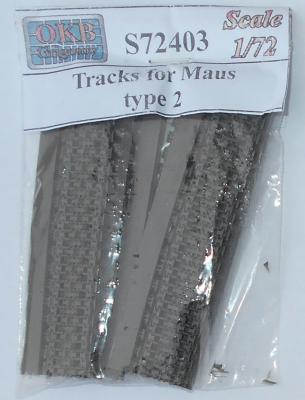
Type 2 Tracks for the Maus (Late)Published:
About the Subject (from Wikipedia)“A German World War II super-heavy tank completed in late 1944. It is the heaviest fully enclosed armored fighting vehicle ever built. Five were ordered, but only two hulls and one turret were completed, the turret being attached before the testing grounds were captured by advancing Soviet military forces. he principal problem in the design of the Maus was developing an engine and drivetrain which was powerful enough to adequately propel the tank, yet small enough to fit inside it. The Maus was too heavy to cross bridges. As a result, an alternative system was developed, where the Maus would instead ford the rivers it needed to cross. In March 1944 the second prototype, the V2, was delivered. It differed in many details from… more |
|
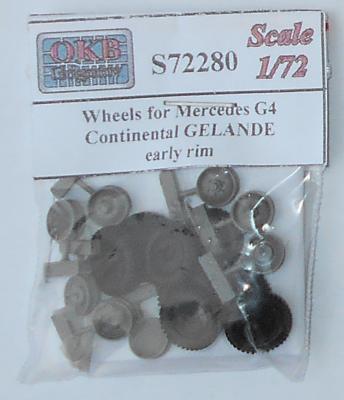
Wheels for Mercedes G4, Continental GELANDE (Early Rim)Published:
About the Subject (from Wikipedia)“The Mercedes-Benz W31 type G4 was a German three-axle off-road vehicle first produced by Mercedes-Benz as a staff/command car for the Wehrmacht in 1934. The cars were designed as a seven-seat touring car or closed saloon, and were mainly used by upper echelons of the Nazi regime in parades and inspections, as they were deemed too expensive for general Army use. The G4 was a development of the G1, launched in 1926. All had an 8-cylinder inline engine, in the first three years of 5018 cc (306.2 cu in) displacement delivering 100 PS (74 kW). It was a 6×4 configuration with four-speed transmission (synchronised upper gears) that transferred drive to all four rear wheels. The vehicles were first delivered to the SS for use by… more |
|
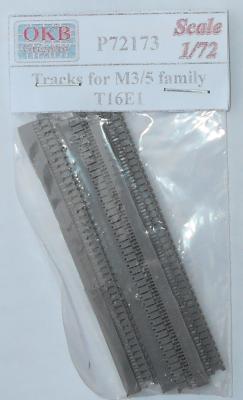
Tracks for the M3/M5 Family (T16E1)Published:
About the Subject (from Wikipedia)“The M3 Stuart/Light Tank M3, was an American light tank of World War II. An improved version of the tank entered service as the M5 in 1942 to be supplied to British and other Commonwealth forces under lend-lease prior to the entry of the U.S. into the war. Afterwards, it was used by U.S. and Allied forces until the end of the war. Although the main criticism from units using the Stuarts was that it lacked firepower, the improved M5 series kept the same 37 mm gun. The M5 gradually replaced the M3 in production in 1942. Total M5 and M5A1 tank production was 8,884; an additional 1,778 M8 75 mm howitzer motor carriages based on the M5 chassis with an open-top turret were produced”. URL:… more |
|
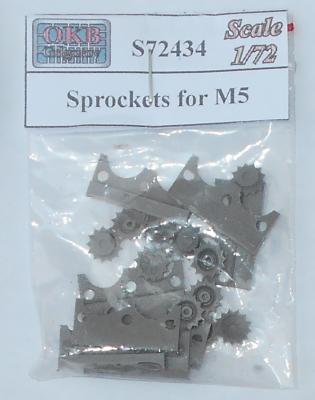
Sprockets for the M5 Light TankPublished:
About the Subject (from Wikipedia)“The M3 Stuart/Light Tank M3, was an American light tank of World War II. An improved version of the tank entered service as the M5 in 1942 to be supplied to British and other Commonwealth forces under lend-lease prior to the entry of the U.S. into the war. Afterwards, it was used by U.S. and Allied forces until the end of the war. Although the main criticism from units using the Stuarts was that it lacked firepower, the improved M5 series kept the same 37 mm gun. The M5 gradually replaced the M3 in production in 1942. Total M5 and M5A1 tank production was 8,884; an additional 1,778 M8 75 mm howitzer motor carriages based on the M5 chassis with an open-top turret were produced”. URL:… more |
|
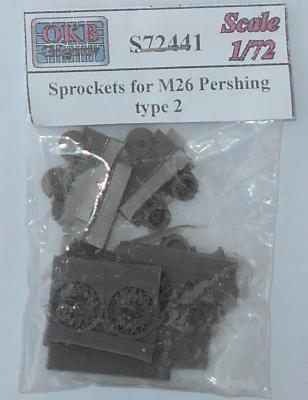
Type 2 Sprockets for M26 PershingPublished:
About the Subject (from Wikipedia)“The M26 Pershing was a heavy tank/medium tank of the United States Army. It was used in the last months of World War II during the Invasion of Germany and extensively during the Korean War. The M26 was intended as a replacement of the M4 Sherman but a prolonged development period meant that only a small number saw combat in Europe. The M26 was the culmination of a series of medium tank prototypes that began with the T20 in 1942, and it was a significant design departure from the previous line of U.S. Army tanks that had ended with the M4 Sherman. Several design features were tested in the prototypes. Some of these were experimental dead-ends, but many become permanent characteristics of subsequent U.S. Army tanks”. … more |
|
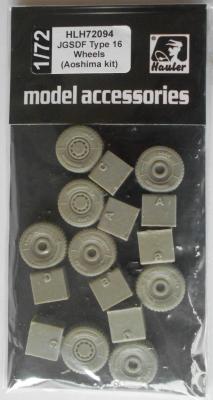
JGSDF Type 16 Wheel SetPublished:
The Subject (Source - Wikipedia)"The Type 16 maneuver combat vehicle (MCV) equips designated combat units. Due to its light weight and small size, it is designed for easy deployment (by aircraft if needed) allowing rapid movement on narrow roads and in built-up areas in response to various contingencies. Despite its small size and light armor, it can successfully attack much larger armored fighting vehicles as well as personnel, using its large caliber gun. Main armament: 105 mm L/52 gun (developed by Japan Steel Works) Secondary armament: 12.7 mm (0.5 in) M2 Browning machine gun, 7.62 mm NATO coaxial Sumitomo Type 74 machine gun (replacing M2 Browning) Type 96 40 mm Automatic grenade launcher or FN Minimi 5.56 mm NATO light machine gun". URL:… more |
|
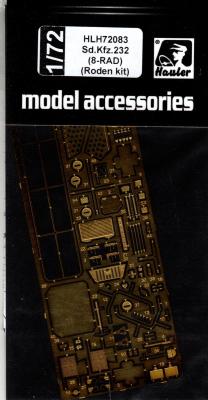
Sd.Kfz.232 (8-RAD) Photoetch SetPublished:
The Subject (Source - Wikipedia)The heavy Panzerspähwagen was a large but very fast and highly versatile addition to the German Army. The original 6-Rad (six wheel) versions were based on a 6x4 truck with an armoured body, but by 1937 they were being replaced by 8-Rad versions. During the replacement phase, the Sd.Kfz. (Sonderkraftfahrzeug, 'special vehicle') numbers were carried directly over; differentiation was made by the inclusion of 6-Rad or 8-Rad in the vehicle's name. The Sd.Kfz. 232 was armed with a 20 mm KwK 30 L/55 autocannon. This cannon was based on the 20 mm FlaK 30 anti-aircraft gun, and was capable of firing at a cyclic rate of 280 rounds per minute. These vehicles were used throughout the war in various guises and first saw combat in the… more |
|
M8 Greyhound Photoetch/Resin Detail SetPublished:
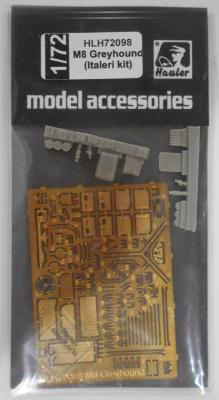
The SubjectThe M8 light armored car was a 6×6 armored car that saw service from 1943 by US and British forces until the end of World War II. Designed and built by Ford Motor Company it was intended as a replacement for the M6. Because it had tires instead of treads, it had great speed at 55 mph on open roads and was very good in support roles as a recon vehicle. It wasn’t without its drawbacks however. Crews put sandbags on the ¼” thick floor to protect them from mines. It was also awkward in wooded areas and rough terrain. Exported widely, it was still in service with some countries in 2006. The ItemIf you want to bring your M8 model kit to the next level, this excellent photoetch/detail set is just the thing for you. This extensive PE… more |
|
Fokker Dr.I Landing GearPublished:
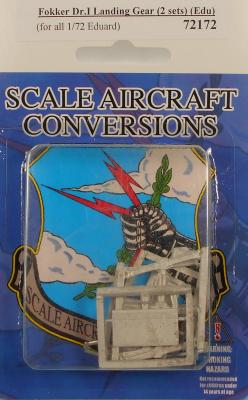
This white metal SAC landing gear/strut set is designed for the Eduard 1/72 Fokker Dr.I series model kits. Known widely as the Fokker Triplane, the fighter entered service in 1917 and was widely used by spring in 1918. The Triplane gained notoriety due to the last spate of the Baron Manfred von Richthofen’s aerial victories. It featured twin 7.92 mm Spandau machines guns as armament. Compared to the Pfalz and Albatross fighters it was significantly more maneuverable in dive and role situations, but suffered from structural and engine failures. It was eventually abandoned due to faster versions of enemy aircraft. These are nice replacement parts that will add highly detailed realism to the Eduard kit while providing additional strength and needed support for the… more |