Thank you to AOA Decals for sending these excellent decals for review, and thank you to the IPMS Reviewer Corps for letting me review them! I am very appreciative of the chance to contribute back to the scale-modeling community. AOA Decals is a new company providing thoroughly researched decals emphasizing USN and USMC subjects, particularly of the Vietnam era.
Reviews
The Pocket Manual is a compilation of various Air Ministry pamphlets, publications and manuals on the De Havilland Mosquito.
The book starts with the design specifications and related documents. This is followed by the pilot notes in chapter 2 and the operations and tactical publications. This last section details aspects of operating the night bomber version, strategic bomber version, pathfinding and even the Sea Mosquito. The book concludes with 105SQ operations record books.
This is an interesting look at various period publications to aid in operating and maintaining the Mosquito. There is good information for the historian, pilot and some nice detailed period cockpit photos with instrumentation callouts. If the Mosquito interests you, you will find this book to your liking
Our thanks to Osprey Publishing for the review copy and my thanks to IPMS/USA for the review opportunity
The Pocket Manual is a compilation of various Air Ministry pamphlets, publications, and manuals on the Hawker Hurricane.
The book starts with the design specifications and related documents. This is followed by the pilot notes in chapter 2, the tactical in chapter 3, and operations in chapter 4 publications. These last sections detail aspects of tactical trials as well as 111 SQ operations record book, Fighter Command Combat report for 12 Group and Sqdn. Leader Douglas Bader’s September 7-19, 1940 flight log.
This is an interesting look at various period publications to aid in operating and maintaining the Hurricane. There is good information for the historian, pilot and some nice detailed period cockpit photos with instrumentation callouts. If the Mosquito interests you, you will find this book to your liking
Our thanks to Osprey Publishing for the review copy and my thanks to IPMS/USA for the review opportunity
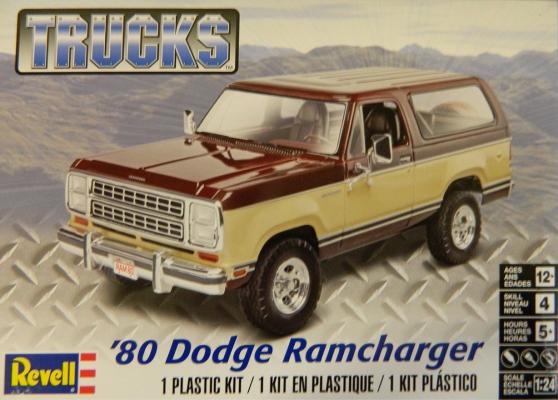
Revell has re-released a fine kit that’s sure to be a hit. It is the 1980 Dodge Ramcharger. A person can go really wild with this kit if they’re willing to change things around a bit.
Engine
The engine is pretty basic and the kit offers no options and no chrome. I installed ignition wires, throttle linkage, and a fuel line with filter.
Interior
The interior is just a simple tub design with molded side panel engraving is really lacking in detail. The kit does have a rear seat that I decided to leave out to carry the spare tire.
Body
The body was straight although the bumpers and grill didn’t fit perfectly into final assembly so it was necessary to do a bit of tweaking. The sunroof is molded into the kit body part. To change things up a bit, on the side and rear kit glass, I used some peach tinted acetate. HOK cinnamon pearl and cocoa pearl adorn the boyd.
Overview
The Dornier Do335 was a German WWII heavy fighter that had a unique twin engine inline push pull setup that made it the fastest propeller driven German fighter of WWII. The Luftwaffe was desperate to get the fighter into production as soon as possible, but with engine availability problems by the time they got it into the fight there was only a handful of planes available and the war was about over.
It’s amazing how many planes were developed by the Germans that were way ahead of their time. Like the Messerschmitt Me262, the Horton Ho229 flying wing, the V-1 and V-2 rockets along with the Do335 and a few more. With the amount of bombing day and night by the Allies it’s a wonder the Germans got any planes developed at all.
The Polikarpov I-16 was the world’s first single-winged fighter plane with retractable landing gears designed by Nikolai Polikarpov and Dmitri Grigorovich while in prison. Service trials of the I-16 began in 1934. Several variants were produced until the Type 24 was brought into service. The Type 24 contained four7.62mm × 54mmR ShKAS machine guns (two located in the wings and two in the fuselage). Landing flaps were added replacing drooping ailerons. Tailwheel added and starboard side cockpit door were also added. The Type 24 was powered by a Shvetsov M-63 radial engine with 1,100 hp at 2,300 rpm for takeoff. The Polikarpov was produced from 1934-1942 with a total 8644 built. An interesting note is that there are only six airworthy I-16 Type 24s in service today.
A perfect addition to your diorama is this WWII era upright piano and bench. Hauler provides nine resin parts and eight photo-etched parts to build the kit. The instructions provide a pictorial on where the parts go, but do not contain any guidance for color. A quick internet search revealed that most were painted in black with a few fancier ones showing a fine wood grain for the main body. The resin is packaged in a re-sealable plastic bag with the photo-etc h in a folded plastic bag secured with a staple.
I have always loved the look and lines of the Westland Lysander so when given the chance, I didn’t hesitate to build the profipack kit from Eduard. To be honest I have the older Gavia boxing in my stash but it doesn’t contain all the little extras that Eduard has added over and above the original boxing of the Gavia kit in 2001. From reading reviews of the Gavia boxing there was small issue in the original tool that involved the location of the alignment holes for the wing strut attachment points. On the recommendation of a friend, I compared the molding of Eduard’s Lysander to the original boxing and Eduard have retooled the lower wing pieces to relocate the alignment holes to the correct position. Go team! The rest of the box o’ parts were top notch and included the great Eduard instruction sheet, color painting guide, decals for five different aircraft, pre-painted photoetch, kabuki masks and of course the polystyrene parts.
David Doyle’s latest book continues to expand on Squadron Signal’s long standing In Action series that initiated back in 1971. This is actually the third book to cover the F-105 in the In Action series. Lou Drendel authored the first in 1974 (1017) followed by Ken Neubeck in 2002 (1185), both of which are out of print. This edition by David Doyle adds considerably to the material provided in the first two. Veteran illustrator Don Greer provides the artwork for the full page length color profiles within this tome.
Thank you to Ginter Books for providing a review copy of their new release, Naval Fighters Number 10, the first of a three volume set covering the Grumman S2F/S-2 Tracker and the WF-2/E - 1 B Tracer. I also appreciate all of those in the IPMS Reviewer Corps, who do the heavy lifting to get the reviews done, from start to finish.
Overview
The Tracker holds a special interest for me beyond my personal enthusiasm for USN aviation, an interest honed after hearing two Navy veterans argue about how effective the aircraft was. Naturally, one was a submarine officer, and the other an S2F aviator. This volume is the first of three projected volumes covering the Tracker, with development, testing, variants and foreign users described.