
Whisky on the Rocks, Volume 1
Helion is a UK-based company that produces books on many aspects of Military History from the Late Medieval period through to the present day. Helion was established in 1996 by University of Warwick graduate Duncan Rogers. Since then, they have published over 1,200 books, with 100 or more new titles coming out every year for readers around the world.
Professor Michael Fredholm von Essen is a historian and former military analyst who has published extensively on the history, defense strategies, security policies, and energy sector developments of Eurasia. He is currently the Head of Research and Development at IRI, an independent research institute. Educated at Uppsala, Stockholm, and Lund Universities, Michael Fredholm von Essen has lectured, including during conferences and as a visiting professor, at numerous institutions and universities around the world. He is the author of numerous books, articles, and academic papers, including Muscovy’s Soldiers: The Emergence of the Russian Army, 1462-1689 (Helion, 2018); Charles XI’s War: The Scanian War between Sweden and Denmark, 1675-1679 (Helion, 2018); Transnational Organized Crime and Jihadist Terrorism: Russian-Speaking Networks in Western Europe (Routledge, 2017); Understanding Lone Actor Terrorism: Past Experience, Future Outlook, and Response Strategies (Routledge, 2016); Afghanistan Beyond the Fog of War: Persistent Failure of a Rentier State (NIAS, 2018); Eight Banners and Green Flag: The Army of the Manchu Empire and Qing China, 1600-1850 (Pike and Shot Society, 2009); and many articles on early modern warfare in the Arquebusier, the journal of the Pike and Shot Society.
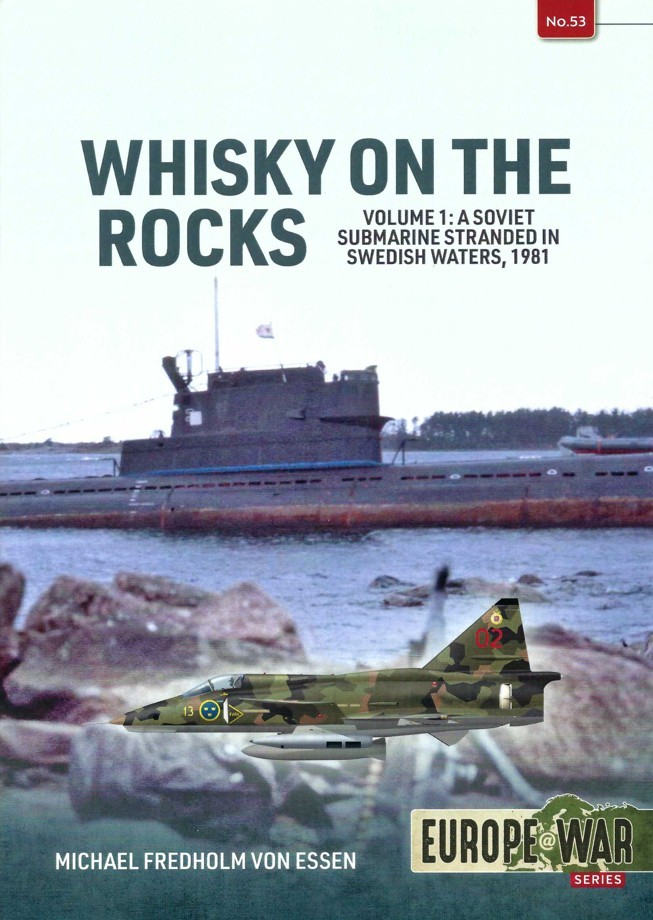
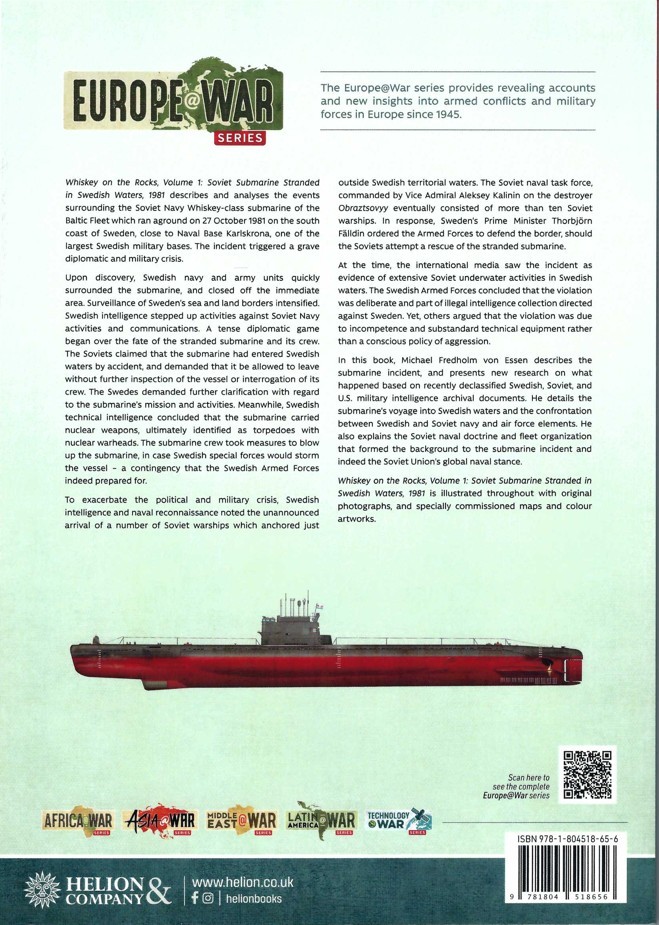
Helion’s latest volume in the Europe @ War series is a square back soft cover that includes 102 glossy paper pages [excluding covers] in their standard portrait A4 [8.25” x 11.75”] format. This tome is the 53rd in this series and was released in Britain on August 6, 2025, and in the United States on October 2, 2025. The front cover’s color photograph is of S-363, a ‘Whiskey V’-class submarine, as viewed from a Swedish Parachute Ranger position. She was stuck on a rock for nearly ten days before being hauled off and out to sea by Swedish tugboats. S-363 was launched on November 16, 1957, and her home port was Liepāja in Latvia, a major Soviet nuclear weapon and naval base. The color profile at the bottom of the cover of the Saab SF 37 Viggen is by Tom Cooper. The SF 37 was a photo-reconnaissance variant that replaced the nose radar with cameras and normally carried two additional camera pods on its fuselage shoulder pylons. Saab built 28 SF 37 Viggens with 25 of those later upgraded to the AJSF 37 variant. This airframe, s/n 37951 / c/n 37951, was coded F 13-02, flew out of the Bråvalla Air Wing based near Norrköping in south-eastern Sweden. She was later upgraded to the AJSF 37 variant and can now be found in F 21 Luleå markings at the Múzeum Letectva Košice in Slovakia. The rear cover features a color side profile by Anderson Subtil of the Soviet Project 613-Class S-363 submarine. She was powered by two 37-D diesel engines of 2,000 bhp each. She carried two nuclear SAET-60M torpedoes that each approximated the yield of the 1945 Nagasaki “Fat Man” nuclear bomb. She also carried two non-nuclear SAET-60 M torpedoes, six SET-53M antisubmarine torpedoes, and four 53-65K conventional torpedoes. The two nuclear torpedoes were designed to attack enemy (United States primarily) aircraft carriers to prevent carrier-launched nuclear bombers from attacking Russia. I counted 39 color photographs and 43 black and white photographs. George Anderson contributed eight black and white maps, with one color map provided by Leif Elsby. Tom Cooper provides six aircraft color side profiles, with Anderson Subtil represented with six naval color side profiles. Renato Dalmaso contributes six color figure illustrations.
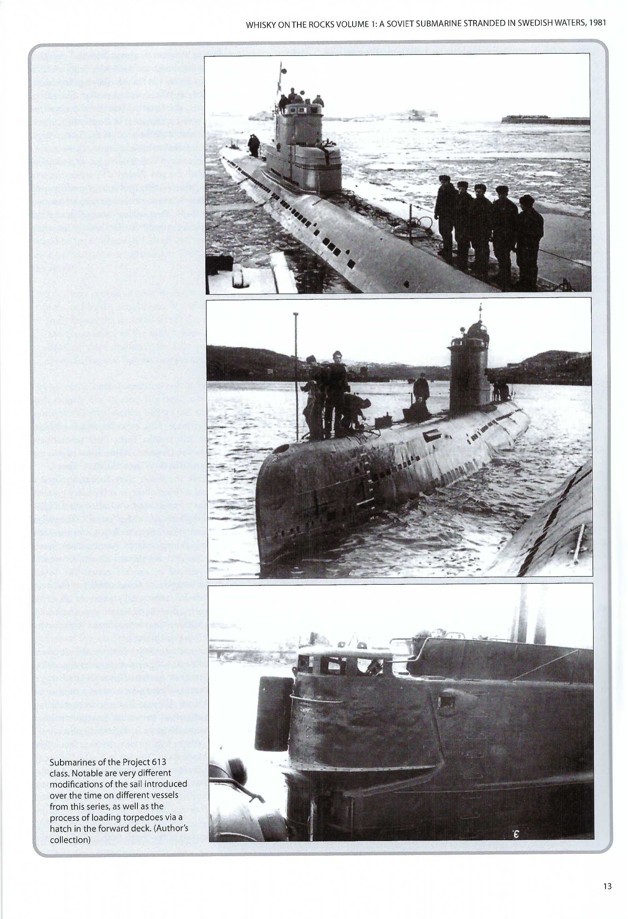
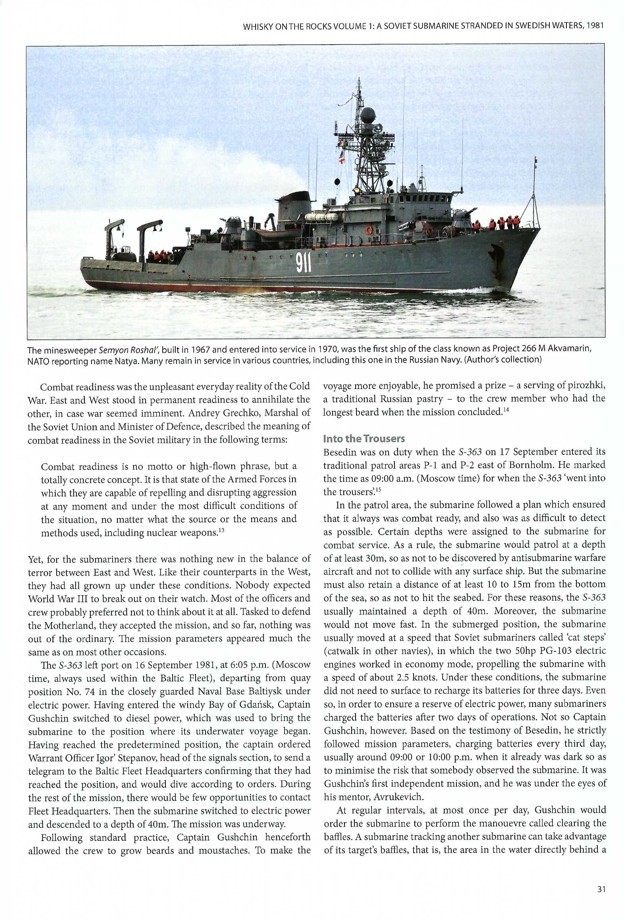
Michael Fredholm von Essen kicks off Volume One in this series with a one-page introduction of the 1981 incident. A short introduction to Colonel Oleg Vladimirovich Penkovsky follows. Penkovsky was the highest-ranking Soviet official to provide top-secret information to the CIA and MI6 before being arrested and executed in 1963. He provided over 5,000 secret documents that provided the West insight into Soviet strategy as well as Soviet ICBM installations and operations that turned out to be critical during the Cuban missile crisis. This leads into Chapter One with a background on the Soviet Navy strategy, and particularly the philosophy of Admiral Sergey Gorshkov, who ended up serving until 1985. Chapter Two describes the S-363 submarine and its crew. Black and white photographs of a Whiskey V class submarine are shown on Page 13. Known as Project 613-class by the Soviets, the bottom picture shows off sail details of a Whiskey V submarine. Like many US Navy postwar submarines, the Project 613 class was based on the German late war Type XXI and some 215 were manufactured [More than any other submarine type since the German Type VII submarines]. The Whiskey III and V class submarines can be identified by the lack of any guns [Twin 25mm and / or twin 57mm guns]. The Whiskey V can be differentiated from a Whiskey III by an improved coning tower with a snorkel and a more streamlined hull. Many of the earlier Whiskey classes were later upgraded to Whiskey V standards. A color photograph of the Russian seagoing minesweeper, Semyon Roshal’ is at the top of Page 31. She was the lead ship of 26 in the Project 266M-class and carried the NATO name Natya. She was launched by Sredne-Nevskiy, Pontonnyy Yard 979 on April 21, 1970, and commissioned on October 30, 1970. She was decommissioned in 1994, but many remain in service in Russia and other countries. Chapter 3 begins a detailed description of S-363’s controversial mission and its stranding next to one of Sweden’s largest marine military bases, Naval Base Karlskrona. The Soviets would send ten ships to force retrieval of the S-363, an action that the Swedes could not tolerate. This was Europe’s Cuban Missile Crisis.
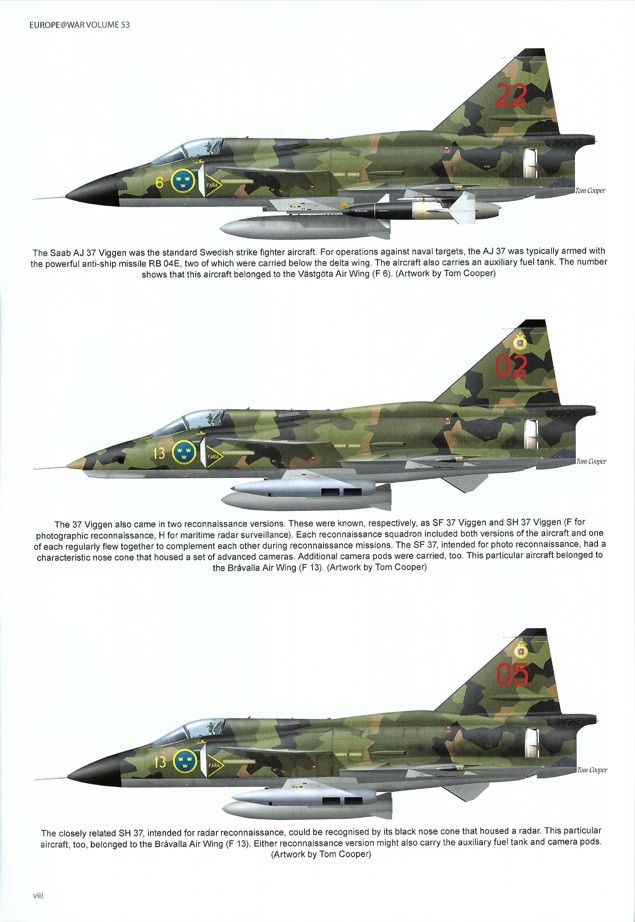
A standard part of Helion’s At War series is the eight [or more] color illustrations near the center of the book. Tom Cooper presents three color side profiles of the Saab Viggen on Page 48. The initial Viggen variant, AJ 37, is shown at the top of the page. This AJ 37 carries a center line drop tank and two wing-mounted RB 04E anti-ship missiles. The Saab RB 04E was a long-range [20 miles], fire-and-forget solid rocket engine missile that originally began service in 1959 with the Saab A 32A Lansen. The closest the RB 04 came to operational use was in the ‘Whiskey on the Rocks’ incident, where AJ 37 Viggens were scrambled to intercept. This airframe, s/n 37022, was originally delivered on March 20, 1973, and served with F7 Wing at Såtenäs [F7-22], near Lidköping near south-central Sweden. She later transferred to the Västgöta Air Wing as F6-22 located near Karlsborg in south-central Sweden. She was unfortunately scrapped on May 25, 1992. The Viggen at the bottom of the page is the SH 37 radar-reconnaissance variant that served with F 13 at the Bråvalla Air Wing based near Norrköping. Here she [37093, delivered on May 11, 1976] is seen with a centerline drop tank and two fuselage-shoulder-mounted camera pods. Normally, the AKK long range camera pod was carried on the right shoulder pylon and the MSK night reconnaissance camera pod was mounted on the left shoulder pylon. She was upgraded to the AJSH 37 variant on February 27, 1996, before her last flight on April 6, 2005.
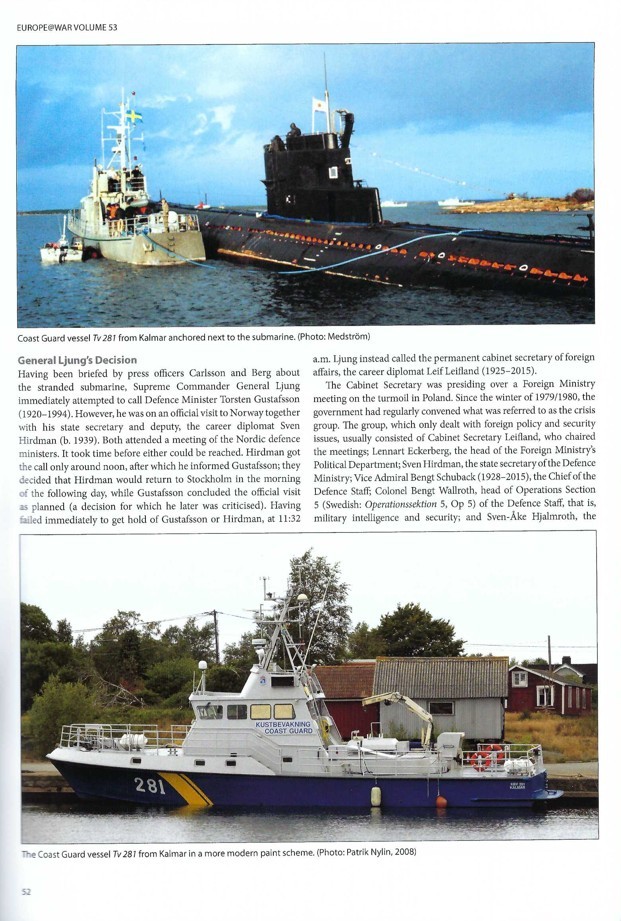
Two color photographs of a Swedish Coast Guard ship, Tv 281, which carried five crew members, is found on page 52. The top picture shows her saddled up next to the S-363. The photo at the bottom of the page shows her in a modern paint scheme. She was 21.9m in length and powered by 2 Cummins KTA38M diesel engines that generated 2,100 h.p. to provide a maximum speed of 30 knots. Originally entering service in 1979, she was rebuilt in 1995 with a new fly bridge before being retired from the Coast Guard in 2011. She is currently wearing a new paint job and is for sale if you are interested.
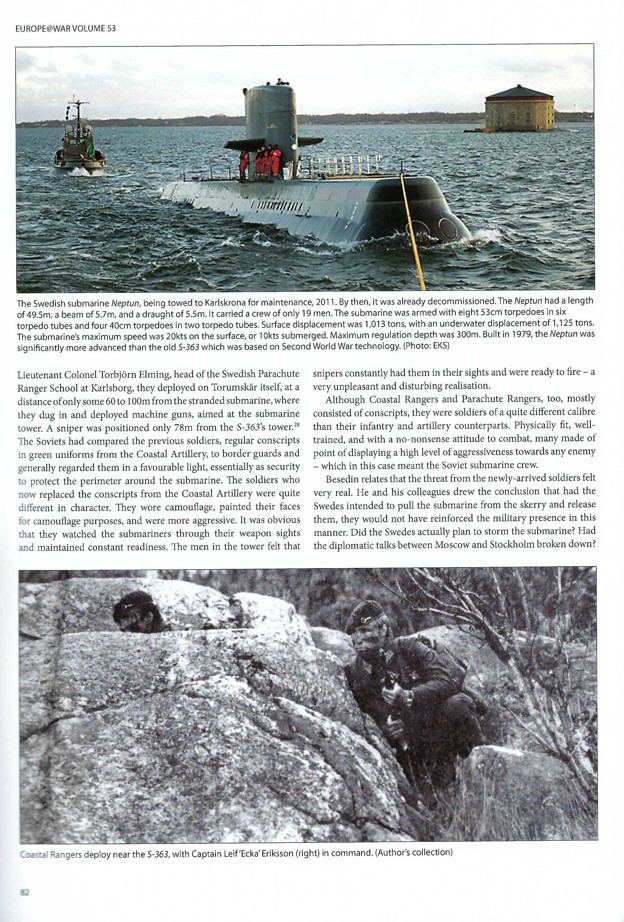
When S-363 hit the rocks, the Swedish Navy was conducting testing of a new helicopter launched antisubmarine torpedo, Torped 42 [Tp 42]. In this exercise, one of Sweden’s modern submarines was the test target. Local residents clearly heard the S-363 hit the rocks and its subsequent attempts to back itself off the rocks but initially attributed the noise to Swedish Navy testing. A color photo of the Swedish submarine HSwMS Neptun [aka A14 Type] can be seen at the top of Page 82. She is the second submarine in the Näcken class. All three were manufactured by Saab Kockums AB shipyard in Karlskrona, Sweden. She was launched on December 6, 1978, and entered service in December 1980. She is currently on display at Marinmuseum Karlskrona [Her two sisters were scrapped in 2015-2016 due to Swedish Defense cuts]. A black and white photograph of two Swedish Coastal Rangers [Kustjägarna] is at the bottom of the page. They are considered to be one of the most elite units in the Swedish military, specializing in amphibious special operations. Captain Leif ‘Ecka’ Eriksson is seen to the right kneeling against a rock with both hands on his rifle. The sections include:
- Abbreviations and Acronyms
- Introduction
- Dramatis Personae
- Prologue
- 1 The Soviet Navy
- The Carrier Threat
- The Polaris Threat
- Defense Zones
- Fleet Organization
- The Navy and RYaN
- 2 The Submarine [Page 13]
- Technical Characteristics of the S-363 [Table]
- The Crew
- 3 The Voyage Begins [Page 31]
- The S-363’s Mission Order [Russian and English]
- Into the Trousers
- Collision
- Crash Dive
- Sailing Blind
- Stranded
- Soviet and U.S. Intelligence
- 4 Wednesday 28 October
- Discovery of the Submarine
- Swedish Armed Forces and Civilian Agencies
- Commander Karl Andersson
- Briefing the Supreme Commander
- ‘My Tugboats Will Pull You Off the Rock and Then You Can Leave Our Waters’
- Color Illustrations – Renato Dalmaso, Anderson Subtil, Tom Cooper [Page 48h]
- 5 The Swedes Mobilize
- General Ljung’s Decision [Page 52]
- Swedish Russophobia
- Immunity?
- The Submarine Incidents at Huvudskär and Utö Islands, 1980
- National and Local Planning
- Technical Intelligence
- 6 The Soviet Salvage Expedition
- Welcoming the Soviets
- A Night at the Opera
- 7 Thursday 29 October
- Blow Up the Submarine! [Page 82]
- 8 Radiation Readings
- Bibliography
- Endnotes
- About the Author
Related Model Ship Kits
MikroMir currently has a 1/350-scale Project 613 / Whiskey III class kit available in injected plastic. It will get you close, but it will require modifications to become a Whiskey V as was the S-363. There is a resin Whiskey V class kit that was released by Polar Bear at some point but seems quite rare currently. The Russian anti-submarine ship Project 1241 was released as a new tool kit in 2014 by Mirage Hobby in 2014 and remains in production. This 1/40 injected plastic kit may need to be slightly modified to represent MPK-140, but it’s close. Combrig Models has announced several Natya class kits in 1/700 scale.
Related Model Aircraft Kits
Many of the aircraft involved are available in 1/144 and 1/72-scale with a few also available in 1/48-scale and 1/32-scale. The Beriev Be-12 was released in 2011 by Amodel in 1/144-scale with multiple subsequent releases. ModelSvit has released the Beriev Be -12 in 1/72-scale in five different releases with the original new tool in 2015. The Antonov An-12 has been released multiple times in 1/144-scale by Eastern Express with a new tool in 2012. Roden released an injection plastic kit of the An-12 as a new tool in 2002 for a 1/72-scale kit that is readily available. Eastern Express released a 1/144-scale Ilyushin Il-20M in 2016 based on the new tool release from 2011. The AJ 37 Viggen was released by JetMads in 2021 as a limited-edition modern resin kit. Both the SH 37 and the SF 37 Viggens in injected plastic were released in 1/48-scale by Tarangus in 2017 [manufactured by Special Hobby]. They sold out quickly and have yet to be re-released. The AJ 37 Viggen in 1/48-scale has been released in several editions by Special Hobby and is readily available. In 1/72-scale, Special Hobby rules the roost with injected plastic releases of the AJ 37 and SF 37 Viggens. The SH 37 Viggen can be built from the Tarangus release of the AJSH 37 kit that was released in 2019.
Conclusion
I really enjoyed this book as it adds a lot of information not readily available in English before. This crisis that clearly could have escalated is presented well by Michael Fredholm von Essen and is based on recently declassified Swedish, Soviet, and US documents. It is easy to read, and I enjoyed it over four days. After finishing reading Volume One, I became aware of a Swedish miniseries [Whiskey on the Rocks, released in the US on January 22, 2025] that is streaming on Hulu that had been dubbed into English. This book is far more interesting from a history perspective, as the Swedish miniseries is meant as a comedy, but the miniseries is still entertaining. I am very much looking forward to Volume 2 in this series. If you own one of the previous releases in the Europe @ War series, you know what you are getting. If this is your initial entry into this series, you will be quite pleased.
My thanks to Helion & Company, Casemate Publishing, and IPMS/USA for the chance to review this great book.
Highly recommended!
Reviewer Bio
Frank Landrus

Frank retired from the Ophthalmic industry with over thirty-six years of Research and Development experience. Frank's first model kit was a 1959 Hawk 1/72 US Marines Vought AU-1 Corsair and has been building models for over sixty years. Frank's first encounter with IPMS was attending a North Central Texas ScaleFest show in 1984. Frank soon became more involved in Make-N-Take activities and became the IPMS Western Coordinator for Make-N-Takes [West of the Mississippi River]. Make-N-Takes quickly became a local model contest and airshow staple reaching a high of reaching over 1,300 children before the COVID shutdown. Frank has volunteered to assist in contest judging since 1985 and is currently the Nationals Head Figure Judge until he is dead or they find someone better.
Comments
Add new comment
This site is protected by reCAPTCHA and the Google Privacy Policy and Terms of Service apply.
Similar Reviews