
Warpaint 151 Hawker Siddeley HS748 & Andover In Military Service
Guideline Publications is the UK's leading publisher of modeling and hobby-related magazines. With a world-class portfolio of titles and an international Social Media presence, Guideline Publications has a dedicated readership that is constantly expanding into new areas. This English language book, Warpaint 151 Hawker Siddeley HS748 & Andover, is authored by Adrian Balch with scale drawings by Sam Pearson. The latest Guideline’s Warpaint series, 151, was published in 2025. A digital edition will soon be available. News on Guidelines’ publications can be found on Facebook.
Adrian M. Balch graduated from Swindon College in 1969 and began working as an assistant publicity manager for a metallurgist company, where he produced brochures and edited the company’s magazine. He joined the Royal Air Force in 1971 and served for 22 years as an Air Traffic Controller around the world. His interest in aviation photography led to his contributions to leading aviation magazines, with his first article published in December 1966. He has also worked with BBC TV and ITN as well as producing publicity calendars and postcards for the aviation industry. He has amassed a collection of over 350,000 color photographs in addition to an even larger number of digital images. His first aviation enthusiast book was published in 1986 by Airlife Publishing Ltd, Aerobatic Teams of the World, with many books following. This is Balch’s fourteenth book in Guideline’s Warpaint Series.
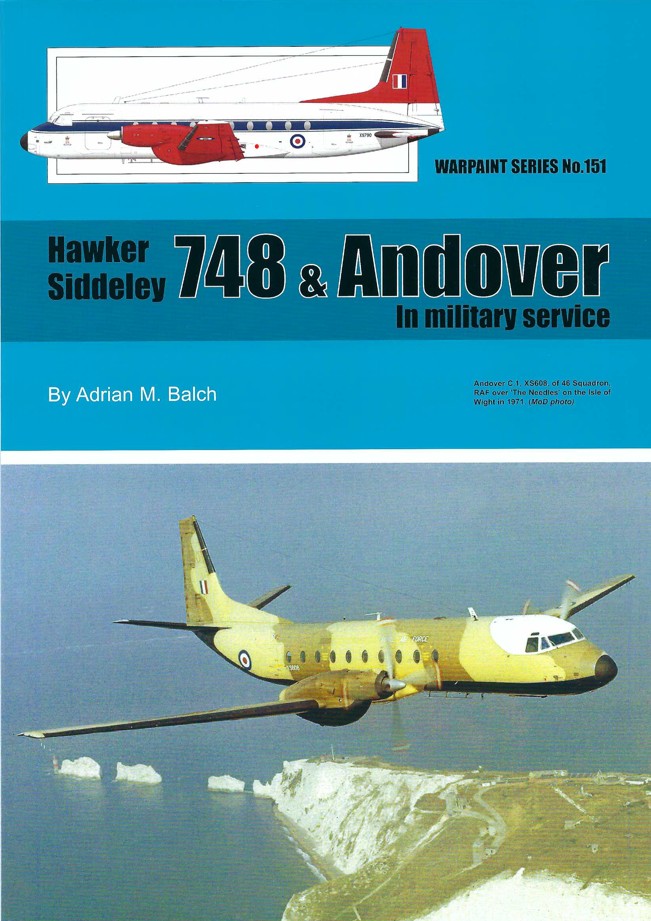
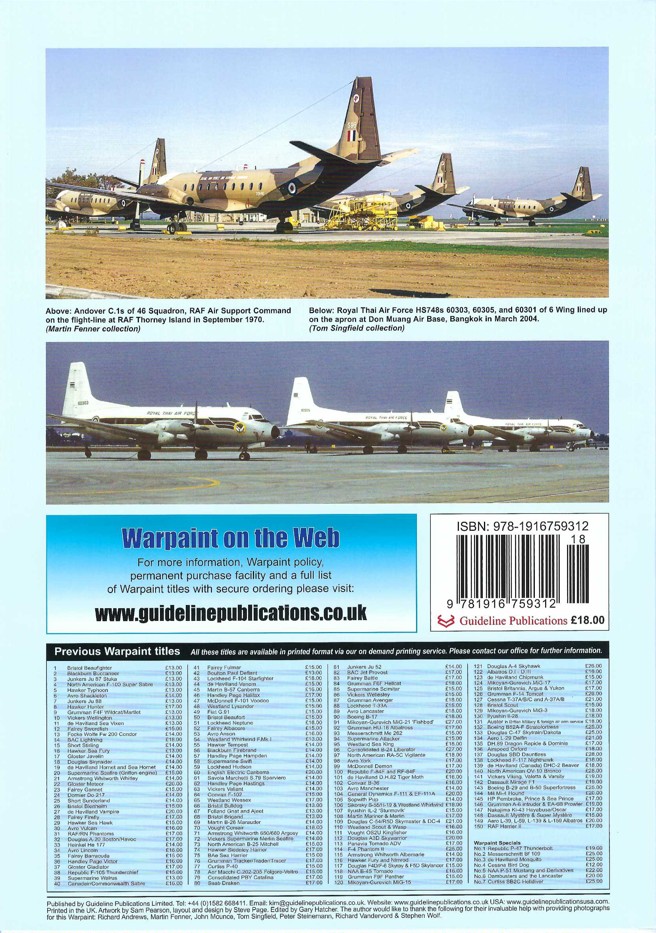
Warpaint's latest is their standard portrait A4 [8.25” x 11.75”] format square-back softbound publication that is 56 pages, including the covers. Sam Pearson contributes eight pages of color illustrations that include 48 color side-profiles along with two pages of 1/72 line drawings showing top, bottom, front views, and five side profiles. I counted 170color photographs and 9 black and white photographs. The front cover features a Sam Pearson color side profile of a Hawker Siddeley Andover CC.2, XS790, of the Queen’s flight based at RAF Benson in 1973. The CC.2 was a VIP transport version of the commercial HS 748 and not a variant of the HS Andover C.1. There would be six CC.2 Queen’s transports manufactured with XS790, being the second one built. She was delivered to RAF Benson in July 1964 and served until 1991 when she went to work for the Defense Research Agency at Boscombe Down. The forward fuselage of XS790 can now be found at the Boscombe Down Aviation Museum at Old Sarum Airfield. A color photograph of HS Andover C.1, XS608, of 46 Squadron is at the bottom of the front cover. She is flying over “The Needles” on the Isle of Wight in 1971. She achieved her first flight on November 4, 1966, before joining 52 Squadron of the Royal Air Force on December 23, 1966. She later served with the Royal New Zealand Air Force as NZ7624 arriving in New Zealand on December 11, 1976. She was withdrawn from service in 1993 having flown 8,395.10 hours. She was a derelict at Ardmore Airport, New Zealand, in May 1995 and was later transferred to the RNZAF Whenuapai Air Force Base Fire Section where she was last seen in 2021. The rear cover features two color photographs. Four Andover C.1s are at the top of the page serving with 46 Squadron.
They are on the flight line at RAF Thorney Island, West Sussex, England, in September 1970. RAF 46 Squadron has a long history, originally being formed in 1916. The squadron was reformed for the third time at RAF Abingdon as a transport unit utilizing Andover C. I transport. The squadron was finally dissolved in March 1975 with the closure of RAF Thorney Island and the remaining Andovers were shifted to other duties. The photograph at the middle of the rear cover shows off three Royal Thai Air Force HS748s of 6 Wing. They are on the flightline of Don Muang Air Base, Bangkok in March 2004. The right most HS748 is RTAF 60301 and is now preserved in the Royal Thai Air Force Museum in Bangkok where she is free to visit. She was the very first HS748 delivered to the Royal Thai Air Force.
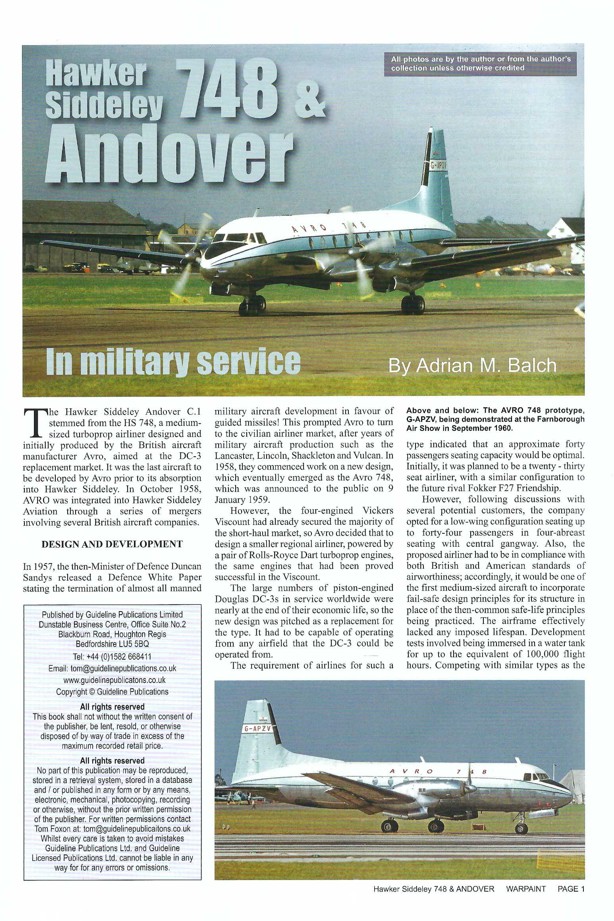
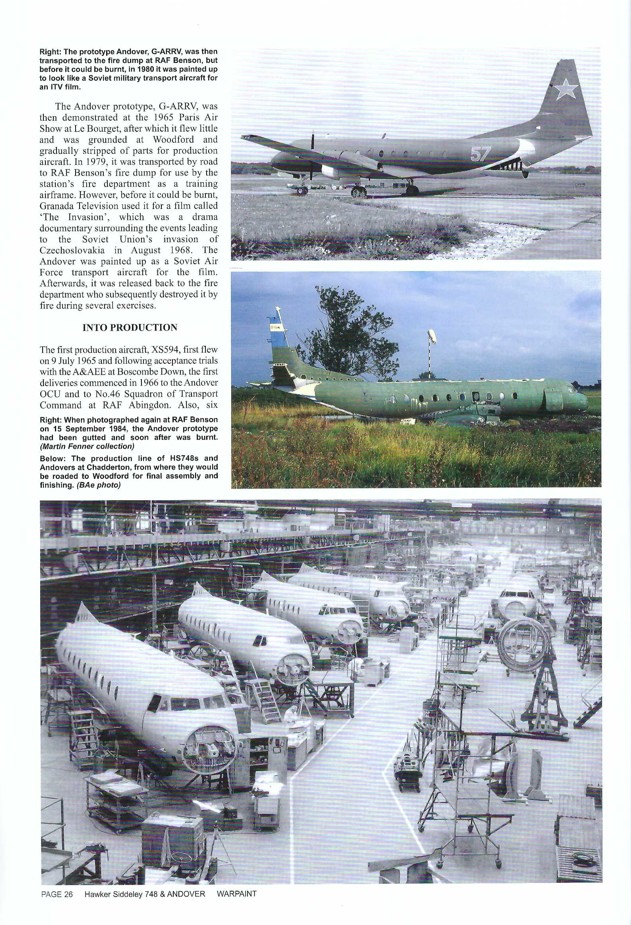
Adrian M. Balch opens with an overview of the development of Avro 748 which would later become the Hawker Siddeley 748 as Avro was absorbed into the Hawker Siddeley company. The design was intended to replace the Douglas DC-3 and would be able to operate from the same runways as the venerable DC-3. Color photographs of the Avro 748 prototype, G-APZV, are shown on Page 1 where she was demonstrated at the September 1960 Farnborough Air Show. A key performance metric was ruggedness and short takeoff and landing [STOL] capabilities. The prototype's first flight was achieved on June 24, 1960, at Woodford Aerodrome with Jimmy Harrison as the chief test pilot. She was later rebuilt in 1963 as the HS748MF [Military Freighter] prototype, G-ARRV, to become the aerodynamic prototype for the Andover C.1, before being scrapped in April 1969. She can be seen at the top and center of Page 26. The black and white photograph at the top of the page shows G-ARRV as a movie star in a ITV film that portrayed her as a Soviet military transport in 1980. The center color photograph shows a gutted G-ARRV at RAF Benson on September 15, 1984. She ended her days at the RAF Benson fire dump in 1985. The black and white photograph at the bottom of the page shows off the HS production line at Chadderton for HS748s and Andovers.
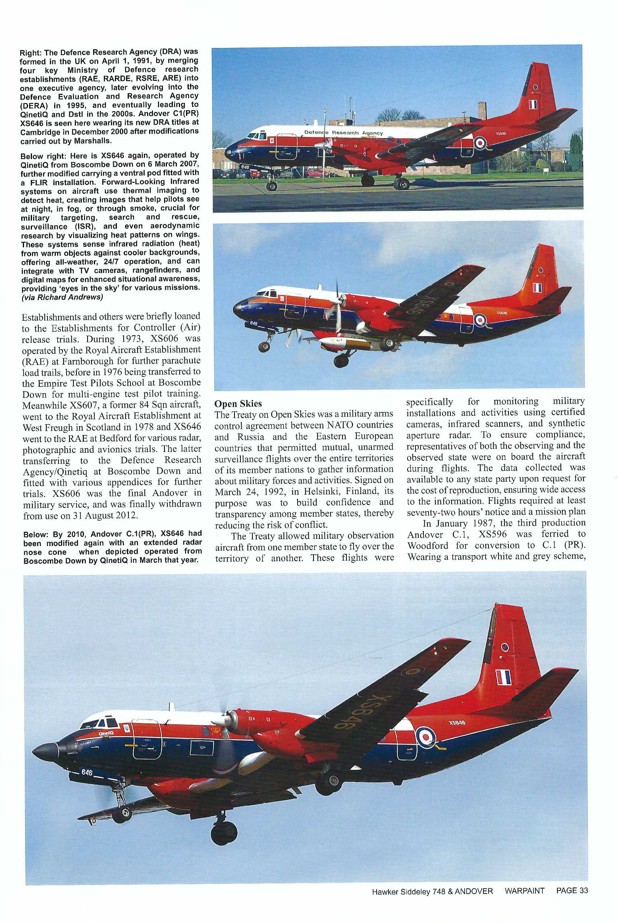
Military Service of the HS748 and Andovers is covered by country, providing many colorful schemes. One of the colorful schemes is highlighted on Page 33 with three color photographs of Andover C.1(PR), XS646, manufactured in 1967. She originally went to the Royal Aircraft Establishment (RAE) for radar, avionics, and photography trials in January 1972. She was later transferred to Boscombe Down and fitted with different radar noses and pods. The top photograph of XS646 shows her wearing the Defense Research Agency logo in December 2000. The center picture shows XS646 on March 6, 2007, carrying a FLIR ventral pod for thermal imaging. The bottom image shows XS646 yet again in March 2010 at Boscombe Downs with an extended radar nose cone. She was scrapped in 2013 at Boscombe Down where her nose is currently stored.
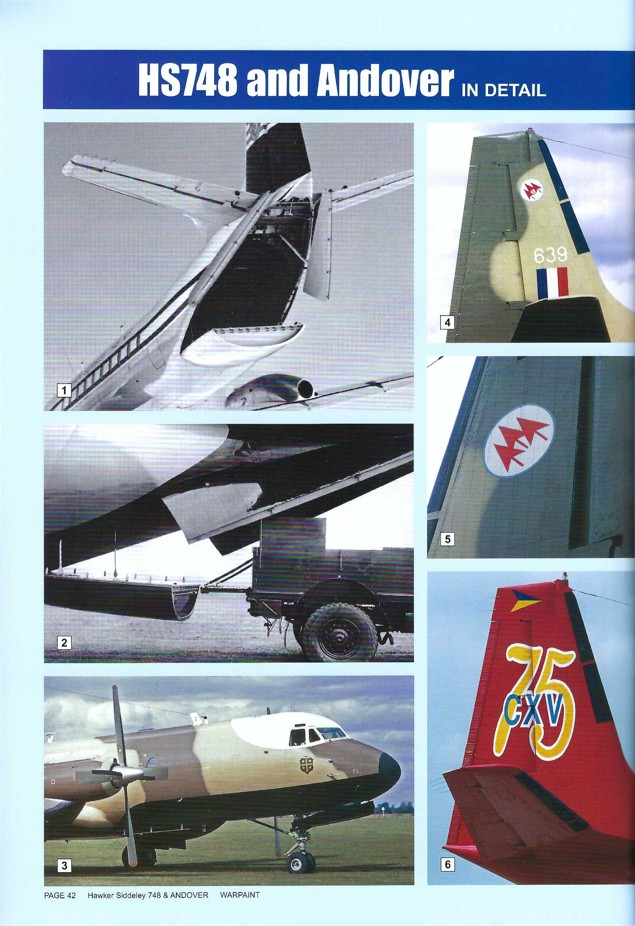
One of the standard features of Warpaint is the In Detail section as seen on Page 42. Black and white photographs one and two show off the Andover C.1 prototype rear freight doors. The second photo demonstrates loading the ‘kneeling’ position. A feature of the Andover was its hydraulic kneeling landing gear to simplify loading and unloading. The color photograph at the lower right [6] showcases the 75th Anniversary tail markings of 115 Squadron in June 1993 on Andover E.3, XS605. XS605 achieved her first flight on September 9, 1966, and entered service with the Royal Air Force as an Andover C.1 on October 14, 1966. She was converted from an Andover C.1 to an Andover E.3 in 1977 to begin her role in Navaid / Radar calibration. She ended her career at RAF Northolt in July 1995 before being scrapped in October 1997.
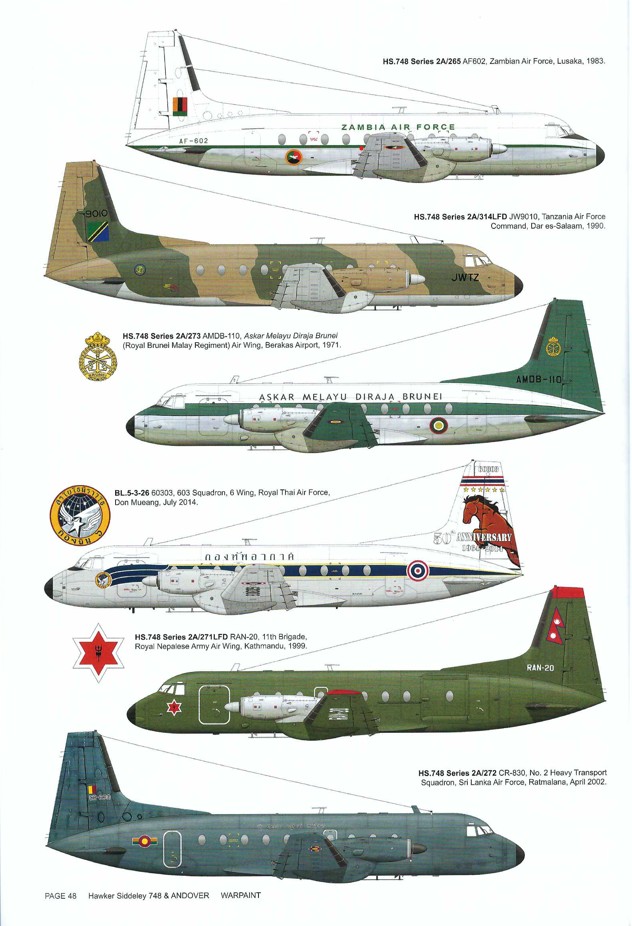
Six examples of the color side profiles by Sam Pearson can be viewed on Page 48. The second profile from the top is a HS748 Series 2A of the Tanzania Air Force, coded JW9010. She was the fourth of four HS748s ordered by Tanzania. She had been flown from Woodford on December 12, 1977, as G-BETX. The last three were ordered with large rear freight doors and a gloss finish but were repainted in matt green and brown camouflage after delivery. JW9010 belly landed at Dar-es-Salaam on February 7, 1991, and was subsequently written off. The fifth profile from the top is the sole HS748 in service with the Royal Nepalese Army Air Wing. Originally a Hawker Siddeley demonstrator [G-AZJH], being the first with the large rear cargo door, She was delivered to Nepal in 1975 in the standard white top with a red cheat line, but was repainted n dark green camouflage when she was transferred from the Nepal Royal Flight to the Royal Nepal Army Air Wing in April 1980. She was retired in October 2009 and has been preserved for display in the Narayanhiti Palace Museum in Kathmandu, Nepal.
The Chapters include:
- Design and Development [Page 01]
- Into Production
- The Military HS748
- In Military Service With:
- Argentina
- Australia
- Royal Australian Air Force
- Royal Australian Navy
- Belgium
- Benin
- Brazil
- Brunei
- Burkino Faso
- Cameroon
- Columbia
- Ecuador
- India
- The Indian Air Force
- Cuba
- Nepal
- South Korea
- Sri Lanka
- Tanzania
- Thailand
- United Kingdom
- Venezuela
- Zambia
- The Andover C. Mk. I
- Into Production [Page 26]
- In Service with No. 46 Squadron, RAF
- Flying in an Andover
- Deployed to the Far East with 52 Squadron
- Deployed to the Middle East with 84 Squadron
- 242 OCU
- Tests and Trials
- Open Skies [Page 33]
- Calibration and ATC Checkers
- Other Roles
- The Andover CC.2s in RAF Service
- The Queen’s Flight Andovers
- Queen’s Flight Livery Variations
- In New Zealand Service
- In Civilian Service
- Production Ends
- Specifications [Table]
- HS748 and Andover In Detail [Page 42]
- Colour Side Profiles by Sam Pearson [Page 48]
- HS748 and Andover 1/144 and 1/192 Scale Drawings by Sam Pearson
The HS748 has been released in 1/72 and 1/144-scale. The 1/72-scale release was originally a vacuformed kit by I.D. Models and later by Formaplane for commercial markings and Royal Australian Air Force markings. White metal landing gear and props were included. A 1/72-scale resin kit was released by Aircraft in Miniature Limited / Rug Rat Resins around 1999 and by S&M Models in 2016. Mach 2 has been promising a 1/72-scale injected release since 2024 but appears to remain vaporware. Welsh Models released a series of vacuformed kits starting in 1980 of the HS 748. Mark I. Models has had multiple injected plastic releases of the HS748 and Andover CC.2 in 1/144-scale, first appearing in 2020. A 1/72-scale resin kit of the Andover C.1 was released by Aircraft in Miniature Limited / Rug Rat Resins around 1999.
Adrian M. Balch delivers a nice monograph on the HS748 and Andover that I was able to read easily in three evenings. I found the Indian attempt to convert their license-built 748s into an Airborne Early Warning platform interesting, even though it was not pursued past the prototype. Equipped with a large circular radome mounted on a pylon above the rear fuselage, the radome broke away from its mounting pylon. As the pylon left the mount, the radome sheared off part of the vertical fin and rudder, causing a total loss of the plane and crew. The text is well supplemented with very clear photographs with good captions. Sam Pearson provides well-executed color side profiles and the 1/144 and 1/192-line drawings. This is a nice reference on the HS748 and Andover, and would be a handy addition to your reference library. If you are building any of the model kits, I would consider this edition essential as an aid to your build. If you own any of the previous releases in the Warpaint series, you know what you are getting. If this is your initial entry into this series, you will be quite pleased.
My thanks to Guideline Publications and IPMS/USA for the chance to review this great monograph.
Highly recommended!
Reviewer Bio
Frank Landrus

Frank retired from the Ophthalmic industry with over thirty-six years of Research and Development experience. Frank's first model kit was a 1959 Hawk 1/72 US Marines Vought AU-1 Corsair and has been building models for over sixty years. Frank's first encounter with IPMS was attending a North Central Texas ScaleFest show in 1984. Frank soon became more involved in Make-N-Take activities and became the IPMS Western Coordinator for Make-N-Takes [West of the Mississippi River]. Make-N-Takes quickly became a local model contest and airshow staple reaching a high of reaching over 1,300 children before the COVID shutdown. Frank has volunteered to assist in contest judging since 1985 and is currently the Nationals Head Figure Judge until he is dead or they find someone better.
Comments
Add new comment
This site is protected by reCAPTCHA and the Google Privacy Policy and Terms of Service apply.
Similar Reviews