
Hungarian Bomber Colours 1927-1945, Volume 1
illustrator: Balázs Kakuk
MMP was founded in 1996 by Roger Wallsgrove, to publish "Mushroom Model Magazine". This quarterly modelling magazine was developed from "Mushroom Monthly”, a club newsletter which ran from 1985 to 1995, achieving a world-wide reputation for quality articles, fearless and honest reviews, and a great sense of humor. From 1997 the magazine was produced in collaboration with Robert Peczkowski and Artur Juszczak (Stratus), which meant a big leap in print quality and design. MMP expanded into book publication in 1999 with Stratus, and since then they have built up a list of hard cover and soft cover titles on aircraft and aviation, naval, military vehicles, and military history. Stratus / MMPBooks are distributed in North America by Casemate Publications. Check out their Facebook page for additional information. This English language book, Hungarian Bomber Colours 1927-1945 Vol. 1. is authored by Dénes Bernád and György Punka. It was illustrated by Balázs Kakuk / Pannon Pixels and was published on April 22, 2026, in Europe and July 9, 2026, in the U.S. This book is a sequel to two earlier books on Hungarian Fighter Colours Vol 1 [2013[ and Vol 2 [2014] published in the same series by Stratus / MMP Books.
Dipl. Eng. Dénes Bernád was born in 1964 in Transylvania (Rumania), in a family of indigenous ethnic Hungarians. He studied at the Transylvanian University in Brasov, where he graduated in 1988 as a Mechanical Engineer. From 1992 he lived in Canada, and in 2006 he returned with his family to Hungary. Currently, he works in the automotive industry as Program Launch Manager. He is fluent in three languages. His main interest is the military history of Central and Eastern Europe, especially Rumania, Hungary and Bulgaria. His books deal especially with air forces and aircraft of these countries. He has written or co-authored seventeen historical books. Aside from the above books, Dénes Bernád has published many studies concerning the history of aviation in Air Enthusiast, Air International and FlyPast (UK), WW1 Aero (USA), Avions (France), Repülés, Aero História and Új Szárnyak (Hungary), Militaria and Skrzydlata Polska (Poland) and Aeronatica, Aeromagazin and Model-Ist (Rumania). He is also the founding member of the Asociatia pentru Propagarea Istoriei Aviatiei (ARPIA) - Association for Propagation of History of Aviation (Bucharest, Rumania) and Magyar Repüléstörténeti Társaság (MRT) - Hungarian Society of Aviation History (Budapest, Hungary). He is also a foreign correspondent of the French aviation magazine Avions.
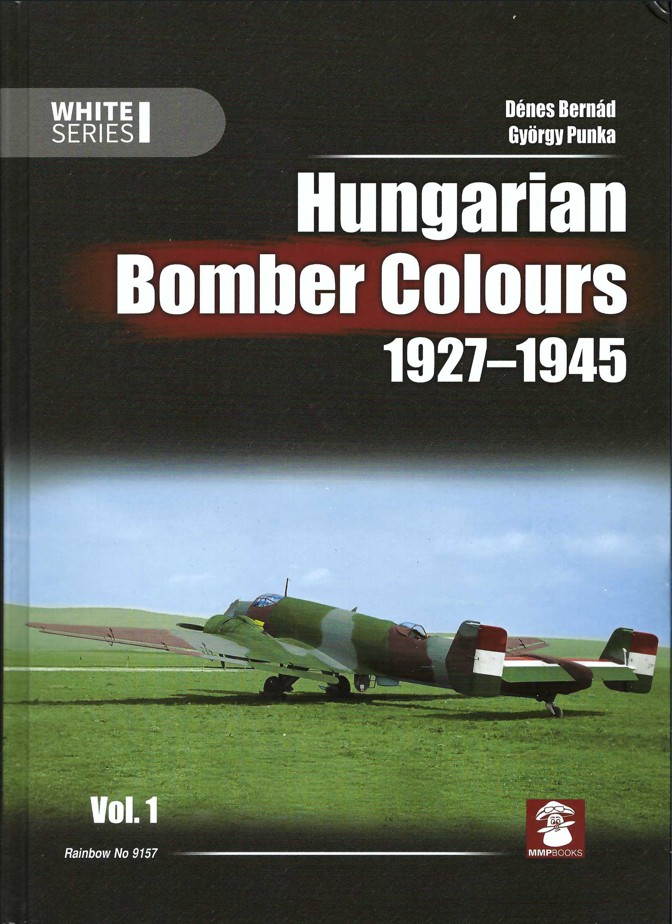
This full-size square back hard cover book [8.50” x 12.00”] comes in at 240 glossy pages. The front cover features a colorized photograph of Junkers Ju 86K-2. She is still in civilian markings, HA-JBV, with minimalist camouflage in the Spring of 1938. The “Yellow Storm” squadron emblem identifies it as part of the Veszprém based 3/3 légiforgalmi alcosport [Light Bomber Squadron]. Veszprém is one of the oldest urban areas in Hungary whose name literally translates to “Stubborn”. Additional information for the cover subject can be found on Page 212, including a color side profile and a color scrap of the “Yellow Storm” emblem. I counted 245 black and white photographs / illustrations along with 38 color pictures. There are 33 color illustrations by Balázs Kakuk and Pannon Pixels with most of the bombers depicting side profiles, dorsal views, ventral views and color scrap illustrations highlighting squadron emblems and other markings.
Dénes Bernád and György Punka kick off this tome with thirteen pages to provide an introduction and background into their investigation into Hungarian camouflage paints. The investigation was to settle arguments by the Hungarian aviation and modeling communities over the correct Hungarian colors. Utilizing independent experts and scientific equipment, the paints used by Hungary were manufactured to be similar to German paints, but they were uniquely Hungarian colors. The methods and resulting data are presented that see, to scientifically resolve the controversy. Then it’s off to the individual Hungarian bombers, most with color illustrations and supporting period photographs. Early in WWI, the first Hungarian bombers were reconnaissance aircraft with observers throwing bombs overboard. Hungarian Emil Barkasz would design the first bomb sight which would be installed on a UFAG manufactured Brandenburg C.I.
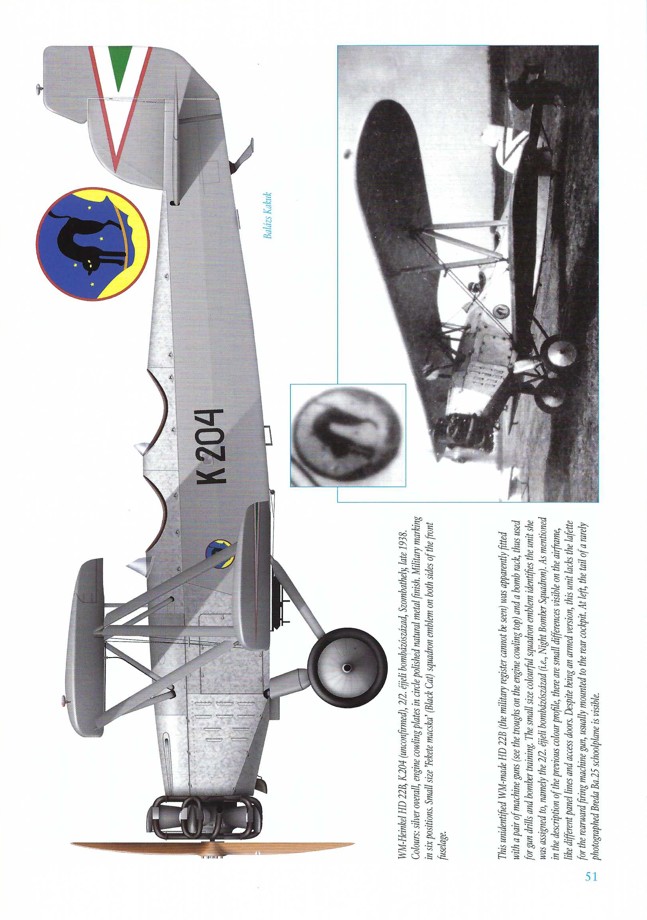
The Heinkel HD 22 was the first aircraft built by the Manfred Weiss Works. Strict restrictions of aviation by the victors after WWI effectively ended in 1926. A Hungarian delegation to Ernest Heinkel resulted in an agreement to acquire plans for the Heinkel HD 22 which would be manufactured in Hungary. A pattern airframe was purchased from Heinkel, and the first Hungarian HD 22 achieved its first flight in 1928. Interestingly one HD 22 was purchased by the US Army Air Corps for use in Germany by the US military attaché. The primary production would be manufactured in Hungary as they masqueraded as a civil aircraft in the local flying clubs. A Manfred Weiss built Heinkel HD 22B is seen on Page 51 and is thought to be K204. It appears that this HD 22B carried two machine gun troughs in the upper forward fuselage.
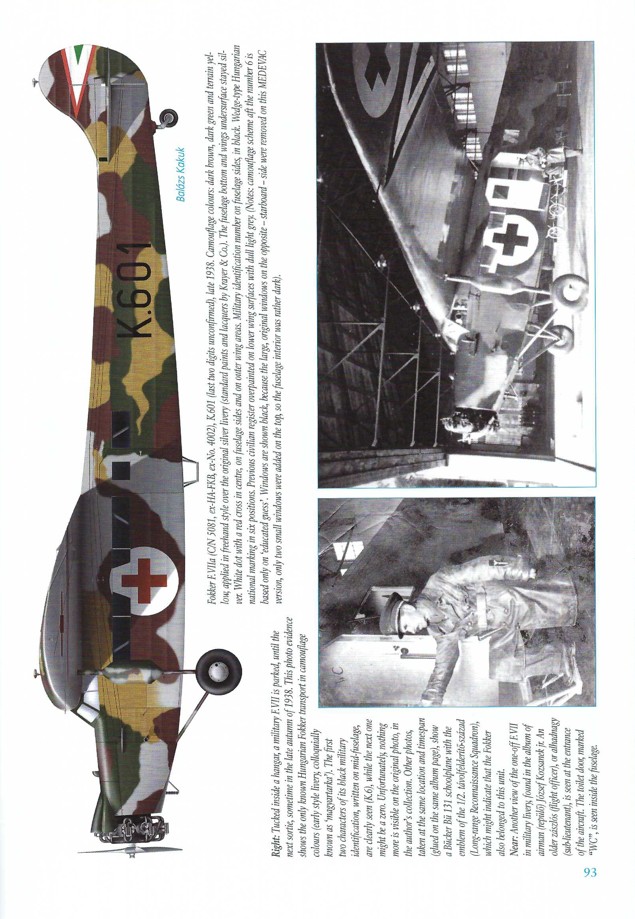
The Fokker F Transport Series was another aircraft built in Hungary by Manfred Weiss Works. Ostensibly an airliner, many were secretly converted to bombers for the LüH, Hungary’s secret Air Force. A military single-engine Fokker F.VIIa, c/n 5081; ex HA-FKB is depicted on Page 93 in full camouflage in late 1938. Originally utilized by the Hungarian airline company, MALERT [previously known as Magyar Légiforgalmi R.T.], all Fokker F transport series were employed by LüH for military purposes, such as bomber trainers. This Fokker started service in September 1928. She was modified for the Medical Evacuation role by Manfred Weiss Works in April 1937. She was damaged in May 1938 at Zinc with repairs bringing the military camouflage scheme by September 1938.
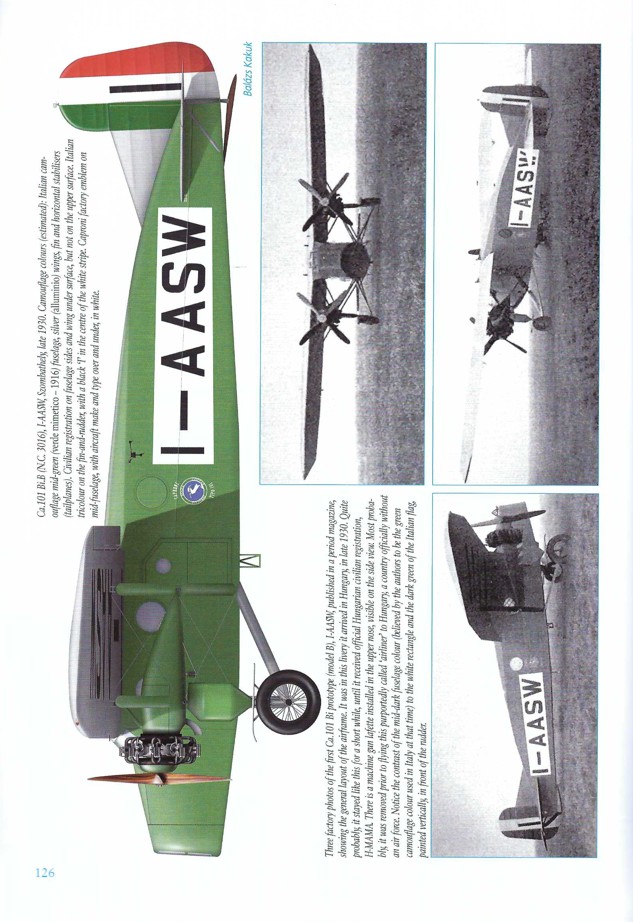
The Caproni Ca.97 was a utility monoplane with one, two, or three engines. Three used Ca.97s were bought from Italy and a single Ca.97 was built by Manfred Weiss Works. All four entered service with MALERT briefly before modified to military service. Their successor was the Caproni Ca.101 Bi., an enlarged variant of the Ca.97. Two Caproni Ca.101 aircraft would be acquired, the first a Ca.101 Bi.B [N.C. 3016, I-AASW] prototype painted in Italian mid-green camouflage depicted on Page 126. The second was a Ca.101 Bi.C [N.C. 3017, H-MAMB] prototype, again painted in Italian mid-green camouflage. The Ca.101 Bi.B had a glass nose for the bombardier and two machine guns [dorsal and ventral positions]. She was later modified and repainted wearing the registration HA-AMA. Upon retirement, she became a gate guard at the main entrance to Szombathely airfield.
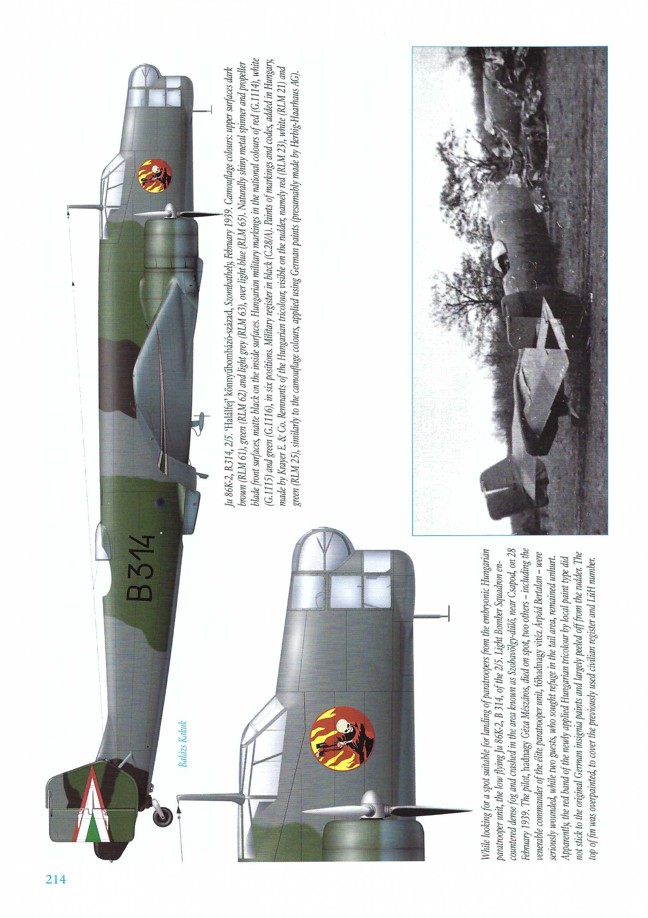
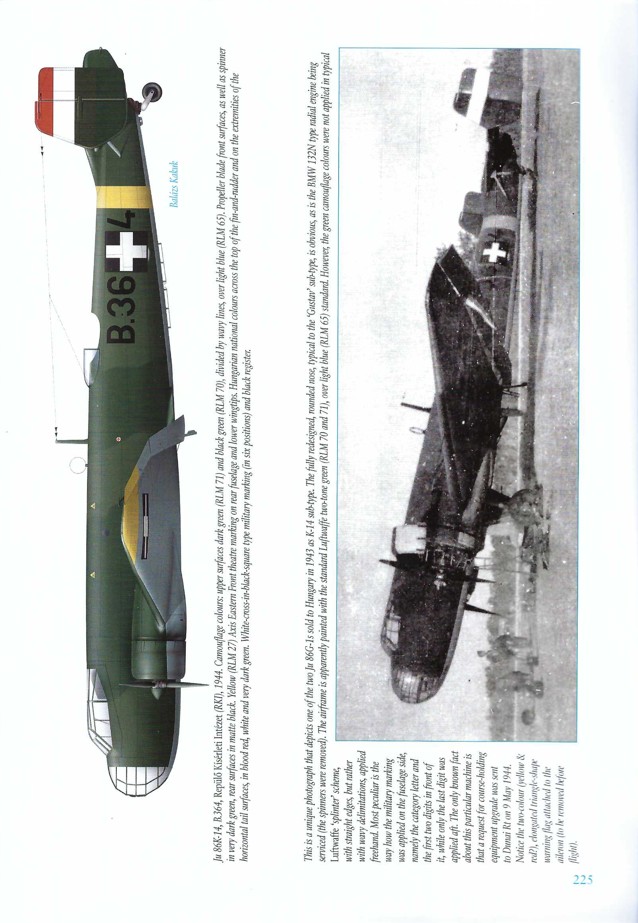
The tale of the Junkers Ju 86 in Hungarian service is up next and covers 98 pages. The Junkers Ju 86V-1 achieved its first flight on November 4, 1934, [there is some debate since it was a semi-secret] dressed up as a passenger airliner. The Ju 86V-2 [aka Ju 86ab 1] flew in January 1935 as a bomber. Production was begun in late 1935 of both the airliner and bomber variants based on changes introduced on the Ju 86V-4 [passenger airliner] and Ju 86V-5 [bomber]. Hungary began pursuit of German bombers in November 1935, looking at the Heinkel He 111 initially. Frustrated with negotiations, the Hungarians turned to Junkers. Timing would be everything as the German Ministry of Aviation (RLM) reduced their order for the Ju 86A, opening the door to Hungary for the bomber export carrying the designation Ju 86K-2. Hungary had wanted to license build the Junker 86, but Germany steadfastly refused [Sweden was approved to license build Ju 86K though…] and in the end 66 airframes were ordered and paid for. Manfred Weiss Works would install their G-R 14K [license-built Gnome-Rhone] engines and was approved to provide maintenance for the Junkers bomber. Difficulties with the Manfred Weiss engines delayed the program, requiring the purchase of the G-R 14K engines from France, through an inter mediatory in Italy. Deliveries from Germany to Hungary began in June 1937. Ju 86K-2, B.314, is displayed on Page 214. She would crash on February 28, 1939, in a dense fog near Csapod [a village in Györ-Moson-Sopron County, Hungary] in an area known as Szobavölgy-dülö looking for a paratrooper landing spot. The pilot was killed, two others were wounded, while two guests who were towards the tail survived untouched. One of the two Ju 86G-1s sold to Hungary as a K-14 is shown on Page 225. Acquired in 1943, the ‘Gustav’ subtype displays a rounded nose and BMW 132N radial engines. The Ju 86G was the final variant produced as a bomber with the cockpit being moved forward and the nose turret removed. The fully glazed nose dramatically improved visibility and was tested on the Ju 86V-10, eventually leading to 40 production ‘G’ models. The sections include:
Dénes Bernád and György Punka have delivered an excellent book on Hungarian bombers for follow up with their two volumes on Hungarian fighters. I was quite attracted to this volume having just finished a review of Guideline’s Warpaint No. 152 on the Junkers Ju 86. If you are a fan of the Junkers Ju 86, you will also want to grab MMP Books 8142 on Swedish Bomber Colors that has a large chapter on Swedish Ju 86 aircraft. I truly enjoy the use of actual photographs to support the color illustrations of each aircraft. MMP Books features this in many of their releases which I think is a huge attraction. This really brings these period photographs to life. This book is essential if you're an aviation enthusiast or are considering building any of the Hungarian bombers included in this Volume 1. I really enjoyed reading this book and plowed through the 240 glossy pages over five nights. I can’t wait for the second volume on Hungarian Bomber Colors. United States distribution of Stratus / MMPBooks is through Casemate.
My thanks to Stratus / MMPBooks, and IPMS/USA for the chance to review this great book.
Reviewer Bio
Frank Landrus

Frank retired from the Ophthalmic industry with over thirty-six years of Research and Development experience. Frank's first model kit was a 1959 Hawk 1/72 US Marines Vought AU-1 Corsair and has been building models for over sixty years. Frank's first encounter with IPMS was attending a North Central Texas ScaleFest show in 1984. Frank soon became more involved in Make-N-Take activities and became the IPMS Western Coordinator for Make-N-Takes [West of the Mississippi River]. Make-N-Takes quickly became a local model contest and airshow staple reaching a high of reaching over 1,300 children before the COVID shutdown. Frank has volunteered to assist in contest judging since 1985 and is currently the Nationals Head Figure Judge until he is dead or they find someone better.
Comments
Add new comment
This site is protected by reCAPTCHA and the Google Privacy Policy and Terms of Service apply.
Similar Reviews