
Flashes in the Dark: Volume 1
Helion is a UK-based company that produces books on many aspects of Military History from the Late Medieval period through to the present day. Helion was established in 1996 by University of Warwick graduate Duncan Rogers. Since then, they have published over 1,200 books, with 100 or more new titles coming out every year, for readers around the world. Casemate markets Helion books in the United States.
Gustavo Marón was born in Mendoza, Argentina, in 1971, into a family of Lebanese immigrants. In 1998, he graduated as a lawyer from the Law School of the National University of Cuyo, Argentina. Since then, he has worked as an advisor to various aeronautical associations, companies and organizations. In parallel, he teaches Aeronautical Law at various Argentine universities and other educational establishments in the country. To date, he has published more than two hundred aircraft investigations on different aspects of Argentine Civil Aviation. This is his second book published by Helion.
Helion’s latest volume in the Latin America @ War series is a square back soft cover that includes 96 glossy paper pages [excluding covers] in their standard portrait A4 [8.25” x 11.75”] format. This tome is the 50th in this series and was released in Britain on January 24, 2026, and in the United States on March 20, 2026. I counted 155 black and white photographs. There are two color maps prepared by b.b.h.illustrations. Luca Canossa provides six color aircraft side profiles; Tom Cooper chimes in with four aircraft side profiles; and Jean-Marie Guillou with one aircraft side profile.
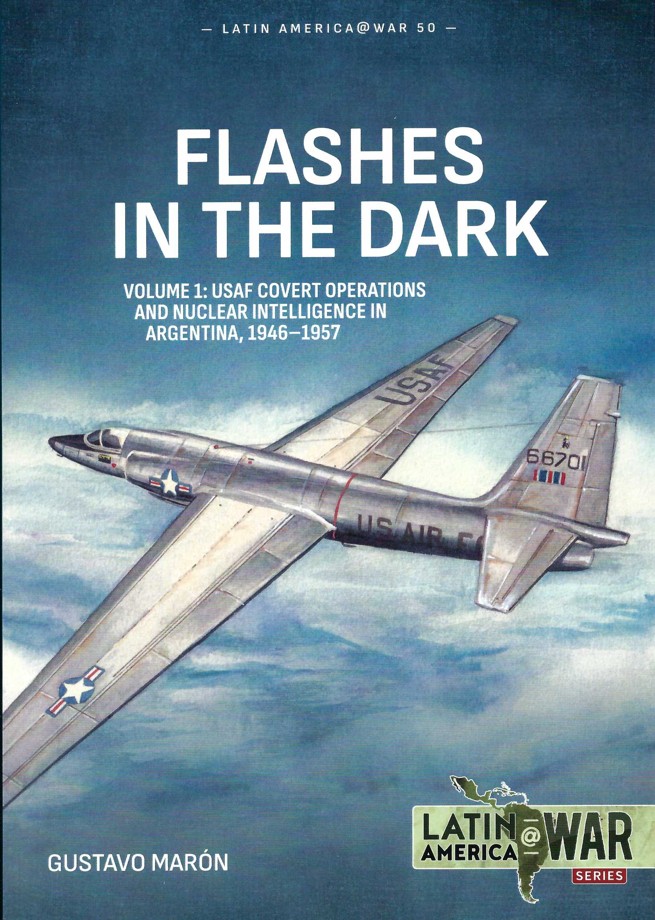
The front cover’s color painting of a Lockheed U-2B is by Renalto Dalmaso. Lockheed’s 56-6701 [c/n 368] is seen early in its career. Built as a U-2A in March 1957 and delivered to Groom Lake before being transferred to Edwards AFB in June 1957 to serve in the Special Projects Branch. She was converted to a U-2B, then in November 1966 to a U-2C. Serving with the USAF thunderstorm research program, she was nicknamed “The Saint”, She also served with the CIA and various Reconnaissance wings. She was configured for the ALSS project in 1972. She was retired in 1982 and flown to Offutt Air Force Base. She currently hangs from the ceiling of the Strategic Air Command and Aerospace Museum in Nebraska.
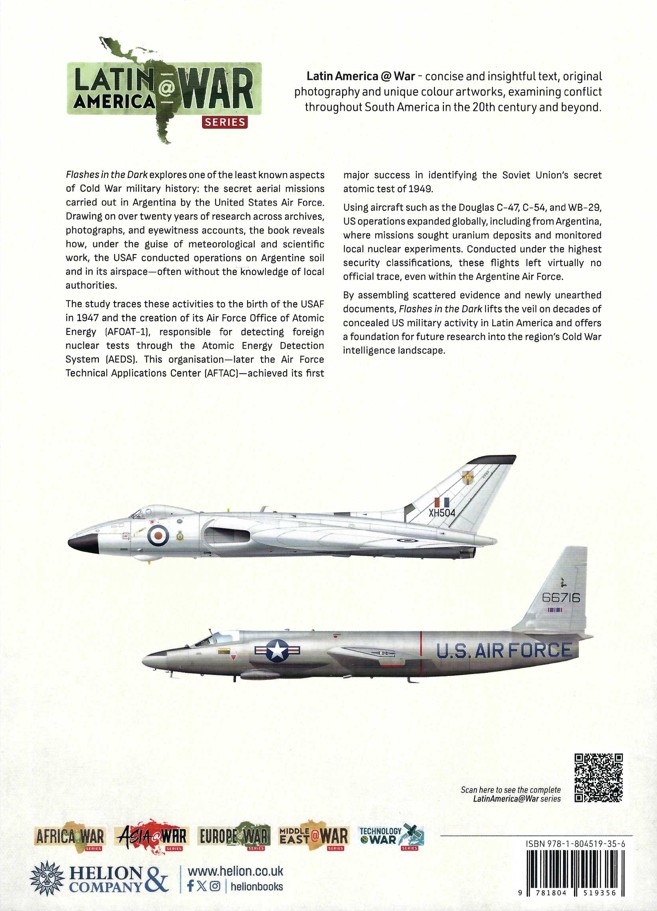
The rear cover color profile by Jean-Marie Guillou is of Avro Vulcan B. Mk 1, s/n XH477. Serving with RAF 83 Squadron based at Waddington, she was one of two Vulcans sent to Buenos Aires in May 1958 to celebrate the inauguration of President Arturo Frondizio. Sadly, XH477 crashed into a hill on June 12, 1963, at Aberdeenshire. Conducting a low-level nighttime exercise, the entire crew of five was killed in the crash. The lower color profile is by Tom Cooper and is WU-2A, s/n 56-6716 [Item 383]. She was originally delivered to Edwards AFB in September 1957 as a U-2A in the “Hard Nose” configuration for the HASP [High Altitude Air Sampling Project]. She was deployed to Argentina in 1958 through 1960. 1965 saw her based at Takhli RTAFB, Thailand, before serving with the Republic of China Air Force in Project Razor. She was transferred back to Strategic Air Command in 1971 and later retired in May 1980 and placed in the USAF Museum loan program. She had been displayed at Davis Monthan from May 1993 through March 2022. She was then transferred in March 2022 to Hill Aerospace Museum in Ogden, Utah as a U-2C.
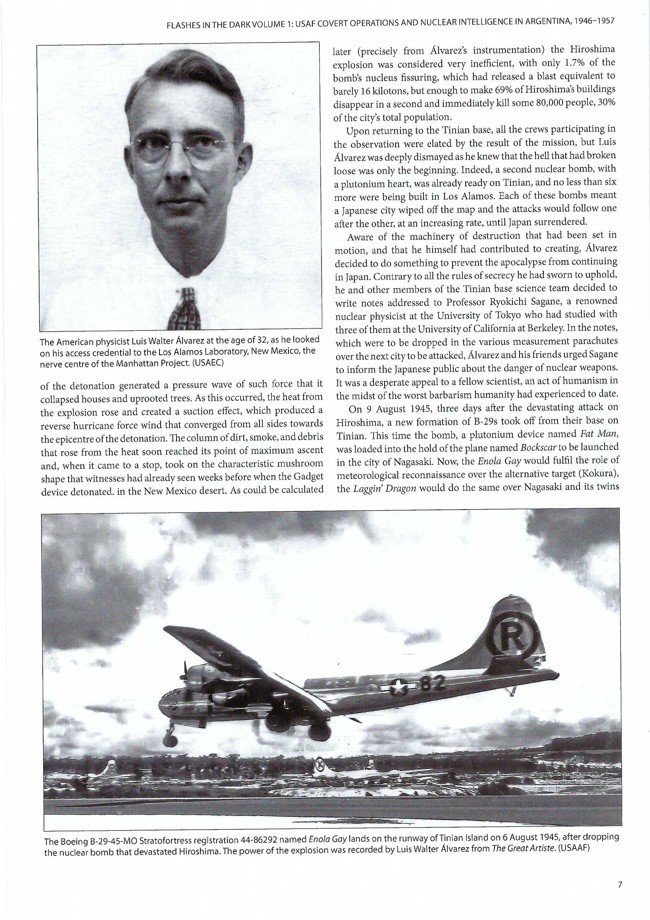
This first volume of Flashes in the Dark from Gustavo Marón kicks off with an introduction to American physicist Luis Walter Alvarez. Alvarez was born in San Francisco on June 13, 1911, and passed on September 1, 1988, in Berkeley, California. He was involved in many activities that led to advancements in radar, along with working with Robert Oppenheimer in early fusion studies. He was part of the design team for the plutonium bomb “Fat Man” and flew in the Silver Plate B-29 “The Great Artiste” to observe and measure the blast of both nuclear bombs dropped on Japan. Enola Gay is shown landing on Tinian Island on Page 07 on August 6, 1945, after dropping the Hiroshima nuclear bomb. Luis Walter Alvarez is shown at the top of the page from his access badge to the Los Alamos Laboratory in New Mexico. His involvement in the Manhattan Project led to his discovery of xenon-133 and krypton-85 in tracking nuclear activities through air sampling. This air sampling became key in determining the progress the Soviet Union was making towards nuclear bombs.
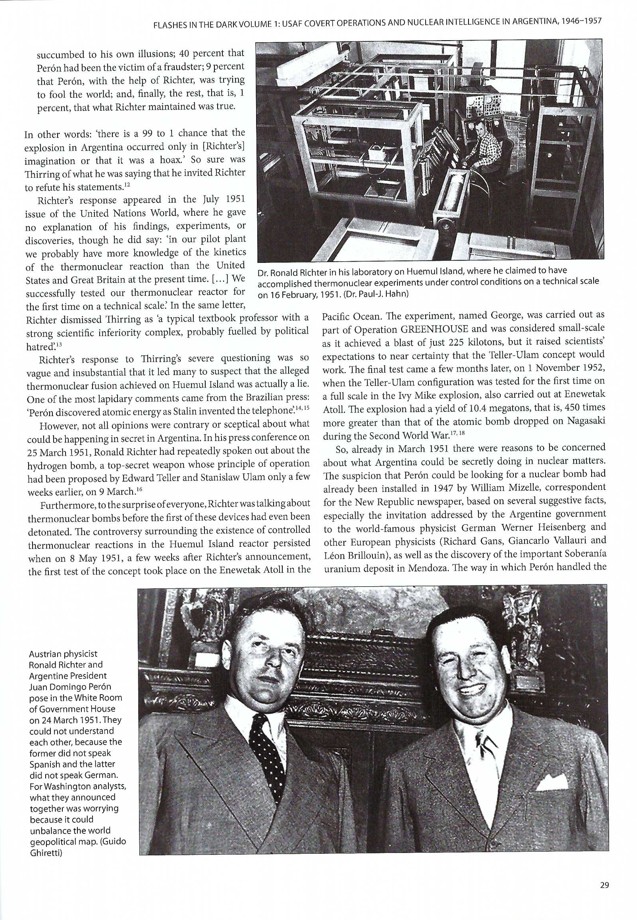
Several US aircraft, including the Boeing B-29 were converted to “weather” versions to accomplish this air sampling. Converted B-29 Superfortresses to the WB-29 configuration became key in radioactive tracking missions through the US AFOAT-1 [Air Force Office of Atomic Energy] program. This became key in Argentina when Austrian physicist Ronald Richter convinced Argentine President, Juan Domingo Peron, that he was able to control fusion experiments in 1948. A reactor was built on Huemul Island, and a public announcement was made that controlled nuclear fusion had been achieved on March 24, 1951, by President Peron as depicted at the bottom of Page 29. A photograph of Richter in his laboratory on Huemul Island is shown at the top of Page 29. This, of course, shocked the atomic physicists of the world that Argentina had become a nuclear power. The AFOAT-1 WB-29s had already been flying over Huemul Island, monitoring the “weather” and knew ahead of time before the world’s scientists claimed fraud.
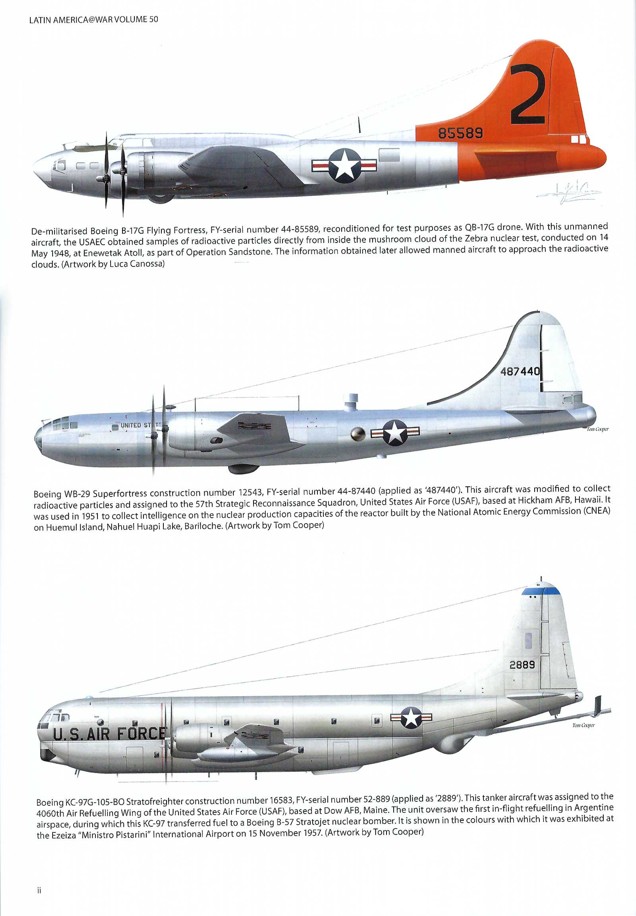
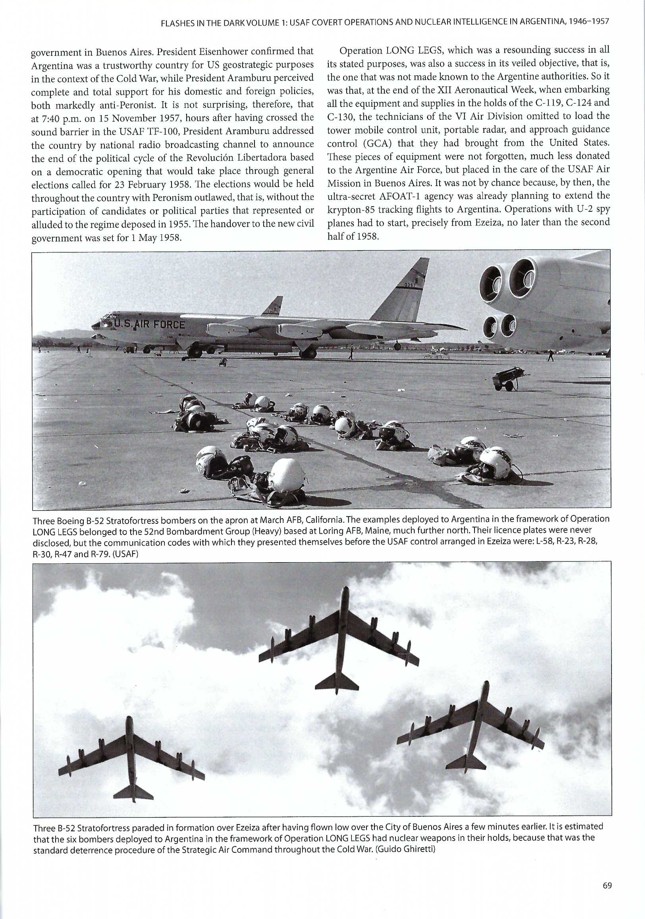
Three color side profiles can be found on Page 44ii. The top profile by Luca Canossa is of a QB-17G drone that was used to sample radioactive particles from the Zebra nuclear test mushroom cloud. QB-17G drones were piloted by a ground operator for taxi and takeoff operations before control was turned over to a DB-17G director for aerial operations. All armament had been removed, and a filter box was located right behind the cockpit. The last of three nuclear tests in 1948 under Operation Sandstone, Zebra was executed on May 14, 1948, at Enewetak Atoll in the Marshall Islands. The Mark 3 bomb yielded 18 kilotons with a uranium core that was only 10% of the U-235 of Little Boy. Optimal results from this test saw the immediate production for the Mark 4 bomb, the first practical piece of ordnance and the first mass-produced nuclear bomb. The center profile by Tom Cooper is one of the Boeing WB-29 Superfortress that was active over Huemul Island collecting intelligence on Ronald Richter’s activities. Based at Hickam AFB in Hawaii, she served with the 57th Reconnaissance Squadron. The Tom Cooper color side profile of the Boeing KC-97G-105-BO, s/n 52-889, at the bottom of Page 44ii was one of four that was deployed under Operation Long Legs. This KC -97G provided re-fueling for B-47 and B-52 bombers that were in the skies over Argentina during Aeronautical Week in 1957. Instituted in Argentina in 1945, these annual series of airshows provided a showcase for US Airpower. Three of the six Boeing B-52 Stratofortress bombers over Ezeiza can be spotted on Page 69. Gustavo Marón notes that it was standard practice of the Strategic Air Command at the time to be loaded with nuclear weapons in their bomb bays.
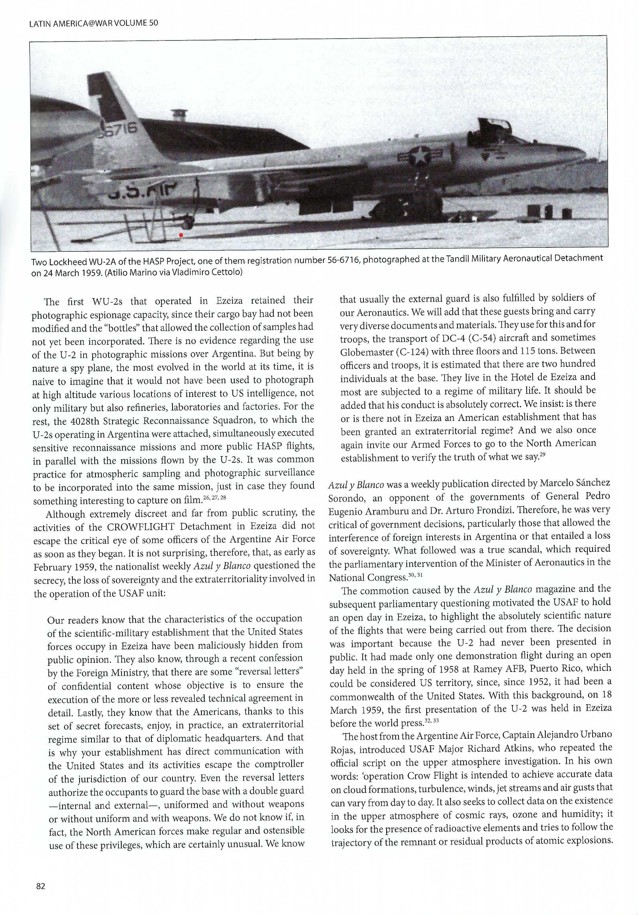
Two of the Lockheed WU-2As of the HASP Project can be seen at the top of Page 82. 56-6716 details have been noted above in the discussion of the rear cover profile. They were at the Tandil Military Aeronautical Detachment [Buenos Aires Province, Argentina] on March 24, 1959. At this date, these two WU-2As had yet to be modified with the nose collection ‘bottles’. An opposition weekly, Azul y Blanco, created a scandal that led to the USAF displaying the WU-2As in public to emphasize their ‘scientific nature’ to study weather. Tandil Air Base remains an active military air base. The sections include:
- Abbreviations and Acronyms
- Introduction
- The Rare Gases of Luis Water Alvarez (1945-1946)
- An Air Force of Scientists (1947-1948)
- Superfortresses Over Huemul (1949-1952)
- Thunderbirds Over Ezeiza (1953-1954)
- Color Illustrations [Page 44ii]
- Ambassadors In Blue
- Warnings From Buenos Aires (1957)
- Silver Crows In The Southern Sky (1958-1959)
- Endnotes
- About the Author
It was a pleasure to read this book as I finished it over two evenings. I found several fascinating topics, several of which are summarized above. Gustavo Marón does provide significant background on the US Cold War nuclear strategy that led to the USAF presence in Argentina. I am looking forward to the release of Flashes in the Dark Volume 2 in this series. This second volume will analyze the USAF Nuclear Espionage in Argentina from 1960 to 1966 and is scheduled for release in late April 2026. I studied quantum physics as an undergrad and was already aware of Luis Walter Alvarez’s many contributions, yet, I was unaware of his contributions on tracking krypton-85 and xenon-133 in the atmosphere. That led me to spend more time looking at Alvarez only to be amazed at how many contributions he had made outside of nuclear fusion. If you own one of the previous releases in the Latin America @ War series, you know what you are getting. If this is your initial entry into this series, you will be quite pleased.
My thanks to Helion & Company, Casemate Publishing, and IPMS/USA for the chance to review this great book.
Highly recommended!
Reviewer Bio
Frank Landrus
Frank retired from the Ophthalmic industry with over thirty-six years of Research and Development experience. Frank's first model kit was a 1959 Hawk 1/72 US Marines Vought AU-1 Corsair and has been building models for over sixty years. Frank's first encounter with IPMS was attending a North Central Texas ScaleFest show in 1984. Frank soon became more involved in Make-N-Take activities and became the IPMS Western Coordinator for Make-N-Takes [West of the Mississippi River]. Make-N-Takes quickly became a local model contest and airshow staple reaching a high of reaching over 1,300 children before the COVID shutdown. Frank has volunteered to assist in contest judging since 1985 and is currently the Nationals Head Figure Judge until he is dead or they find someone better.
Comments
Add new comment
This site is protected by reCAPTCHA and the Google Privacy Policy and Terms of Service apply.
Similar Reviews