
Cuban Military Aviation, Volume 1
Helion is a UK-based company that produces books on many aspects of Military History from the Late Medieval period through to the present day. Helion was established in 1996 by University of Warwick graduate Duncan Rogers. Since then, they have published over 1,200 books, with 100 or more new titles coming out every year, for readers around the world.
Hélio Higuchi hails from São Paulo, Brazil, where he was born in 1953. A hotel manager, he has degrees in Architecture and Urban Design and Marketing. A researcher of Latin American military subjects, he is a regular contributor to Brazilian periodicals Asas, Flap and Tecnologia e Defesa. He is the author of A Serviço do Generalíssimo – Os Pilotos Brasileiros na República Dominicana (In the Service of the Generalissimo – Brazilian Pilots in the Dominican Republic, 2014) and Cuban MiGs: The Defenders of Castro’s Air Force (Harpia Publishing, 2023).
Antonio Luis Sapienza Fracchia was born in Asunción, Paraguay on 14 May 1960. He graduated from the Catholic University of Asunción where he got a B.A. in Clinical Psychology. He also took specialized English courses at Tulane University of New Orleans, Louisiana, USA and San Diego State University in California. He is now a retired English Teacher and Academic Coordinator of the Centro Cultural Paraguayo-Americano (CCPA), a binational institute in Asunción. Married with two children, he resides in the capital. In his function as an aviation historian, Sapienza became a founding member of the Instituto Paraguayo de Historia Aeronáutica “Silvio Pettirossi” and has written more than 500 related articles for the specialized press around the world. Sapienza has received five decorations for his academic merits, and published eleven books, including a number for Helion’s @War series.
Helion’s latest volume in the Latin America @ War series is a square back soft cover that includes 86 glossy paper pages [excluding covers] in their standard portrait A4 [8.25” x 11.75”] format. This tome is the 48th in this series and was released in Britain on August 22, 2025, and in the United States on August 31, 2025.
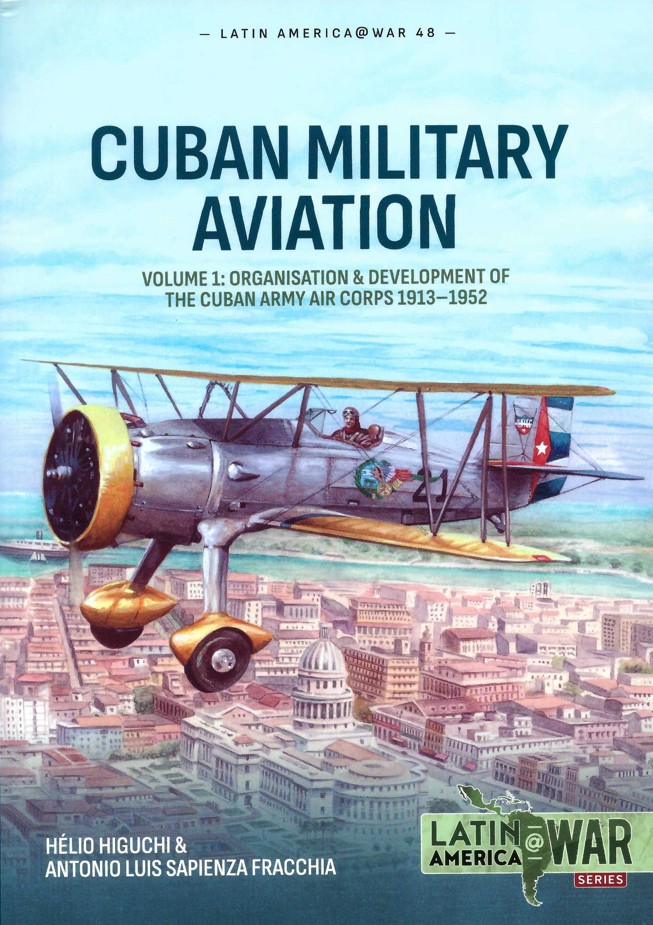
The front cover’s color painting is by Renalto Dalmaso. Flying a Curtiss Model 35A Hawk I is Captain Leonard James Povey, an American citizen who was hired to train Cuban pilots. The Curtiss Model 35A Hawk I was a variant of the US Army Air Corps P-6 Hawk fighter but powered by a 450 hp Pratt & Whitney R 1340 radial engine. The decoration under the cockpit is of a Taino Cacique [chieftain], Hatuey. Hatuey is a legend in Cuba having led a group of natives against the Spaniards led by Diego Veelazquez and is celebrated as Cuba’s first national hero. The rear cover color profile by Jean-Marie Guillou is of one of seven General Motors TBM-3S2 Avenger torpedo bombers that served with the Cuban Naval Air Force. These Avengers were a TBM-3 conversion to a dedicated anti-submarine warfare [ASW] role. This generally included the removal of the rear gun turret.
I counted 219 black and white photographs. Antonio Sapienza contributes two color maps. Luca Canossa provides sixteen color aircraft side profiles; Tom Cooper chimes in with two aircraft side profiles; and Jean-Marie Guillou with four aircraft side profiles,
This first volume Cuban Aviation from Hélio Higuchi and Antonio Luis Sapienza Fracchia kicks off with hot air balloon flights in 1828. The first Cuban born aeroplane pioneer was Captain Jaime Gonzalez Crocier is shown at the center of Page 8. Crocier had traveled to France to study at Bleriot’s flying school in Chateaufort and earned his pilot’s certificate in December 82. Captain Crocier’s first Cuban flight was on February 23, 1914, the third to fly an aeroplane in Cuba. Crocier is also responsible for the first flight accident in Cuban as he managed to slam into an electric pole, damaging his aircraft. The photograph at the bottom of the page is Crocier’s Morane-Saulnier G [previously owned by Augustine Parlah] that would be the second military aircraft in Cuba. Crocier would drop leaflets during the Rebellion of the Chambeloneros in February 1917. Sadly, Crocier would die in a plane crash on July 4, 1920, shortly after take-off. Today, Crocier is remembered with his name on a small international airport near Cienfuegos, "Aeropuerto Jaime Gonzales".
Captain Leonard James Povey was a critical part of Cuban aviation and can be seen on the front cover and on Page 20. The photograph at the top of the page depicts Povey posing in front of his Curtiss Model 35A Hawk I with a great view of the emblem bel ow the cockpit of Hatuey. The bottom of the page shows Povey standing in front of a Waco S3HD-A, also with the emblem of Hatuey. The Waco D series were military biplanes built in Troy, Ohio, [Home to a great museum] that were exported outside of the United States. The -A suffix indicated it was armed. This S3HD-A featured a 420 hp Pratt & Whitney Wasp Jr radial engine and two bomb racks [probably USAAC A-3] under the fuselage between the spatted landing gear. A .30-caliber Browning was on a flexible mount in the rear cockpit along with one forward firing Browning in the lower right-wing root. Povey would later become famous all over the world for his Cuban-Eight maneuver that earned him first place in the 10th Annual American Air Maneuvers held in Miami, Florida.
Three of Luca Canossa’s color side profiles can be found on Page 36ii. The top profile is Captain Leonard James Povey’s Curtiss Model 35A Hawk I. The center profile is one of five Curtiss-Wright CW-19R, a two-seat fighter powered by a Wright J-760 Whirlwind radial engine. The Cuban CW-19R carried a 30-caliber Browning on a flexible mount in the rear cockpit and one 30-caliber Browning in the engine cowling. Wing gun pods on each outer wing could be fitted. The color profile at the bottom of the page is a Curtiss SNC-1 Falcon fighter that was rejected by the CAEC [Cuerpo de Aviación del Ejército de Cuba]. The SNC-1 Falcons [CW-22], originally meant to supplement the CW-19R fighters were transferred to Venezuela instead.
The first Cuban Navy aircraft was an Atlantic Aircraft [Fokker] F.9 Universal on floats, however, it would take till 1935 before additional Navy aircraft would be acquired. Frigate Captain Ernesto Julio Usatorres Ubieta is pictured on Page 55 along with other Cuban naval aviation pioneers in front of a North American Texan. Born in Havana, Cuba, on November 7, 1908. Ernesto would graduate from Military Aviation School in 1930. The Chief of General Staff of the Navy, Angel Aurelio Gonzalez placed Ernesto in charge of bringing aviation to the Cuban Navy in 1934. The postcard at the bottom of the page highlights Lt Antonio Menendez Pelaez’ flight from Cuban to Seville, Spain. The aircraft is a Lockheed Sirus 8A, nicknamed the 4 de Septiembre. This Lockheed Sirus 8A, c/n 146 featured an enlarged fin and rudder with eight being built, powered by a 450 hp Pratt & Whitney Wasp C radial engine. Originally owned by Stafford L. “Casey” Lambert of St. Louis, it was sold to Texaco on July 8, 1932. wearing number “16”. The Cuban Navy took ownership, and she was christened 4 de Septiembre on January 9, 1936, to honor a revolution that displaced President Machado. Unfortunately, this historic aircraft was destroyed in a hanger fire in 1945.
Cuba supported the Allies in World War II and post-war seeing modern aircraft integrated into their air force. This included the American Republics Program (ARP) and the Mutual Defense Assistance Program (MDAP). These included Grumman TBM Avengers, Lockheed P-38 Lightnings, Republic P-47 Thunderbolts, Consolidated PBY Catalinas, and North American B-25 Mitchells. Cuban B-25J Mitchells and P-47 Thunderbolts can be spotted on Page 71. The photograph at the middle of the page shows Cuban serial number 302, a B-25J [44-30348] that was acquired in 1947 under the auspices of ARP. Here she is shown after making a belly landing in 1952 at Camp Columbia. The B-25J at the top of the page is Cuban serial number 305, a B-25J [44-25848] that was also acquired in 1947 under ARP. Notable is that the dorsal turret has been deleted but she is still wearing her chin gun packs.
The sections include:
- Abbreviations and Acronyms
- Acknowledgements
- Introduction
- The Genesis of Cuban Military Aviation
- Introduction
- The Birth of the Cuban Army Aviation Corps (CAEC) [Page 08]
- The First World War
- The Postwar Years and the Acquisition of Aircraft
- The Conspiracy of Veterans and Patriots
- The Organization and Evolution of the Cuban Army Aviation Corps
- The Military Aviation School
- The Gibara Expedition
- The CAEC Goodwill Flight to Central America
- The CAEC and the Revolution of 1933
- The Leonard James Povey Era [Page 20]
- New Reorganization of the CAEC
- The CAEC in World War II and the Lend-Lease Program
- Cuba Enters the War
- Table 1: Lend-Lease Aircraft Delivered to the CAEC
- USAAF Bases in Cuba
- Aircraft Built in Cuba
- CAEC Accidents in the Mid-1940s
- Cuban Pilots Who Fought Overseas During World War II
- William Ralph Perez
- Miguel ‘Mike’ Enciso Seiglie
- Fulgencio Batista Zaldívar (1901-1973)
- Early Life
- Joining the Military
- Sergeant Batista Becomes a Dominant Political Figure
- Batista’s First Presidential Term, 1940-1944
- Return to the Presidency
- Lucrative Business in Batista’s Cuba
- Fidel Castro and Revolution
- Exit From Power
- Death
- Legacy
- Color Illustrations [Page 36ii[
- The Caribbean Legion in Cayo Confites
- Table 2: FAERA Aircraft Types
- The Cuban Naval Air Force (FAN)
- The Birth of Cuban Naval Aviation [Page 55]
- Lieutenant Menendez’s Epic Flight From Cuba to Spain
- The Pan-American Flight for Columbus Lighthouse
- The First New Aircraft
- Aircraft Acquisitions in the 1940s, Lend-Lease Program, and World War II
- Table 3: Lend-Lease Aircraft for the FAN
- The American Solidarity Flight
- Final Acquisitions in the 1950s
- Navy Captain Ernesto Julio Usatorres Ubieta
- The CAEC in the Late 1940s and Early 1950s
- Table 4: FAERA Aircraft Incorporated into the CAEC
- The P-38 Fighter Operations in the CAEC
- The American Republics Program (ARP) for the CAEC and Other Acquisitions
- The B-25 Mitchell Operations [Page 71]
- Table 5: CAEC/FAEC B-25 Mitchell Fleet
- Efforts to Acquire Combat and Transport Aircraft in the Early 1950s
- Epilogue
- Appendix
- Table 6: CAEC Aircraft Types 1913-1952
- Table 7: FAN Aircraft Types 1928-1958
- Table 8: Cuban Armed Forces Rank
- Endnotes
- Sources
- About the Authors
It was a pleasure to read this book as I finished it over three evenings. I found several fascinating topics, several of which are summarized above. Additionally, was the tale of how the Cubans acquired some of their former US aircraft, including a B-25H with its 75mm nose cannon. This B-25H was originally acquired as war surplus for the civilian market by Universal Aviation of Tulsa, Oklahoma, but they did not know how to uninstall the 75mm cannon. I am looking forward to the release of Voume 2 on Cuban Military Aviation in this series. This second volume will analyze the Cuban Air Force as it transferred from the United States influence to Soviet support and control. If you own one of the previous releases in the Latin America @ War series, you know what you are getting. If this is your initial entry into this series, you will be quite pleased.
My thanks to Helion & Company, Casemate Publishing, and IPMS/USA for the chance to review this great book.
Highly recommended!


Reviewer Bio
Frank Landrus
Frank retired from the Ophthalmic industry with over thirty-six years of Research and Development experience. Frank's first model kit was a 1959 Hawk 1/72 US Marines Vought AU-1 Corsair and has been building models for over sixty years. Frank's first encounter with IPMS was attending a North Central Texas ScaleFest show in 1984. Frank soon became more involved in Make-N-Take activities and became the IPMS Western Coordinator for Make-N-Takes [West of the Mississippi River]. Make-N-Takes quickly became a local model contest and airshow staple reaching a high of reaching over 1,300 children before the COVID shutdown. Frank has volunteered to assist in contest judging since 1985 and is currently the Nationals Head Figure Judge until he is dead or they find someone better.
Comments
Add new comment
This site is protected by reCAPTCHA and the Google Privacy Policy and Terms of Service apply.
Similar Reviews