
Cross & Cockade International Summer 2026 Vol 57/2
The non-profit UK based group known as the Great War Aviation Society publishes their journal, Cross & Cockade International, four times a year. Issues are available in English as printed [Softbound, A4 (8.27” x 11.69”), 80 pages plus centerfold] as well as digital copies (or both). A new magazine, Contact!, is now available in both print and digital download. The Society also provides a free newsletter (sign up on their website) and occasionally publish WWI themed books like the Sopwith Dolphin monograph I reviewed earlier for IPMS USA. This Journal is the sister of the US Journal, Over The Front. The Great War Aviation Society also hosts a lecture series available through Zoom. If interested, you will need to register early as the call is limited in attendance. The Great War Aviation Society also is on Facebook and on X [Twitter].
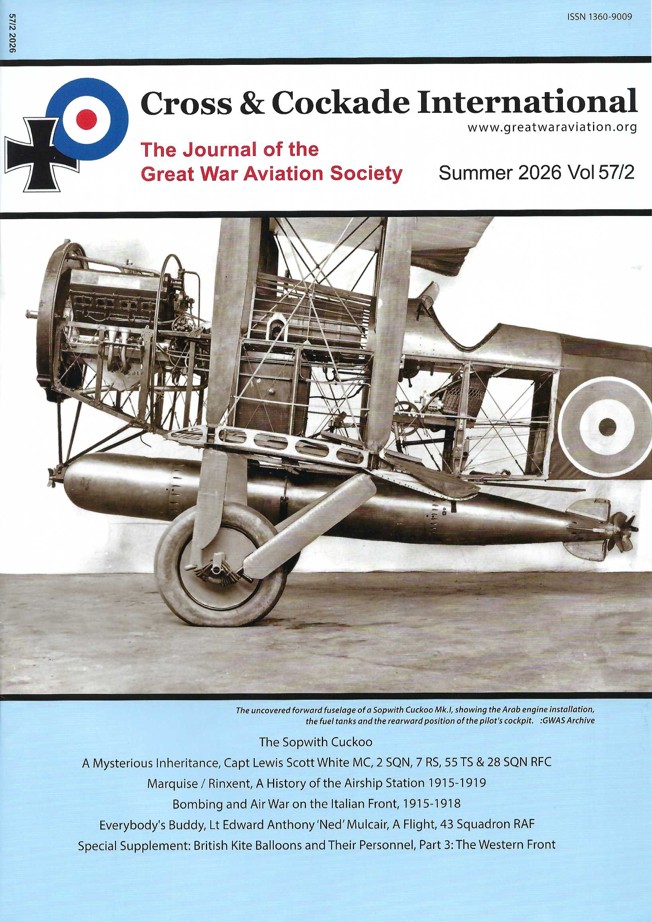
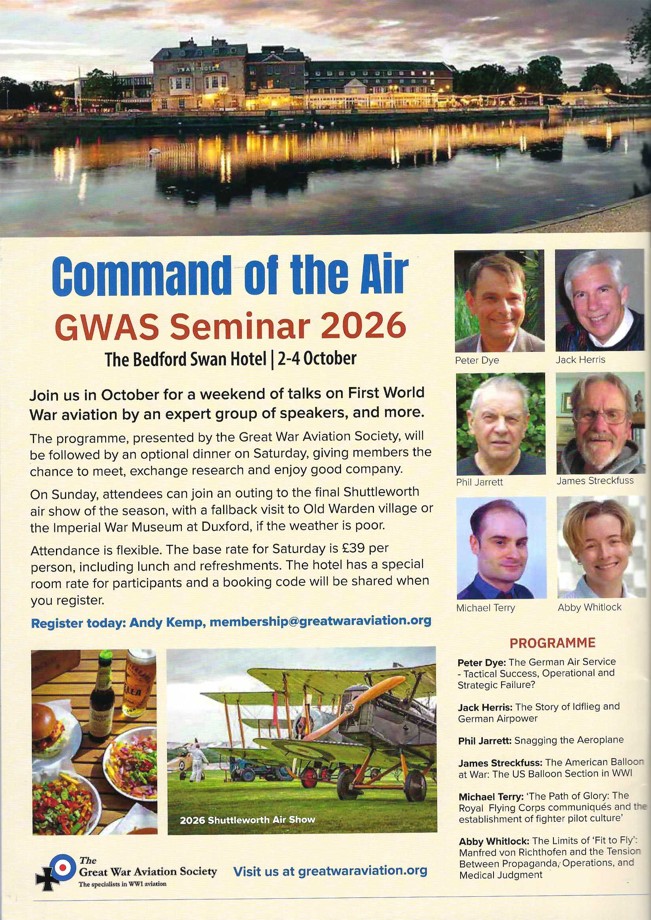
The Summer 2026 journal of Cross & Cockade International features a black and white photograph of a Sopwith Cuckoo Mk. I [originally designated T.1]. The uncovered forward fuselage shows off the Arab engine installation along with the fuel tanks, pilot’s cockpit, and the torpedo. The prototype T.1 flew in June 1917 with a Hispano-Suiza engine with the first production T.1 delivered in May 1918. The Sunbeam Arab was used as the RAF S.E. 5a had priority for the Hispano-Suiza 8 engines, forcing Sopwith to switch to the heavier Arab engine. The Admiralty ordered a production order of 300 in February 1918, but with the Armistice, only 232 were completed. The rear cover features an advertisement for the Great War Aviation Society 2026 Seminar at the Bedford Swan Hotel in early October.
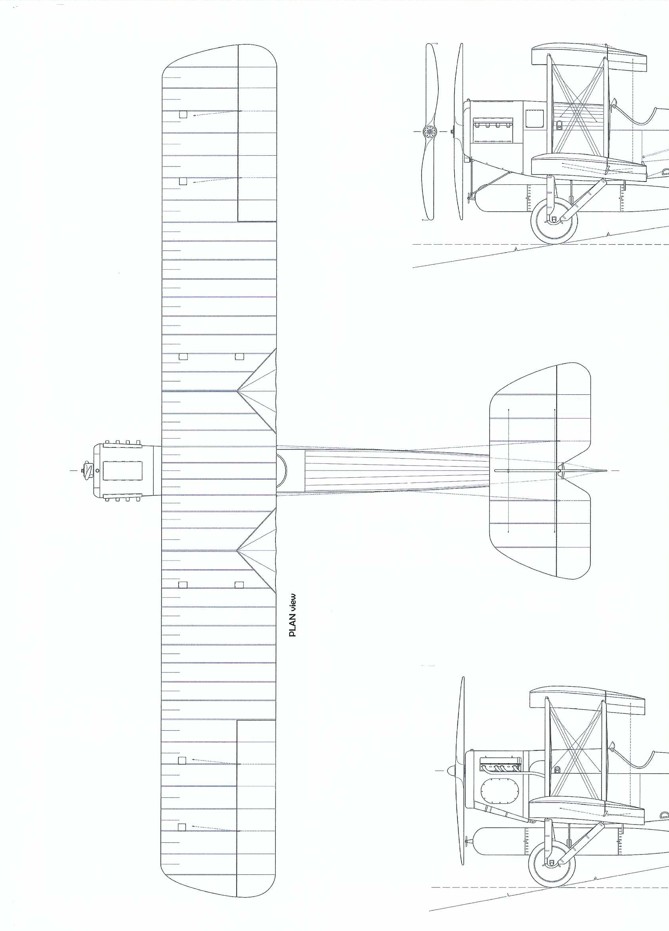
The pullout center section presents Part 3 of the current series on British Balloons and Their Personnel by Trevor Henshaw. There are no photographs, but there is a daily operation recap from March 18, 1918, to September 24, 1918, covering eight pages. There is also a four-page set of 1/48-scale drawings by Martin Digmayer and seven black and white photographs on the Sopwith Cuckoo with Page 1 attached to this review. These drawings include the Sopwith Cuckoo T.I prototype, the Mk. I, and the Mk. III prototype with the 275 hp Rolls-Royce Falcon III engine. A Sopwith 3-view drawing from October 23, 2017, is also included on the T.I prototype.
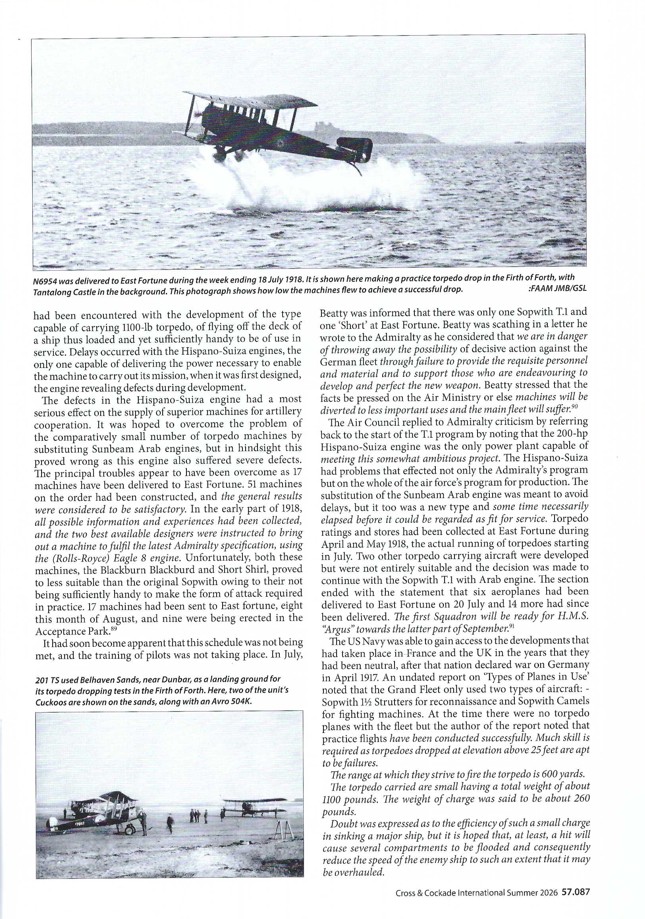
Colin Owers delivers a substantial update to the Windsock Datafile Number 90 on the Sopwith B.I and Cuckoo T.I with previous unpublished photographs. This thirty-one-page tale has sixty-three black and white photographs along with the separate four-page Martin Digmayer drawings pullout with seven more photographs. The top of Page 57-087 depicts N6954 launching a torpedo [Probably a Mk. IX] in the Firth of Forth in front of Tantalong Castle. Notable is how low pilots flew to successfully drop their torpedo. The best torpedo drops were achieved between 12 and 20 feet above the water. N6954 was delivered to 201 Training Squadron at RNAS East Fortune, Scotland, the week ending July 18, 1918. She was part of the third batch of Cuckoos ordered and part of the second batch produced by Blackburn. The Blackburn logo can faintly be seen on the tail fin. The picture at the bottom of the page reveals two Cuckoo T.Is with an Avro 504K parked on Belhaven Sands, near Dunbar, after test dropping their torpedoes.
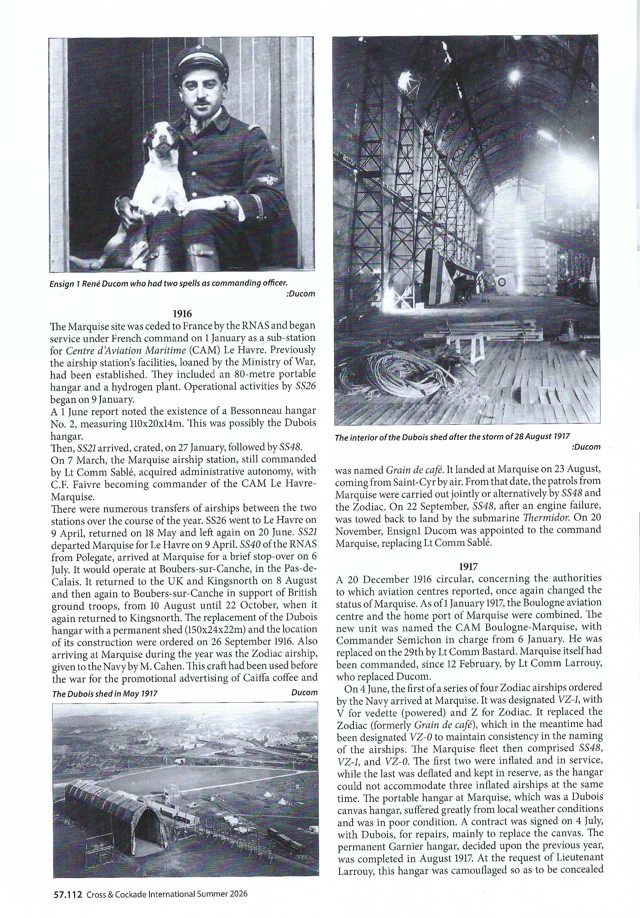
Peter Hallett tracks down a photograph of a young RFC officer sporting a Military Cross ribbon in A Mysterious Inheritance: Capt Lewis Scott White MC. This five-page article and biography of Captain Lewis Scott White MC, includes thirteen black and white photographs. The mystery photograph was resolved with the help of GWAS membership secretary, Andy Kemp. With Lewis White. In the process, Peter Hallett was able to uncover information about his great uncle, John Roger ‘Jack’ James that served in 28 Squadron RFC. Robert Feuilloy is up next with a look at Marquise / Rinxent: A History of the Airship Station 1915-1919. This is a four-pager with fourteen photographs and a black and white map. The top of Page 57.112 depicts the two-time commanding officer of the Marquis Station, Rene Ducom, posing with a friend. The other two photographs show the canvas covered Dubois shed exterior and interior in 1917.
A.D. Harvey contributes an introduction on Italian WWI bombers with Bombing and Air War on the Italian Front, 1915-1918. This three-page article includes six period photographs.
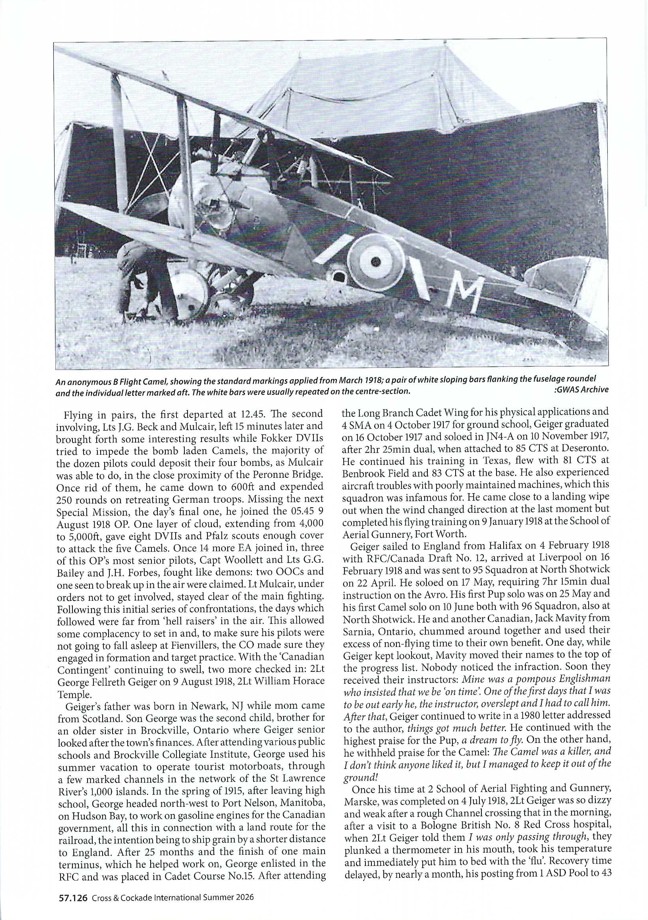
The late Stewart K. Taylor wraps things up with a biography of Canadian pilot, Lt ‘Ned’ Mulcair in Everybody’s Buddy: Lt Edward Anthony ‘Ned’ Mulcair. This is a 23-page feature that includes fifty-five period black and white photographs. Mulcair’s biography is presented along with other members of 43 Squadron RAF. 43 Squadron, the Fighting Cocks, was established on April 15, 1916, with the Royal Flying Corps. Sopwith 1 ½ Strutters were delivered in December 1916, and they were deployed to France in January 1917 and transitioned to the Sopwith Camel in September 1917 with their role changing to ground attack. A 43 Squadron B-Flight Sopwith Camel is at the top of Page 57-126 sporting standard markings from March 1918. Conversion to the Sopwith Snipe was initiated in August 1918 and completed in October 1918. It was in a Snipe that Mulcair came close to an aerial victory. While escorting DH9 bombers, he poured 150 rounds into a Fokker D.VII and was credited with an Out Of Control (OOC). Ned would return home after the war, finding work with the SKF Ball Bearing Company and later supervising aircraft manufacturing in Toronto. Mulcair would pass at the age of 76 on November 3, 1973. As typical in previous articles, Taylor includes shorter biographies of others that served with Lt Mulcair in 43 Squadron.
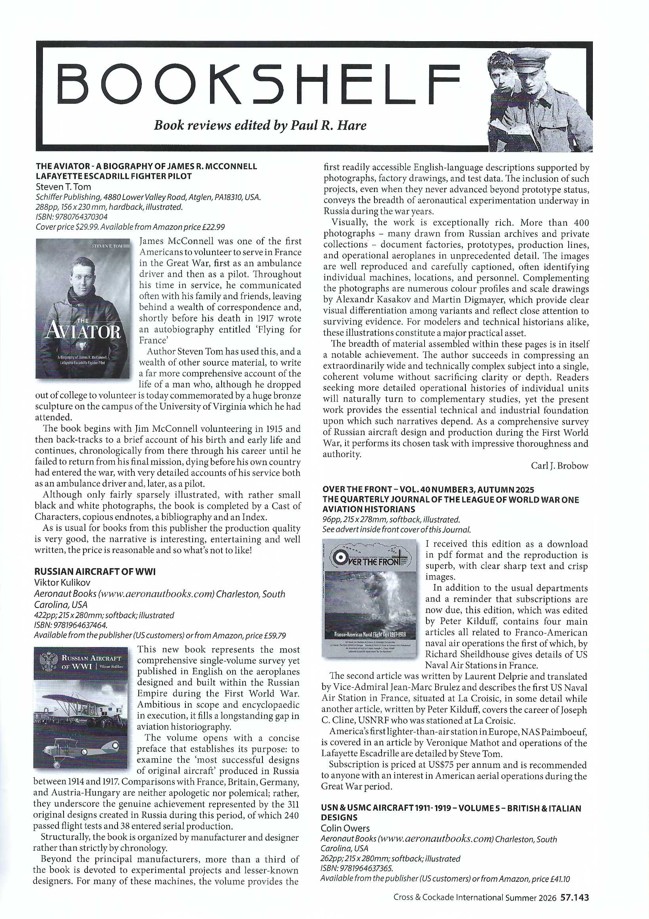
Thirteen black and white photographs populate From The Albums for three pages, although one of those is found at the end of the Bookshelf section. These pictures are Part 4 from the Nicod Album via Alex Revell and feature personnel and a few aircraft. The Bookshelf section is a review of WWI aviation specific books and magazines with this issue totaling seven as seen on Page 57-143.
Topics:
- Editorial by Mick Davis
- The Sopwith Cuckoo by Colin Owers [Page 57.087]
- A Mysterious Inheritance: Capt Lewis Scott White MC by Peter Hallett
- Marquise / Rinxent: A History of the Airship Station 1915-1919 by Robert Feuilloy [Page 57.112]
- Bombing and air War on the Italian Front, 1915-1918 by A.D. Harvey
- Everybody’s Buddy: Lt Edward Anthony ‘Ned’ Mulcair by Stewart K. Taylor [Page 57.126]
- From The Albums: The Nicod Album via Alex Revell; Part 4
- Bookshelf – Edited by Paul R. Hare [Page 57.143]
This is another fabulous issue from The Great War Aviation Society, and I am always impressed with the quality of the articles, both from a research perspective, and readability. I especially enjoyed the first person accounts in the lead article by Colin Owers, Peter Hallett’s tale of Captain Lewis Scott White, and the Stewart Taylor ending article on Everybody’s Buddy. The period pictures, maps, and drawings in this journal come off looking great thanks to their printing on the journal's glossy paper. If you are into early / WWI aviation; this journal is an incredible source of information that will have you on the edge of your seat waiting for the next issue.
My thanks to The Great War Aviation Society and IPMS/USA for the chance to review this great issue.
Highly recommended!
Reviewer Bio
Frank Landrus

Frank retired from the Ophthalmic industry with over thirty-six years of Research and Development experience. Frank's first model kit was a 1959 Hawk 1/72 US Marines Vought AU-1 Corsair and has been building models for over sixty years. Frank's first encounter with IPMS was attending a North Central Texas ScaleFest show in 1984. Frank soon became more involved in Make-N-Take activities and became the IPMS Western Coordinator for Make-N-Takes [West of the Mississippi River]. Make-N-Takes quickly became a local model contest and airshow staple reaching a high of reaching over 1,300 children before the COVID shutdown. Frank has volunteered to assist in contest judging since 1985 and is currently the Nationals Head Figure Judge until he is dead or they find someone better.
Comments
Add new comment
This site is protected by reCAPTCHA and the Google Privacy Policy and Terms of Service apply.
Similar Reviews