
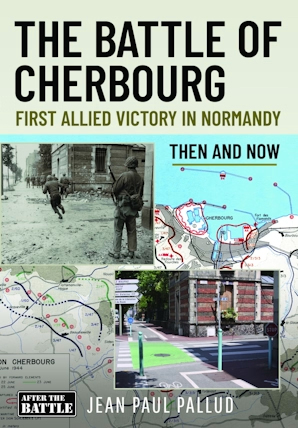
The Battle of Cherbourg, First Allied Victory in Normandy, Then and Now
About the Author
The following is taken from the jacket cover.
Jean Paul Pallud was born in France in 1949 and studied physics at Grenoble University, graduating as a physicist engineer. Specialising in the history of the Second World War,he has worked alongside After the Battle for over 43 years, his first submission to the magazine appearing in 1979 and his last in 2022.
As one of the main contributors to the magazine, he ventured behind the then – Iron Curtain, journeyed north of the Northern Circle, and far into the deserts of North Africa. He has written and contributed to over 80 articles on a wide variety of wartime topics and is the author of many After the Battle’s most memorable feats. He authored five major books: The Battle of the Bulge Then and Now, Blitzkrieg in the West Then and Now, Rückmarsch Then and Now, Operation ‘Torch’ Then and Now, and The Desert War Then and Now. He also co-authored German Coastal Radar Stations Then and Now with Winston Ramsey and has contributed to three more After the Battle books. He has written over 150 articles and books in French.
What You Get
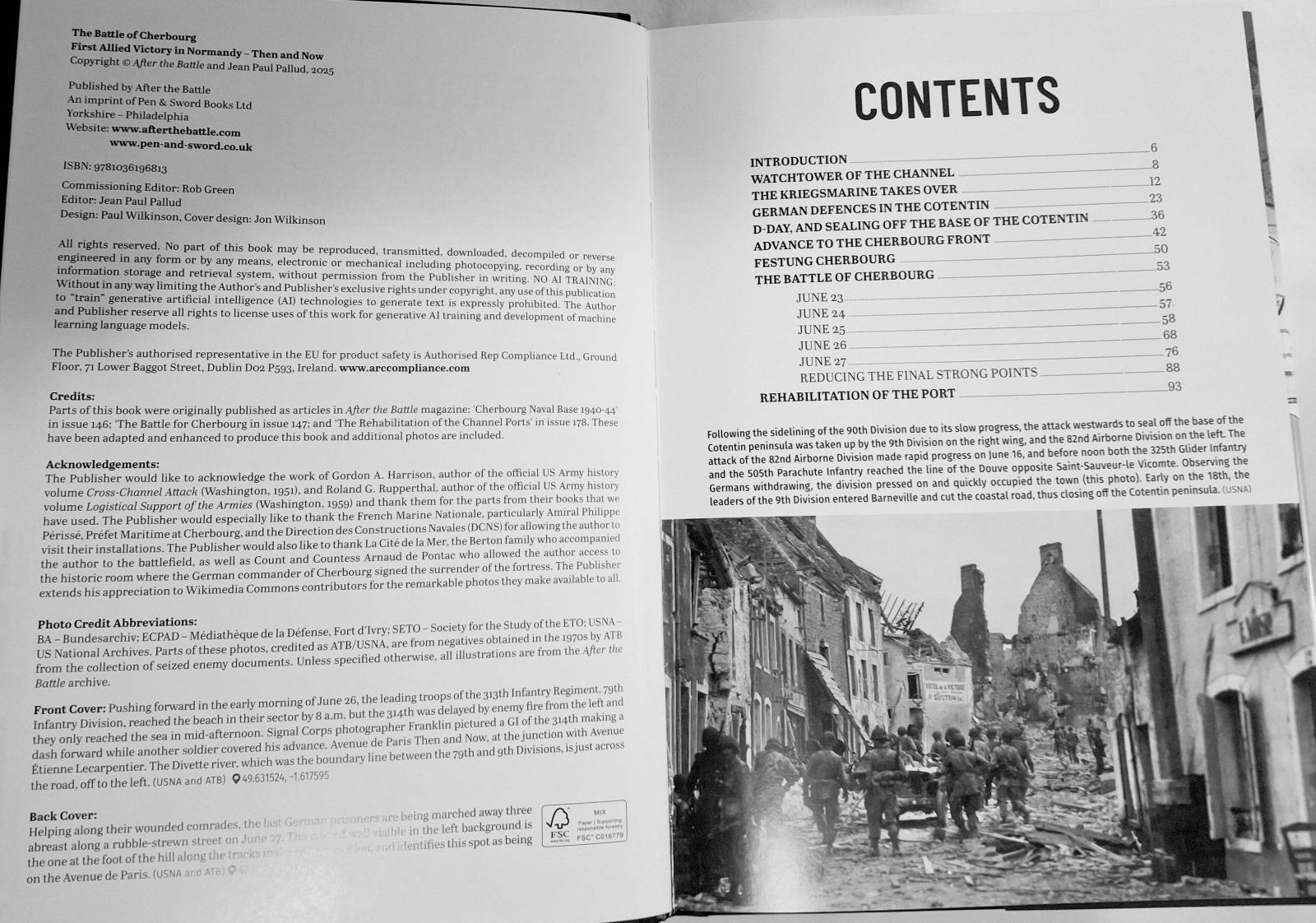
This is a hard bound edition in standard 7⅛ by 10 format with 136 semi-glossy pages. The book contains an Introduction, 8 Chapters, and 26 Then and Now photos.
The Introduction sets the stage for the rest of the book. It talks about the Allies’ plans to capture the deep-water port of Cherbourg as a priority. Chapters 2 through 7 discuss the various parts of the battle to cutoff the Cotentin peninsula. Chapter 8 is broken down into day-by-day subsections of the battle for Cherbourg from June 25 to the final surrender on June 29. Chapter 9 talks about the effort it took to rehabilitate the port from the German demolition.
Although not listed in the Table of Contents there is a final chapter titled The Battle of Cherbourg Then and Now in Colour.
Chapter 1 - Introduction
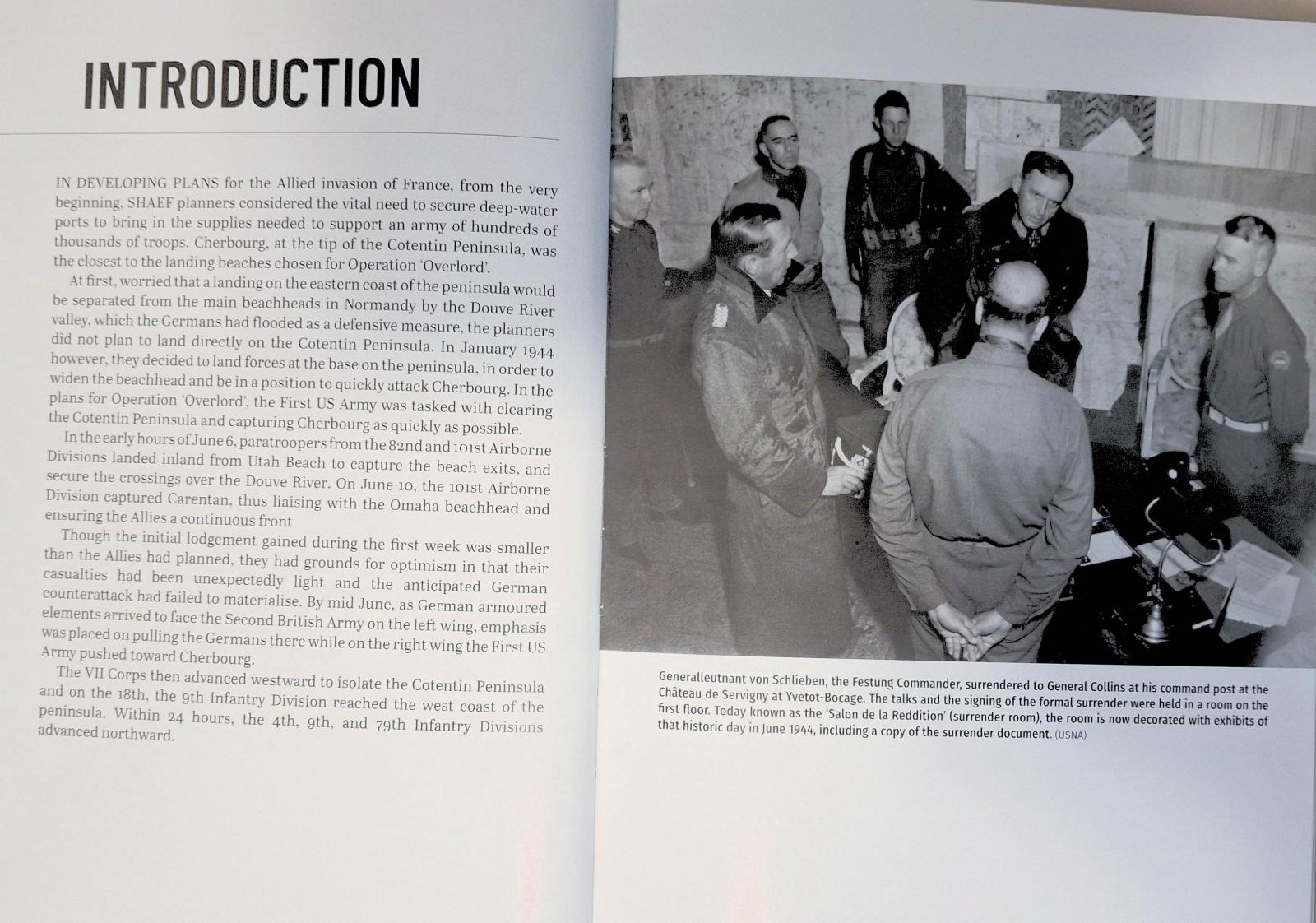
Provides information that sets the stage for the rest of the book. It tells that the importance of capturing a deep-water port would be paramount to the success of the Allied invasion of France and Europe. The port of Cherbourg was the closest such port to the planned invasion landing beaches. The decision was made not to land troops directly on the Cotentin Peninsula, but to swing the American Army west after the landings and cutoff the peninsula at the base. Once isolated the American VII Corps, consisting of the 4th, 9th, and 79th Infantry Divisions, would advance north and capture Cherbourg.
Chapter 2 - Watchtower of the Channel
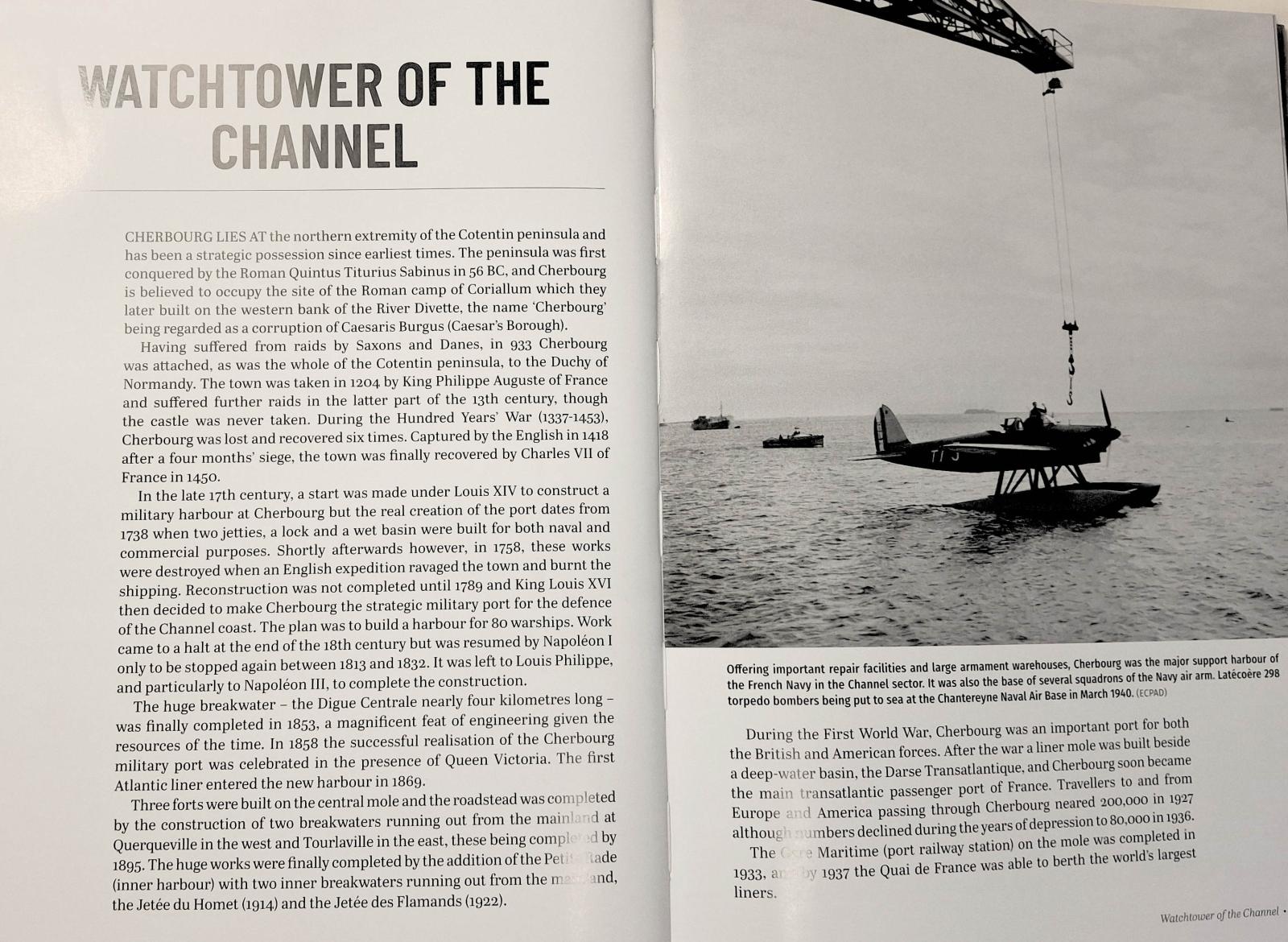
This chapter provides a brief history of the importance of Cherbourg from the time of the Romans in 56 BC to the start of World War II. It also gives the major layout of the port. Two long outer breakwaters, two shorter inner breakwaters, one large quay.
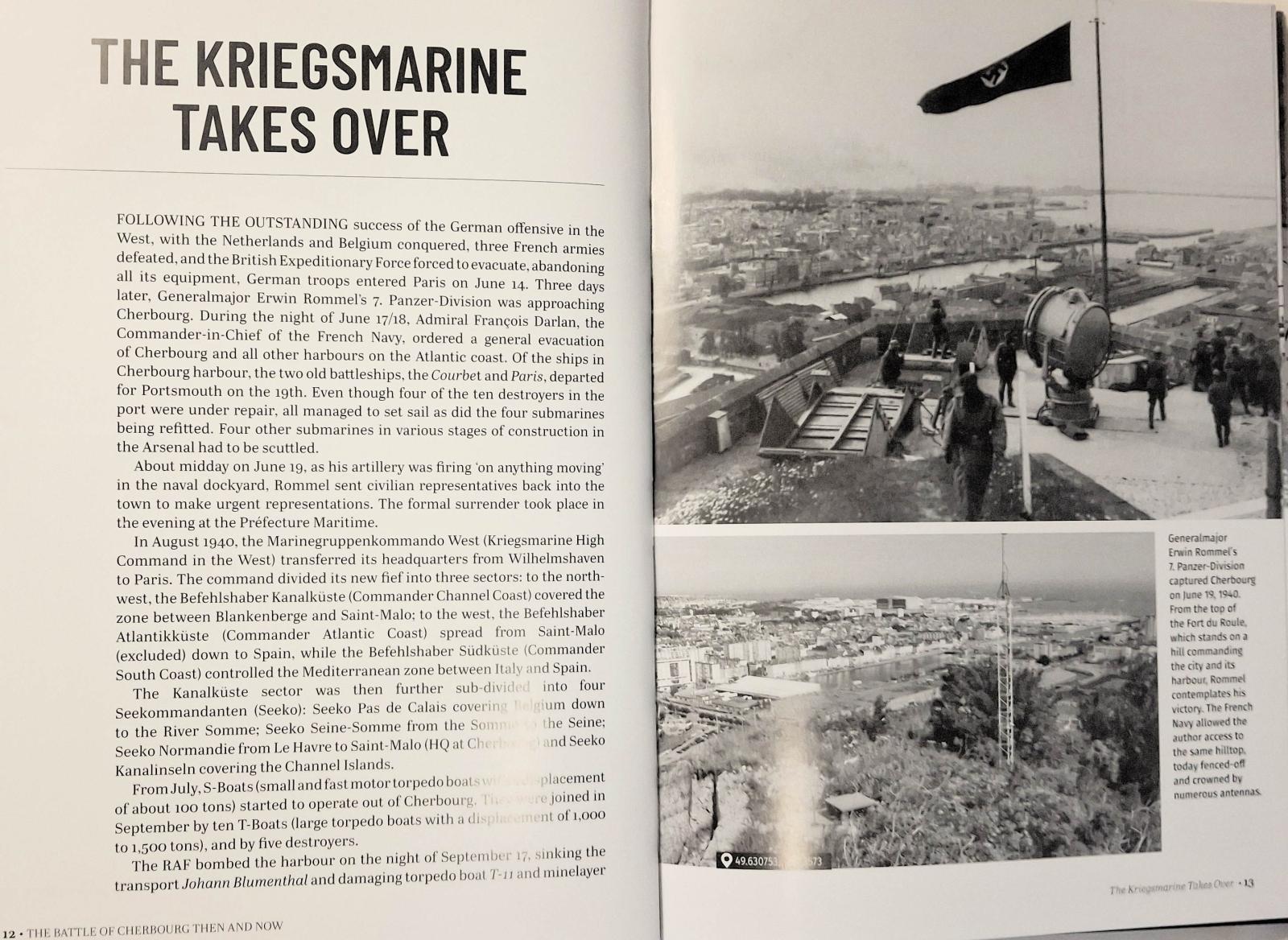
Chapter 3 - The Kriegsmarine Takes Over
This chapter discusses the German setup of the Normandy coast after the fall of France. The coast was broken into three sectors. The northwest sector covered from Blankenberge, Belgium to Saint Malo, France. West sector ran from Saint Malo to Spain. The final sector covered the Mediterranean coast from Spain to Italy.
The Kriegsmarine stationed both S-boats and larger T-boats at the port. From here they conducted strikes against shipping in the southern portion of the English Channel.
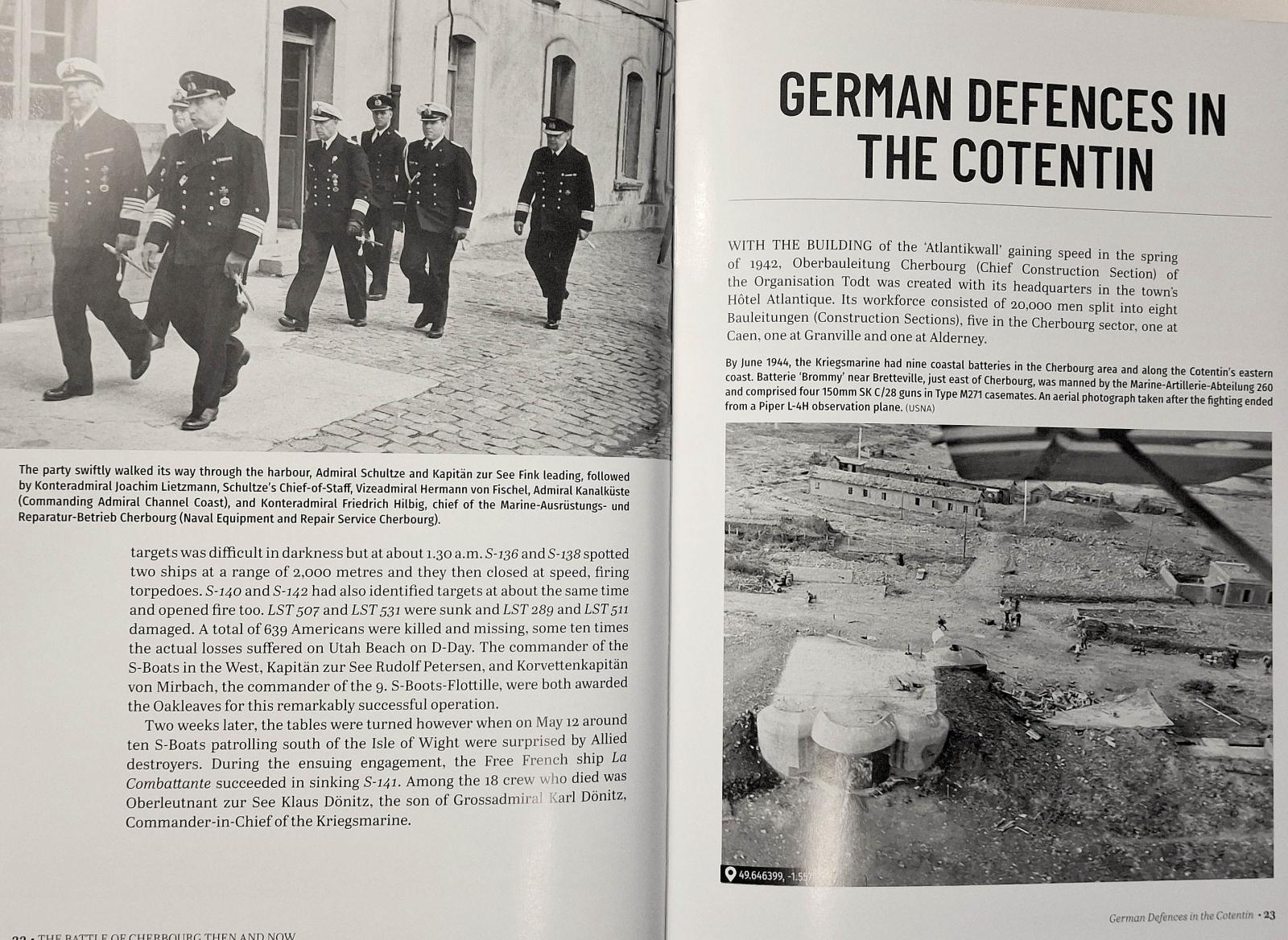
Chapter 4 - German Defenses in the Cotentin
As suggested by the chapter title the defensive preparations and military strength are discussed in this chapter. The LXXXIV. Armeekorps had two divisions along the east coast from Caen to Carentan, three divisions in the Cotentin peninsula, and one division holding the Channel Islands.
Of the divisions in the Cotentin peninsula the army had two coastal artillery regiments. One with ten batteries along the peninsulas eastern coast and in the Cherbourg area. The other regiment had eight batteries stationed along the peninsulas western coast. The photos accompanying this chapter show some of the various artillery positions.
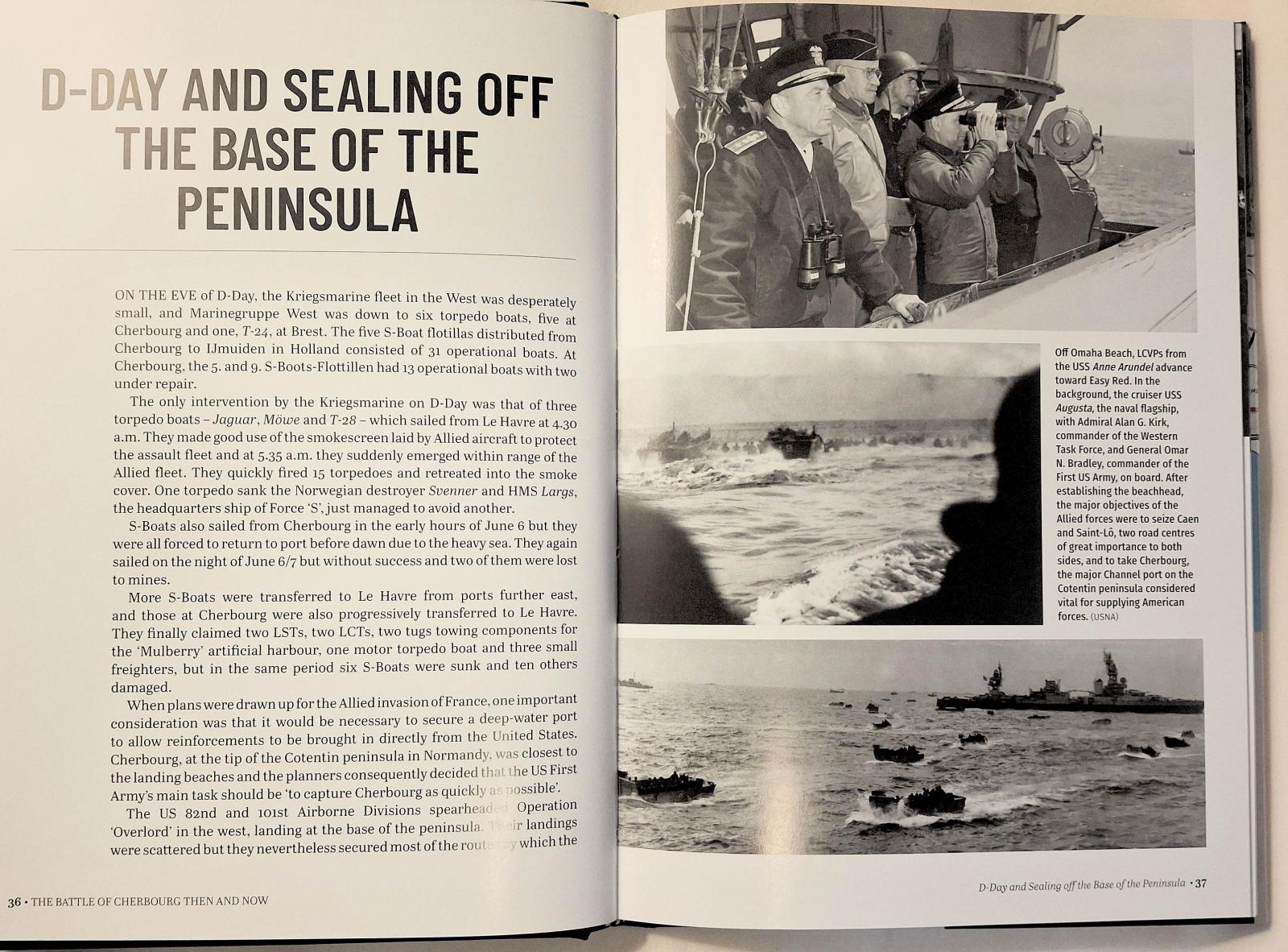
Chapter 5 - D-Day and Sealing Off the Base of the Peninsula
This chapter provides a broad discussion of the battles that took place between the American VII Corps and the German LXXXIV Armeekorps. On June 9 the German 77 Infanterie-Division was ordered to Valognes to intercept the American advance. By June 14 commander of Heeresgruppe B, Erwin Rommel, sent the 243 and 709 Infanterie-Divisions to defend Cherbourg, while sending the 77 Infanterie-Division south.
By the evening of June 18, the Americans had effectively cutoff the Cotentin peninsula. A new plan of attack was developed by General J. Lawton Collins, Commander of VII Corps, and Lieutenant General Omar Bradley, commander of the US First Army. The plan was to advance three divisions abreast the 4th on the west, the 9th in the center, and the 79th on the east.
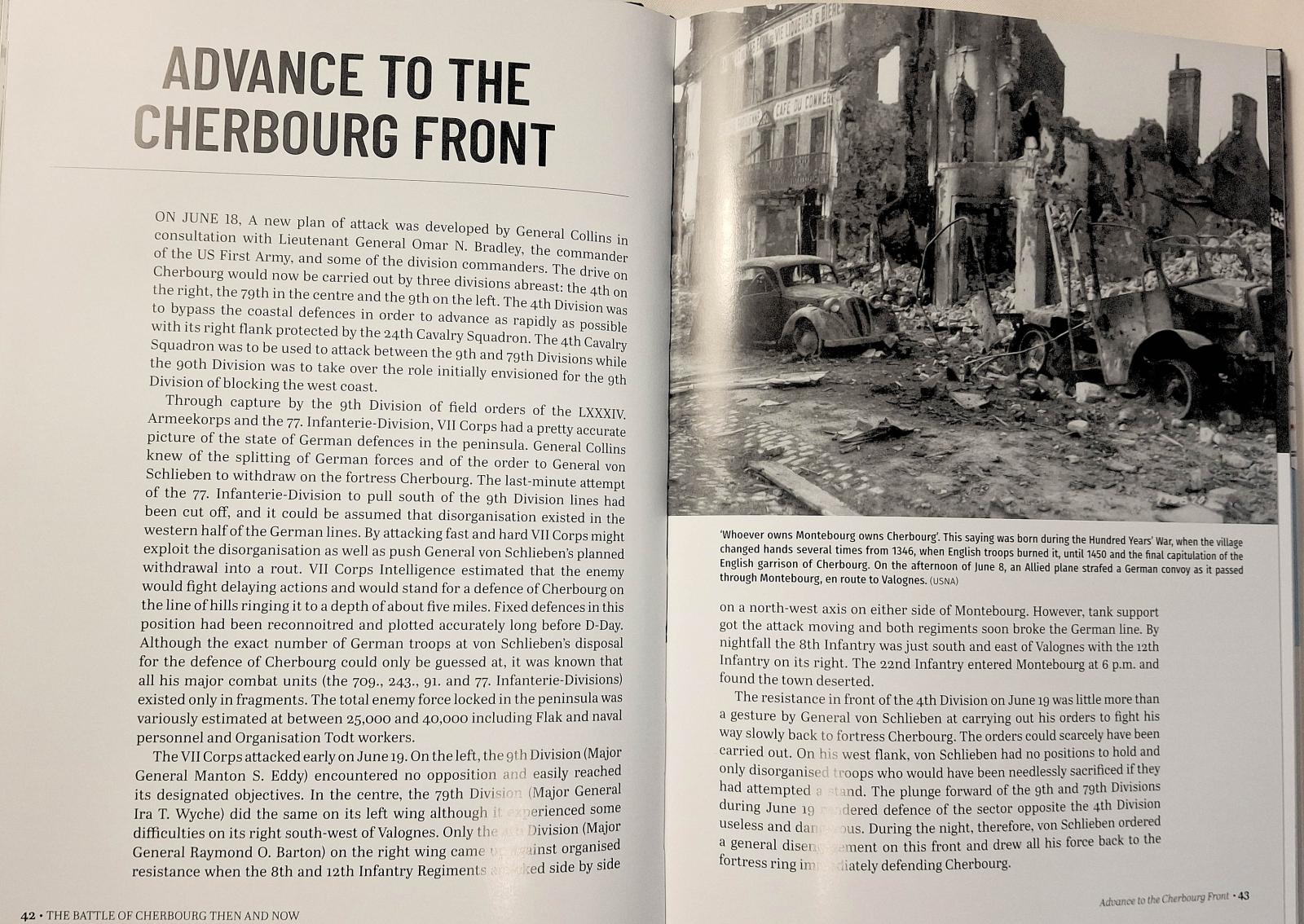
Chapter 6 - Advance to the Cherbourg Front
Chapter 6 discusses the battle up the Cotentin peninsula during June 19 and 20.
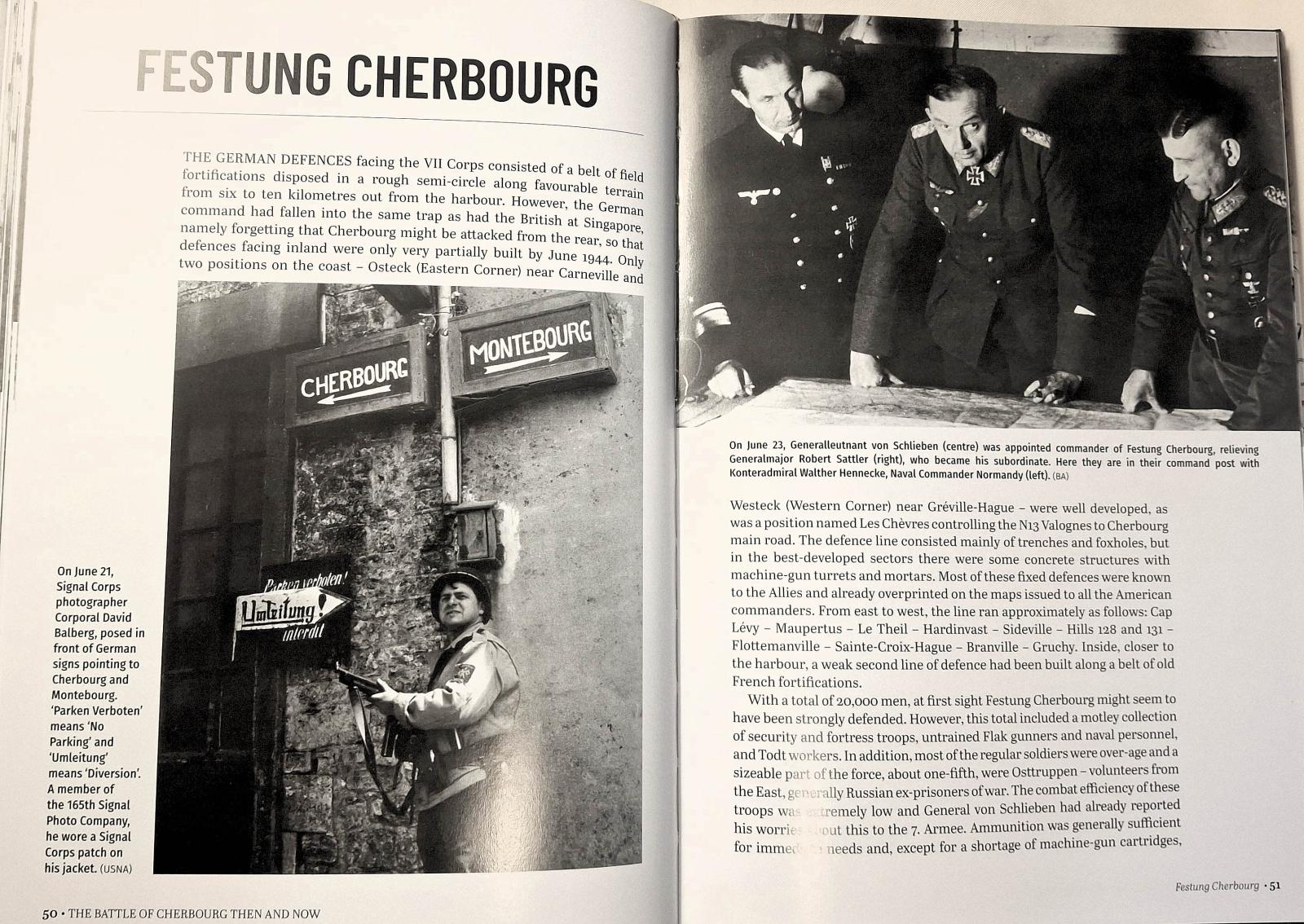
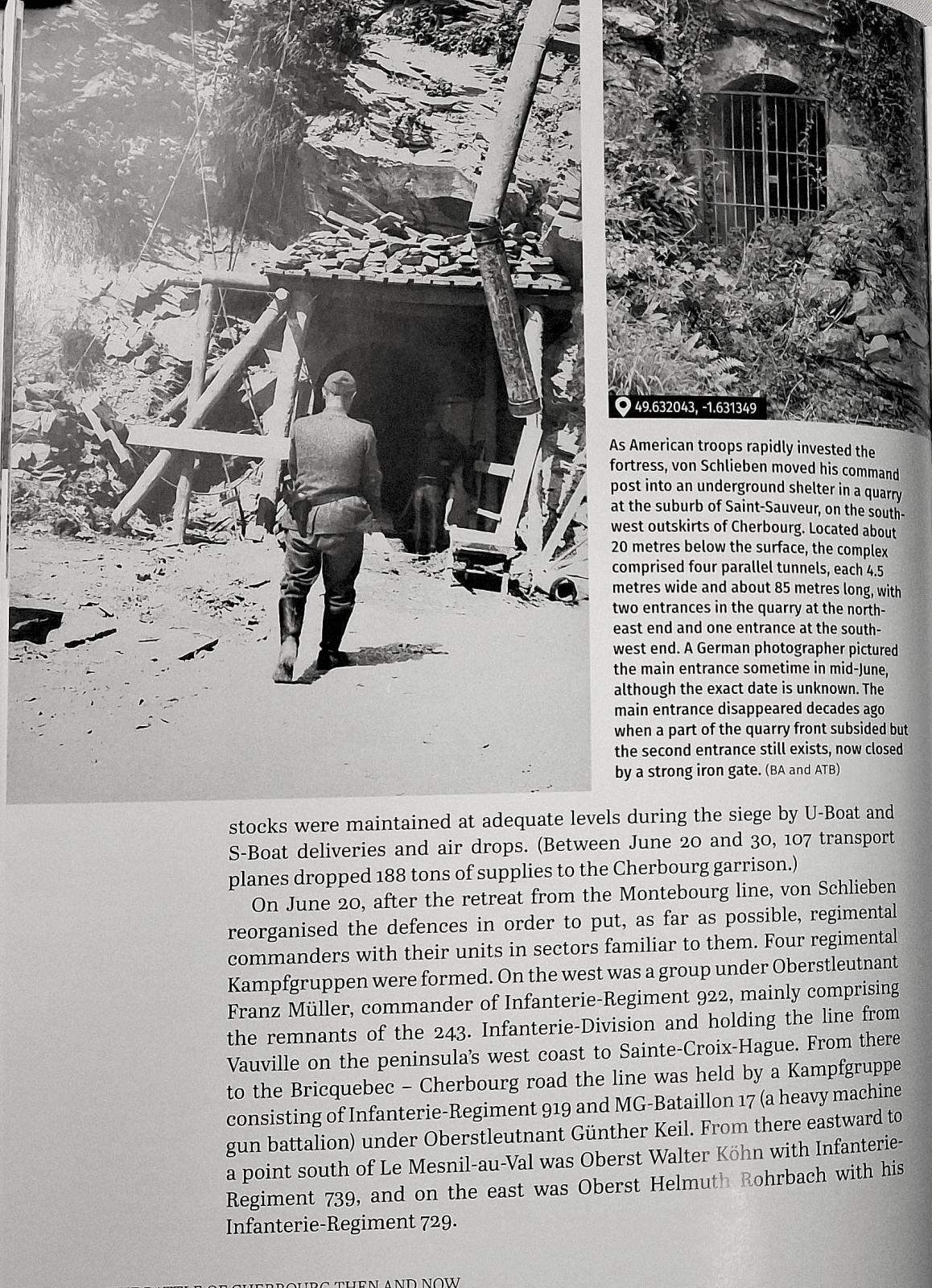
Chapter 7 - Festung Cherbourg
This chapter continues the discussion of the battles on June 21. It also presents the defenses that Germans had setup around Cherbourg. Two semi-circular defensive rings around the city, set in the hills of the countryside.
Chapter 8 - The Battle of Cherbourg
Chapter 8 starts with battles of June 22. There are then five subsections covering each day from June 23 to June 27. The final subsection talks about capturing the final strong points.
Generalleutnant Karl-Wilhem von Schlieben was given duty for the defense of Cherbourg. The Germans put up stiff resistance in defense of the port. On June 26 von Schlieben sent a final message to 7 Armee. He surrendered, but only those under his immediate command, approximately 840 soldiers. Soldiers under the command of Fregattenkapitan Hermann Witt continued a strong defense from the Arsenal. Knowing the fall of this position was imminent Witt along with 185 men took two boats and escaped to Fort de l’Ouest on the outlying breakwater. They defended this position until their surrender on June 30.
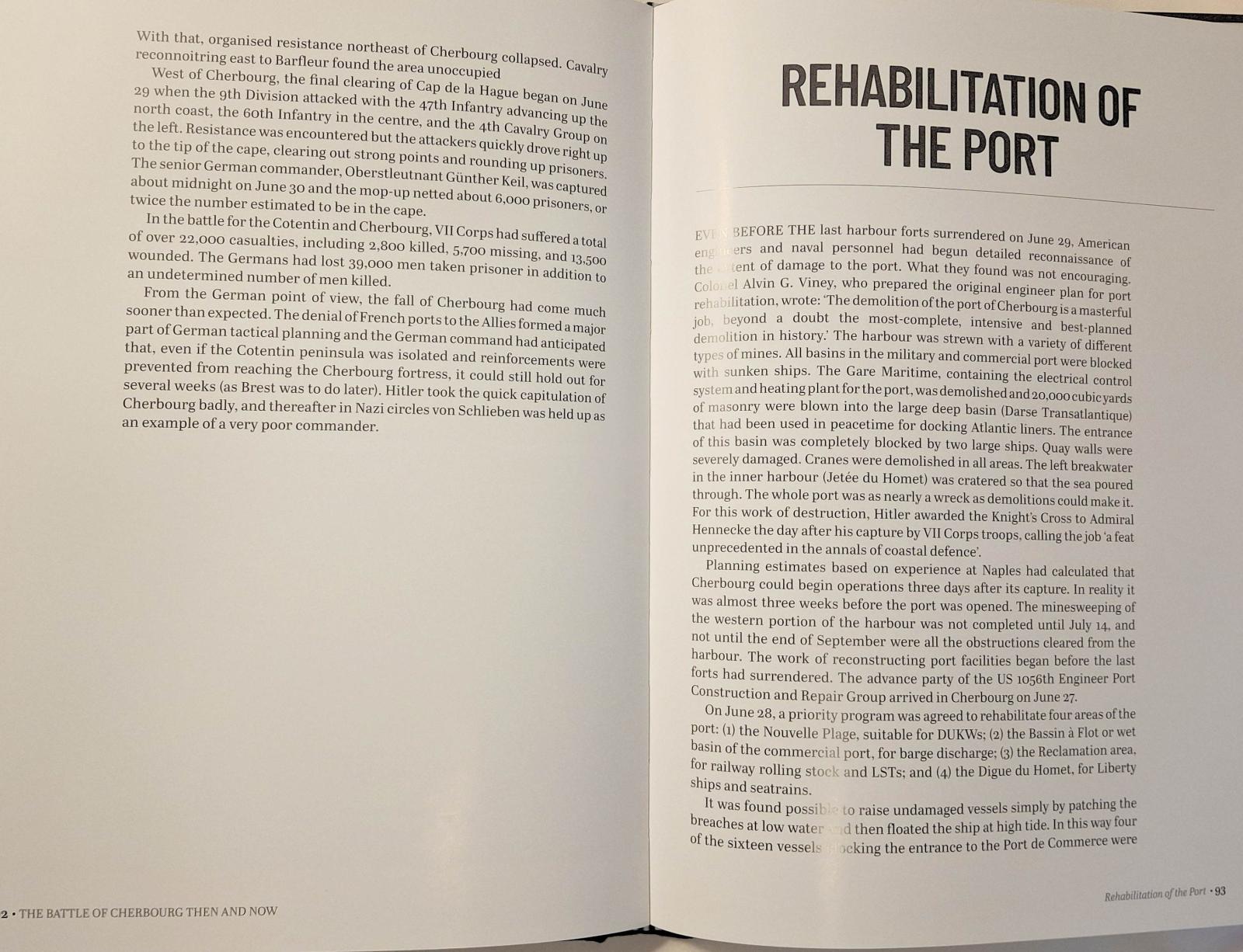
Chapter 9 - Rehabilitation of the Port
Chapter 9, mostly through photographs, talks about the effort put forth to rehabilitate the port for use. Colonel Alvin G. Viney wrote “The demolition of the port of Cherbourg is a masterful job, beyond a doubt the most-complete, intensive and best-planned demolition in history.” Planning estimates calculated that the port could begin operations in three days. In actuality it took three weeks before the port was opened. And full operation was not obtained until mid-September 1944.
From its opening in mid-July until the port of Antwerp was liberated in late November Cherbourg handled more than half of all cargo unloaded in France for the American armies. And remained the main port supporting the US forces in Europe until the end of the war.
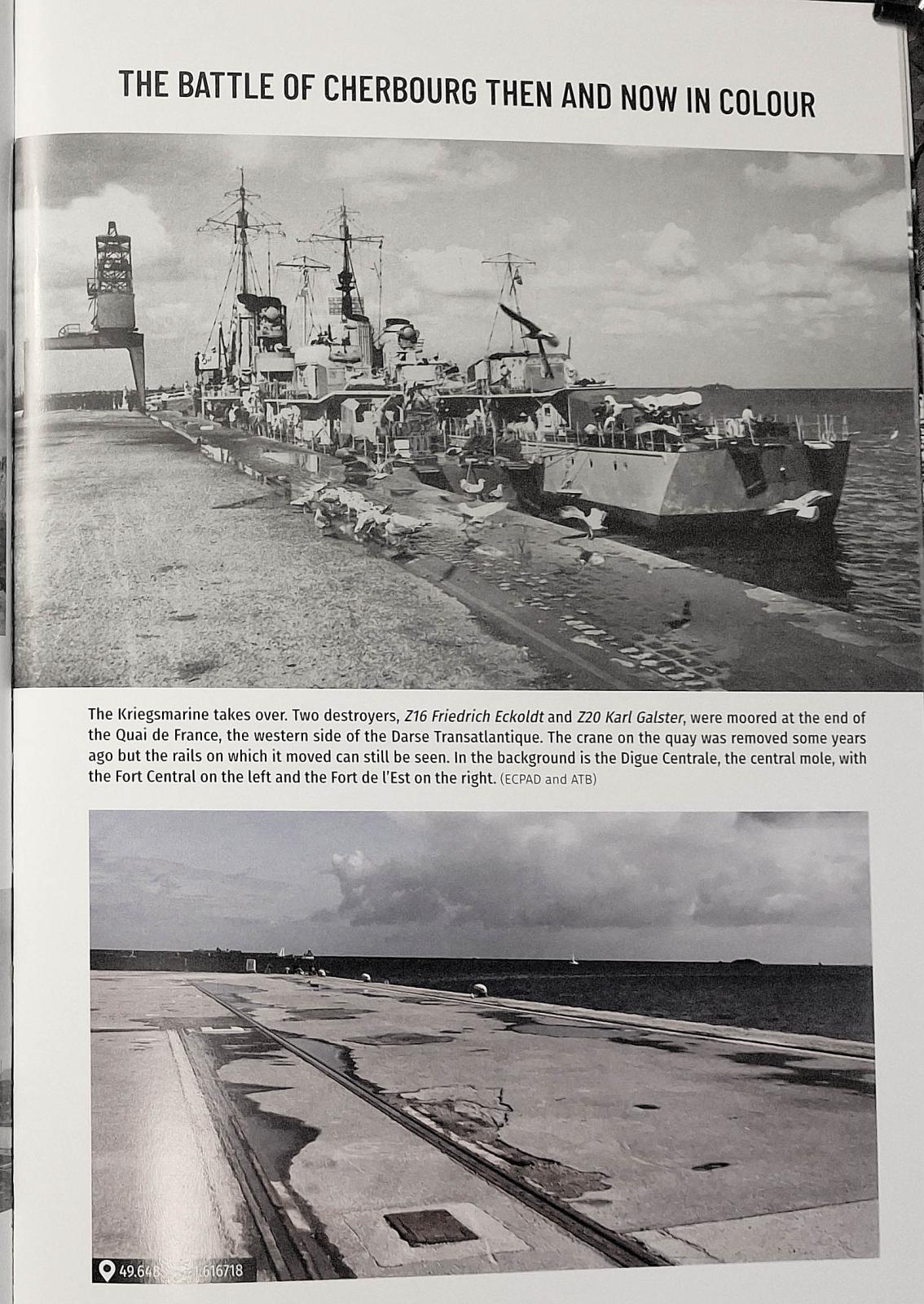
Chapter 10 - The Battle of Cherbourg Then and Now in Colour
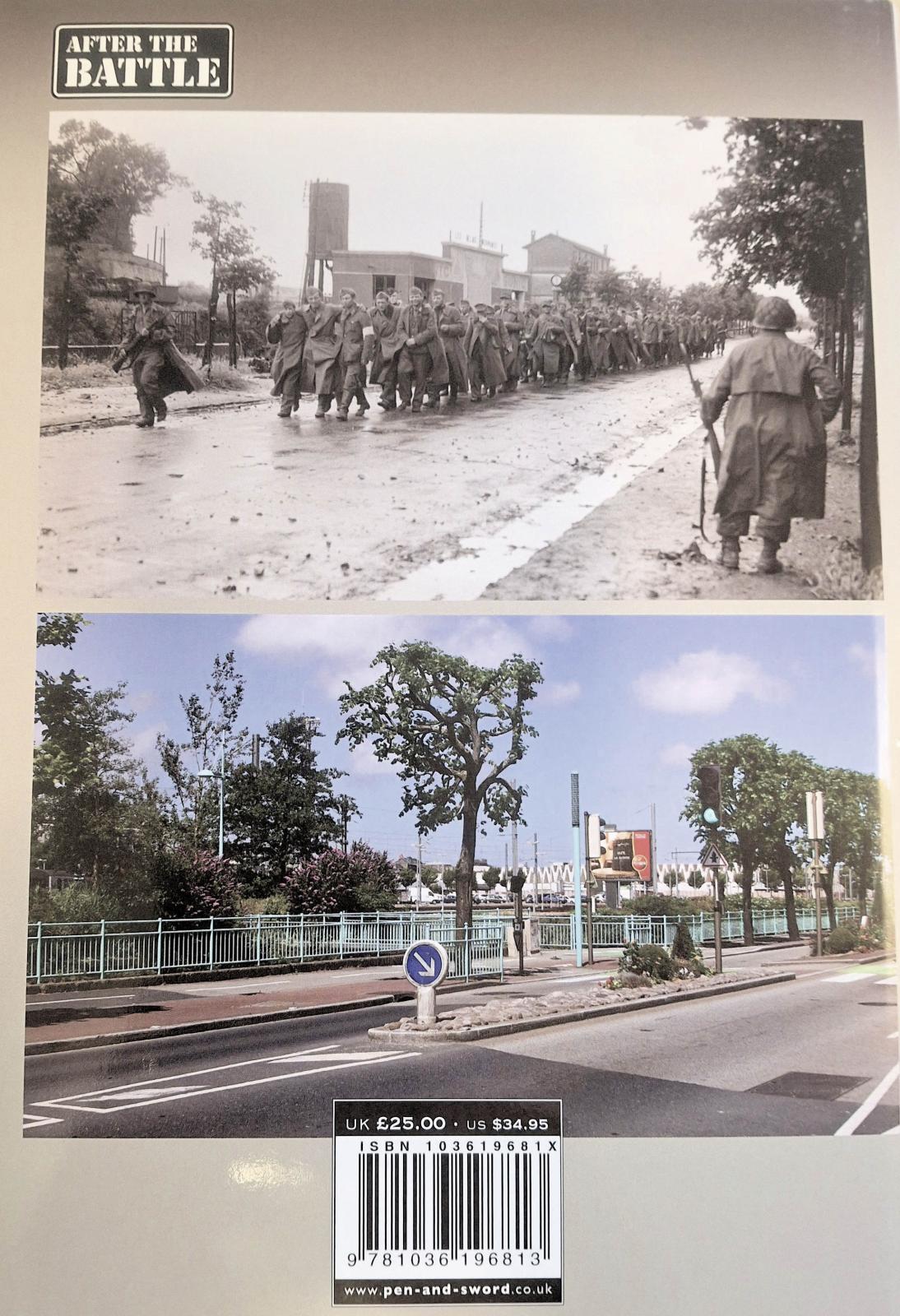
This chapter is a series of 23 then and now photos from the battle of Cherbourg. The “Then” photos are in black and white, while the “Now” pictures are in color. One fun fact from these is that some of the “Then” photos show movable galleries for passengers to exit from transatlantic passenger ships and go directly to waiting trains. Many of these galleries survived the German demolition and are still in use today.
Bottom Line
While not a detailed account of events it provides more than enough information to follow the events and locations of the battle. All photographs have detailed captions on their location, with many including who the photographer was. The only negative about the entire book is that no map(s) is provided. So, if one wants to follow along with the villages taken, then you will have to use your own map (I used Google Earth).
I would strongly recommend this book to anyone with a penchant for World War II history. Especially those who prefer photos to text.
I would like to heartly thank Pen and Sword Books and Casemate Publishers for providing the book for review, and to IPMS/USA for giving me the opportunity to review it.
Comments
Add new comment
This site is protected by reCAPTCHA and the Google Privacy Policy and Terms of Service apply.
Similar Reviews