Reviews of products for scale ship models, including submarines.

Review Author
Mike Kellner
Published on
Company
Eduard
Scale
1/72
MSRP
$32.95

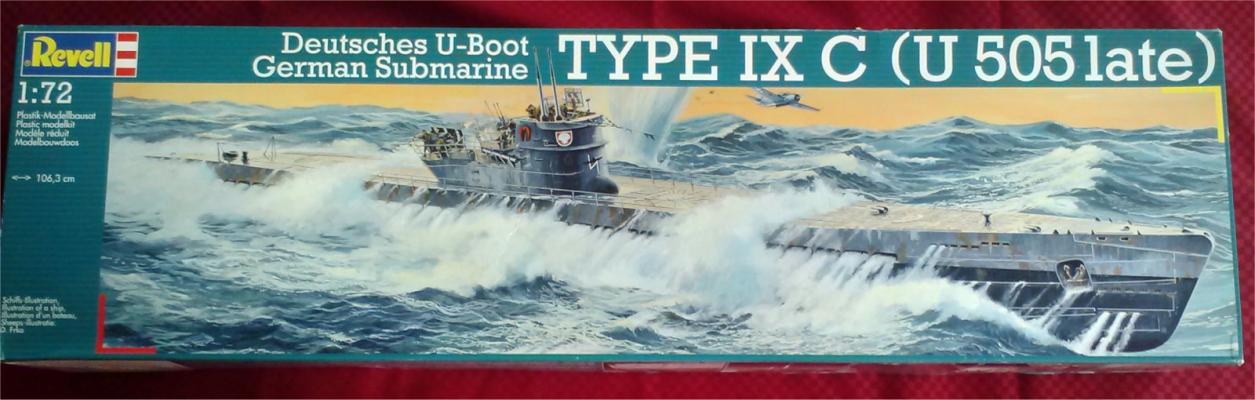
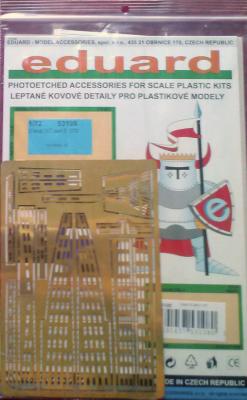
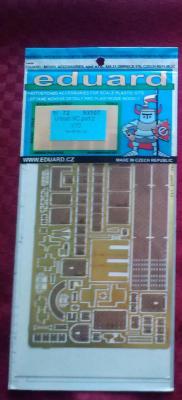
Set 2 of Eduard's PE for the new Revell U-505 in 1/72 scale consists of detail for the deck plus the armament. I’m not particularly “into” photo etch, but when asked I accepted, since I had the opportunity to build the sub. This set consists of one sheet of brass.

I started with the deck plates, as I thought they would be the easiest components. Although the instructions show that Eduard wants the builder to remove various kit parts which they mark in red, there was no removal needed for these parts. I found, however, that removing the kit details (rivets) in the areas where the plates fit worked much better because that way they lie flat. They fit great and adhered nicely with super glue. (I used Bob Smith Industries thin CA for attaching them).

Review Author
Dave Morrissette
Published on
Company
Eduard
Scale
1/72
MSRP
$19.95

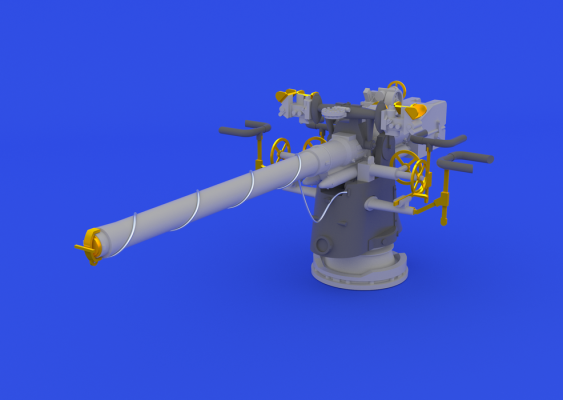
At the start of WWII, the U-boat packs operated with impunity in the North Atlantic and while their torpedoes sunk a lot of ships, their deck guns did a lot of damage also. This ended with the advent or air patrols and small carriers. Eduard has produced an excellent resin and photoetch kit of the 8.8cm gun used on the Type VII U-boats. My only recommendation is to check references in that on the later Type VII's, the gun was removed due to its ineffectiveness due to the threat of aircraft.

Eduard kit consists of 14 perfect resin parts and 15 photoetch parts on a single fret. The first dozen of these parts actually forms the gun sight alone. Fit is excellent but the parts are small with some being 2mm long and requiring bends. The rest of the gun assembly is smooth with the resin parts coming off the pour stubs easily and fitting perfectly. Add the adjustment wheels and tampion (gun plug) and its clamp and the gun can be set aside.

Review Author
Bill Kluge
Published on
Company
Gallery Models
Scale
1/350
MSRP
$329.98

The Ship

Launched in April 1943 and commissioned four months later, USS Intrepid (CV-11) participated in numerous actions in the central and western Pacific from early 1944 until the end of the Pacific War, including Leyte Gulf and Okinawa. She was hit twice by kamikazes but was still on station at the end of hostilities. Intrepid underwent modernization twice during the 1950s, which enclosed her bow and gave her an angled flight deck. Reclassified as an Anti-submarine Carrier (CVS-11), Intrepid was the lead ship for the NASA’s Mercury Aurora 7 and the Gemini 3 splashdown recovery. From April 1966 to February 1969, she made three deployments to the waters off Vietnam. She ended her active career back in the Atlantic and Mediterranean, being decommissioned in 1974 with over 30 years of service. In August 1982, Intrepid was reopened as a museum ship in New York harbor.

Review Author
Ron Bell
Published on
Company
Trumpeter
Scale
1/350
MSRP
$79.95

The Ship

Heavily armed, shallow draft ships are known as monitors, named after the USS Monitor from the American Civil War. The USS Monitor carried two large guns in a rotating turret and had a flat hull with low freeboard. A later series of US ships that were designed for coast and harbor defense had a similar design and were generically called monitors. The term came to be applied to a ship that had main armament far beyond what would have been normal for a ship of its size and shallow draft to allow it to operate close inshore for bombardments. Monitors were used by the British during the First World War at Gallipoli and along the coast of occupied France and Belgium. A monitor was even used to shell the German light cruiser SMS Koenigsberg while she was laid up in the Rufiji River in Africa. No other ship type had a shallow enough draft or had heavy enough armament to deal with German cruiser.

Review Author
Mike Van Schoonhoven
Published on
Company
Model Art
MSRP
$22.12

Model Art Magazine is a monthly magazine that covers aircraft, armor, ships, and car modeling. Model Art started releasing magazines in 1966 and has evolved from there over the past forty-six years. They also release many special releases during the year as is the case of this issue.

This issue is the second in the series Ship Model Database Extra Edition. The first covered IJN Destroyers that were produced from 1918–1941, and this one covers the IJN Carriers 1922–1945. The carriers included in this are the Hosho, Akagi, Kaga, Ryujo, Soryu, Hiryu, Shokaku, Zuikaku, Taiho, Unryu, Amagi, Katsuragi, Shinano, Shoho, Zuiho, Ryuho, Chitose, Chiyoda, Hiyo, Junyo, Taiyo, Unyo, Chuyo, Kaiyo, and Shinyo. The magazine is broken down into eleven sections. I will cover each section below.

Book Author(s)
Jamie Prenatt, Mark Stille
Review Author
Dave Morrissette
Published on
Company
Osprey Publishing
MSRP
$17.95

While most people know of the Gray Wolves and the story of the U-Boat packs, not many know of the war waged by the Axis by the midget submarines. Osprey's latest book can correct that fact. Axis Midget Submarines covers just what the title says, midget submarines from Italy, Germany and Japan.

Each section follows a similar format. First, the history and countries doctrine of war are covered. Next, there is a section covering the development and types of midget subs used. The war time service record is then covered and also their prototypes and concept ideas. Each part is then summarized by an analysis and conclusion for each type.

Review Author
Keith Pruitt
Published on
Company
Master Model
Scale
1/350
MSRP
$16.95

History

I’ll have to admit a personal fascination with the story of the USS Indianapolis. I read a magazine article about the tragedy during my high school years, which was probably close to the 30th anniversary. In July of 1945, the Indianapolis, a Portland-class heavy cruiser, was tasked with the top secret mission of delivering parts for the first atomic bomb to be dropped on Hiroshima, Japan. On the next leg of her journey, the ship was struck by two torpedoes from a Japanese submarine. The ship sank within minutes, leaving almost 900 of her surviving crew stranded in the Pacific Ocean at the mercy of the elements, dehydration, and marauding sharks. After three days in the water, they were finally rescued, but only 317 of the men survived the ordeal.

Book Author(s)
David Greentree
Review Author
Mike Hinderliter
Published on
Company
Osprey Publishing
MSRP
$18.95

Osprey has put out book # 57 in their Duel series. It is about the British Q Boats or decoy boats, as they were also known, versus the German U-boats. This book is another interesting book about World War 1 to go along with the wars 100 year anniversary.

The Imperial German U-boats were preying on the merchant ships that were supplying the British war effort. The U-boats were doing such a good job of this that Britain had to think of something that would make the submarines surface. Once surfaced, the U-boat became more vulnerable and the ship would have a better chance to fight. Enter the Q ship, a ship that appears to be a lone merchant ship and easy target. Once the U-boat surfaces the Q ship’s hidden guns appear and open fire.

The book is divided into eleven sections:

Review Author
Joe Porche
Published on
Company
Cyber-Hobby
Scale
1/700
MSRP
$47.00

Upon opening the kit I found the plastic to be delicately molded in an easy to paint light grey styrene with fair detail for a model its scale and size. The parts count is rather high because many of the details are molded as fine separate niceties. Very small (less than an 1/8th inch) parts such as the masks, life rafts, antenna, and supports are molded in this fine plastic and make use of magnifying devices necessary.

Parts count:

Book Author(s)
Mark Stille CDR, USN (Ret)
Review Author
Ned Ricks
Published on
Company
Osprey Publishing
MSRP
$17.95

Highlights from Osprey’s website: “Designed and produced under the regulations of the Washington Naval Treaty, the heavy cruisers of the Pensacola, Northampton, Portland, New Orleans and Wichita classes were exercises in compromise. While they possessed very heavy armament – the Pensacolas, for example, carrying a main battery of ten 8” guns – this came at the cost of protection – armor was the same thickness as a gun cruiser, and incapable of protecting the vessels from enemy 8” fire. As the classes evolved, these flaws began to be corrected, with the main battery being reduced, and increased protection being added to the vital areas of the ship. Despite these drawbacks, the pre-war heavy cruiser classes served with distinction throughout World War II.”

This volume does a good job of informing the largely uninitiated (that would be this reviewer) about the difficulties of designing these large warships and the consequences of the decisions made.