Reviews of products for scale miscellaneous models.

Book Author(s)
Mark Lardas
Review Author
Jim Pearsall
Published on
Company
Osprey Publishing
MSRP
$24.00

This Osprey book covers one of the most ignored campaigns of the later stages of the Civil War. Mark Lardas does a very good job of covering the leadership, the units and the strategies of this campaign.

The book is divided into the following sections/chapters

Book Author(s)
Air Commodore Graham Pitchfork, RAF
Review Author
George Cully
Published on
Company
Osprey Publishing
MSRP
$15.00

Drawing heavily upon an unpublished history of Britain’s Air Sea Rescue Service produced after WWII by the Air Ministry’s Air Historical Branch, this softback reprint was originally published in 2005 as a follow-on to a 2003 effort by Pitchfork entitled Shot Down and On the Run. That book dealt with British and Commonwealth aircrew who found themselves on the ground in enemy territory—mostly in northern Europe—but were able to successfully “escape and evade,” often with the help of brave souls who risked their lives—and the safety of their families--in so doing.

Review Author
Ben Morton
Published on
Company
AFV Club
Scale
1/35
MSRP
$64.99

This is what the website Army Recognition has to allow about the Raytheon Hawk Missile: The HAWK (Homing All the Way Killer) MIM-23 is an all-weather low to medium altitude ground-to-air missile system developed and designed by the American Defense Company Raytheon. The HAWK semi-active radar seeking medium-range SAM system commenced development in 1952 with the US Army awarding a full-scale development contract to Raytheon for the missile in July 1954. Northrop was to provide the launcher and loader, radars and fire control. The first guided test firing took place in June 1956 with the development phase completed in July 1957. Initial Operational Capability (IOC) of the Basic HAWK, MIM-23A, took place in August 1960 when the first US Army battalion was activated.

Follow the link to a video, via Critical Past, of a Hawk missile blowing a QF-80 drone to smithereens.

Book Author(s)
Marc Romanych and Greg Heuer
Review Author
Doug Hamilton
Published on
Company
Osprey Publishing
MSRP
$18.00

Railway guns are in simple terms huge guns on trains. First conceived and fabricated during the American Civil War in 1862 by Confederate forces, railway guns came into being to rapidly bring large artillery where needed. Traditional methods of dismounting a large gun tube and moving them by horse drawn train was time consuming and manpower intensive. European observers sent to scrutinize took notice of many of the advances made during the Civil War, and improved upon what they saw. Fast forward to World War I and railway guns were again deployed. Most of the combatants deployed railway guns of varying size and with varying results. This book is a basic course on these WWI era weapons.

Review Author
Allan Murrell
Published on
Company
Hasegawa
Scale
1/35
MSRP
$54.95

This is a re-issue of a kit first issued in 2015. It is an excellent kit in the Hasegawa range and is very easy to build as long as you watch the instruction details carefully.

In the box is:

  • 2 x black rubber sprues
  • 2 x orange sprues
  • 1 clear sprue
  • 2 x light grey sprues
  • 3 x dark grey sprue
  • 1 length of hose
  • 1 decal sheet
  • 4 x poly caps
  • 1 mesh sheet
  • 2 x springs
  • 1 instruction booklet
  • 1 collector card

The sprues are extremely well molded with no flash and great detail. The parts are all molded in the correct colors so if the build is done well there is no need to do much painting.

Construction

Stage 1 Assembly begins with the female driver, I left the arms off as these need to be positioned correctly once in the cabin seat.

Book Author(s)
Alan Ranger
Review Author
Allan Murrell
Published on
Company
Mushroom Model Publications - MMP Books
MSRP
$20.00

The book is a Photo album of photographs taken from the German perspective of Dunkirk in 1940.

The book contains many photograph’s never before published and makes this a fascinating book.

All the pictures give some great views from the German side and allows you to see Dunkirk form a very different direction to the normal publications. I was particularly impressed with the pictures showing vehicle’s and the sunken ships of the beach.

I recommend this book to everyone with a interest in the Dunkirk

Thanks go to Mushroom Model Publishing for providing this book to review and IPMS USA for allowing me to review it for them

Book Author(s)
Graham Pitchfork
Review Author
Pablo Bauleo
Published on
Company
Osprey Publishing
MSRP
$15.00

Osprey Publishing has recently released a very interesting book covering the history of RAF and Commonwealth aircrews shot down behind enemy lines and their escape stories.

The book is neatly organized in the following chapters

  • The Escape and Evasion Organization
  • North-West Europe
  • Middle East and Mediterranean
  • The Far East

The first chapter describes the whole organization (MI-9) being setup in the early years of the war charged with establishing escape routes and networks for any personal behind enemy lines (not only for aircrews). In addition of setting up escape routes, this organization was in charge to develop escape aides, tools and supplies, which were part of an ‘escape kit’ provided to armed personnel. Some of the escape aids included miniature compasses, pictures of the themselves (for fake IDs, maps, et).

Book Author(s)
Brit Buttar
Review Author
Ben Morton
Published on
Company
Osprey Publishing
MSRP
$30.00

That Thing You Do! is a 1996 American musical written and directed by Tom Hanks in his directorial debut; he also co-stars in it. Set in the summer of 1964, the film tells the story of the rise and fall of a one-hit wonder pop band. The film also resulted in a musical hit with the song "That Thing You Do". (Wikipedia)

One of the more memorable lines from the film involves one member (Steve Zahn) of the band, reflecting upon their collective fate, asking another member (Tom Everett Scott), "How did we get here?" His response is "I led you here, sir, for I am Spartacus."

It is often mentioned that the execution of the Archduke Ferdinand and his wife in Sarajevo by Serbian nationalists was the catalyst for the beginning of the First World War. While that event did have an effect, forces were already in motion prior to that circumstance that really laid the foundation for that war.

Book Author(s)
Martin Pegler
Review Author
Doug Hamilton
Published on
Company
Osprey Publishing
MSRP
$20.00

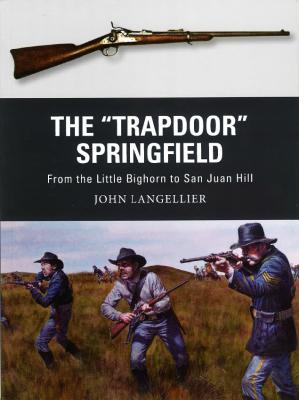
The American Civil War was a time of transition, both materially and tactically. On the material side of the equation, metallurgy and weaponry were seeing huge advances. The tactical side struggled to keep pace. When war first broke in 1861 commanders saw the battlefield as a linear environment. That is; long lines of men advancing toward each other to get close enough for the smoothbore weapons of the day to reach maximum efficiency. Technology moved forward with rifled weapons that were more accurate at longer ranges. And coupled with advances in sighting and powder, the ability to reach out and touch your foe at longer ranges meant linear battlefield tactics were becoming obsolete in a deadly way.