Hope you understand if this review contains some insight into the After The Battle standard presentations. These books, of which there are now over 86 issues (and this number does not count the WWI, Military, Aviation, Maritime or Ancient History books), take a photographic trip through the battles or campaigns named (e.g. Arnhem, Bastogne, Omaha Beach). These publications take great pains to compare the war time photographs to modern day images of the same location, which in most cases still stand today. Most of the titles are available as eBooks, Audiobooks, DVDs, and the original magazines.
Helion is a UK-based company that produces books on many aspects of Military History from the Late Medieval period through to the present day. Helion was established in 1996, and since then they have published over 1,200 books with 100 or more new titles coming out every year.
Author, Dr. Stephen Rookes, works for the French Air Force as a researcher and lecturer at the Centre de Recherche de l’Armée de l’air et de l’espace (CREA) in Salon-de-Provence, France. Originally from Devon in the UK, he is now a French national. Stephen Rookes is the author of four books published by Helion, and the author of peer-reviewed articles in English and in French. He specializes in the history of Cuban exiles and takes a particular interest in the CIA's covert operations in Central America and in Africa.
Charlie’s Plastic Models has produced four 3D printed caddies for modelers, each with different holes, receptacles, and spaces to accommodate various modeling supplies we use in our hobby.
My review sample was billed as the “Finishing Caddy” without Micro Set/Sol holes (for those bottles). The photo of this item from his website (www.charliesplasticmodels.com) shows it containing appropriate items like panel washes, Solvaset, cotton swabs and brushes [Photo 1]. I saw another great possibility for my sample and turned it into “Gluey Louie” by loading it with more basic tools to stick one bit of plastic to another: two kinds of liquid cement, CA, and applicators from The Glue Looper. [Photo 2] tweezers and small clamps. This may not be exactly what it was intended for in the first place but boy, it works for me.
Carnation Revolution Volume 2: Coup in Portugal, April 1974 is a part of Helion and Company’s Europe@War series, No. 39 (HEL 11844). This is the third book about Portuguese forces that I have read, authored by José Augusto Matos (he co-authored Sanctuary Lost, Portugal’s Air War for Guinea 1961-1974, Volume 1, with Matthew M. Hurley, reviewed, and the first volume by authors José Augusto Matos and Zelia Oliveira.
For those who have not read Volume 1, or the previous review, a recap is necessary as the title states, this book is the second volume of this coup that re-shaped Portugal’s future and starts where the first volume leaves off.
A new 3D printed tool caddy for the model building hobbyist. It has multiple compartments to fit all types of tools and a handy yet convenient addition to any modeler’s benchtop.
In the Package and Product Notes
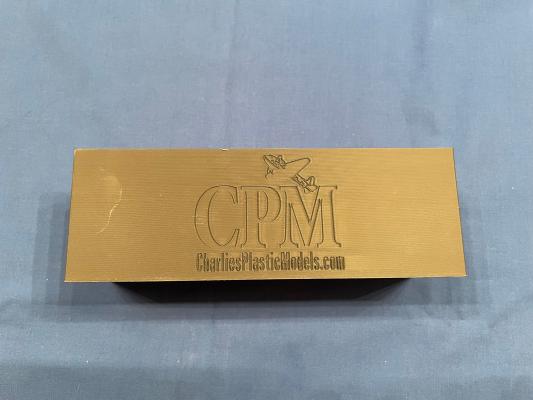
The tool caddy is molded in gray resin and produced by a 3D printer. The buildup layers are visible (but small), and a nice recessed printed “CPM” logo is located on the backside wall of the caddy. If one wanted to paint it a different color, it can be easily done but I would recommend a good primer coat first.
The footprint measures 7.25” long X 2.56” wide (184 X 65 mm). The back wall is 2.5” tall (63.5 mm), and the lower compartment walls are 1.5” tall (38 mm).
If you use the Micro Set/Sol combination for decal work like I have for years then you have (if you're honest), tipped the small round bottles they come in. While there are some other holders out there, Charles Plastic Models has given us a truly useful combination holder. Not only are there inserts for the Micro decal solutions, but this product also includes a port for the round Solvaset bottle and two bays for the square decal set bottles from Tamiya or Mr. Hobby. Several panel liner and weather solutions also come in the same size square bottles. Behind these are openings for brushes, tools, and anything else you use for decals and liners.
Each of the openings is sized to allow easy insertion of the bottles and the bottom of the holder is rough textured to keep it from sliding around. This product has solved a problem I’ve battled for a long time. All this for 10 bucks. Check out Charlie’s website for this product and a few other variations of it.
Pig Models is a new manufacturer on the market, and I must confess that they would have done well checking international languages before settling on this label (“Have you seen their latest kit? It’s a real pig.”).
All kidding aside, they have produced an extremely intriguing model that I never thought I’d see in this lifetime – a replica of a very common World War 2 (and beyond) Naval mount for 5-inch secondary armament in my preferred modeling scale. Molded in a Navy gray and clear plastic, this is a highly detailed replica of this formidable weapons system.
This well-researched book, The Battle for Grozny Volume 1, is part of the Europe at War Series, which contains 46 titles to date. The author, Efram Sandler was born in the former Soviet Union and is a former combat veteran of the Israeli Defense Force Armored Corp. He has authored or co-authored eight books of this amazing series.
In the mid-1990s, the south-central region of the former Soviet Union was in turmoil. The Republic of Ichkeria had declared independence and influence from Chechnya was growing stronger. The Kremlin and Boris Yeltsin, Russian President from 1991-1999, grew increasingly concerned over controlling oil and gas pipelines, which Dzhokhar Dudadev, leader of Chechen opposition, had seized. Yeltsin eventually launched a large-scale military operation on December 9, 1994.
This 27th publication of the ‘Europe at War’ series was of particular interest to me personally. I lived in northern Germany in the years leading up to and including the Fall of the Berlin Wall and had many direct encounters – most of them not good – with East German authorities.
Andrew Long of Great Britain is a military history researcher. His interest in the Cold War begin with a trip to West Berlin in 1986 (perhaps he and I crossed paths and didn’t even know it!). He traveled through Check Point Charlie to visit East Berlin. Andrew makes sense of this very complex period of history by intertwining stories of politics, ideology, personalities, technology and geography. He has also written Cold War Berlin: An Island City, Volumes 1 & 2 as well as ‘Secrets of the Cold War’.
The David vs. Goliath nature of the inception and survival of Israel in the Middle East provides an element of fascination to those interested in military history, especially the air war component. Israel came into existence at a time when technology was taking giant leaps forward, but due to mixed support of the birth of the small nation, restrictions and embargoes played heavily into the Israeli Defense Force’s ability to build up its air arm. In this alone it battled great odds to piece together a hodge-podge of aircraft in their early years, but understanding the value that air warfare brought to them in their tenuous geographic and political situation, they continued to spend significant resources to develop a competent air force.